

What is there today
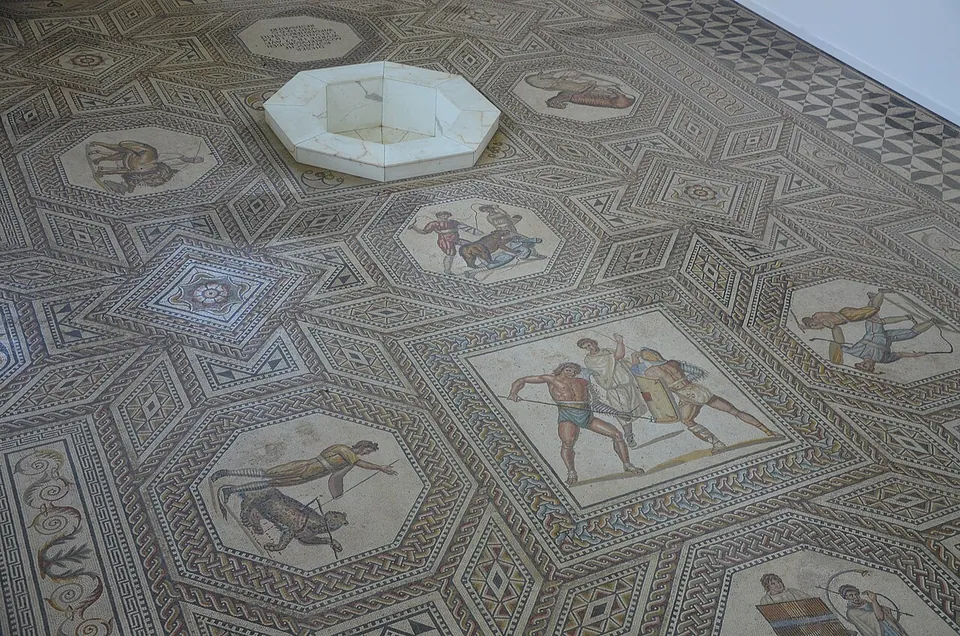
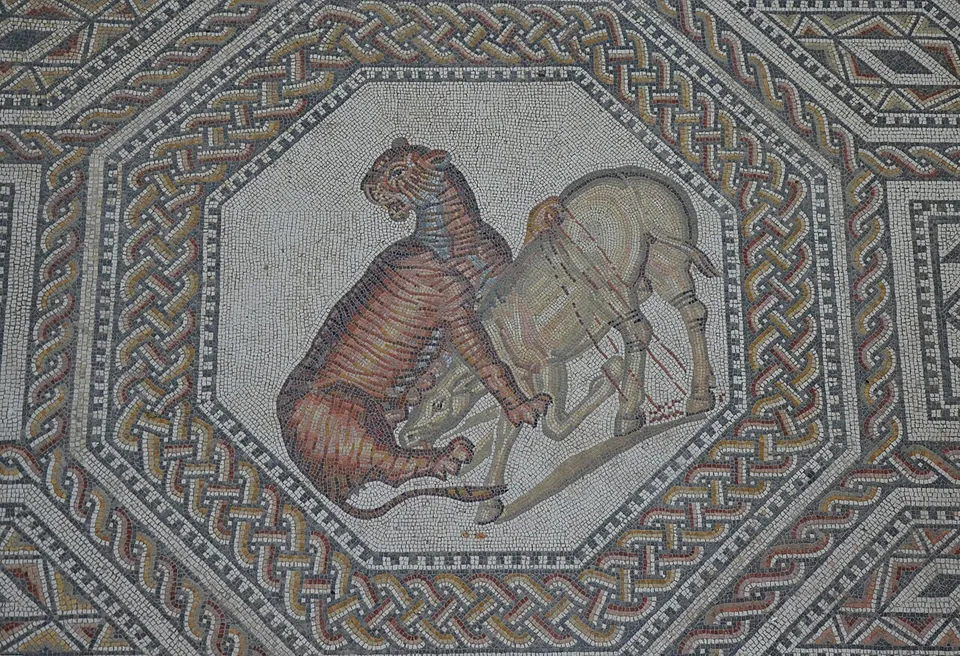
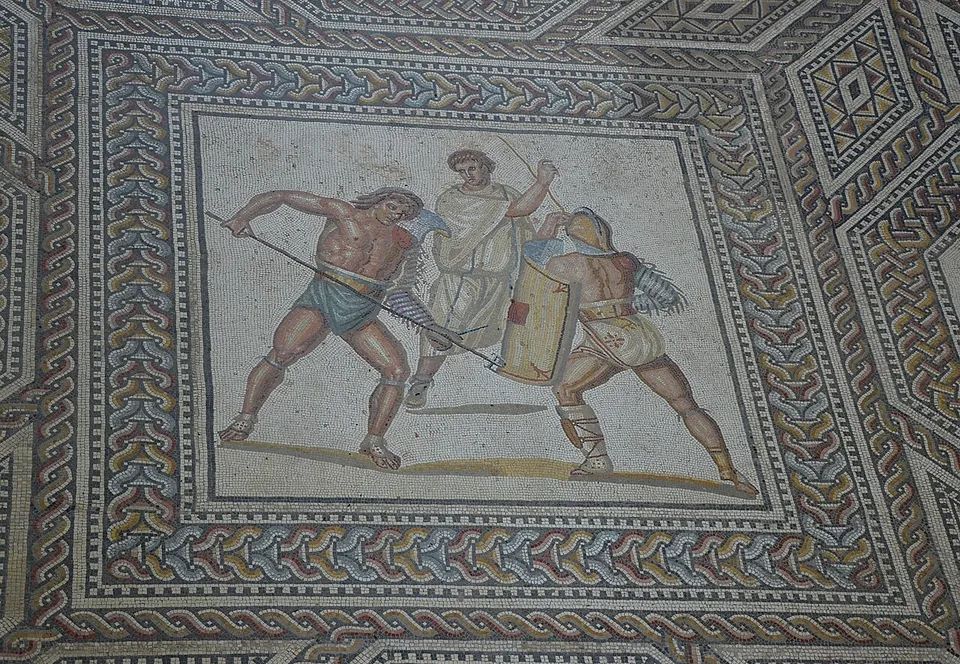
The mosaic is the site. It measures 15.65 by 10.30 m and is preserved in situ in the reception hall of the manor house, inside a protective building put up in the 19th century (de.wikipedia). Of eight medallions with figured scenes from the amphitheatre, seven survive. Six are octagons, set around an octagonal water basin on the entrance side and a large square panel on the other. The octagons show a tiger leaping on a wild ass; a lion resting its paw on the ass’s severed head while an old keeper tries to lead it away with a stick; three keepers with whips facing a bear that has knocked one of them down; a spearman who has wounded a panther; two unequally armed fighters, one with a whip and one with a stick; and two musicians with a trumpet and a water organ. The square panel shows a retiarius, armed with trident, net and dagger, against a helmeted secutor, with a referee looking on (de.wikipedia). The overview article on Saarland’s Roman remains calls these the best-preserved Roman mosaics north of the Alps (de.wikipedia).
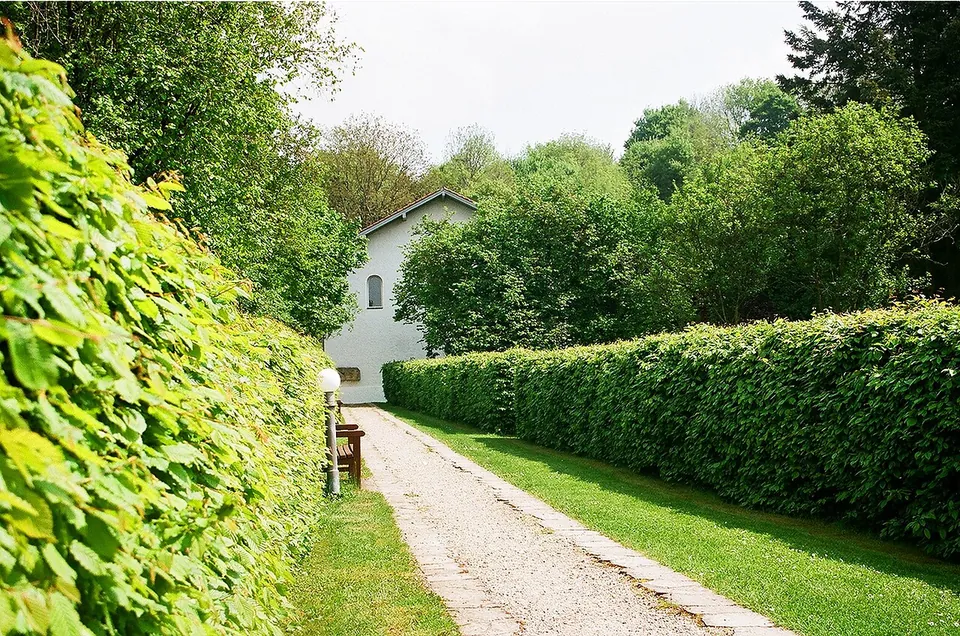
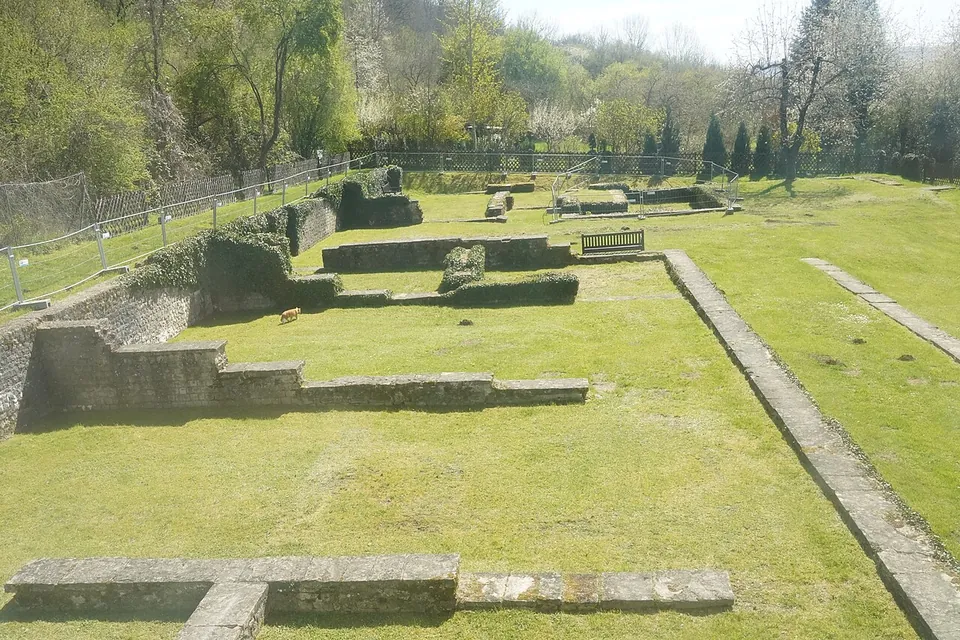
On either side of the protective building you can see the foundation walls of parts of the manor house, among them the column stumps of a peristyle north of the mosaic hall (de.wikipedia). Much of the rest of the estate - the bath house, the long garden portico, the farm buildings towards the river - is known from excavation, and no source describes it as laid out for visitors; part of the farmyard has been built over since 1999 (de.wikipedia). About 540 m from the villa, towards the Moselle, OSM maps a Roman burial mound. When it was excavated in 1986/87 it turned out to have a ring wall 44.5 m across at its foot; afterwards the mound was heaped up again and part of the ring wall rebuilt (de.wikipedia).
Is it worth the trip?
Yes, if mosaics are your thing. This is one exceptional floor and some foundations in the grass, not a ruin field to wander for hours, but the floor is full of figures and action and it is still in the room it was made for. It is cheap, €3, and free for anyone under 18.
It pairs naturally with the Roman Villa Borg, about 6 km away, where a villa has been rebuilt: Borg shows you what such an estate looked like, Nennig shows you one of its original floors. Trier, with its own amphitheatre, is about 40 km down the Moselle.
Getting there
Nennig is a village of the municipality of Perl in Saarland, near the Moselle; Pleiades puts the villa some 40 km upstream from Trier. The entrance is on Römerstraße (the operator). The bus stop “Nennig, Römische Villa” is about 100 m from the site and a car park about 130 m; there are toilets and an inn within about 100 m (OpenStreetMap).
It is open every day, 10.00 to 18.00 from April to October and 11.00 to 16.00 in February, March and November, and closed in December and January. A ticket is €3, or €1.50 reduced (groups of ten or more paying visitors, among others); children and young people up to 18, students and severely disabled visitors go free, and so does everyone on Wednesday afternoons from 15.00 and on the first Sunday of each month. The ticket desk does not take cards (the operator, kulturbesitz.de, read 30 October 2026 - check before travelling).
Visiting details
- Opening hours
- Daily 10.00–18.00 from April to October, and 11.00–16.00 in February, March and November. Closed in December and January.
- Tickets
- €3, reduced €1.50 (groups of 10 or more paying visitors, among others). Free for children and young people up to 18, students and severely disabled visitors, and for everyone on Wednesday afternoons from 15.00 and on the first Sunday of every month. Cash only.
- Parking
- A car park is mapped about 130 m from the site (OSM way/169346799), and the bus stop "Nennig, Römische Villa" about 100 m away (OSM node/5046808489).
Before you go
- Closed in December and January.
- No card payment at the ticket desk (the operator).
Hours and prices checked 30 October 2026 on the operator's own site. Confirm before travelling.
History
The villa was found by chance in 1852. Large parts of it were dug up by Johann Nikolaus von Wilmowsky up to 1864, in 1866 by Heinrich Schaeffer, a sculptor and forger of inscriptions, and from 1869 to 1872 by Ernst aus’m Weerth; the digs brought a forgery scandal that was taken up well beyond specialist circles (de.wikipedia). Pleiades gives the excavation as running from 1866 to 1876. New systematic excavations followed from 1987 to 1999.
For a long time Nennig was read as a pure luxury residence. The newer excavations showed it to be an axial-courtyard villa (Axialhofvilla), with a residential part, the pars urbana, and a working farm, the pars rustica. The farm was a long yard crossed by broad paved roads running from the Moselle, just under 2 km away, up to the manor house, with working and living buildings along both sides; three of them have been proven by excavation (de.wikipedia). The manor house was 120 m wide, with a porticoed façade between projecting corner wings, two side wings joined to it by porticoes and interpreted as guest quarters, a detached bath house of almost 500 m², and a garden portico nearly 260 m long between house and bath (de.wikipedia).
Coins, brooches and pottery date the villa’s founding to the 1st century AD, and the latest finds come from the second half of the 4th century (de.wikipedia); the Saarland overview article dates the building to the 2nd century instead. The mosaic itself belongs to the 3rd century; its scenes come from the amphitheatre, of a kind Trier had had since the end of the 2nd century (de.wikipedia).
More photographs


Nearby
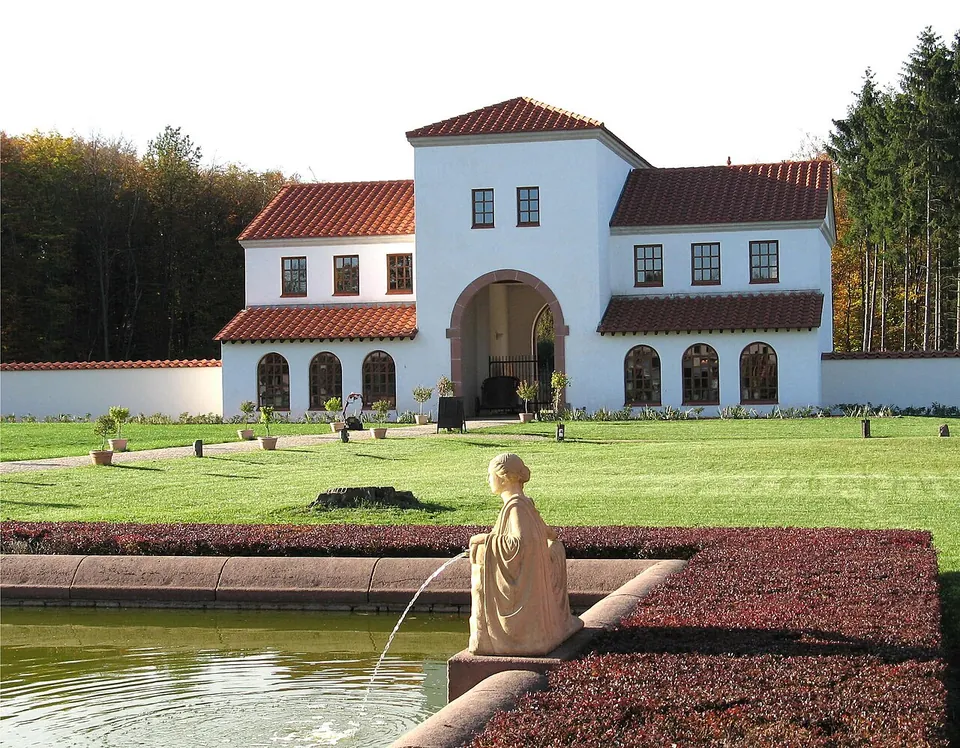
Photo: Johnny Chicago at lb.wikipedia · CC BY-SA 3.0 · Commons
6 km · villa · Saarland
Roman Villa Borg
The buildings around the inner courtyard stand again: the gatehouse, the manor house, the bath house, the residential and working wing and the Roman kitchen.
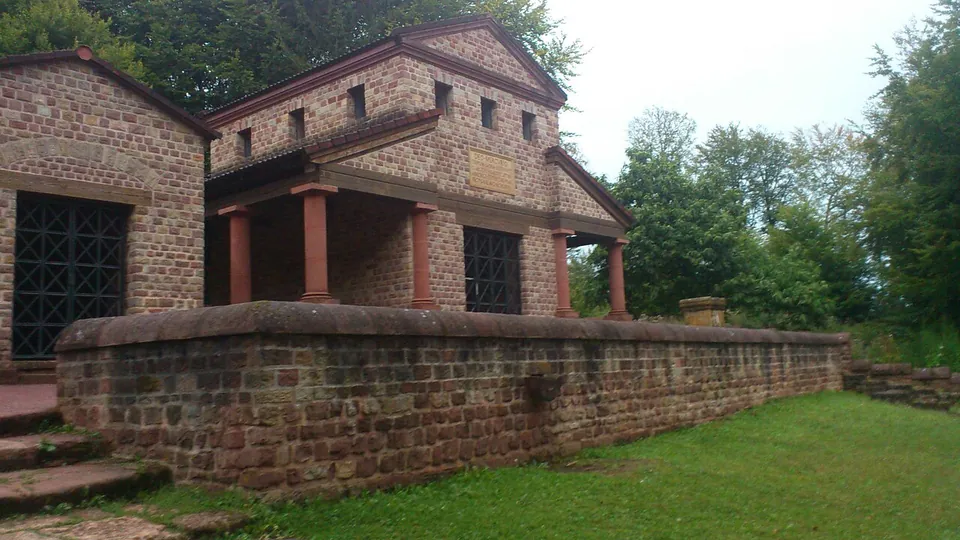
Photo: Ecemaml · CC BY-SA 3.0 · Commons
18 km · sanctuary · Rhineland-Palatinate
Roman temple of Tawern
Inside a walled precinct of about 46 × 36 m (de.wikipedia), the main temple has been rebuilt: a Gallo-Roman ambulatory temple with a portico on three sides, Tuscan columns, and a central chamber, the cella, rising above the portico roof.
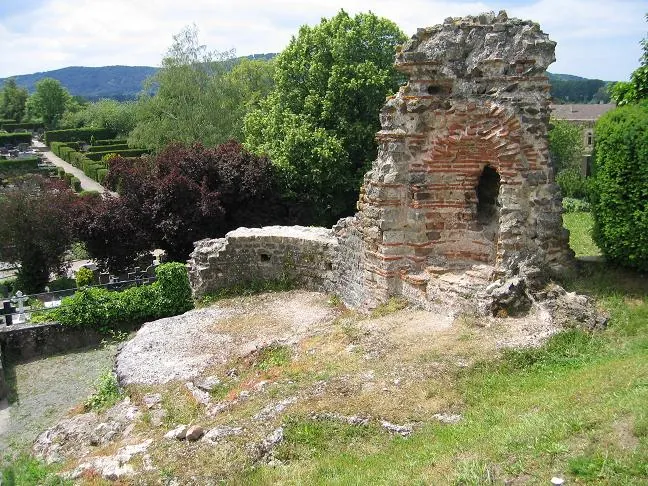
Photo: Johannes Simon · Public domain · Commons
23 km · villa · Rhineland-Palatinate
Kaiservilla Konz
The piece the tourist board points to is part of a cold-water basin, about 4 m high.


Straight-line distances.
Sources
Every fact on this page comes from the records below, each used under the licence noted.
| Source | Licence |
|---|---|
| Pleiades 109198 | CC BY |
| Wikidata Q76637550 | CC0 |
| Vici.org 4397 | CC BY-SA (text), CC0 (metadata) |
| OpenStreetMap way/169352532 | ODbL |
| Wikipedia (de) — Römische Villa in Nennig | CC BY-SA 4.0 |
| Wikipedia (de) — Archäologische römische Befunde im Saarland | CC BY-SA 4.0 |
| Stiftung Saarländischer Kulturbesitz — opening hours (the operator) | licence not recorded |
| Stiftung Saarländischer Kulturbesitz — admission prices (the operator) | licence not recorded |
| Stiftung Saarländischer Kulturbesitz — free and reduced admission (the operator) | licence not recorded |