

What is there today
The sanctuary as it survives is the rebuilding of Sulla’s time, early in the 1st century BC (Pleiades), and it is laid out on three terraces (it.wikipedia).
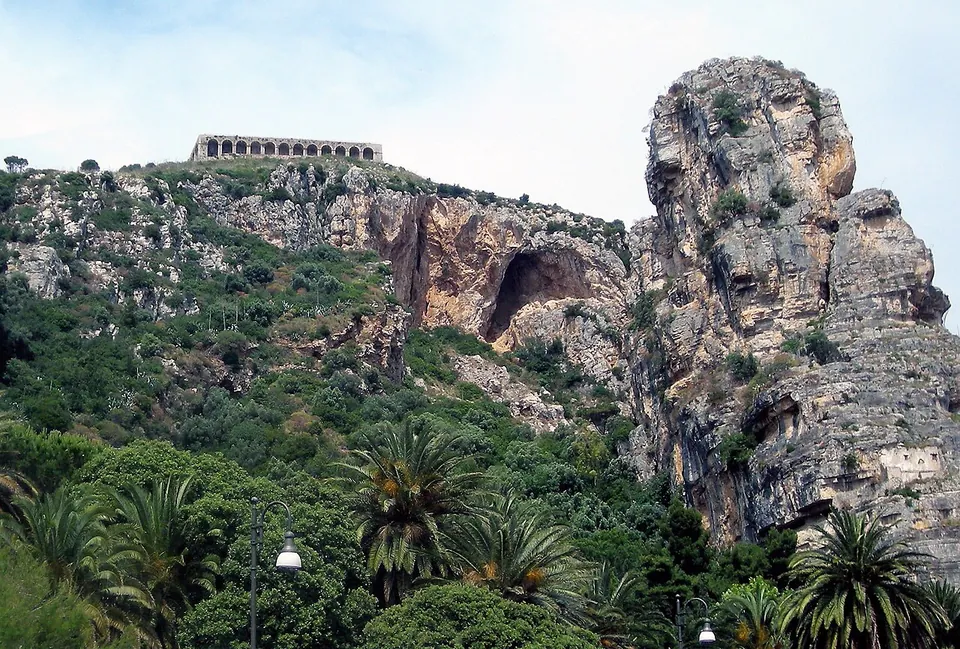
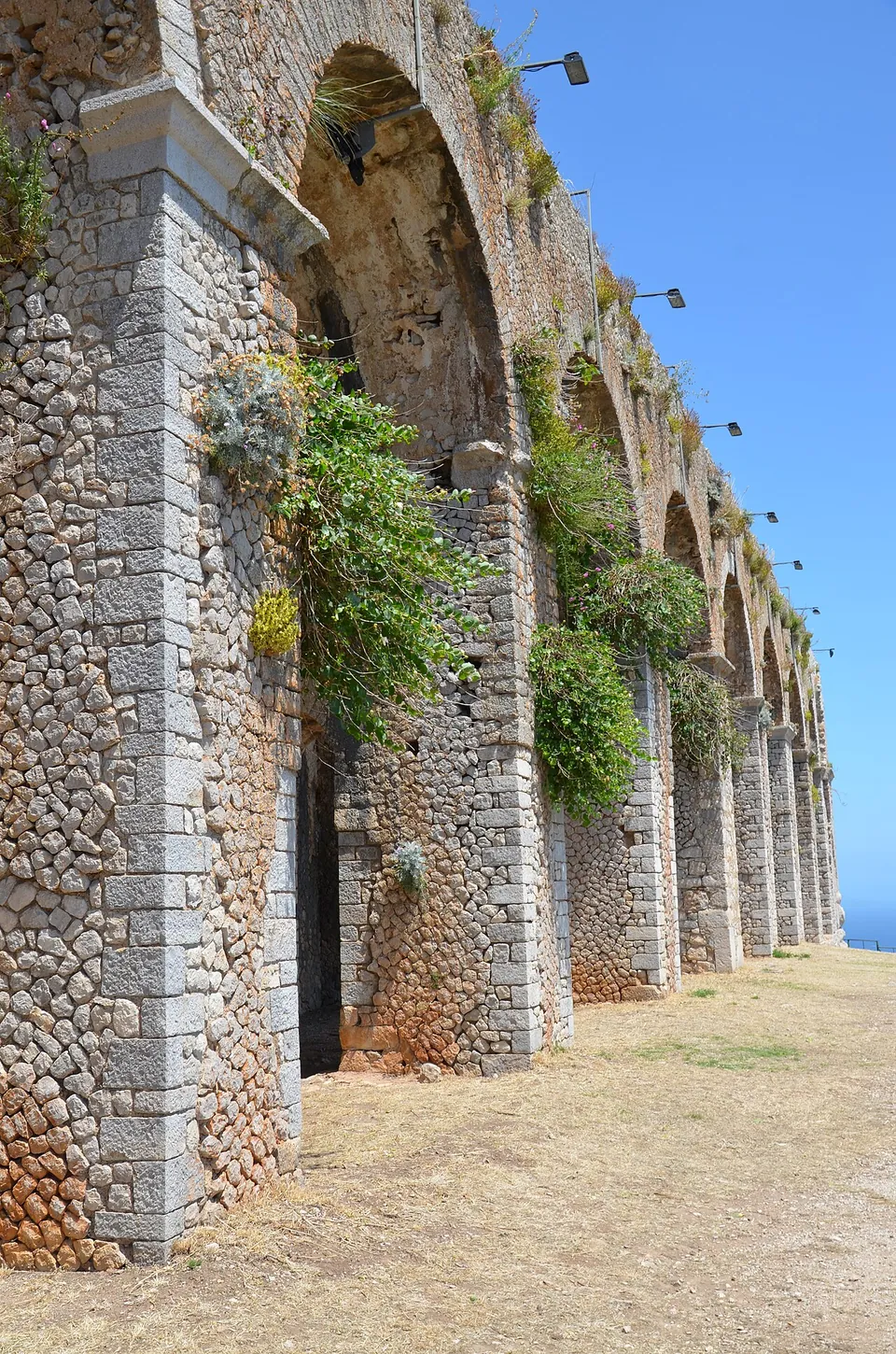
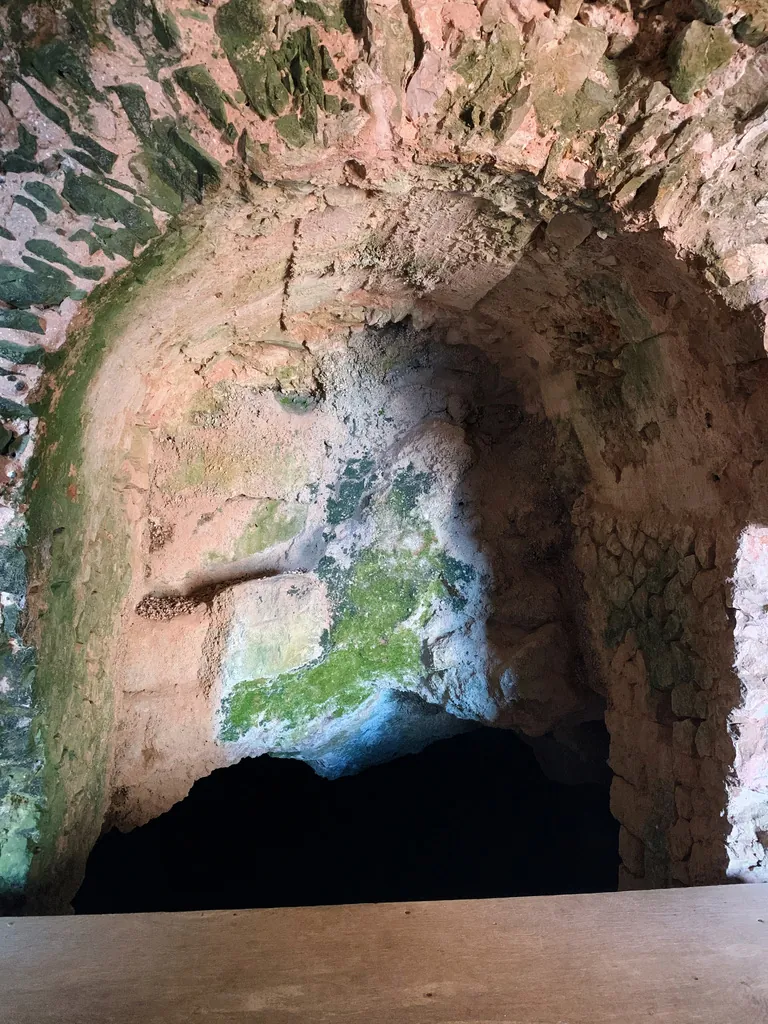
The middle terrace carried the great temple, about 19 by 33 m, on a high podium reached by twelve steps, with six Corinthian columns of limestone across its front; inside the cella was a mosaic of white tesserae edged in black (it.wikipedia). The sanctuary was destroyed after the Roman period, and what holds the eye now is the platform the temple stood on: a front of twelve arches in opus incertum, each opening into a barrel-vaulted room, the rooms linked by tall arched passages and backed by a vaulted, plastered corridor about 3.5 m wide (it.wikipedia). This base is still well preserved (en.wikipedia). Behind the temple, a portico built against the rock served as a resting place for pilgrims (it.wikipedia), and traces of its frescoes can still be seen (en.wikipedia). Beside the temple stood the oracle: a natural, isolated rock with linked hollows inside, encased in a masonry base, at whose foot the excavators of 1894 found many lead votive offerings; a natural cave below the terrace was probably connected with it (it.wikipedia).
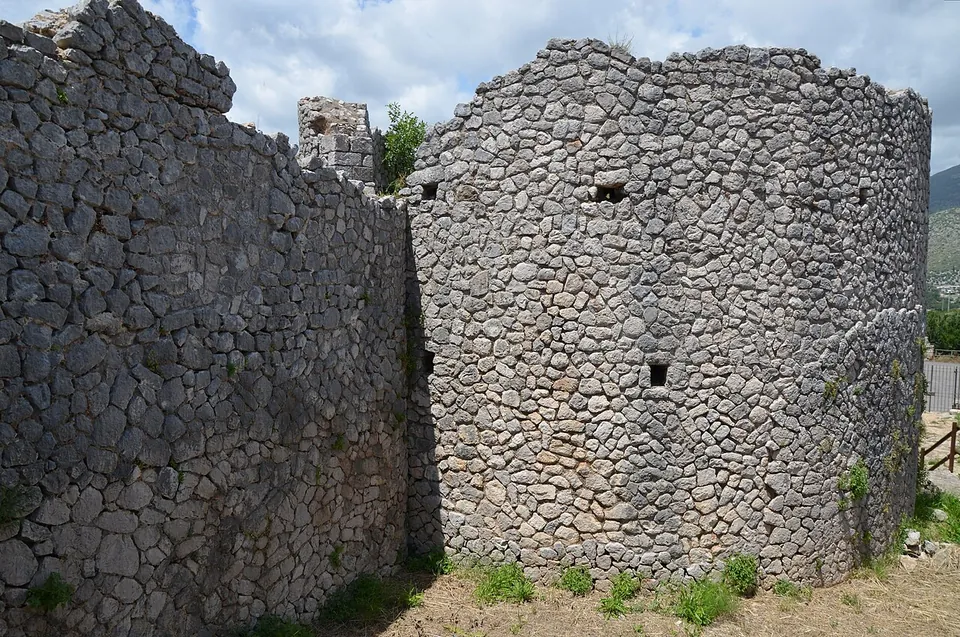
Above lies the walled upper terrace, the so-called entrenched camp, mainly military: a square with a portico on three sides, open to the south, a sentry walk and linked cisterns behind it, a small temple in one corner, and a circuit of walls with nine round towers that tied the sanctuary to the town’s acropolis (it.wikipedia). To the west, the “small temple” terrace has nine vaulted rooms with traces of painting in the First Pompeian Style, imitation marble of the third quarter of the 2nd century BC, and in the church the Benedictines later made of its inner corridor, traces of 9th-century frescoes of the Virgin and Child between Saints Michael and Gabriel (it.wikipedia).
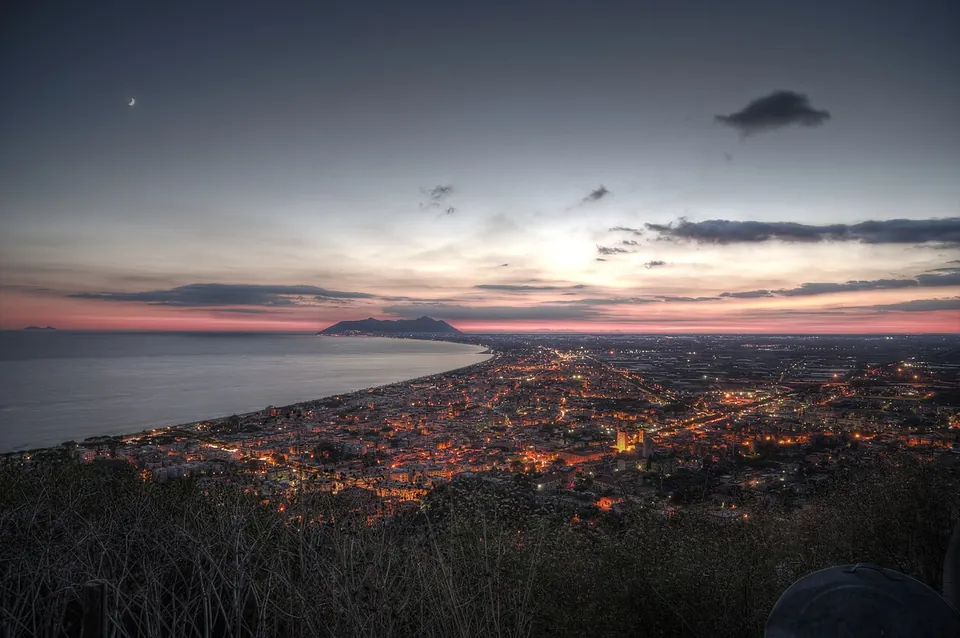
Information boards in Italian and English stand across the site, and viewpoints are mapped on the hilltop (OpenStreetMap). The view runs over Terracina and the coast.
Is it worth the trip?
Yes. It belongs to the group of great Republican sanctuaries of Lazio built on dramatic terraces between the mid-2nd and mid-1st century BC (it.wikipedia), and it is the highlight of Roman Terracina: an arcaded platform on a cliff top, a walled camp with its towers, vaulted rooms with ancient paint, a cave probably tied to an oracle, and a view over the coast. Come for the terraces, the vaults and the view; the temple that crowned the platform was destroyed after the Roman period.
It is also the easiest part of Roman Terracina to fit in: open daily from March to October and six days a week in winter, where the forum route in the old town runs only on Friday to Sunday afternoons (the operator; see Tarracina – Terracina).
Getting there
The sanctuary is on the hill above the town, about 900 m in a straight line from the forum square. By car, Via Panoramica passes about 100 m from the site, and there is a paid car park about 90 m away; a bus stop is mapped about 110 m from it (OpenStreetMap).
It opens every day from 09.00 to 13.00 and again in the afternoon: 14.00–17.00 from November to February, when it is closed on Wednesdays; 14.00–18.00 in March and October; 15.00–19.00 in April and September; and 15.00–20.00 from May to August. For October 2026 the operator has posted continuous hours instead, 09.00–18.30 until the 24th and 09.00–17.00 from the 25th. Last entry is 45 minutes before closing, and the site is closed on 1 January and 25 December. In October 2026 guided visits run by booking at 09.30 and 16.30 (15.30 from the 25th).
A ticket is €10, or €15 with a guided visit; ages 13 to 18 and Terracina residents pay €5, groups of ten or more €7 each, and children under 13 with an adult, disabled visitors and their companions go free (Fondazione Città di Terracina, read 20 October 2026; the municipality’s own page still gives older figures). Check before travelling, since hours and prices change.
Visiting details
- Opening hours
- Every day 09.00–13.00, then 14.00–17.00 from November to February (closed on Wednesdays), 14.00–18.00 in March and October, 15.00–19.00 in April and September, 15.00–20.00 from May to August. October 2026 has continuous hours instead: 09.00–18.30 until the 24th, 09.00–17.00 from the 25th. Last entry 45 minutes before closing; closed 1 January and 25 December. In October 2026, guided visits by booking at 09.30 and 16.30 (15.30 from the 25th).
- Tickets
- €10, or €15 with a guided visit; €5 for ages 13–18 and Terracina residents; €7 each for groups of ten or more; free for children under 13 with an adult, and for disabled visitors and their companions.
- Parking
- A paid car park about 90 m from the sanctuary (OSM way/62218707), off Via Panoramica; a bus stop about 110 m away (OSM node/11207272233).
Before you go
- From November to February the sanctuary is closed on Wednesdays.
Hours and prices checked 20 October 2026 on the operator's own site. Confirm before travelling.
History
The hill, the Romans’ mons Neptunius, is the last spur of the Ausonian mountains where they reach the Tyrrhenian Sea and close the Pontine plain to the south (it.wikipedia). The first terraces, in polygonal masonry, belong to the time when Terracina became a Roman colony in 329 BC and the Via Appia was laid round the back of the hill in 312 BC; they probably carried an oracle, perhaps without a temple. The rooms of the “small temple” followed in the second half of the 2nd century BC (it.wikipedia).
In Sulla’s time, early in the 1st century BC, the hilltop was rebuilt on a grand scale, with a circuit wall, a military camp to control the passage of the Via Appia and the new great temple on its terrace (it.wikipedia); Pleiades dates the sanctuary to about 100–70 BC. The wall may have been raised against Sulla’s march on Rome in 83 BC, in his war with Marius (it.wikipedia).
Whose temple it was is an open question. Tradition gives it to Jupiter Anxur, the protector of the town, but an inscription naming Venus and votive objects, glass-paste doves among them, inscribed to Venus Obsequens have cast doubt on that (it.wikipedia; en.wikipedia). One reading makes the older shrine on the “small temple” terrace the goddess Feronia’s, and the great temple a Venus cult added after Sulla’s victory, Venus being the protector of the dictator’s fortune (it.wikipedia).
After the Roman period the sanctuary was destroyed and burned, and its ruins were known in the Middle Ages as the “palace of Theodoric”. In the early Middle Ages a Benedictine monastery of St Michael the Archangel settled on the “small temple” terrace and gave the hill its name; remains of a medieval square tower and enclosure walls, and traces of use in the 13th century, show the summit was still used militarily, and the area was abandoned at the end of the 16th century. The local scholar Pio Capponi began excavating in 1894, followed by Luigi Borsari in 1896 (it.wikipedia). Since 2000 the site has been protected as a natural monument, entrusted to the municipality of Terracina (it.wikipedia).
More photographs


Nearby
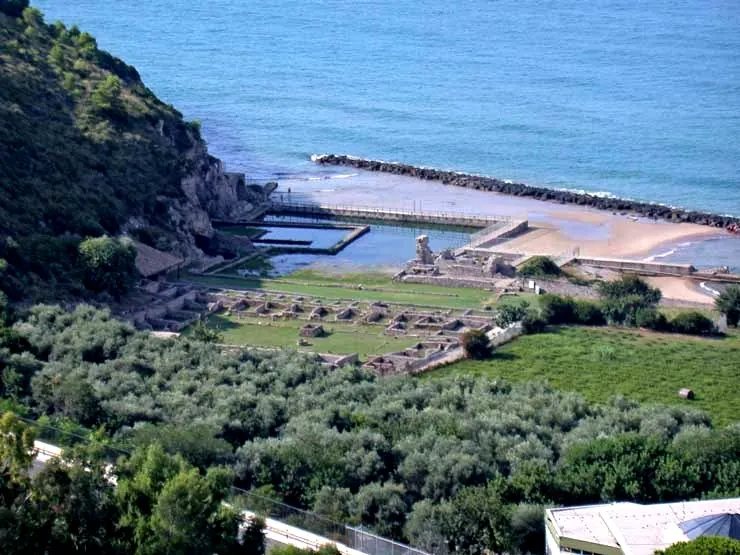
Photo: MM · Public domain · Commons
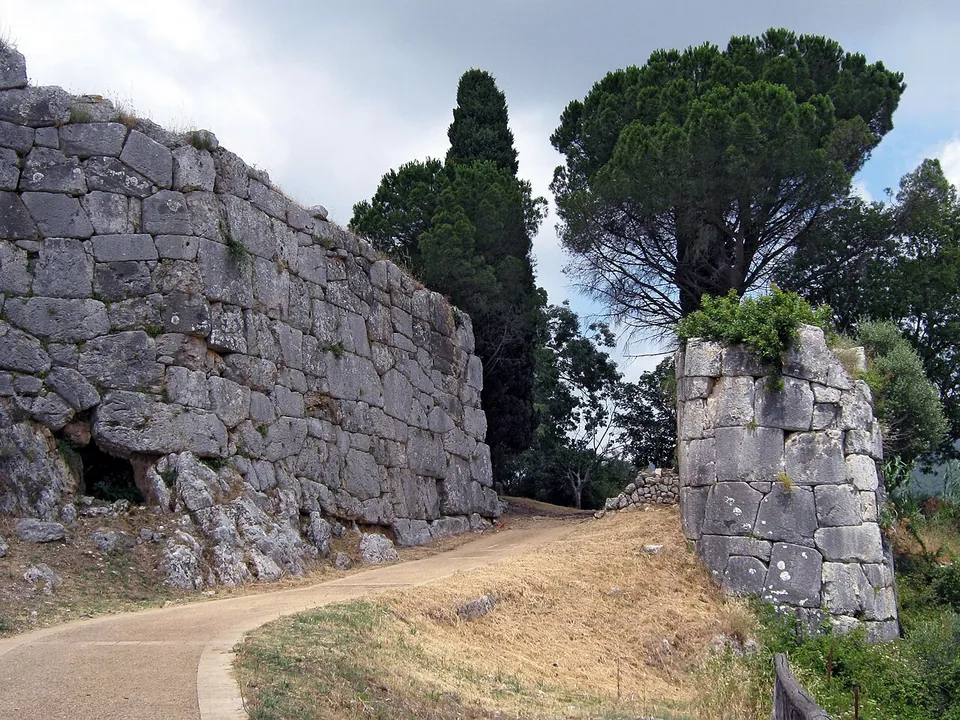
Photo: Kroelleboelle · CC BY-SA 3.0 · Commons
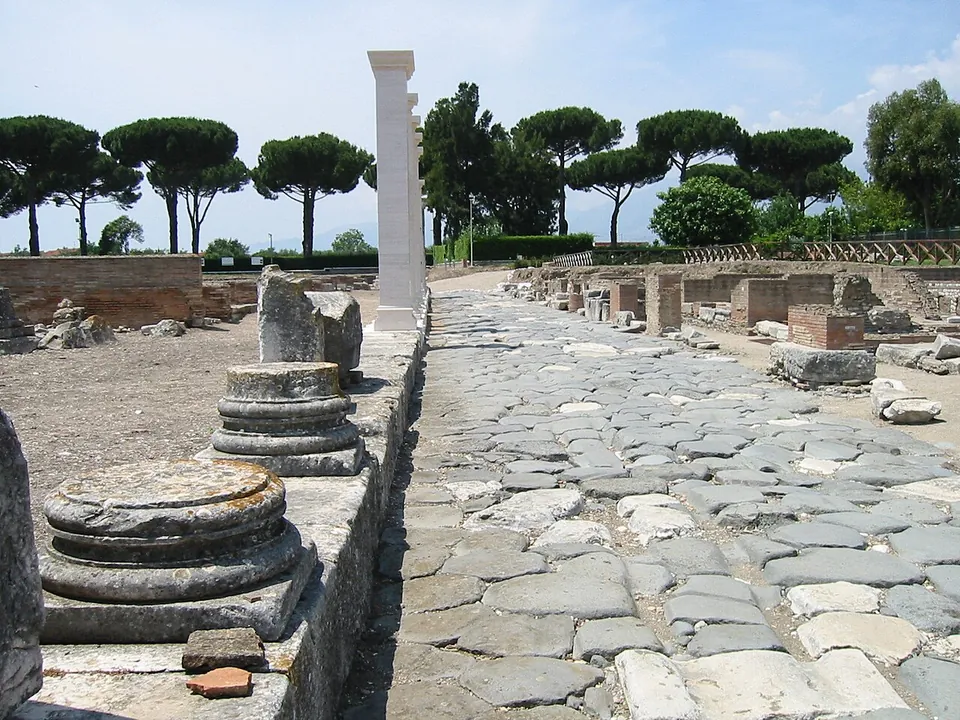
Photo: AlMare · Public domain · Commons
43 km · city · Lazio
Minturnae
The Via Appia crosses the park as the ancient town's main street, an original stretch paved in basalt blocks (it.wikipedia).


Straight-line distances.
Sources
Every fact on this page comes from the records below, each used under the licence noted.
| Source | Licence |
|---|---|
| Pleiades 867719962 | CC BY |
| Wikidata Q3983252 | CC0 |
| OpenStreetMap way/73050979 | ODbL |
| Wikipedia (it) — Tempio di Giove Anxur | CC BY-SA 4.0 |
| Wikipedia (en) — Temple of Jupiter Anxur | CC BY-SA 4.0 |
| Wikipedia (fr) — Temple de Jupiter Anxur | CC BY-SA 4.0 |
| Pleiades — Tarracina(e)/Anxur | licence not recorded |
| Fondazione Città di Terracina — opening hours (the operator) | licence not recorded |
| Fondazione Città di Terracina — Monte Sant'Angelo tariff from 1 January 2025 (the operator) | licence not recorded |
| Città di Terracina — Tempio di Giove Anxur (the municipality) | licence not recorded |