Hidden gemHub · 1 stop4th c. BC – 7th c. ADTicketed
Tarracina – Terracina
Anxur, Tarracinae
city · Lazio, Italy
What it is
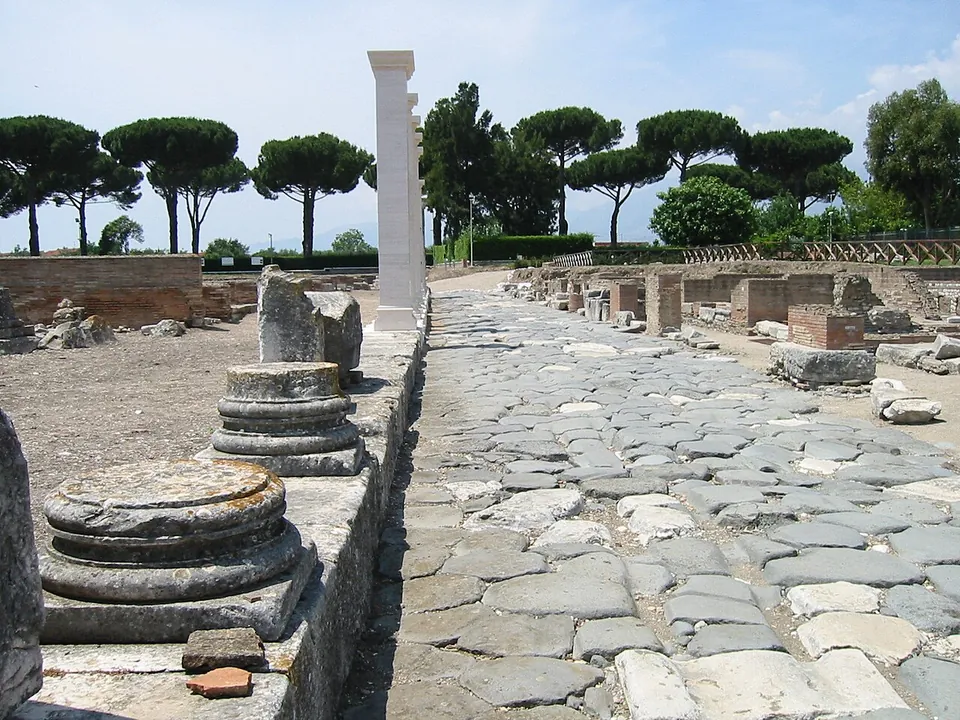
Tarracina, the Volscian Anxur, was a Roman colony on the Via Appia where the hills meet the sea south-east of Rome, and modern Terracina is still built on it: a forum square paved in Roman stone, a theatre, a temple with one column standing, and on the cliff above the town the great terraced sanctuary of Monte Sant'Angelo, traditionally the Temple of Jupiter Anxur.
What you’ll see
The Roman town has two levels, and they are visited separately. Up on Monte Sant'Angelo, 227 m above the sea, stands the sanctuary.
Worth the trip?
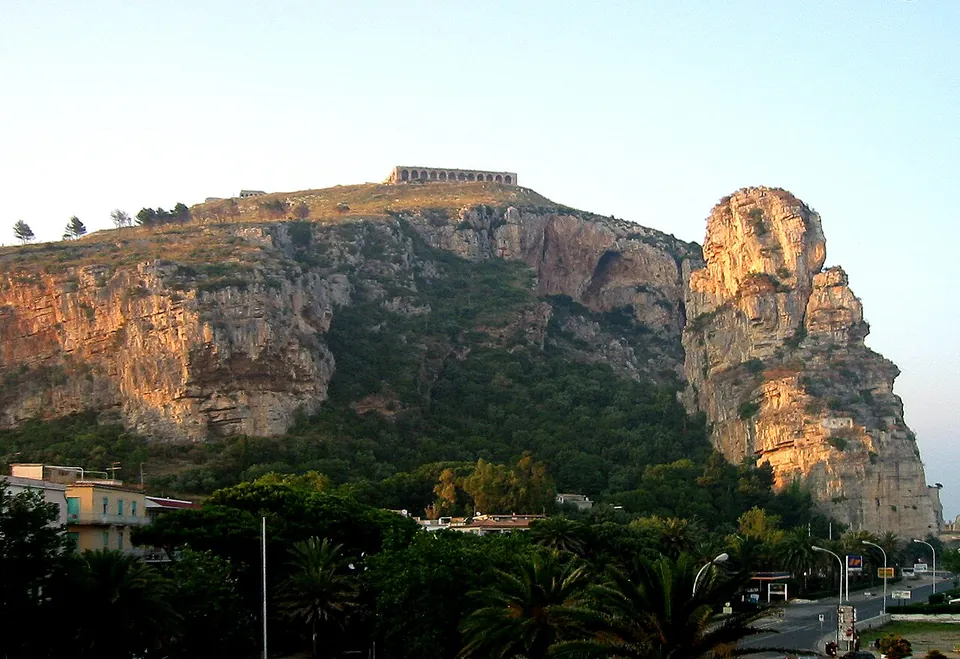
Yes. The sanctuary on Monte Sant'Angelo is one of the great Republican sanctuaries of Lazio, set high on terraces between the mid-2nd and mid-1st century BC (it.wikipedia), and its arcaded platform on the cliff top can be seen from the town below and from the sea; the walk round the terrace for the view alone justifies the trip up.
Getting there & cost
Terracina lies on the coast 56 km south-east of Rome on the Via Appia (en.wikipedia).Ticketed · Monte Sant'Angelo €10, or €15 with a guided tour · checked 18 October 2026Hours, tickets and parking
Monte Sant'Angelo above Terracina, with the arcaded terrace of the sanctuary along its summit. · Photo: AlMare · CC BY-SA 2.5 · Wikimedia Commons
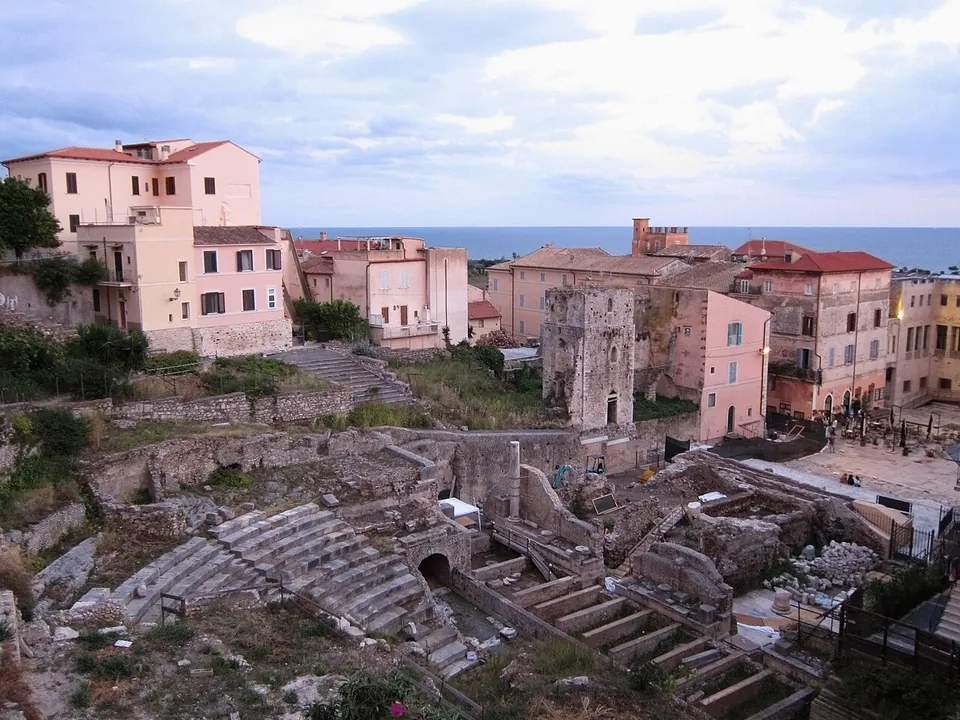
The Roman theatre beside Piazza del Municipio, under excavation in 2020. · Photo: Mænsard vokser · CC BY-SA 4.0 · Wikimedia Commons
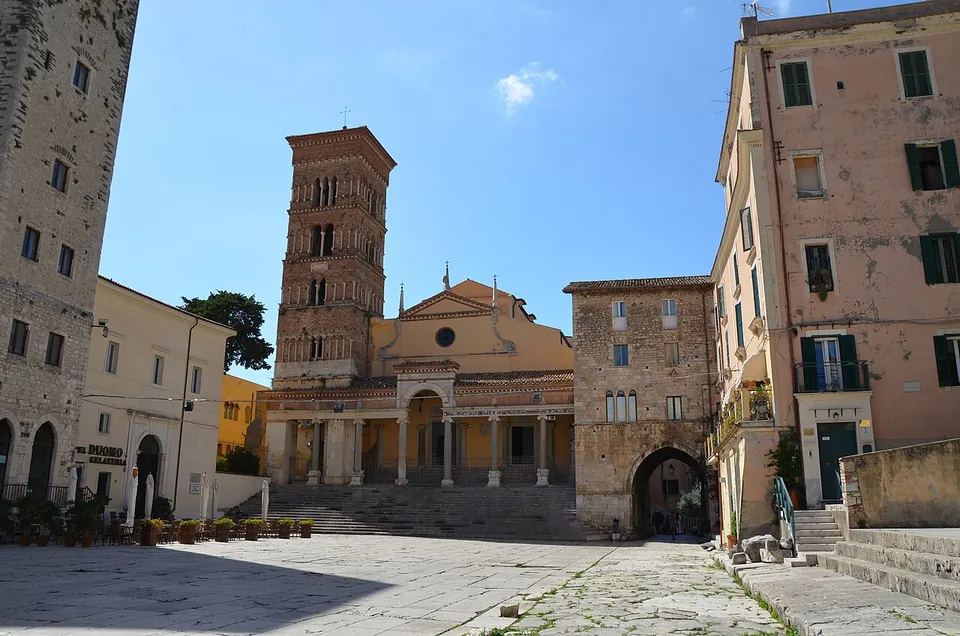
Piazza del Municipio, the Forum Aemilianum, with the cathedral of San Cesareo. · Photo: Carole Raddato from FRANKFURT, Germany · CC BY-SA 2.0 · Wikimedia Commons
The stops
1 place to see, the best preserved and best known first.
The sanctuary as it survives is the rebuilding of Sulla's time, early in the 1st century BC (Pleiades), and it is laid out on three terraces (it.wikipedia).
Ticketed
What is there today
The Roman town has two levels, and they are visited separately. Up on Monte Sant’Angelo,
227 m above the sea, stands the sanctuary. What
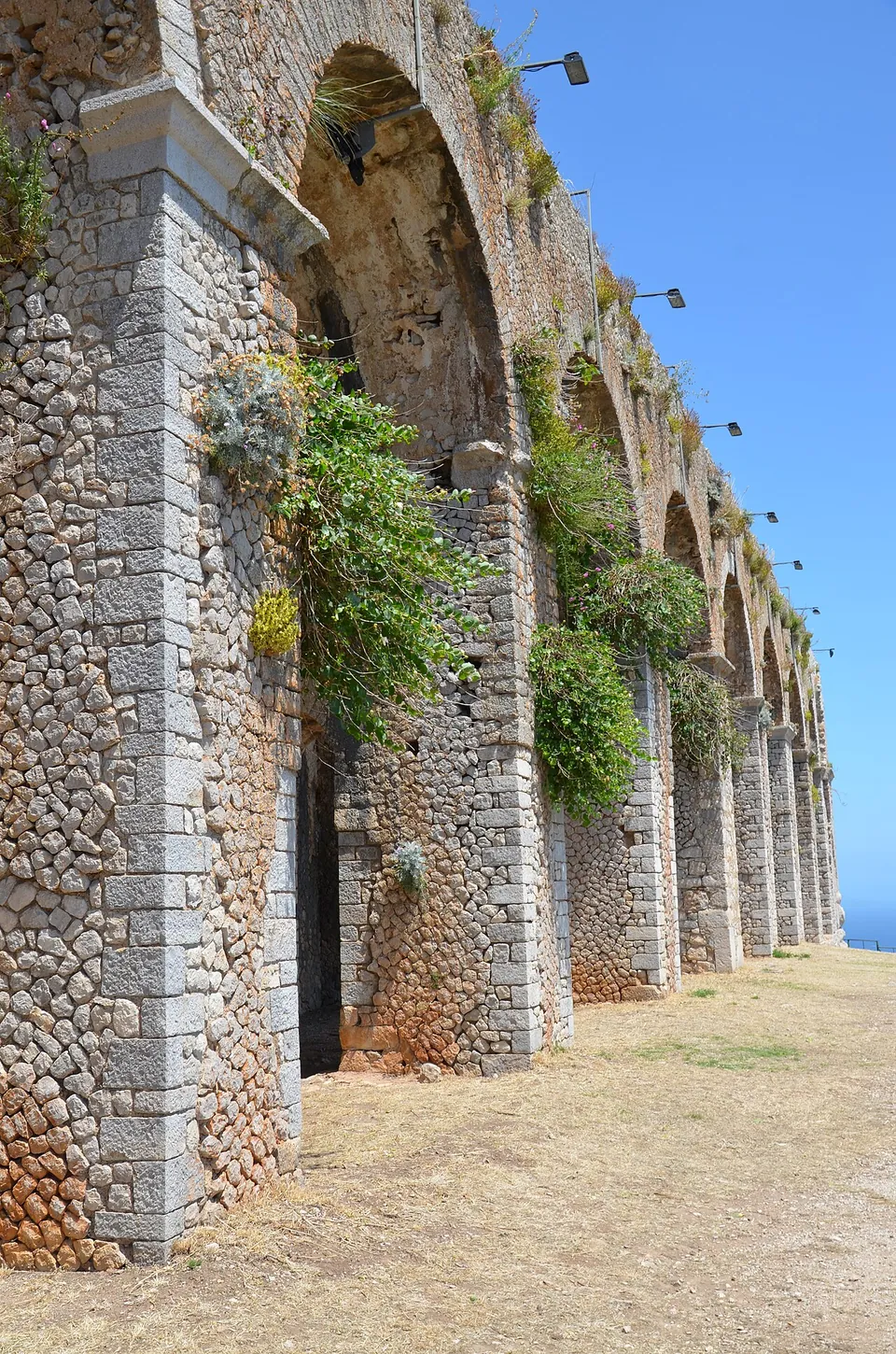
survives is its rebuilding of Sulla’s time, early in the 1st century BC: a huge platform carried
on twelve arches in opus incertum, on which stood a temple with six Corinthian columns across its
front; a natural rock beside it, with hollows inside, served as the oracle; above it lies
a military terrace that was walled with nine round towers, and to the west the vaulted rooms of
the so-called small temple, painted in the 2nd century BC (it.wikipedia). The dedication is open:
tradition gives the temple to Jupiter Anxur, the town’s protector, but an inscription and votive
offerings naming Venus have put that in doubt (it.wikipedia; en.wikipedia). The views run over
the coast and the Pontine Marshes (en.wikipedia), and bilingual information boards are set up across the site
(OpenStreetMap).
Down in the old town, Piazza del Municipio is the forum itself, the Forum Aemilianum, and its
Roman paving of large stone slabs, found under the later surface in 1846, is still the floor of
the square (the operator; en.wikipedia). An inscription naming A. Aemilius, the magistrate who
saw to the paving in the 1st century BC, is set in it in letters once filled with bronze (en.wikipedia; it.wikipedia). A
four-sided arch that served as an entrance to the forum came to light after the bombing of the
Second World War; two of its sides survive, and a well-preserved stretch of the Via Appia runs
beneath it (en.wikipedia).
Around the square, the bombing of 4 September 1943 and the clearance after it exposed what the
later buildings had hidden. The theatre of Sulla’s time, which held about 4,000 people
(it.wikipedia), was rediscovered when the bombs brought down the houses facing the square; its
excavation and restoration ran from 2000, above all between 2018 and 2023 (the operator). The
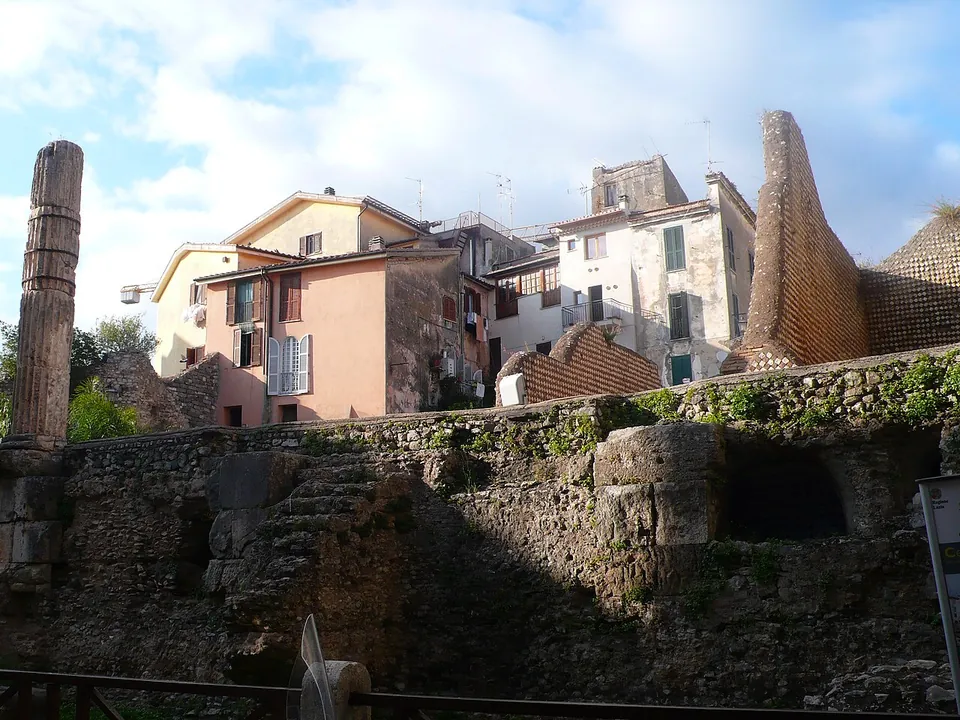
so-called Capitolium, a three-cella temple of the mid-1st century BC on the Appia, keeps one
of its four front columns, fluted travertine over 5 m tall, and the walls of its three cellae; the
idea that it served Jupiter, Juno and Minerva is a hypothesis first put forward in 1926 (the operator). The cathedral
of San Cesareo, consecrated in 1074, is built into the town’s main temple: en.wikipedia identifies it
as a temple of Rome and Augustus, and part of its side wall with engaged columns can be seen
(en.wikipedia). Two vaulted rooms in that temple’s podium, traditionally called “favisse”, a name the
operator calls improper, now display mosaics from a nearby house (the operator).
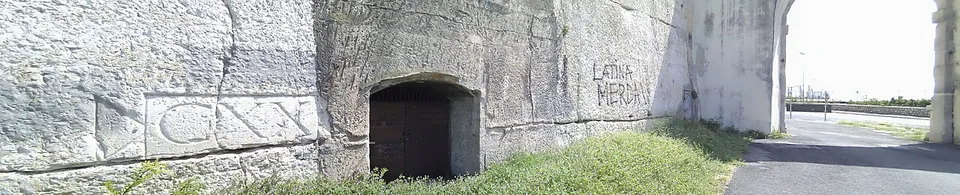
At the foot of the promontory the Via Appia passes Pisco Montano, the cliff cut back so that
the road no longer had to climb over the hill, probably early in Trajan’s reign. Marks on the rock face every 10
Roman feet record the depth of the cut; the lowest, CXX, stands for 36 m (en.wikipedia).
Is it worth the trip?
Yes. The sanctuary on Monte Sant’Angelo is one of the great Republican sanctuaries of Lazio, set
high on terraces between the mid-2nd and mid-1st century BC (it.wikipedia), and its arcaded
platform on the cliff top can be seen from the town below and from the sea; the walk round the
terrace for the view alone justifies the trip up. The old
town adds something rarer: a forum that is still the town’s square, with the theatre and a temple
opening off it.
Plan around the timetable. The sanctuary opens every day for most of the year, but the forum
and theatre can be visited only on an accompanied tour on Friday, Saturday and Sunday
afternoons, so on other days a visitor sees the square and the Capitolium from the street.
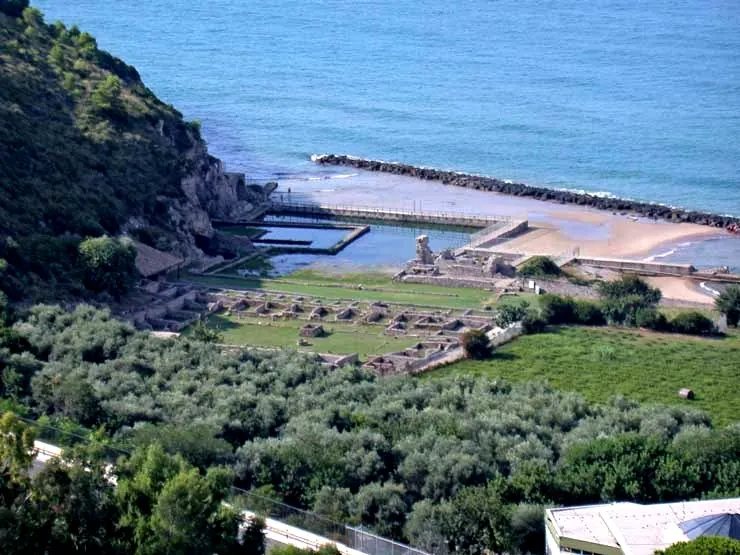
The lower town by the harbour, where the amphitheatre, baths and port stood, has little to show
(en.wikipedia).
Getting there
Terracina lies on the coast 56 km south-east of Rome on the Via Appia (en.wikipedia). The branch
railway into town has been suspended since a landslide in 2012; the nearest station is Monte San
Biagio-Terracina Mare on the FL7 line, about 15 km away and linked to the centre by bus
(it.wikipedia). A bus stop on Via Roma is about 100 m from the forum, and there is a paid car park
about 55 m from it (OpenStreetMap). The sanctuary is a separate trip up the hill, about 900 m from
the forum in a straight line; it has a paid car park and a bus stop each about 100 m from the
temple (OpenStreetMap).
The sanctuary of Monte Sant’Angelo opens every day from 09.00 to 13.00 and again in the
afternoon: 14.00–17.00 from November to February, when it is closed on Wednesdays; 14.00–18.00
in March and October; 15.00–19.00 in April and September; and 15.00–20.00 from May to August. For
October 2026 the operator has posted continuous hours instead, 09.00–18.30 until the 24th and
09.00–17.00 from the 25th. Last entry is 45 minutes before closing, and the site is closed on 1
January and 25 December. A ticket is €10, or €15 with a guided tour; ages 13 to 18 and Terracina
residents pay €5, groups of ten or more €7 each, and children under 13 with an adult go free.
The Foro Emiliano is shown only on an accompanied route, Friday to Sunday from 16.00 to 20.00,
with tours at 16.30 and 18.30, preferably booked; it costs €12, €5 for ages 13 to 18 and
residents, and nothing under 13. The operator’s pages for the theatre, the Capitolium and the
favisse point to the same timetable and tariff (Fondazione Città di Terracina, read 18 October
2026; the municipality’s own page gives different figures). Check before travelling, since
hours and prices change.
Visiting details
Opening hours
Sanctuary of Monte Sant'Angelo (Temple of Jupiter Anxur, cryptoporticus, small temple and castrum): in October 2026 daily 09.00–18.30 until the 24th, then 09.00–17.00. The year-round calendar opens 09.00–13.00 every day and again in the afternoon, 14.00–17.00 from November to February (closed Wednesdays), 14.00–18.00 in March and October, 15.00–19.00 in April and September and 15.00–20.00 from May to August. Last entry 45 minutes before closing; closed 1 January and 25 December. Foro Emiliano: Friday to Sunday 16.00–20.00, by accompanied tour only (16.30 and 18.30), preferably booked. The so-called favisse of the Tempio Maggiore: Friday to Sunday 16.00–20.00.
Tickets
Monte Sant'Angelo €10, or €15 with a guided tour; €5 for ages 13–18 and Terracina residents; €7 each for groups of ten or more; free for children under 13 with an adult. Foro Emiliano (the historic-centre route, accompanied visit compulsory) €12; €5 for ages 13–18 and residents; free under 13. The square itself is a public piazza.
Parking
In the old town, a paid surface car park about 55 m from the forum square (OSM way/1208630927). At the temple, a paid car park about 100 m from the sanctuary (OSM way/62218707).
Before you go
The branch railway to Terracina has been suspended since a landslide in 2012; the nearest station is Monte San Biagio-Terracina Mare, about 15 km away, linked by bus.
The forum tour runs only on Friday, Saturday and Sunday afternoons.
Hours and prices checked 18 October 2026 on the operator's own site. Confirm before travelling.
History
The town appears under two names, Latin Tarracina and Volscian Anxur (en.wikipedia). It stood
where the hills reach the sea and leave no way round, commanding the Pontine marshes, and it was
under Roman control by 509 BC, when it appears in the first treaty between Rome and Carthage.
The Volsci retook it; Rome recaptured it in 406, lost it in 402 and recovered it in 400, and in
329 BC secured it with a colony of Roman citizens (en.wikipedia; Pleiades). The Via Appia arrived
in 312 BC, first climbing over the hill behind the promontory; the censor Lucius Valerius Flaccus
tried to take it round the headland in 184 BC (en.wikipedia).
Sulla rewarded the town for its loyalty in the civil war with Marius: the theatre and the
rebuilding of the sanctuary on Monte Sant’Angelo are credited to his time, early in the 1st
century BC (it.wikipedia). The emperor Galba was born here in 3 BC, and in AD 69 the town was the
scene of one of the last clashes of the Year of the Four Emperors (it.wikipedia). The harbour was
built under Trajan and Antoninus Pius in the 2nd century (en.wikipedia), and in 198 Septimius
Severus gave the town the Via Severiana, a coast road from Ostia (it.wikipedia; en.wikipedia).
The last Roman work was a new circuit of walls in the 5th century (en.wikipedia).
Terracina was sacked in 409 and 595, and after the Lombard invasion it held out as a Byzantine
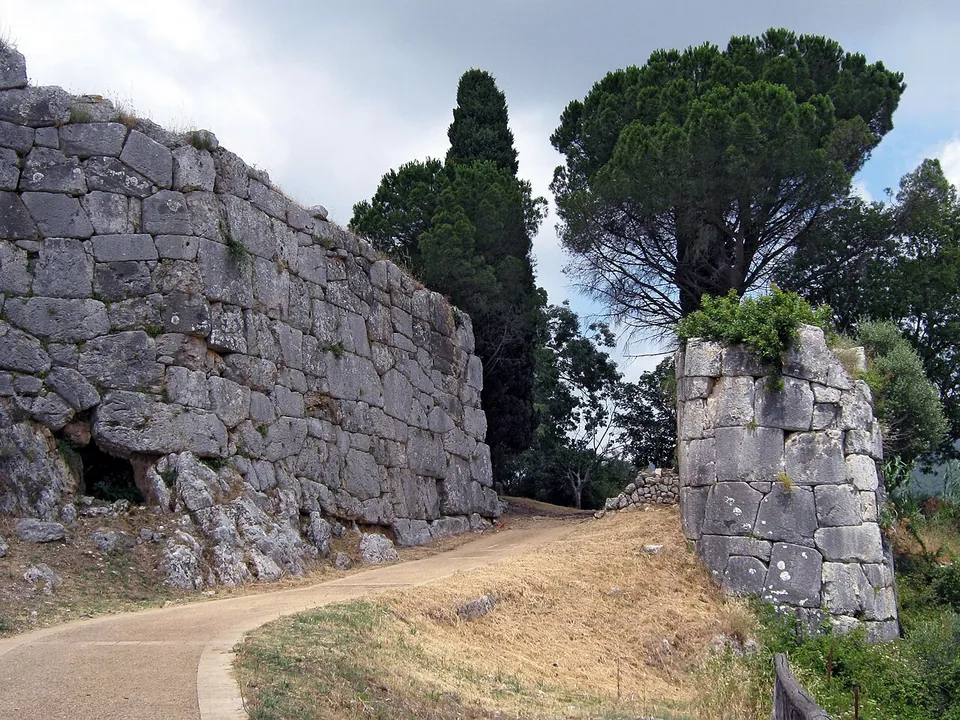
stronghold (en.wikipedia). The sanctuary was destroyed after the Roman period; its ruins were
known in the Middle Ages as the “palace of Theodoric”, and a Benedictine monastery of St Michael
the Archangel, which gave the hill its present name, settled in the small temple, where traces of
9th-century frescoes remain. The local scholar Pio Capponi began excavating it in 1894, followed by Luigi
Borsari in 1896 (it.wikipedia).
More photographs
The so-called Capitolium, with its one surviving column. · Photo: RatMan1234 · CC BY-SA 4.0 · Wikimedia Commons
The arcades of the sanctuary terrace on Monte Sant'Angelo. · Photo: Carole Raddato from FRANKFURT, Germany · CC BY-SA 2.0 · Wikimedia Commons
Pisco Montano, the rock cut for the Via Appia, with the height mark CXX carved in its face. · Photo: Tdr125 · CC BY-SA 3.0 · Wikimedia Commons