

What is there today
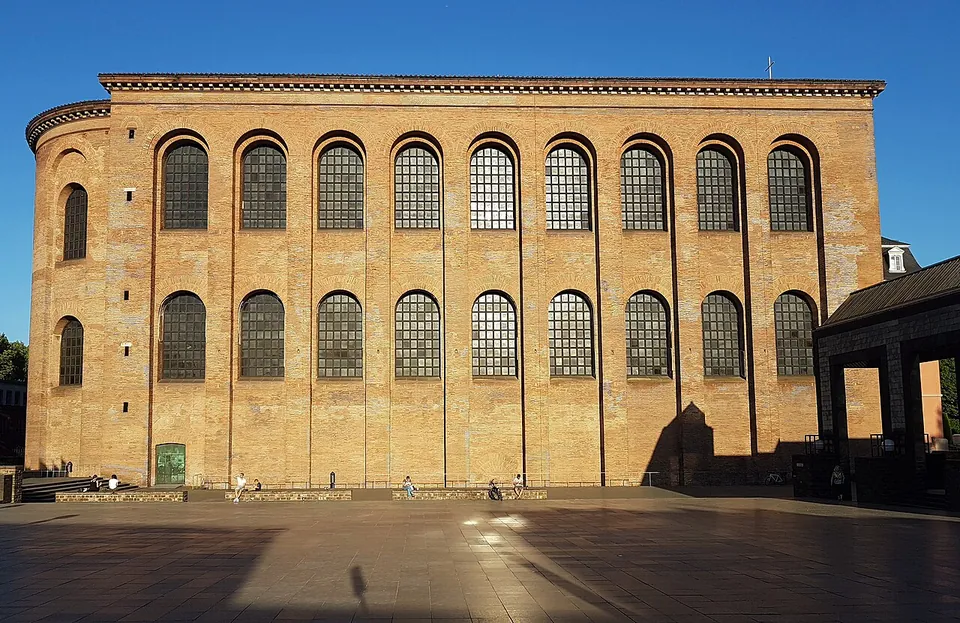
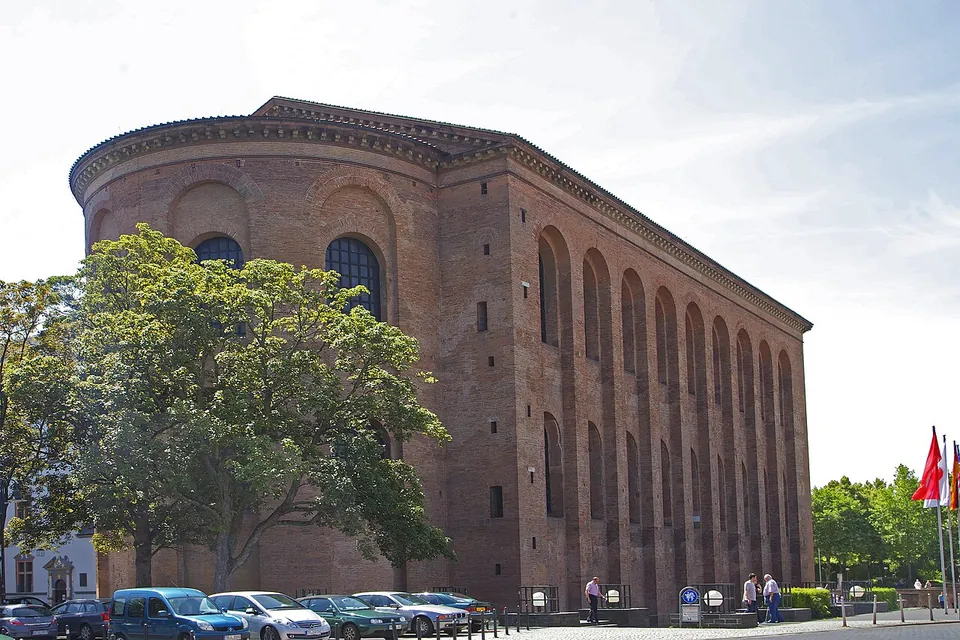
This is a complete building, not a ruin, but not all of it is Roman. The apse at the north end, the long west wall and parts of the south wall are original; the east and south walls were rebuilt in the 19th century, and the roof, the coffered wooden ceiling, the windows and the floor date from the reconstruction after the Second World War. The red sandstone parts are modern additions (de.wikipedia).
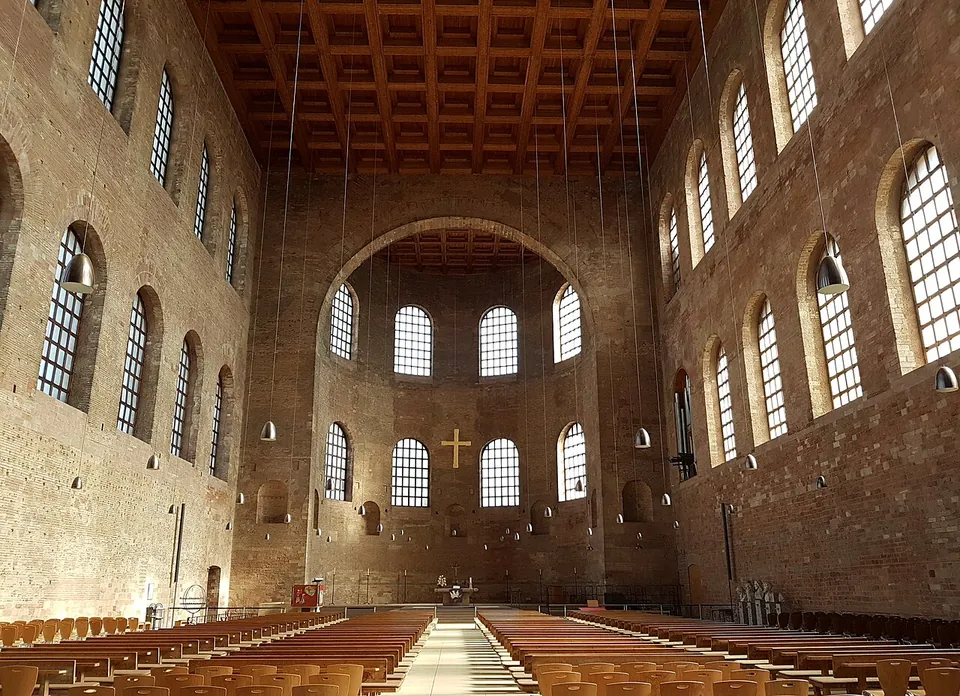
Inside, it is one room with no columns. The parish gives it as 67 m long, 27.5 m wide and 33 m high, and says the Porta Nigra would fit inside it; Pleiades and en.wikipedia give the width as 26 m, so allow for about 26 to 27.5 m. en.wikipedia, followed by Pleiades, calls it the largest hall to survive from antiquity; the parish says, more cautiously, one of the largest column-free rooms of the ancient world. When it was rebuilt in the 1950s the walls were left as bare brick, so the interior is plain: pews, an altar, an organ of 2014 hung on the south wall, and the heads of 19th-century statues of Christ and the Evangelists on stelae along the east wall. The imperial throne is thought to have stood in the apse (de.wikipedia; the parish).
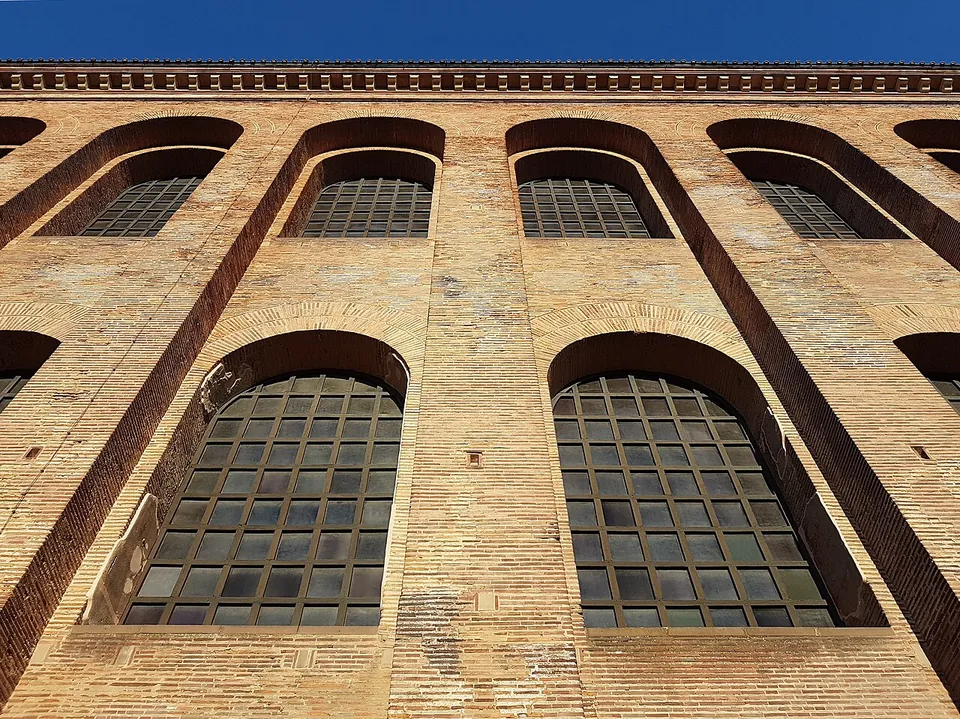
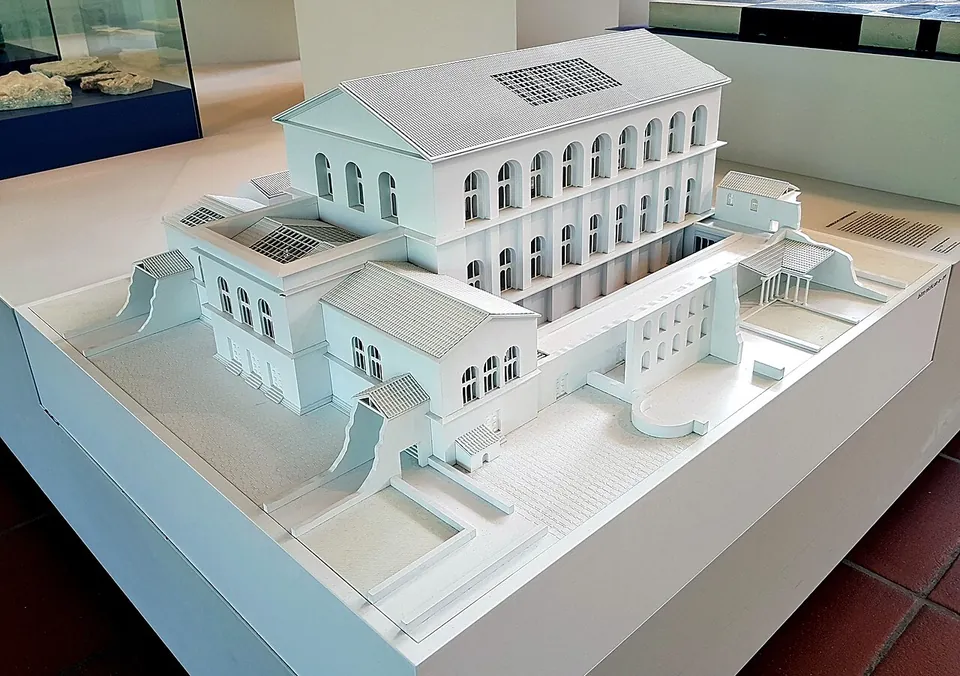
Look closely at the outside too. Remains of the original Roman exterior painting survive at nine of the fourteen lower window bays on the west and north sides, and 65 m² of Roman plaster on the north side (de.wikipedia). The hall did not stand alone: a marble-clad porch lay in front of the main entrance on the south side, and courtyards with porticoes ran along the outside. Their remains are either conserved or marked in the paving of the square around it (de.wikipedia). A bronze tactile model of the building stands on the square to the west (de.wikipedia; OpenStreetMap).
Is it worth the trip?
Yes, as one of the stops in Trier. Here you stand inside the emperors’ own audience hall, rebuilt to its Roman size, which conveys the scale of the late Roman residence better than any plan. It lies between the cathedral and the Imperial Baths, and the parish lists no admission charge. The parish counts over two million visitors a year.
Go knowing what you will see. Two of its walls and almost everything inside it are 19th- and 20th-century work, only traces of the Roman marble facing remain, and the room reads as a vast, plain church. And because it is a working church, it can be closed to sightseers at short notice for a service, an event or a rehearsal (the parish).
Getting there
The hall stands on the east side of Trier’s old town, between the cathedral and the Imperial Baths, with Konstantinplatz in front of it and the Electoral Palace built against it (de.wikipedia). It is about 400 m from the Imperial Baths and 700 m from the Porta Nigra as mapped, so it is easily done on foot as part of a walk round the Roman monuments. The bus stop “Trier, Konstantin Basilika” is about 70 m away (OpenStreetMap), and the Tiefgarage Basilika car park is just south of the Electoral Palace (de.wikipedia).
From April to October it is open Monday to Saturday 10.00 to 18.00 and Sunday 14.00 to 18.00. In November and from January to March it opens Tuesday to Saturday 10.00 to 12.00 and 14.00 to 16.00, Sunday 14.00 to 16.00, and is closed on Mondays; in December it opens on Mondays as well. The parish publishes no admission charge; its church guide gives group tours on request for €75 (trier.ekir.de, read 30 October 2026; check before travelling). Part of the excavations carried out beneath the floor in 1950–1954 can be seen on a special guided tour, with the entrance near the pulpit (de.wikipedia); the parish’s pages do not say how to book it.
Visiting details
- Opening hours
- April to October: Monday to Saturday 10.00–18.00, Sunday 14.00–18.00. November and January to March: Tuesday to Saturday 10.00–12.00 and 14.00–16.00, Sunday 14.00–16.00, closed Mondays. December: Monday to Saturday 10.00–12.00 and 14.00–16.00, Sunday 14.00–16.00.
- Tickets
- The parish publishes no admission charge for visits. Group tours with the church guide are available on request for €75.
- Parking
- The Tiefgarage Basilika, an underground car park, is just south of the Electoral Palace next door (de.wikipedia). The bus stop "Trier, Konstantin Basilika" is about 70 m away (OpenStreetMap).
Before you go
- The building is a working Protestant church and can close to sightseers at short notice for services, events or rehearsals (the parish).
Hours and prices checked 30 October 2026 on the operator's own site. Confirm before travelling.
History
In the 2nd century four city blocks in the north-east of Roman Trier were joined into an administrative quarter around a central hall, identified as a legate’s palace. When the quarter was remodelled as Constantine’s residence, the audience hall was built over that palace, probably in 305–311, as the core of a residence with forecourts and side buildings. Building stalled even in Constantine’s time and was probably only finished under Gratian around 379. With the Imperial Baths and the circus it formed a palace district modelled on the relation between the Palatine and the Circus Maximus in Rome (de.wikipedia).
It was a hall for audiences and court ceremony. The floor and the walls up to the top window ledges were faced with inlaid marble, the room above that was finished in stucco, and the floor was heated by a hypocaust. Some of the marble survives, and above all the holes for the iron clamps that held it (de.wikipedia). The name “basilica” was given to it in the 19th century and is a misnomer: it is a single hall, not a basilica with aisles, and it was never a church in Roman times (de.wikipedia).
After the court left at the end of the 4th century the hall lost its purpose and, at some point, its roof. Under the Franks and then the archbishops of Trier it became a fortress: the windows were walled up, buildings were put up inside, and the apse was made into a residential tower. In 1008 it held out against a sixteen-week siege led by Henry II in person. From 1614 the archbishop-elector Lothar von Metternich pulled down the east wall and most of the south wall to build his new palace, and the rest of the hall became one of its wings (de.wikipedia).
The Prussian king Friedrich Wilhelm IV had the hall rebuilt to its Roman size as a Protestant church, consecrated in 1856, which makes it the oldest building in Germany in use as a church. On 14 August 1944 an American air raid burnt it out, leaving only the outer walls. It was rebuilt in the 1950s and consecrated again in December 1956. The building belongs to the state of Rhineland-Palatinate and is used by the Protestant parish of Trier. Since 1986 it has been part of the UNESCO World Heritage Site of Trier’s Roman monuments, cathedral and Church of Our Lady (de.wikipedia).
More photographs


Nearby
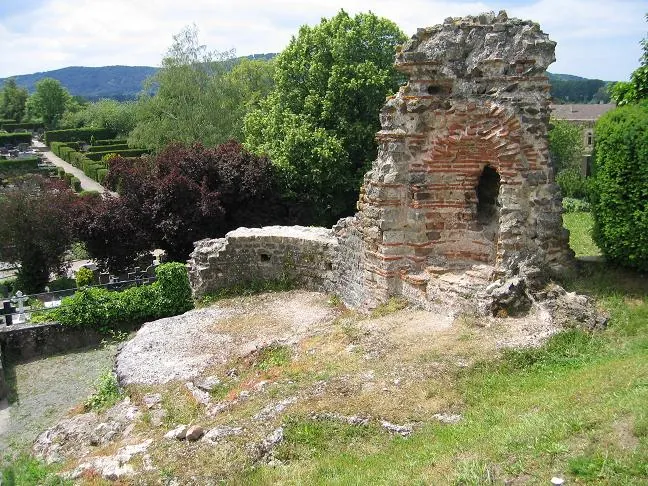
Photo: Johannes Simon · Public domain · Commons
8 km · villa · Rhineland-Palatinate
Kaiservilla Konz
The piece the tourist board points to is part of a cold-water basin, about 4 m high.
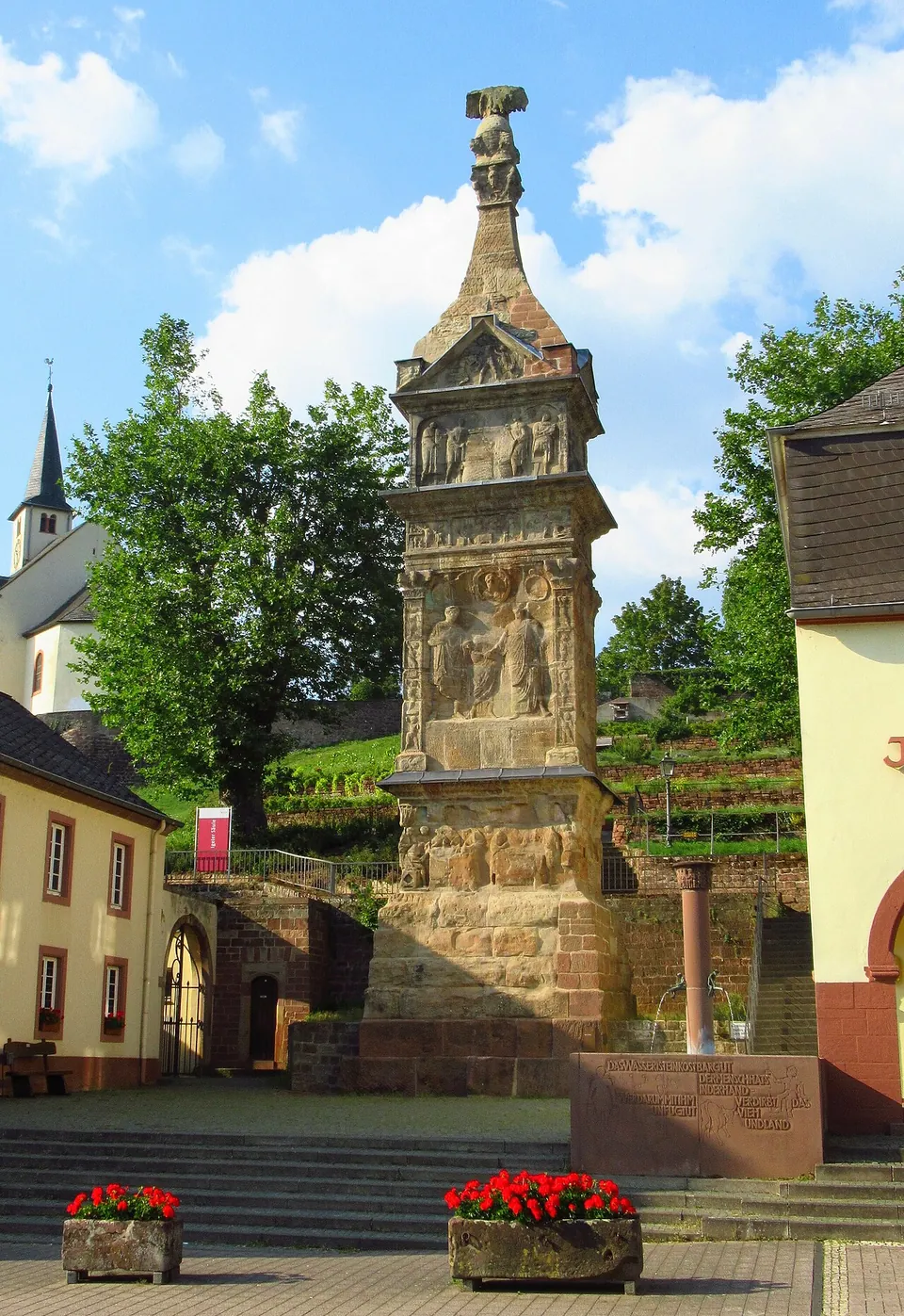
Photo: Dkvtig · CC BY-SA 4.0 · Commons
8 km · tomb · Rhineland-Palatinate
Igel Column
The monument itself, still standing where the Romans built it.
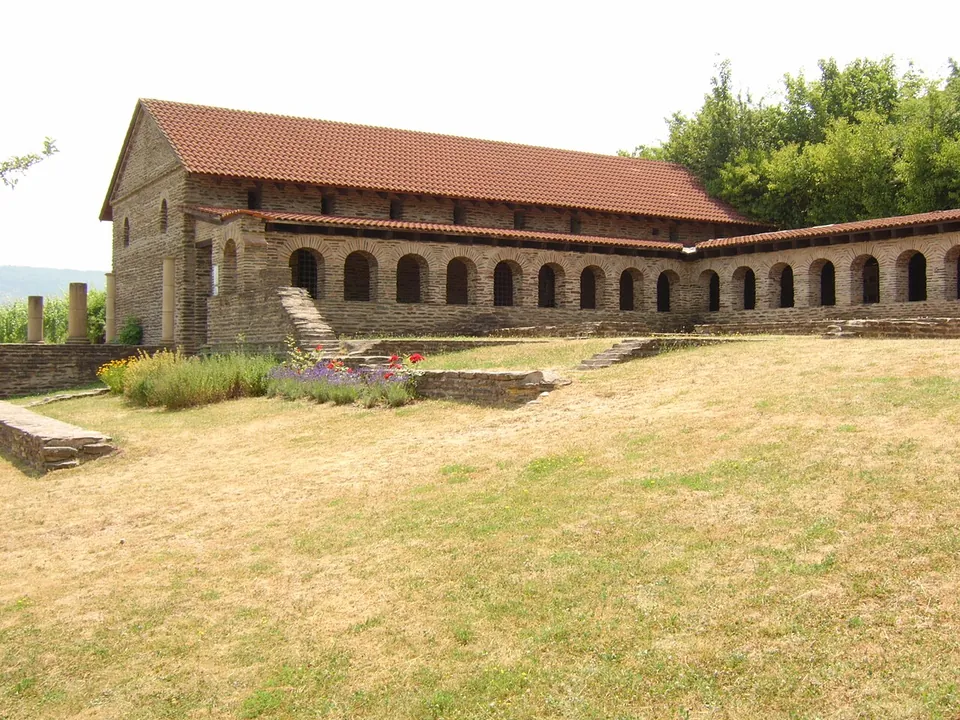
Photo: Areks · CC BY-SA 3.0 · Commons
10 km · villa · Rhineland-Palatinate
Villa urbana of Longuich
What you see first is a long stone building with a tiled roof and an arcade of round arches.


Straight-line distances.
Sources
Every fact on this page comes from the records below, each used under the licence noted.
| Source | Licence |
|---|---|
| Pleiades 780510607 | CC BY |
| Wikidata Q686773 | CC0 |
| OpenStreetMap way/50283505 | ODbL |
| Wikipedia (de) — Konstantinbasilika | CC BY-SA 4.0 |
| Wikipedia (en) — Aula Palatina | CC BY-SA 4.0 |
| Evangelische Kirchengemeinde Trier (the parish that uses the building) — Konstantin-Basilika, opening hours | licence not recorded |
| Evangelische Kirchengemeinde Trier — dimensions and interior | licence not recorded |
| Evangelische Kirchengemeinde Trier — history of the building | licence not recorded |