Skip to content
Menu
LandmarkHub · 7 stops1st c. BC – 5th c. ADTicketed

Augusta Treverorum – Trier

Treveris, Col. Augusta Treverorum

city · Rhineland-Palatinate, Germany

What it is
Trier is the Roman city of Augusta Treverorum on the Moselle, from the late 3rd to the end of the 4th century one of the residences of the western emperors, and its Roman buildings still stand across the modern town: a city gate, an imperial audience hall, two great bath complexes, an amphitheatre and a bridge, listed with the cathedral as a UNESCO World Heritage Site since 1986 (de.wikipedia).
What you’ll see
The stops each have their own page; this is the outline of what the town holds.
Worth the trip?
Yes, and give it a full day at least. UNESCO listed these monuments for their number and the quality of their preservation (de.wikipedia), and the seven described above lie within about 1.7 km of one another as mapped, so all of it can be done on foot.
Getting there & cost
Trier has a main railway station, and a signposted footpath leads from it to the Porta Nigra (the operator). By car, the Parkhaus Porta Nigra is 50 m from the gate.Ticketed · €6 per monument for adults, €5 reduced, €3 for ages 6–17, free under 6 (Porta Nigra, Imperial Baths, amphitheatre and Forum Baths alike) · checked 30 October 2026Hours, tickets and parking
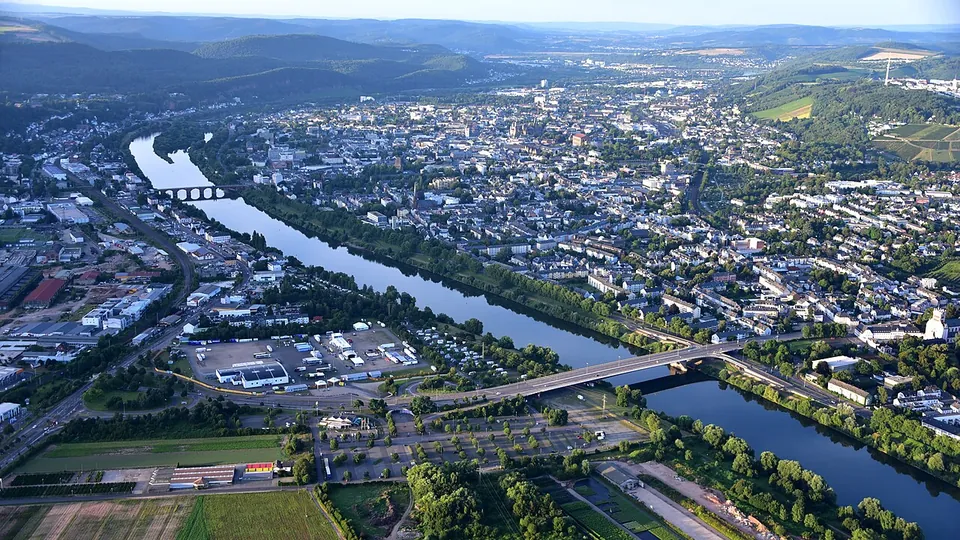
An aerial view of a city spread across a wide, flat river valley, the river curving through it under several bridges, with wooded hills rising behind.
Trier from the air, in the wide valley of the Moselle. · Photo: Wolkenkratzer · CC BY-SA 4.0 · Wikimedia Commons
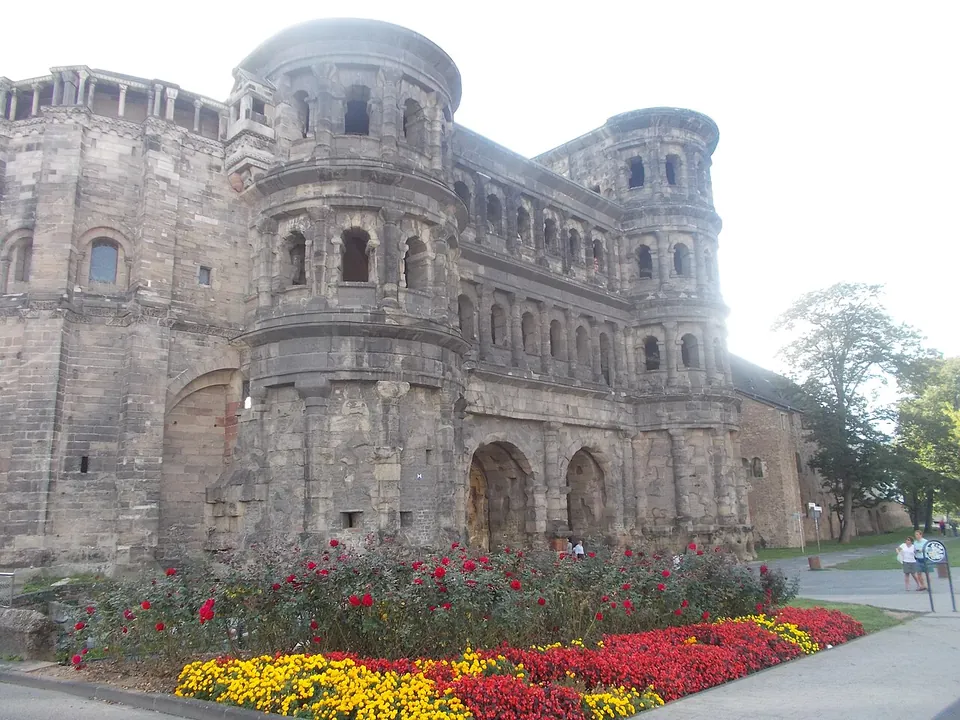
A massive gate of dark, weathered sandstone blocks with a rounded tower at one end and tiers of round-arched windows above a ground floor of arches, with red and yellow flower beds in front.
The Porta Nigra, the north gate of the Roman city and the only one of its gates still standing. · Photo: Lsjm · CC BY-SA 4.0 · Wikimedia Commons
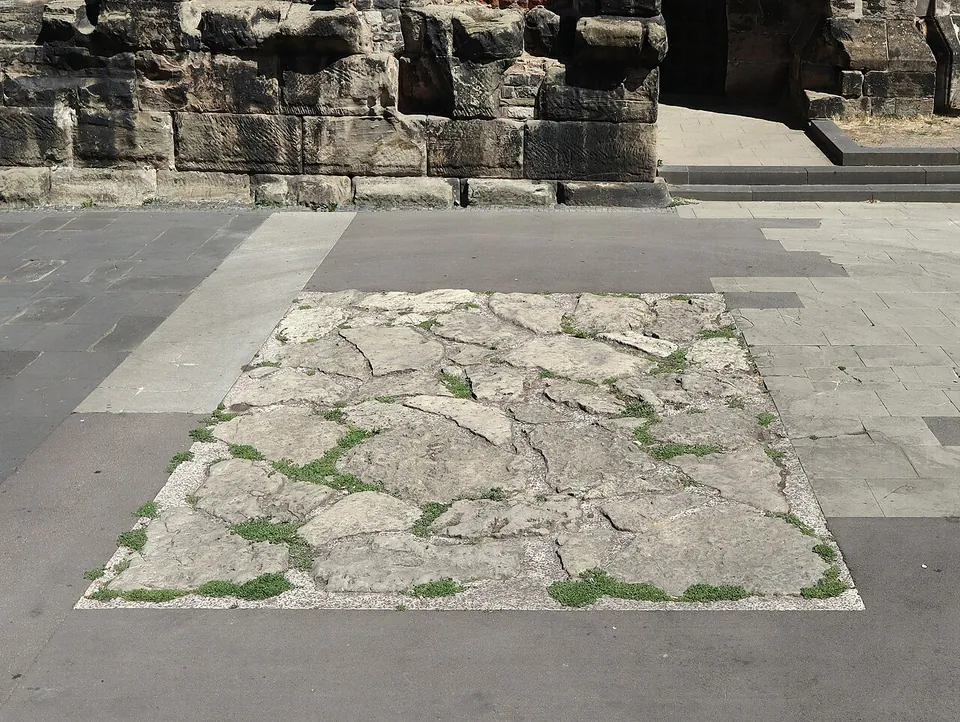
A rectangle of large, irregular grey paving stones with grass growing in the joints, set into modern paving beside the stone base of a building.
A stretch of Roman street paving left visible at the south-east corner of the Porta Nigra. · Photo: Palauenc05 · CC BY-SA 4.0 · Wikimedia Commons

The stops

7 places to see, the best preserved and best known first.

See all 7 stops on the mapWhere each one is, so you can plan your own way round.Open the map →
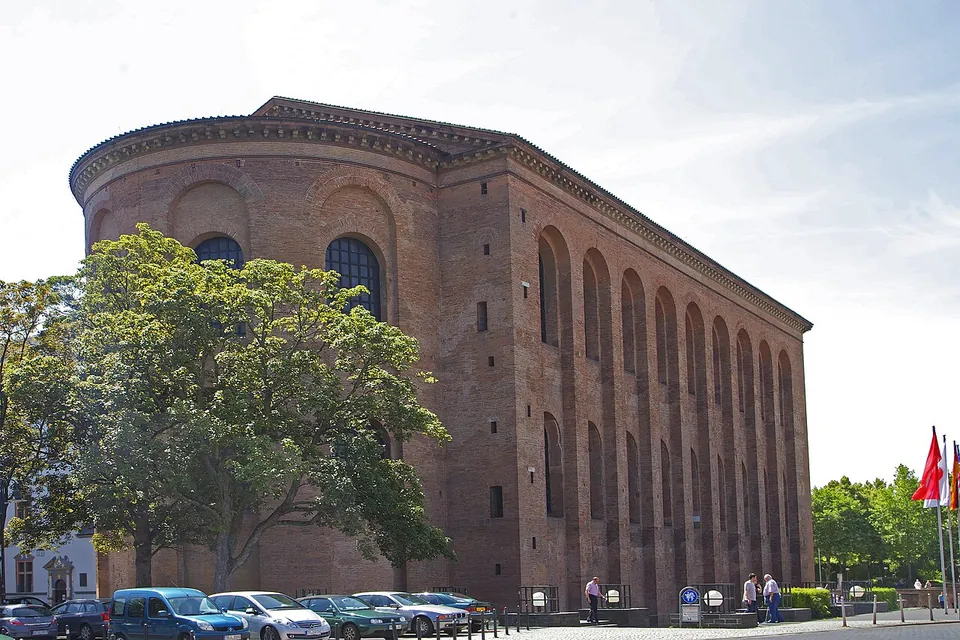
  1. A tall, plain brick hall with a rounded end on the left; its long side is divided by tall arched recesses, each framing two round-headed windows one above the other, with trees and parked cars along its base.

    Photo: W. Bulach · CC BY-SA 4.0 · Commons

    palace · Rhineland-Palatinate

    Aula Palatina

    This is a complete building, not a ruin, but not all of it is Roman.

    Free
  2. A massive gatehouse of dark, weathered sandstone seen at an angle, two rounded towers with tiers of round-arched windows flanking a pair of ground-floor arches, a plainer block of masonry at the left end, and beds of red and yellow flowers in front.

    Photo: Lsjm · CC BY-SA 4.0 · Commons

    gate · Rhineland-Palatinate

    Porta Nigra

    This is a gate standing almost complete, not the foundations of one.
    Ticketed
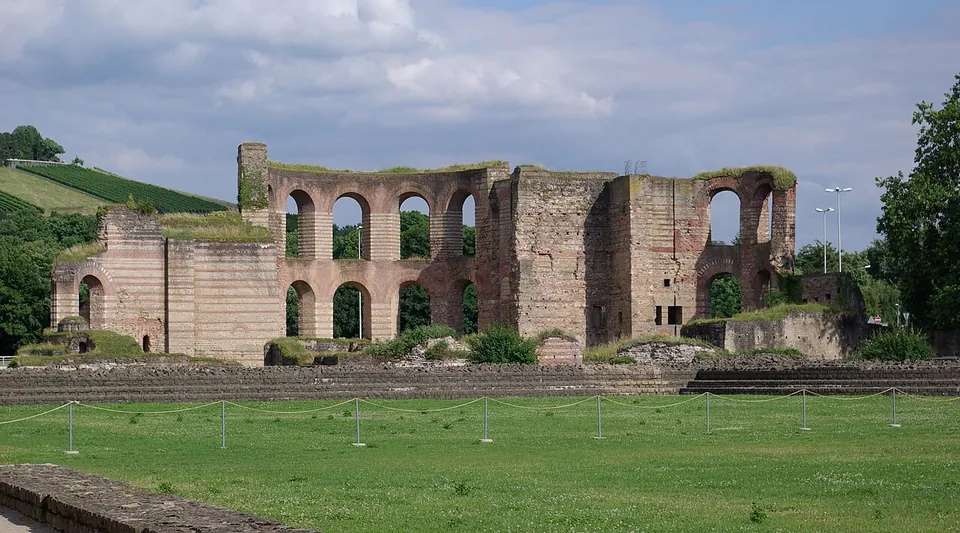
  3. The ruined walls of a large building in brick and pale stone, pierced by rows of tall arched openings and rising to a square block at one end, beyond a mown lawn edged by a low rope barrier, with a vineyard on the hillside behind.

    Photo: Berthold Werner · Public domain · Commons

    bath · Rhineland-Palatinate

    Trier Imperial Baths

    The standing part is the core of the baths around the caldarium, the hot-bath hall, whose apse walls are the best preserved (de.wikipedia; hr.wikipedia).
    Ticketed
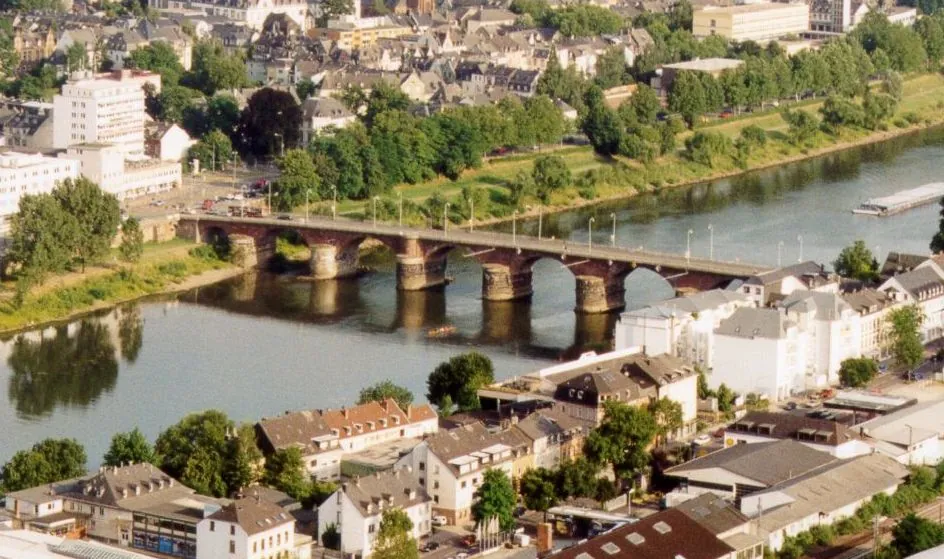
  4. Seen from high above, a long bridge of dark stone piers and reddish arches crosses a wide, calm river between rows of houses, with trees and a grassy bank along the far shore.

    Photo: Stefan Kühn · CC BY-SA 3.0 · Commons
    bridge · Rhineland-Palatinate

    Roman Bridge

    What you are looking for is the piers, not the arches.

    Free
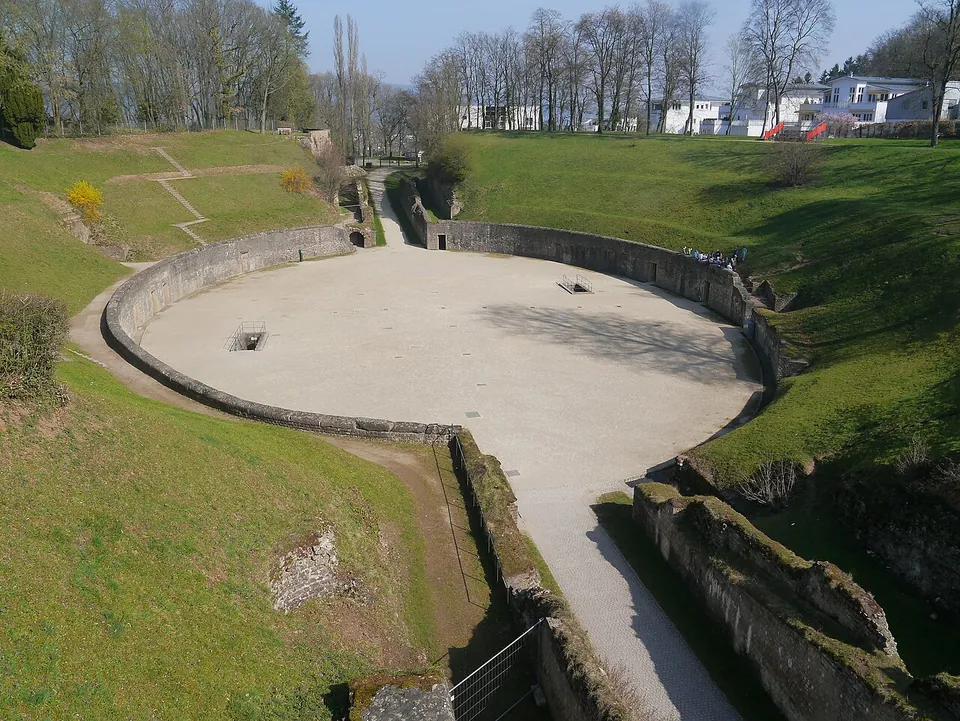
  5. An oval arena floor of pale gravel enclosed by a low stone wall, with grassed banks rising all round where the seating was, a walled passage leading in at one end, and houses on the skyline above the far slope.

    Photo: Zairon · CC BY-SA 3.0 · Commons

    amphitheatre · Rhineland-Palatinate

    Trier Amphitheatre

    The arena is the centrepiece: an oval about 71 m long and 47.5 to 49 m wide (Pleiades; de.wikipedia), enclosed by what the operator describes as a protective parapet wall four metres high.
    Ticketed
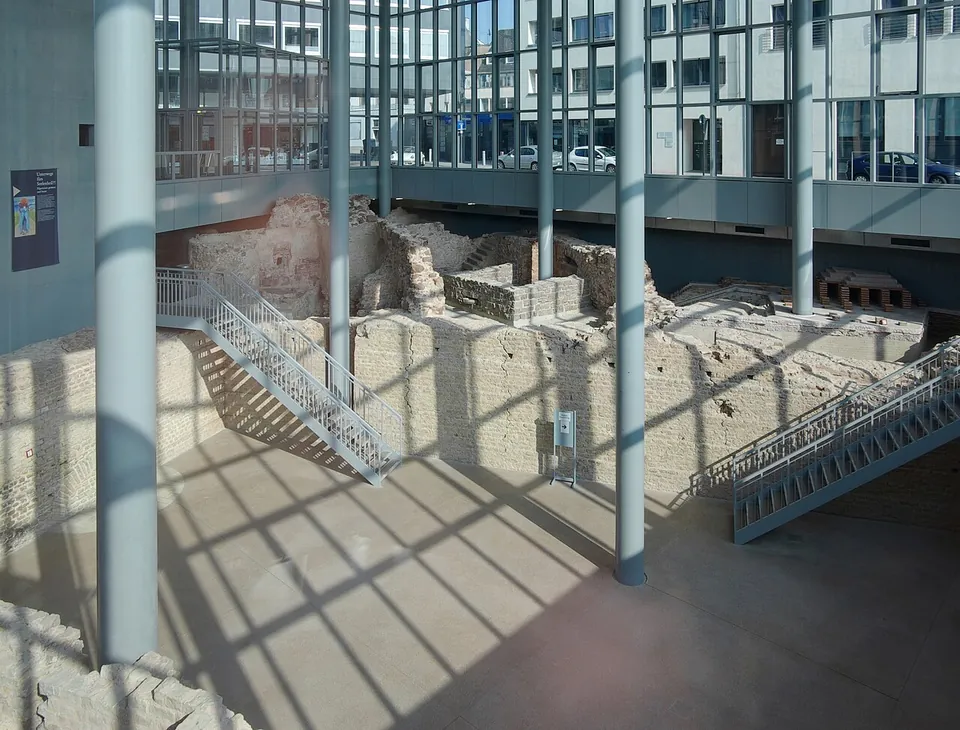
  6. Inside a tall glass hall carried on slender steel columns, two steel staircases lead down into a wide sunken excavation where low walls of stone and brick stand on the pale ground, with sunlight falling in stripes across it.

    Photo: Berthold Werner · CC BY-SA 3.0 · Commons

    bath · Rhineland-Palatinate

    Forum Baths

    You walk among walls, not over a lawn.

    Ticketed

What is there today

The stops each have their own page; this is the outline of what the town holds.

  • Porta Nigra – the north gate of the Roman wall and the only gate that survives. Building began in 170, a date fixed by tree-ring dating in 2018, and it survived because in the Middle Ages it was turned into a church (de.wikipedia).
  • Aula Palatina (Konstantinbasilika) – the audience hall of the late Roman palace, 69.8 m long and 27.2 m wide outside, and about 30 m high in antiquity; the parish gives the interior as 67 m long and 33 m high, so the figures measure different things. Not all of it is Roman: the south and east walls were pulled down after 1614, and the hall was rebuilt as a Protestant church from 1844 and again after the Second World War; the red sandstone parts are modern (de.wikipedia).
  • Imperial Baths (Kaiserthermen) – planned as one of the largest baths in the empire, exceeded only by three in Rome, but never put into use as baths; under Valentinian I the half-built complex was given a new purpose. Its east front, kept because it was built into the medieval town defences, still stands; published figures put it at 19 m to over 20 m high (de.wikipedia).
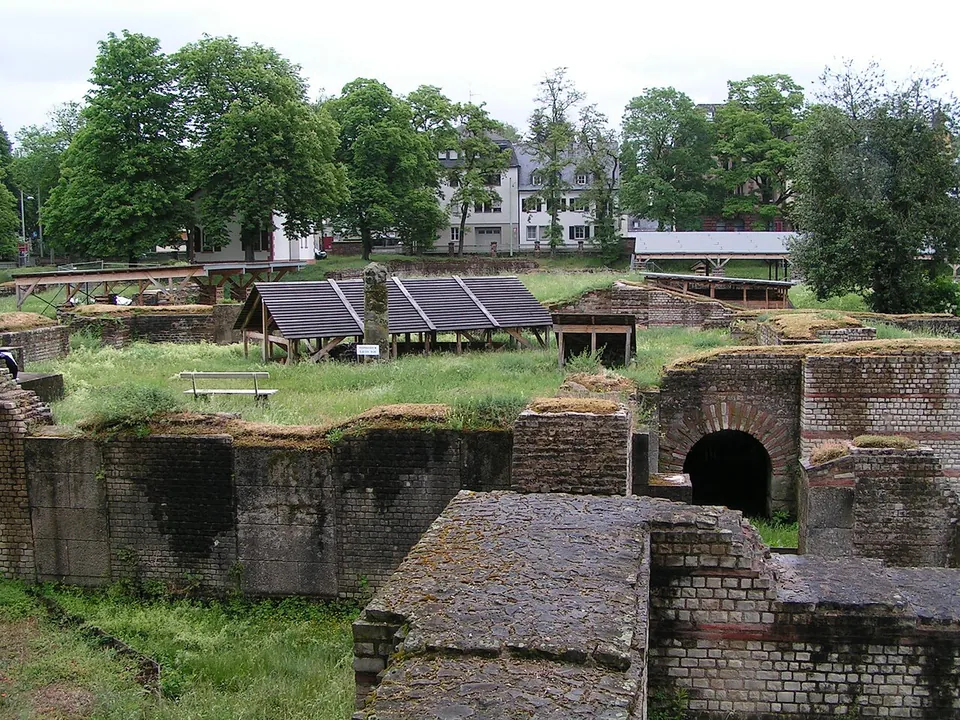
  • Barbara Baths (Barbarathermen) – mid-2nd-century baths covering about 4.2 hectares, surpassed in their day only by the Baths of Trajan in Rome. What is left are excavated foundations, seen from a visitor walkway with nine information stations (de.wikipedia; the operator).
  • Forum Baths (Thermen am Viehmarkt) – remains found under the Viehmarkt square in 1987 during building work, shown with an excavated Roman street under a glass hall by the architect Oswald Mathias Ungers. de.wikipedia counts them as the city’s oldest public baths, of around AD 80, while noting that their purpose is disputed; the operator describes a 2nd-century building of unknown use that became a public bath in the 4th century.
  • Amphitheatre – built into the slope of the Petrisberg for 18,000 to 20,000 spectators; published dates run from about AD 100 to the end of the 2nd century. The oval arena, about 71 m long and 47.5 to 49 m wide, and some of its underground vaults survive (Pleiades; de.wikipedia).
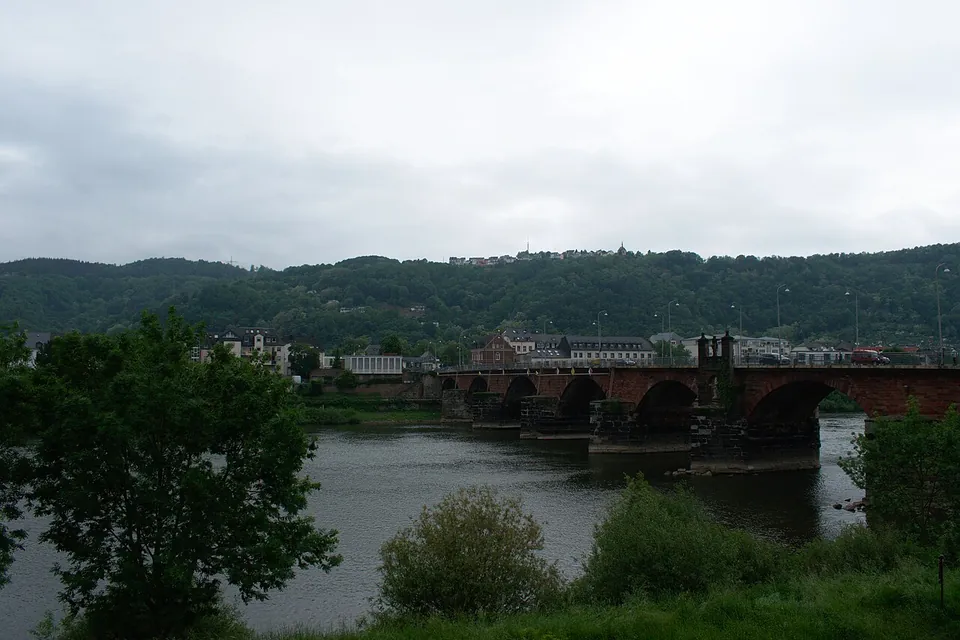
  • Roman bridge (Römerbrücke) – its stone piers were built between 144 and 155 under Antoninus Pius; the stone arches above them date from 1343 (de.wikipedia). It is still in use (de.wikipedia, World Heritage article).

Away from the main group, the so-called Franzensknüppchen on the Petrisberg may be a monumental Roman burial mound, though that has not been settled (de.wikipedia).

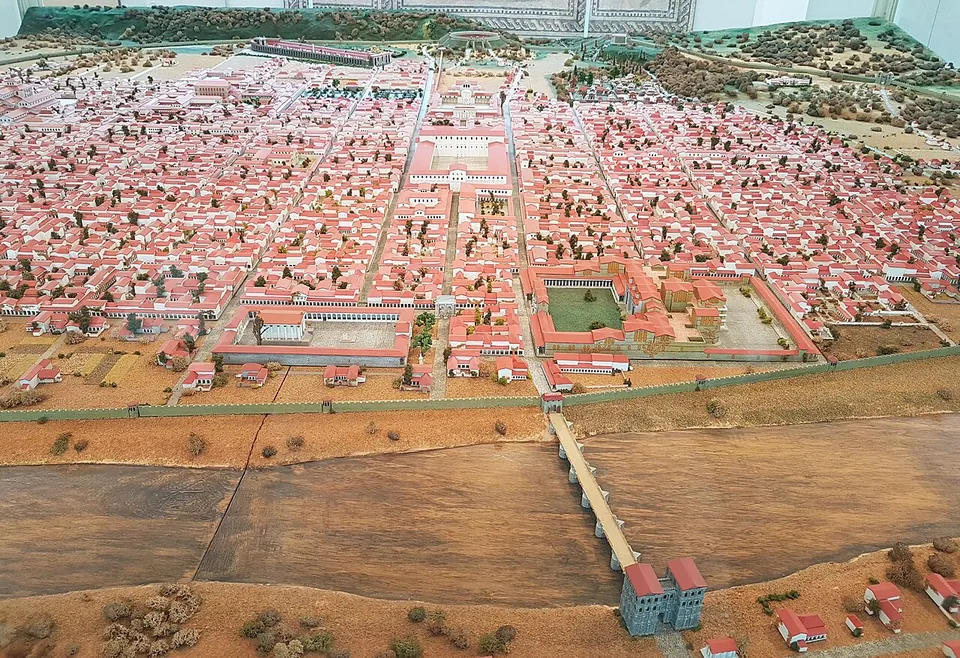
The town itself holds more. On the north side of the cathedral, along Windstraße, the brickwork of a square hall added to the 4th-century church complex late in that century is visible up to a height of 30 m, and short stretches of the Roman city wall survive, 70 m of them accessible on Langstraße (de.wikipedia). The finds are in the Rheinisches Landesmuseum, among them a hoard of 2,570 gold coins weighing 18.5 kg, found in 1993, and a large scale model of the Roman city (de.wikipedia; Commons).

Is it worth the trip?

Yes, and give it a full day at least. UNESCO listed these monuments for their number and the quality of their preservation (de.wikipedia), and the seven described above lie within about 1.7 km of one another as mapped, so all of it can be done on foot.

Know what each one is before you go. The Porta Nigra, the Aula Palatina and the east front of the Imperial Baths are the standing buildings; the Barbara Baths are excavated foundations, and the amphitheatre is an arena inside its walls and grassed banks. Two monuments are under conservation work at the moment: the south side of the Porta Nigra is partly scaffolded, and part of the Imperial Baths’ caldarium is closed (the operator). And much of the Roman city lies under the modern one: of the circus, which held at least 50,000 people, nothing is preserved (de.wikipedia).

Getting there

Trier has a main railway station, and a signposted footpath leads from it to the Porta Nigra (the operator). By car, the Parkhaus Porta Nigra is 50 m from the gate.

The Aula Palatina has its own hours, set by the parish: from April to October it opens 10.00 to 18.00 Monday to Saturday and 14.00 to 18.00 on Sunday, and in the other months only for a few hours at midday and in the afternoon, so check its page. The Porta Nigra, the Imperial Baths and the amphitheatre open daily: 09.00 to 18.00 from April to September, 09.00 to 17.00 in March and October, and 09.00 to 16.00 from November to February, with last entry half an hour before closing. The Forum Baths open Tuesday to Sunday, 11.00 to 17.00. All are closed on Rosenmontag, 24 to 26 December, 31 December and 1 January. Each of these four costs €6 for an adult, €5 reduced and €3 for ages 6 to 17. The walkway over the Barbara Baths is free. If you are seeing more than two, the AntikenCard Premium, €28, covers all four plus the Rheinisches Landesmuseum; the Basic card, €18, covers two of them plus the museum. Both are for one adult with up to four children under 18, and are valid to the end of the year (zentrum-der-antike.de, read 30 October 2026; check before travelling, since prices move).

Visiting details

Opening hours
Porta Nigra, Imperial Baths and amphitheatre: daily 09.00–16.00 in January, February, November and December, 09.00–17.00 in March and October, 09.00–18.00 from April to September; last entry 30 minutes before closing. Forum Baths (Thermen am Viehmarkt): Tuesday to Sunday and public holidays 11.00–17.00, closed Mondays. All closed on Rosenmontag, 24–26 and 31 December and 1 January. The walkway over the Barbara Baths keeps the same seasonal hours as the first three. Aula Palatina (the parish's hours): April to October Monday to Saturday 10.00–18.00, Sunday 14.00–18.00; November and January to March Tuesday to Saturday 10.00–12.00 and 14.00–16.00, Sunday 14.00–16.00; December Monday to Saturday 10.00–12.00 and 14.00–16.00, Sunday 14.00–16.00.
Tickets
€6 per monument for adults, €5 reduced, €3 for ages 6–17, free under 6 (Porta Nigra, Imperial Baths, amphitheatre and Forum Baths alike). The Barbara Baths walkway is free. AntikenCard Basic €18: two of the four ticketed monuments plus the Rheinisches Landesmuseum; AntikenCard Premium €28: all four plus the museum. Each covers one adult with up to four children under 18 and is valid to the end of the calendar year.
Parking
Parkhaus Porta Nigra, 50 m from the gate (the operator). The operator lists no parking right at the Barbara Baths; the nearest car park it names is 200 m away in Lorenz-Kellner-Straße.

Before you go

  • The south side of the Porta Nigra is partly under scaffolding for facade restoration; it stays open, but routes inside may be restricted.
  • The southern part of the caldarium in the Imperial Baths is closed to visitors while the walls are secured.
  • The Barbara Baths are seen from a visitor walkway; the excavated ground itself may not be entered.
  • The operator warns that the monuments can close at short notice in bad weather.

Hours and prices checked 30 October 2026 on the operator's own site. Confirm before travelling.

History

The city was probably founded under Augustus around 18/17 BC: that is the tree-ring date of the first Roman bridge over the Moselle, and the name Augusta points the same way, though the year is not recorded in any ancient text (de.wikipedia). It was the chief town of the Treveri (Pleiades) and belonged to the province of Gallia Belgica. In his account of the events of AD 69 Tacitus calls it a colonia. The 1st and 2nd centuries brought the Forum Baths, the amphitheatre and the Barbara Baths, and from about 170 a 6.4 km wall enclosing 285 hectares, with the Porta Nigra as its north gate (de.wikipedia).

Its great period began in 293, when the Caesar Constantius I chose Trier as his residence. His son Constantine, who spent several years here between 306 and 324, built it up as an imperial seat with a palace on the model of the Palatine in Rome. The Aula Palatina belongs to this imperial building programme; the Imperial Baths were begun shortly before 300 and never finished as baths. Trier was the seat of the praetorian prefect of the Gauls, ran one of the most important mints of the late empire, and had a bishop by 314, the oldest attested see on German soil. Emperors resided here again from 367 to 388, among them Valentinian I and Gratian, and the poet Ausonius was tutor at the court (de.wikipedia). How many people lived here is uncertain: published estimates put the 4th-century population at anywhere from about 30,000 to as many as 100,000 (de.wikipedia).

The court left around 400, and the prefecture moved to Arles by 418 at the latest. Franks sacked the city four times between 410 and 435, the Barbara Baths went out of use in the first half of the century, and around 480 Trier fell to the Franks for good. The bishopric continued without a break, and the cathedral grew out of the 4th-century church complex (de.wikipedia).
More photographs

A large scale model of a city of red-roofed buildings laid out on a street grid, with a long bridge crossing a river in the foreground and a towered gatehouse at its near end.
The scale model of Roman Trier in the Rheinisches Landesmuseum, with the bridge over the Moselle in front. · Photo: Kleon3 · CC BY-SA 4.0 · Wikimedia Commons
A tall, plain brick hall whose long side is divided by tall arches, each framing two round-headed windows one above the other, with trees and parked cars along its base.
The Aula Palatina, the audience hall of the late Roman palace, now a Protestant church. · Photo: W. Bulach · CC BY-SA 4.0 · Wikimedia Commons
The ruined walls of a large building in brick and pale stone, pierced by rows of tall arched openings, standing beyond a mown lawn edged by a low rope barrier, with a green hillside behind.
The Imperial Baths, begun shortly before AD 300 and never put into use as baths. · Photo: Berthold Werner · Public domain · Wikimedia Commons
An oval arena floor of pale gravel enclosed by a low stone wall, with grassed banks rising all round where the seating was and a walled passage leading in on one side.
The amphitheatre, set into the foot of the Petrisberg; published dates run from about AD 100 to the end of the 2nd century. · Photo: Zairon · CC BY-SA 3.0 · Wikimedia Commons
A long bridge of dark stone piers and arches crossing a wide river under a grey sky, with houses on the far bank and wooded hills behind.
The Roman bridge over the Moselle; the piers are Roman, the stone arches above them medieval. · Photo: Flocci Nivis · CC BY 4.0 · Wikimedia Commons

Nearby

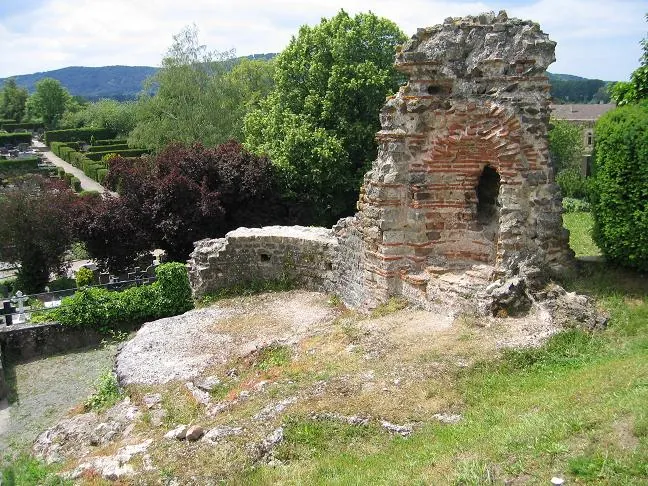
  • A ragged fragment of wall several metres high, built of grey rubble stone laid in courses with bands of red brick and pierced by a round-arched brick opening, with a lower stretch of wall beside it and bare rock and grass in front; clipped hedges and wooded hills behind.

    Photo: Johannes Simon · Public domain · Commons

    8 km · villa · Rhineland-Palatinate

    Kaiservilla Konz

    The piece the tourist board points to is part of a cold-water basin, about 4 m high.
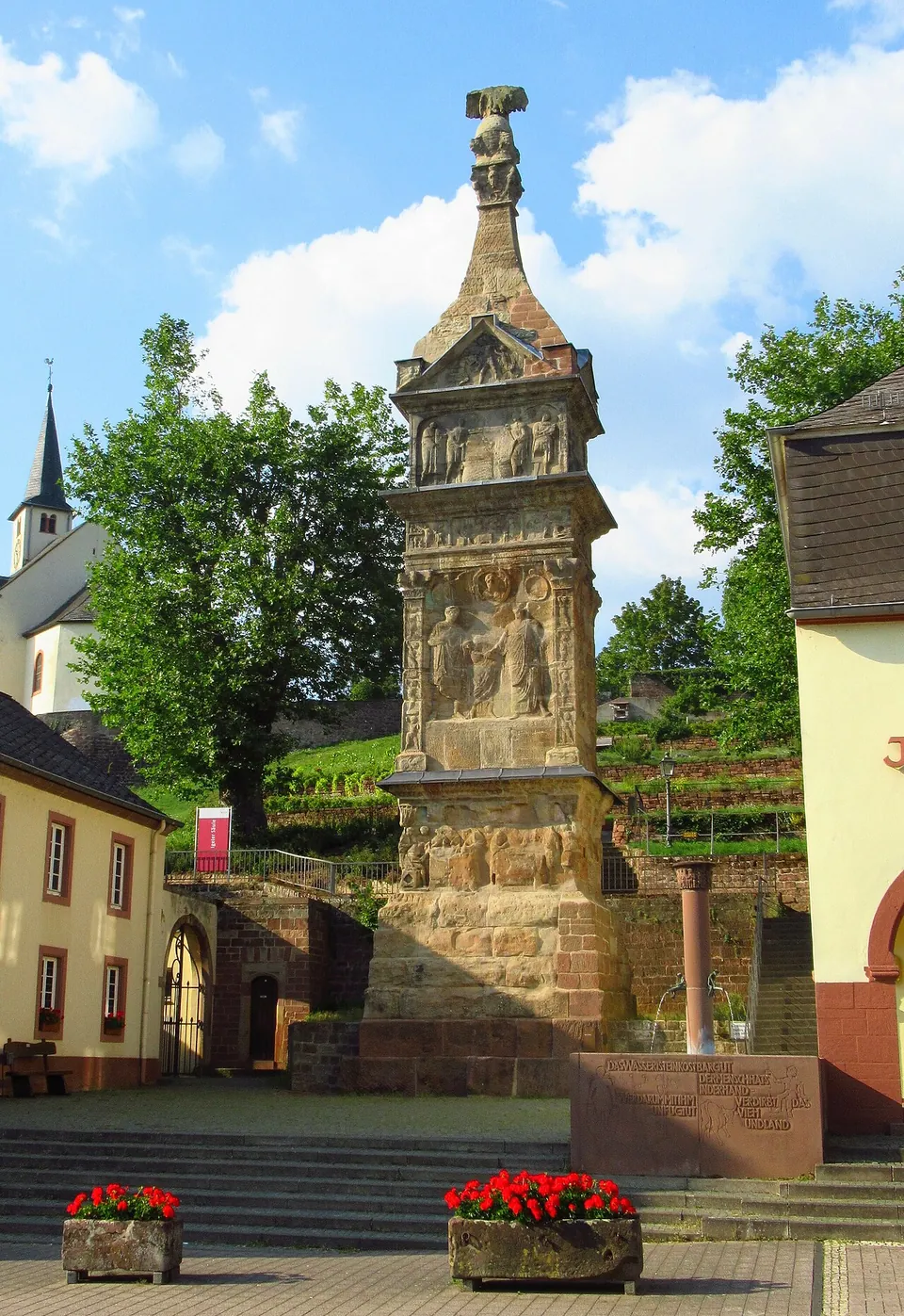
  • A tall, slender stone monument rising in tiers from a stepped base, its storeys covered in figure reliefs and capped by a steep pointed roof with a weathered sculpture on top, standing at the head of a paved square between houses, with a church spire and green trees behind.

    Photo: Dkvtig · CC BY-SA 4.0 · Commons

    8 km · tomb · Rhineland-Palatinate

    Igel Column

    The monument itself, still standing where the Romans built it.
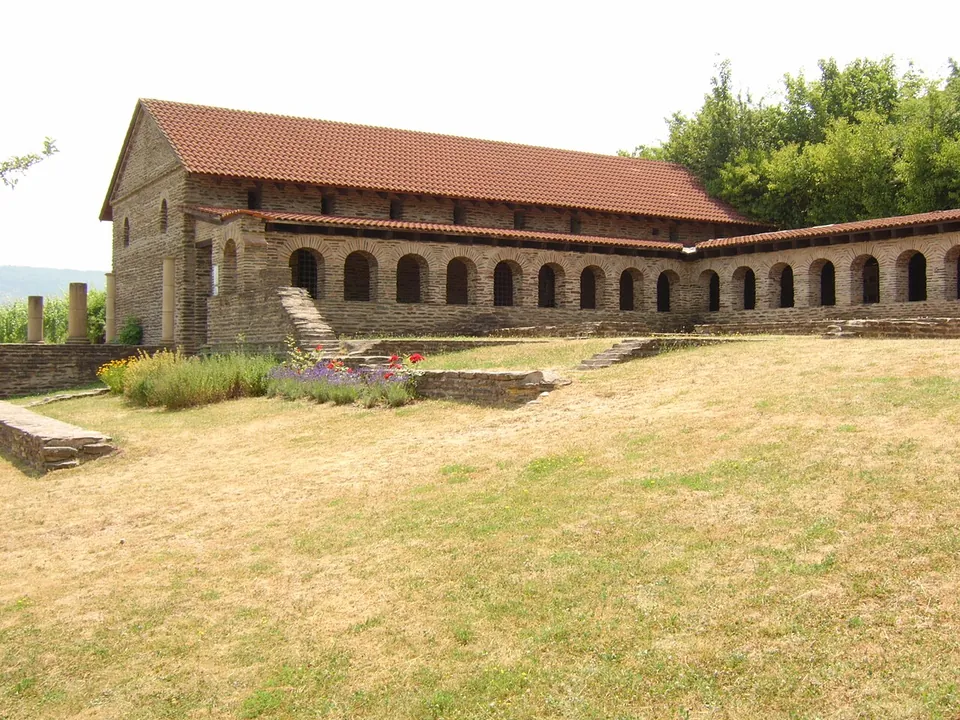
  • A long single-storey building of grey rubble stone with brick bands and a red tiled roof, fronted by an arcade of round arches, standing behind a mown lawn with low walls, flower beds and a column base in the foreground.

    Photo: Areks · CC BY-SA 3.0 · Commons

    11 km · villa · Rhineland-Palatinate

    Villa urbana of Longuich

    What you see first is a long stone building with a tiled roof and an arcade of round arches.

Straight-line distances.