

The sanctuary of Isis and Magna Mater is the precinct where Roman Mainz worshipped the Egyptian goddess Isis and the Great Mother, Magna Mater, whose cult goes back to Cybele of Asia Minor. It was found in 1999 beneath a building site in the city centre, and its walls are now shown, free of charge, in a small museum in the basement of the Römerpassage shopping centre.
What is there today
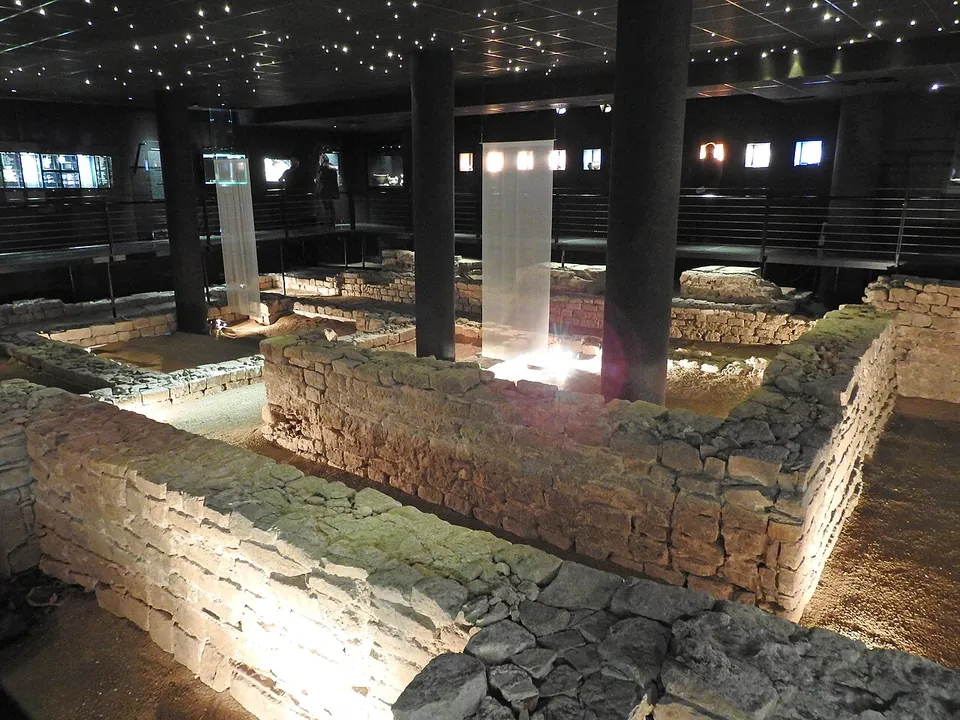
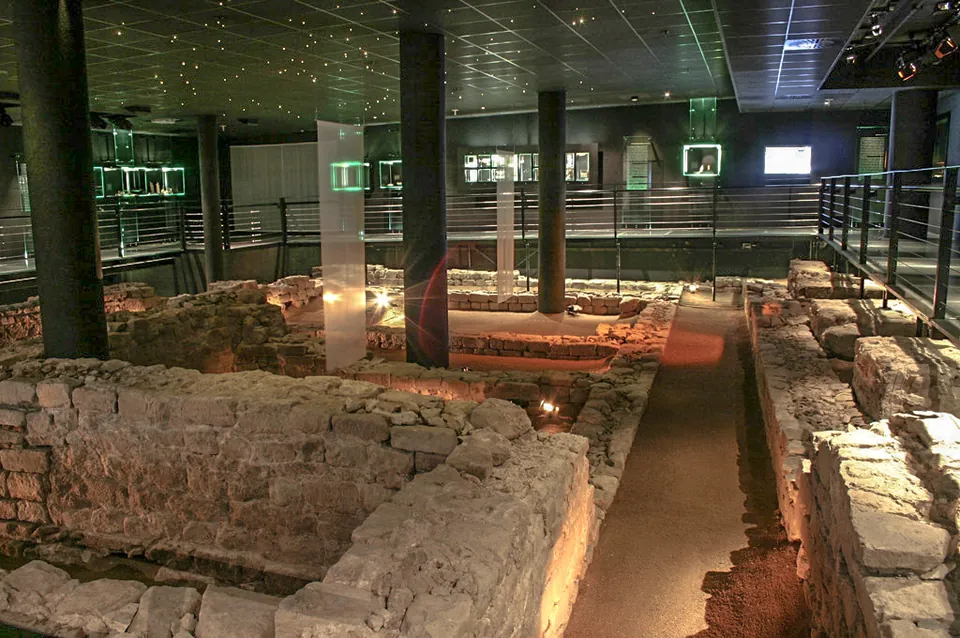
The remains are the sanctuary as it stood in the 2nd century: low stone footings of buildings whose walls above them were timber-framed and plastered, conserved and set back into the ground five metres down, the depth at which they were found, on their original alignment to the Roman street (de.wikipedia). They are not quite in place, though. To make room for an underground car park the walls were taken apart and moved several metres, and part of the remains was lost to the building work (de.wikipedia; en.wikipedia).
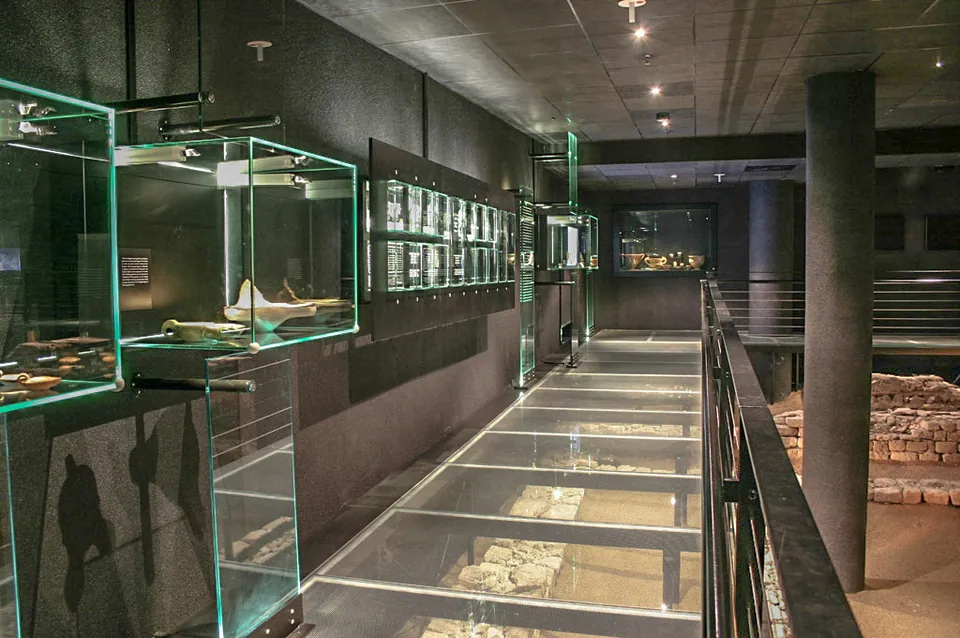
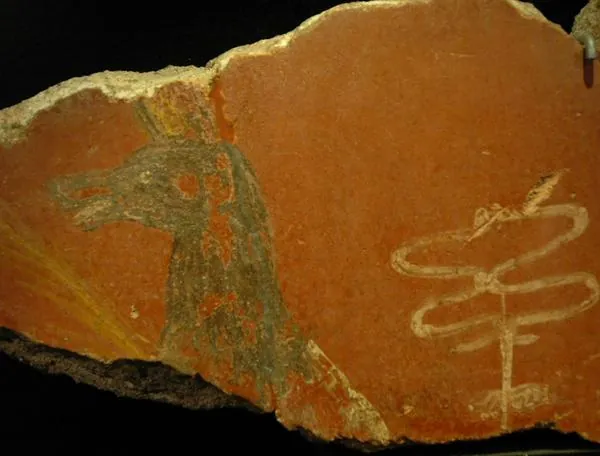
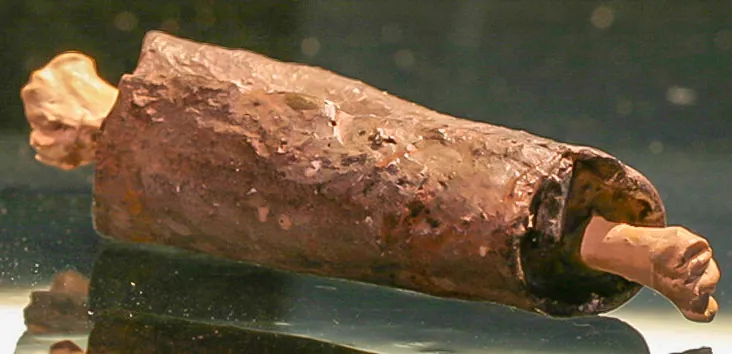
The staging does much of the work. The room is kept dark, with small lights in the ceiling recreating the night sky of 21 December AD 69 (en.wikipedia), and a glass walkway leads all round the walls. Images of Isis and the Mater Magna are projected among them, a filmed scene re-enacts a ritual, and in a recorded sequence a Roman citizen of Mainz, Claudius Secundus, voiced by the Mainz cabaret artist Lars Reichow, talks about the cult in AD 69 (de.wikipedia; the operator). Cases set into the walls hold original finds from the excavation (de.wikipedia), and there are sound effects and computer animations (the operator). Photographs on Commons from 2004 and 2018 also show a display of the Iron Age woman’s grave found beneath the sanctuary.
Is it worth the trip?
If you are in Mainz, yes. It is free, central, open six days a week, and it shows something the city’s other Roman remains cannot: what went on at a Roman sanctuary, from burnt offerings to paid-for curses. The Initiative Römisches Mainz, which runs it, calls it the only excavated Isis sanctuary in Germany, and de.wikipedia the first sanctuary shared by these two goddesses found outside Italy.
Set the expectation, though. What survives is modest: low footings in a basement, moved from their exact spot, in a museum that de.wikipedia calls small. The finds and the presentation are the reason to go, not the masonry, and it is not a reason to travel to Mainz on its own. Pair it with the rest of Roman Mainz: the Landesmuseum, with the city’s Roman stone monuments, is about 300 m away (OpenStreetMap), and the Roman theatre about 1.2 km.
Getting there
The sanctuary is in the basement of the Römerpassage, Römerpassage 1, 55116 Mainz. The way in is on the ground floor, through the entrance of the Taberna archaeologica opposite Thai Express (the operator). There is step-free access and an accessible toilet (the city of Mainz); the step-free entrance is a side entrance on the lower floor (OpenStreetMap). The nearest city bus stop, Neubrunnenplatz / Römerpassage, served by lines 6, 6A, 64, 65 and 99, is about 150 m away, and the Römerpassage underground car park about 60 m (OpenStreetMap).
It opens Monday to Saturday, 11.00 to 18.00, with last admission at 17.45, and admission is free (the operator; the city of Mainz, read 30 October 2026). It is closed on Sundays and public holidays, from the Saturday to the Tuesday of the Mainz carnival (Fastnacht), and on 24 and 31 December, and occasionally it closes for booked group tours and events, so if your day is fixed, phone first; special hours are announced on the operator’s news page. Volunteers of the Initiative lead guided tours of about an hour, in English or French for an extra charge; book ahead, and groups of more than ten are asked to register even without a tour (the operator).
Visiting details
- Opening hours
- Monday to Saturday 11.00–18.00, last admission 17.45. Closed on Sundays and public holidays, from the Saturday to the Tuesday of Fastnacht (the Mainz carnival), and on 24 and 31 December. It occasionally closes during opening hours for booked group tours and events, so the operator asks visitors on a fixed schedule to phone ahead.
- Tickets
- Free. Guided tours (about an hour, led by volunteers) are booked through the Initiative Römisches Mainz; tours in English or French cost extra, and groups of more than ten are asked to register even without a tour. No tour prices are published.
- Parking
- Parkhaus Römerpassage, an underground pay car park with about 170 spaces, about 60 m away (OpenStreetMap node/263683357).
Before you go
- The sanctuary is in the basement of a shopping centre and opens on shop days only, Monday to Saturday; it is closed on Sundays.
Hours and prices checked 30 October 2026 on the operator's own site. Confirm before travelling.
History
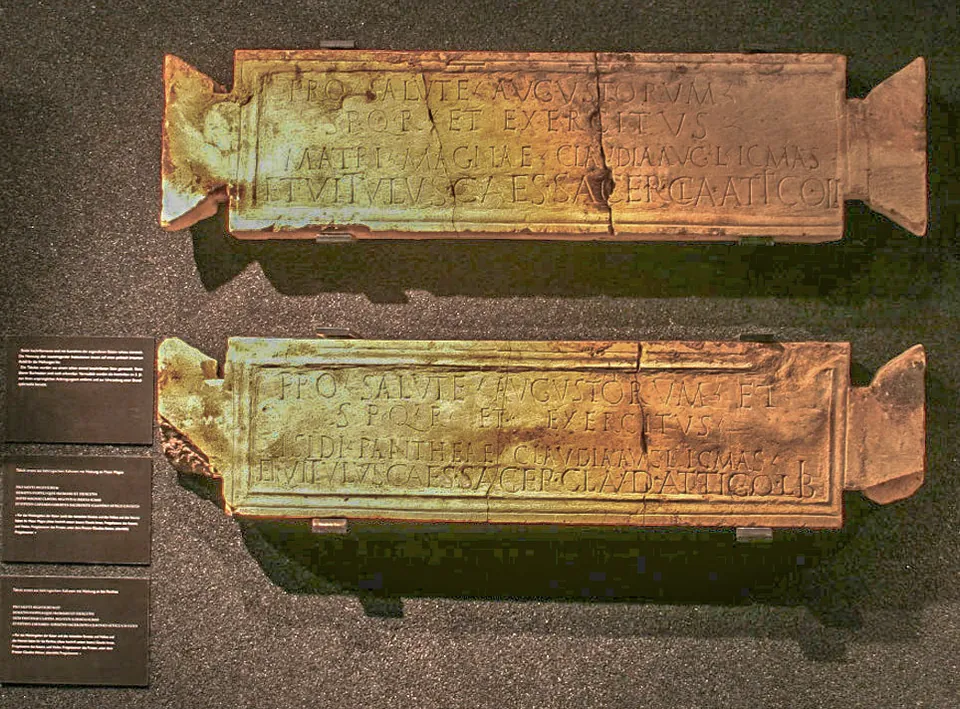
Rome’s legionary camp at Mainz dates from 13/12 BC, and the sanctuary was founded in the last third of the 1st century AD, beside the main road from the camp down to the Rhine bridge (de.wikipedia). A building inscription names the emperor Vespasian (69–79), and two inscribed tablets, set up by an imperial freedwoman, Claudia Icmas, and an imperial slave, Vitulus, under the priest Claudius Atticus, are dedicated to Isis Panthea and the Mater Magna for the welfare of the emperor, the Senate, the people and the army (en.wikipedia). The archaeologist in charge, Marion Witteyer, read the naming of every pillar of the state, the army among them, as a sign of a politically charged occasion (de.wikipedia); en.wikipedia judges the arguments for a direct link between the first building and the imperial house not compelling.
The builders chose the spot with care. Iron Age burial mounds, some 700 years older, were still visible on the ground, and the Romans built a masonry shaft down into the central grave, which seems to have taken burnt offerings (de.wikipedia; en.wikipedia). That grave, a woman’s, has been dated by its wooden funerary board to 680–650 BC (de.wikipedia). The first sanctuary had two small cult buildings inside a walled precinct, with timber-framed buildings with hearths outside it, probably for ritual meals. In the 2nd century they gave way to a larger building about 16 m across, with its own well chamber (de.wikipedia; en.wikipedia).
The finds show the cult in unusual detail. Some 300 oil lamps were found, most on the hearths where offerings were burnt, along with dates, figs, pine nuts and grain, and the bones of cockerels and songbirds (de.wikipedia; en.wikipedia). The sanctuary also served for curses, which Roman law forbade: 34 lead curse tablets, mostly calling on the Mater Magna or Attis to punish a thief or a cheat, doubled the number known from Germany, and two clay figures pierced with holes were found nearby, one with a lead tablet naming its target, Trutmo Florus, son of Clitmo (de.wikipedia; en.wikipedia). The cult lasted at least until the end of the 3rd century; then the sanctuary was abandoned, with no sign of violent destruction (de.wikipedia; en.wikipedia). From the 14th century a convent of the Poor Clares and the courts of patrician families were built over the site (de.wikipedia).
The remains came to light at the end of 1999, during building work for the shopping centre, and were excavated over 17 months, to early 2001. The plan was to remove them once recorded, the fate already met by a mithraeum found at the Ballplatz in the 1970s. A new citizens’ group, the Initiative Römisches Mainz, collected signatures against it, around 20,000 by one count and several tens of thousands by another, and the walls were kept (de.wikipedia; en.wikipedia). The city and the state shared the cost of about €3.5 million (de.wikipedia; en.wikipedia), the centre was named Römerpassage at the Initiative’s suggestion (en.wikipedia), and the sanctuary opened on 30 August 2003, when an estimated 25,000 people came into the city centre for the opening festival (de.wikipedia).
More photographs



Nearby
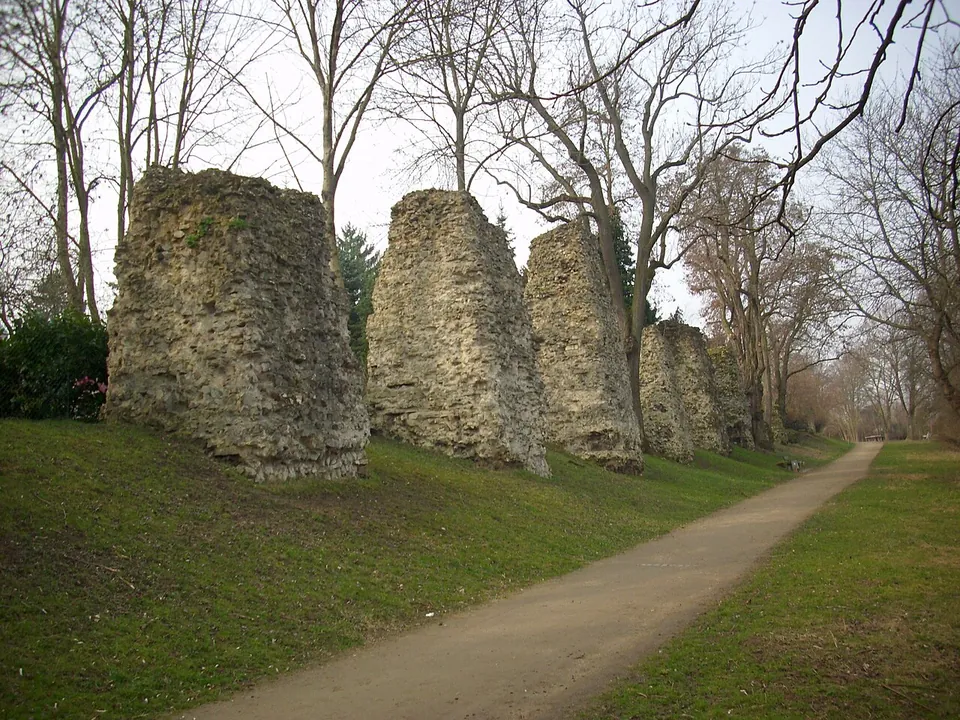
Photo: Nixnubix · CC BY-SA 4.0 · Commons
2 km · aqueduct · Rhineland-Palatinate
Römersteine
Along the path stands a line of rough masonry stumps, the cores of the piers that once carried the water channel across the valley.
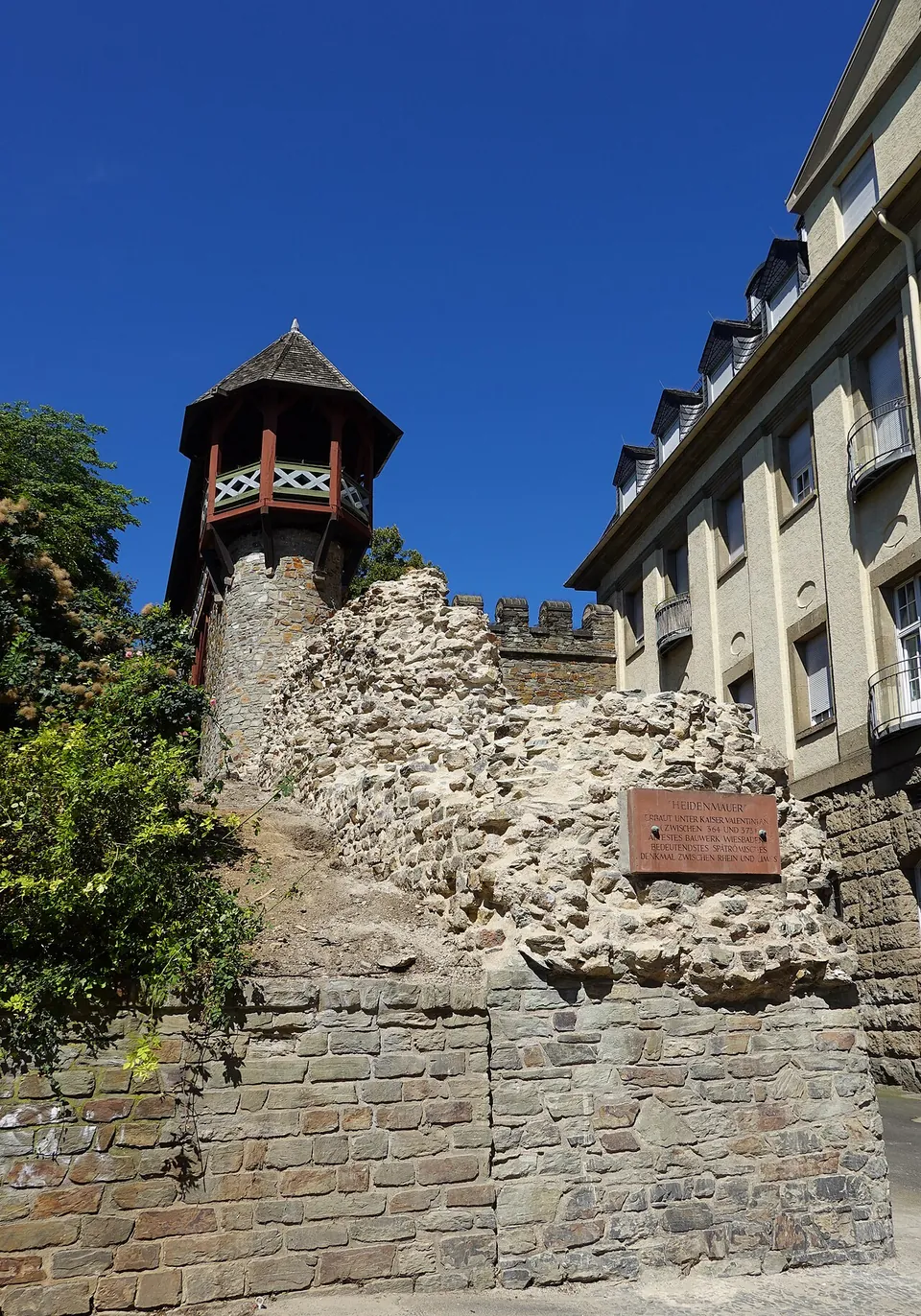
Photo: Geolina163 · CC BY-SA 4.0 · Commons
9 km · city · Hesse
Aquae Mattiacae
The wall has been traced for 520 m through the old town, but only two short stretches stand above ground, one on each side of the Römertor (the city's Stadtlexikon), about 80 m in all (de.wikipedia).
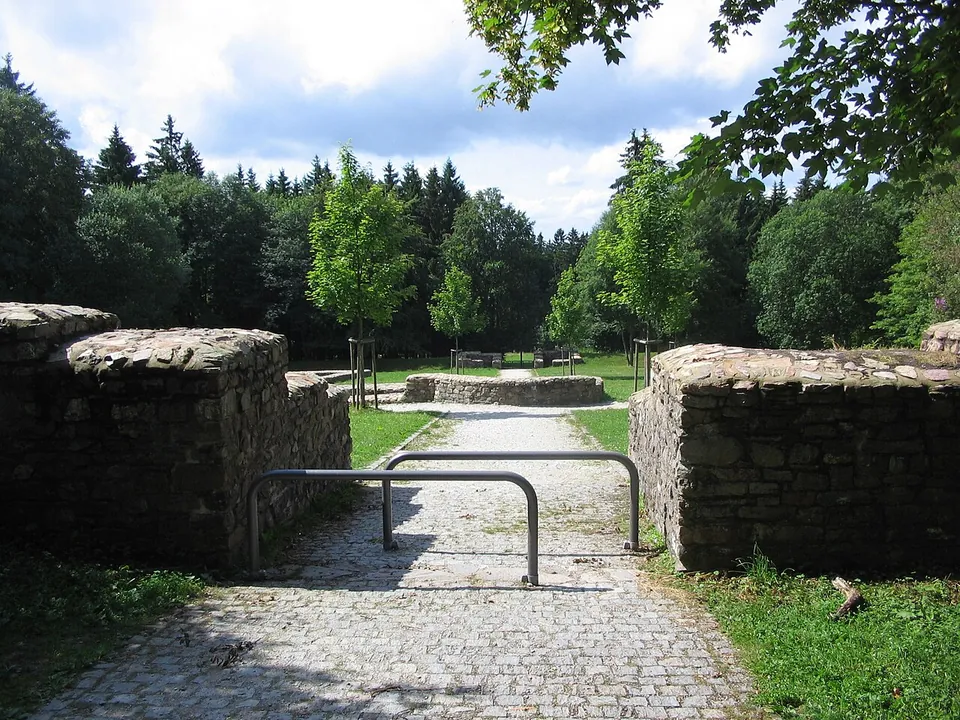
Photo: Brühl · Public domain · Commons
28 km · fort · Hesse
Kastell Kleiner Feldberg
The fort is a clearing in the forest with its complete ground plan laid out in low stone walls: a rectangle of 78 by 93 m with rounded corners and gateways in its sides, and, at the centre, the headquarters building (principia) with the curved apse of its shrine of the standards (de.wikipedia; the operator).


Straight-line distances.
Sources
Every fact on this page comes from the records below, each used under the licence noted.
| Source | Licence |
|---|---|
| Pleiades 109133 | CC BY |
| Wikidata Q879706 | CC0 |
| OpenStreetMap node/263683554 | ODbL |
| Wikipedia (de) — Heiligtum der Isis und Mater Magna (Mainz) | CC BY-SA 4.0 |
| Wikipedia (en) — Sanctuary of Isis and Magna Mater in Mainz | CC BY-SA 4.0 |
| Initiative Römisches Mainz — the sanctuary, hours and visitor service (the operator) | licence not recorded |
| Initiative Römisches Mainz — news and events (special opening hours) | licence not recorded |
| Landeshauptstadt Mainz — Shrine of Isis and Mater Magna (the city's own listing) | licence not recorded |