Skip to content
Menu
Hidden gemHub · 3 stops1st c. BC – 5th c. ADFree

Mogontiacum – Mainz

Moguntiacum, Mainz

city · Rhineland-Palatinate, Germany

What it is
Mogontiacum is Roman Mainz: the legionary base that Drusus founded above the Rhine in 13/12 BC grew into the capital of the province of Upper Germany, and its surviving monuments are scattered across the modern city, all within about 2 km of one another.
What you’ll see
Nothing of Roman Mainz stands whole. It never had the townscape of Trier or Cologne: it was mainly a military base until the second half of the 4th century and apparently never held the rank of a colonia (de.wikipedia).
Worth the trip?
As a stop on a Rhine journey, yes, especially for the theatre and the Isis sanctuary, but set the expectation honestly: this is a modern city with Roman pieces in it, not a Roman town you walk through.
Getting there & cost
The theatre lies directly above Mainz Römisches Theater station, and the Drususstein is about 340 m away in the citadel (Rheinhessen-Touristik; de.wikipedia).Free · Landesmuseum Mainz €6 · checked 30 October 2026Hours, tickets and parking
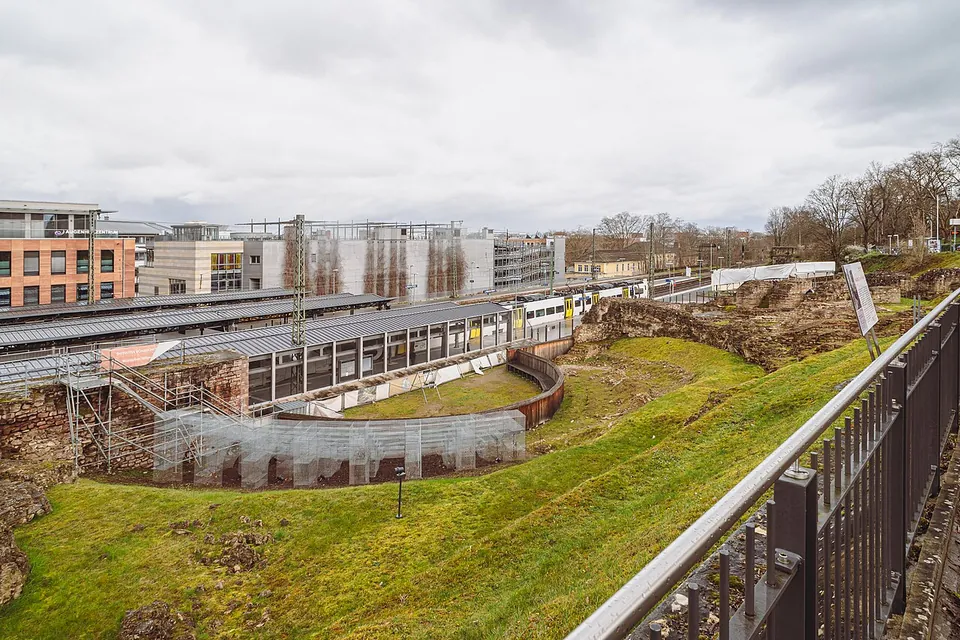
The excavated Roman theatre seen from a railing above it, its grassed slopes curving round a semicircle of rebuilt seating wrapped in netting, with the platforms and roofs of the railway station running along the far side.
The Roman theatre, with the station that was built across its stage. · Photo: Flocci Nivis · CC BY 4.0 · Wikimedia Commons
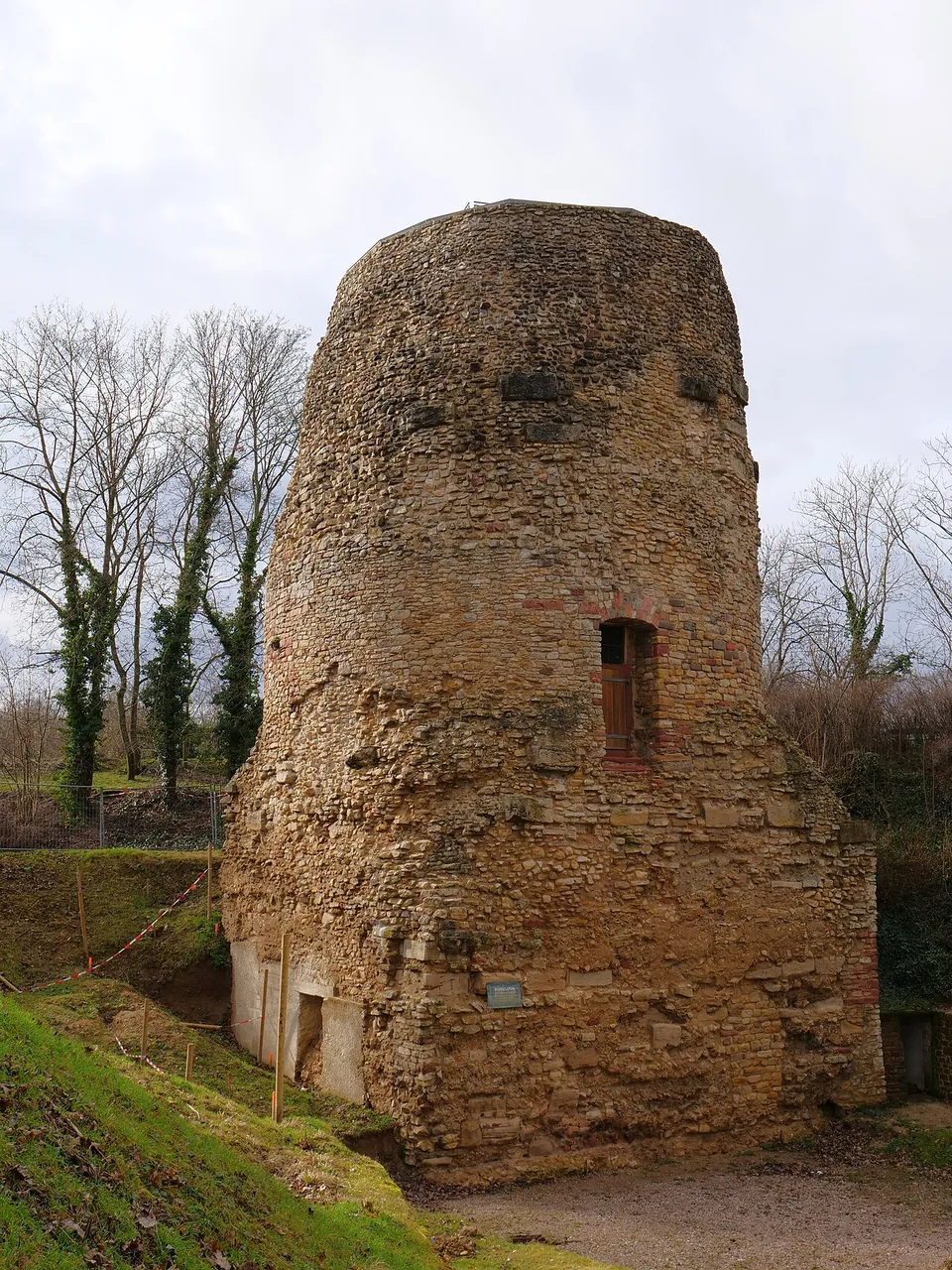
A tall, tapering core of rough stone masonry, rounded and weathered, with a small window opening in its face, standing on a grass bank among bare trees.
The Drususstein, the monument to Drusus inside the citadel. · Photo: Barnos · CC BY-SA 4.0 · Wikimedia Commons
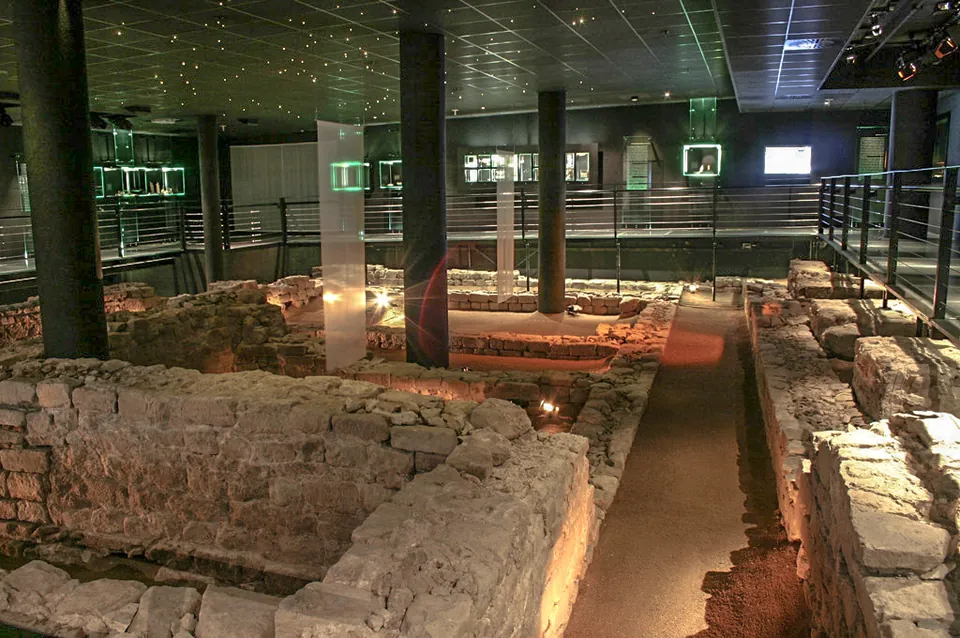
Low walls of pale squared stone lit from below in a dark basement room, with a walkway with railings running past them and display cases on the walls behind.
The sanctuary of Isis and Mater Magna, shown where it was found under the Römerpassage. · Photo: Martin Bahmann · CC BY-SA 3.0 · Wikimedia Commons

The stops

3 places to see, the best preserved and best known first.

See all 3 stops on the mapWhere each one is, so you can plan your own way round.Open the map →
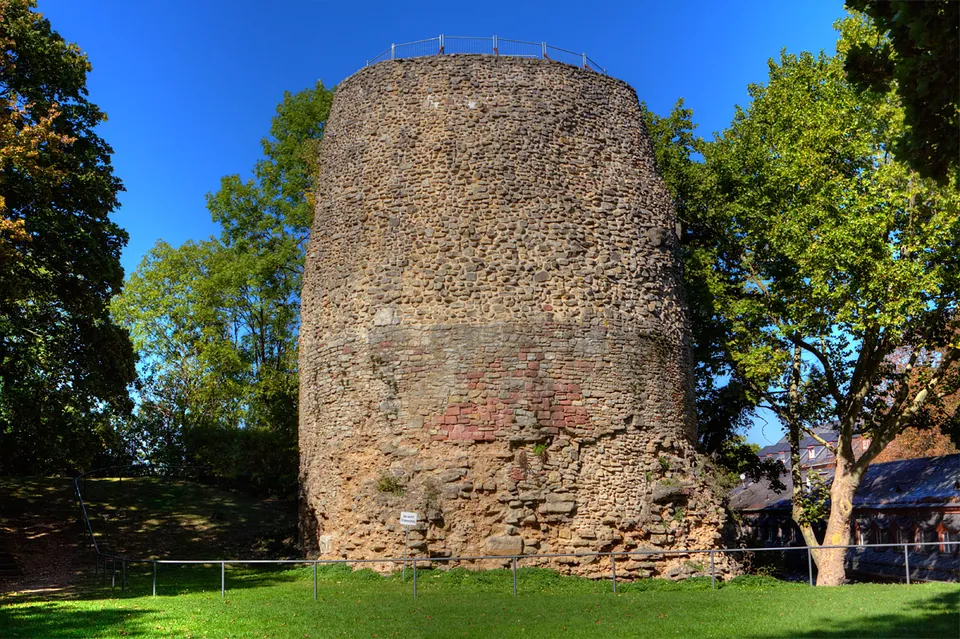
  1. A tall, slightly tapering round tower of rough grey and brown rubble masonry with a flat top, a band of reddish stone running round its lower part, standing on a mown lawn behind a low fence with trees on either side.

    Photo: Martin Bahmann · CC BY-SA 3.0 · Commons

    tomb · Rhineland-Palatinate

    Drususstein

    What you see is a slightly tapering cylinder of Roman cast masonry, mortar and rubble with larger dressed blocks set into it, standing on a square base of which only part is visible.

    Free
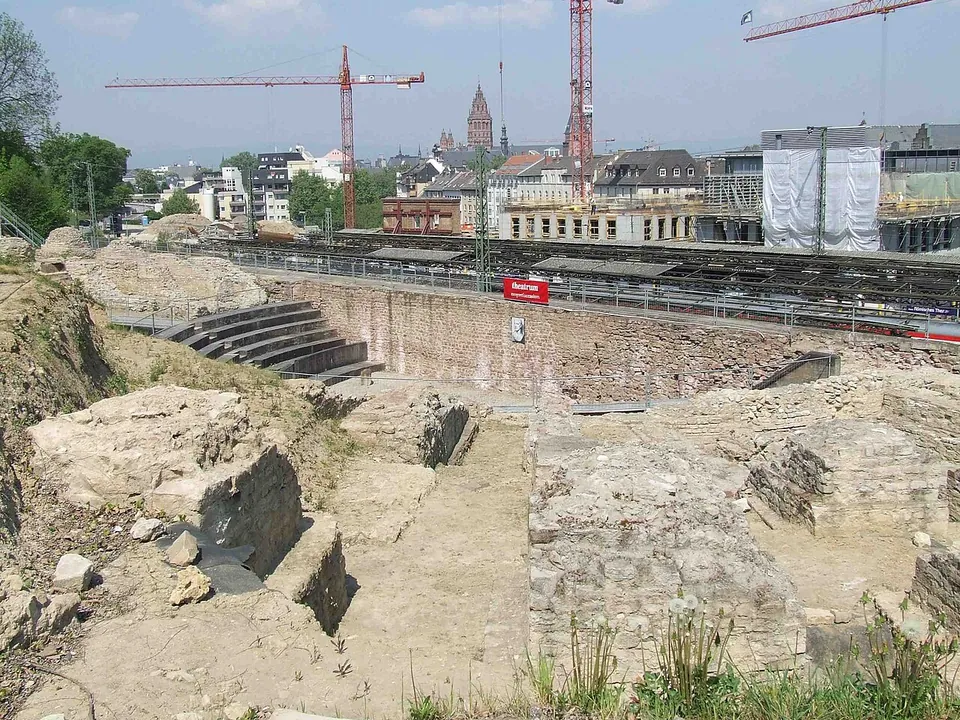
  2. Rough foundation walls and cut-back masonry blocks of the theatre in the foreground, a few rebuilt rows of seating on the left, and beyond a long brick wall the tracks of the station, with the towers of Mainz Cathedral and building cranes on the skyline.

    Photo: User:Kandschwar · CC BY-SA 2.0 de · Commons

    theatre · Rhineland-Palatinate

    Roman theatre at Mainz

    What survives is the theatre's lower structure on the slope below the citadel: piers and foundations of Roman concrete (opus caementicium), faced on the outside with small squared stones, with double layers of brick slabs laid in to stabilise them (the city of Mainz).

    Free
  3. Low walls of pale, roughly squared stone, lit from below, lining a narrow passage in a dark basement hall, with black pillars rising among them, a railing running round the room above and lit display cases on the far wall.

    Photo: Martin Bahmann · CC BY-SA 3.0 · Commons

    sanctuary · Rhineland-Palatinate

    Sanctuary of Isis and Magna Mater

    The remains are the sanctuary as it stood in the 2nd century: low stone footings of buildings whose walls above them were timber-framed and plastered, conserved and set back into the ground five metres down, the depth at which they were found, on their original alignment to the Roman street (de.wikipedia).

    Free

What is there today

Nothing of Roman Mainz stands whole. It never had the townscape of Trier or Cologne: it was mainly a military base until the second half of the 4th century and apparently never held the rank of a colonia (de.wikipedia). What survives is a handful of separate places, each a short visit in its own right:

  • The Roman theatre (its page), excavated since 1997 on the slope below the citadel. With an auditorium 116 m across and room for around 10,000 spectators, it is one of the largest Roman stage theatres north of the Alps, and by de.wikipedia’s account the largest (de.wikipedia; Rheinhessen-Touristik). The foundations of its stage building were demolished in 1884 to lay the tracks of the station beside it, named Mainz Römisches Theater since 2006 (de.wikipedia).
  • The Drususstein (its page), about 340 m from the theatre and in sight of it, inside the southern bastion of the 17th-century citadel. It is a mass of cast masonry almost 20 m high, the surviving core of what was most likely the cenotaph the army raised to Drusus after his death in 9 BC, and, besides the Igel Column, the only Roman tomb north of the Alps still standing above ground where it was built (de.wikipedia).
  • The sanctuary of Isis and Mater Magna (its page), found in 1999–2000 during building work for a shopping arcade and shown since 2003 in its basement, five metres down, at the depth where it was found. A glass walkway runs round the foundations, with finds from the excavation displayed around them (de.wikipedia; the city of Mainz).
  • The Römersteine in the Zahlbach valley: the cores of the aqueduct’s piers, some still several metres high, along a stretch of about 600 m (de.wikipedia).

The city’s Roman finds are in the Landesmuseum Mainz, whose stone hall holds the Roman monuments, among them the Great Jupiter Column; a replica of the column stands in front of the state parliament (the museum; de.wikipedia). The Museum für Antike Schifffahrt, which shows the Roman ships found in Mainz in 1981–82, is closed until 7 March 2027 (the museum).

Is it worth the trip?

As a stop on a Rhine journey, yes, especially for the theatre and the Isis sanctuary, but set the expectation honestly: this is a modern city with Roman pieces in it, not a Roman town you walk through. The theatre is the one big set piece; the Drususstein is a striking but shapeless core of masonry; the sanctuary is a carefully staged basement display; the aqueduct is a row of stumps beside a footpath. If you can choose only one Roman city on the Rhine and Moselle, Trier has far more standing.

Getting there

The theatre lies directly above Mainz Römisches Theater station, and the Drususstein is about 340 m away in the citadel (Rheinhessen-Touristik; de.wikipedia). The Landesmuseum, in the Große Bleiche, is 10 to 15 minutes’ walk from the main station, or buses 6, 6A, 64, 65 and 68 to Bauhofstraße (the museum).

The Landesmuseum opens Tuesday 10.00–20.00 and Wednesday to Sunday 10.00–17.00, closed Mondays; a ticket is €6, €5 reduced, €3 for ages 6 to 17, and free under six (the museum, read 30 October 2026). Its stone hall is expected to be closed from 24 to 27 November 2026. The hours and terms of each Roman stop are on its own page.

Visiting details

Opening hours
The Roman remains in the city are separate stops, each with its own page and hours. The Landesmuseum Mainz, which holds the Roman stone monuments and the Great Jupiter Column, opens Tuesday 10.00–20.00 and Wednesday to Sunday 10.00–17.00, and is closed on Mondays.
Tickets
Landesmuseum Mainz €6; reduced €5; ages 6 to 17 €3; under 6 free.

Before you go

  • The Museum für Antike Schifffahrt, with the Roman ships found in Mainz, is closed for a full rebuild and reopens on 7 March 2027.
  • The Landesmuseum's stone hall is expected to be closed from 24 to 27 November 2026.

Hours and prices checked 30 October 2026 on the operator's own site. Confirm before travelling.

History

Drusus built the legionary camp in 13/12 BC on high ground above the Rhine, opposite the mouth of the Main, and the civilian settlements around it soon grew into one town (de.wikipedia). From AD 90 at the latest it was the capital of Germania Superior and the seat of its governor, which is why monumental buildings rose here despite the town’s military character (de.wikipedia). A stone aqueduct, about 9 km long, was built by the Mainz legions under the Flavian emperors to supply the camp; a bridge more than 400 m long, its timber deck on stone piers, crossed the Rhine from the 80s AD (de.wikipedia).

When Rome gave up the frontier lands east of the Rhine after the middle of the 3rd century, Mogontiacum became a frontier town again. It was walled for the first time shortly after 250, enclosing about 150 hectares, and a second, shorter wall was begun between 360 and 370, when the legionary camp was given up (de.wikipedia). Over the next 150 years Germanic raiders devastated the town several times, and by about 470 at the latest it belonged to the Frankish kingdom (de.wikipedia).

More photographs

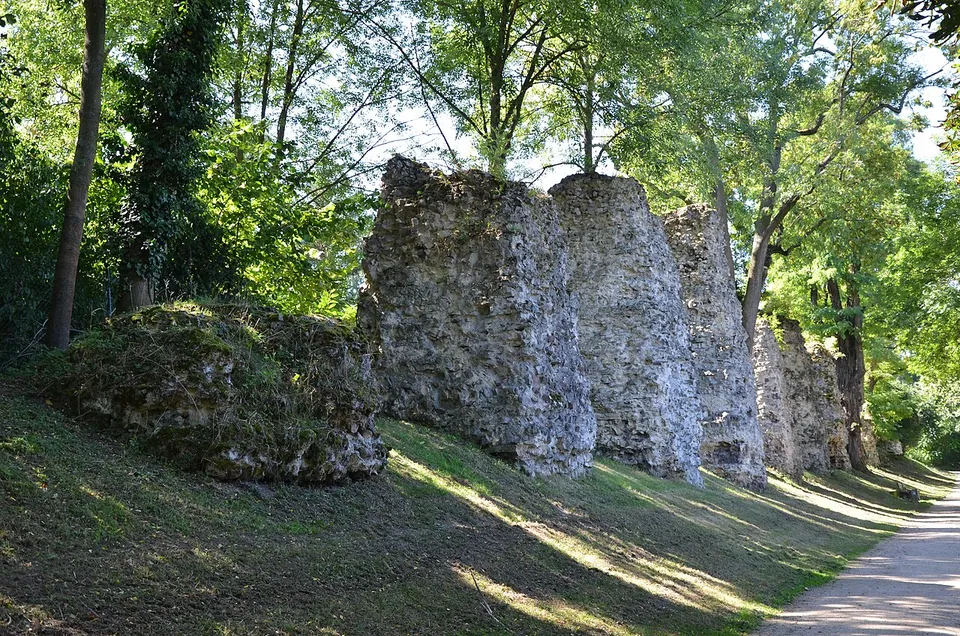
A row of rough, weathered masonry stumps several metres high standing on a grassy bank beside a footpath under trees.
The Römersteine, the stripped cores of the aqueduct's piers in the Zahlbach valley. · Photo: Carole Raddato from FRANKFURT, Germany · CC BY-SA 2.0 · Wikimedia Commons

Nearby

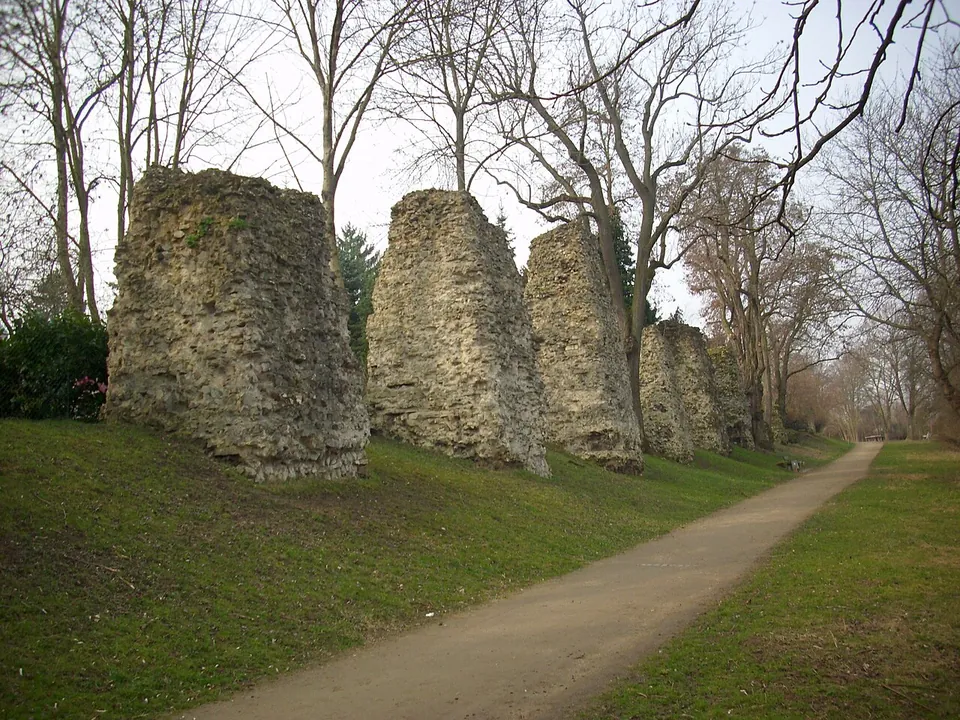
  • A row of rough, weathered masonry stumps of rubble and mortar standing on a grassy bank beside a gravel path under bare winter trees.

    Photo: Nixnubix · CC BY-SA 4.0 · Commons

    2 km · aqueduct · Rhineland-Palatinate

    Römersteine

    Along the path stands a line of rough masonry stumps, the cores of the piers that once carried the water channel across the valley.

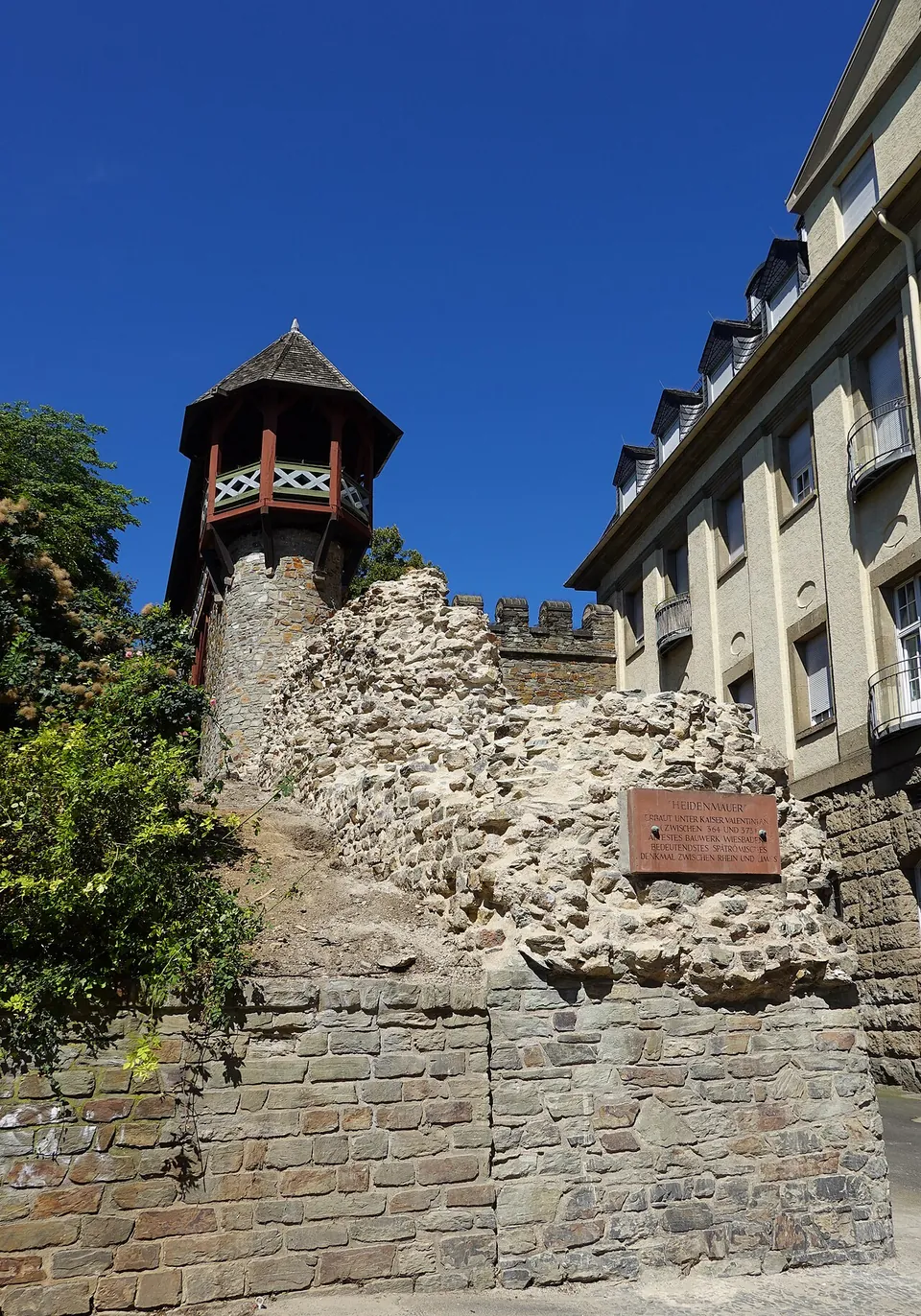
  • A high stretch of rough wall of irregular stones bedded in mortar, carrying a metal plaque, rises above a lower base of neatly coursed squared stone. Behind it stand a round tower with a red timber gallery and a crenellated wall pierced by an arch.

    Photo: Geolina163 · CC BY-SA 4.0 · Commons

    10 km · city · Hesse

    Aquae Mattiacae

    The wall has been traced for 520 m through the old town, but only two short stretches stand above ground, one on each side of the Römertor (the city's Stadtlexikon), about 80 m in all (de.wikipedia).

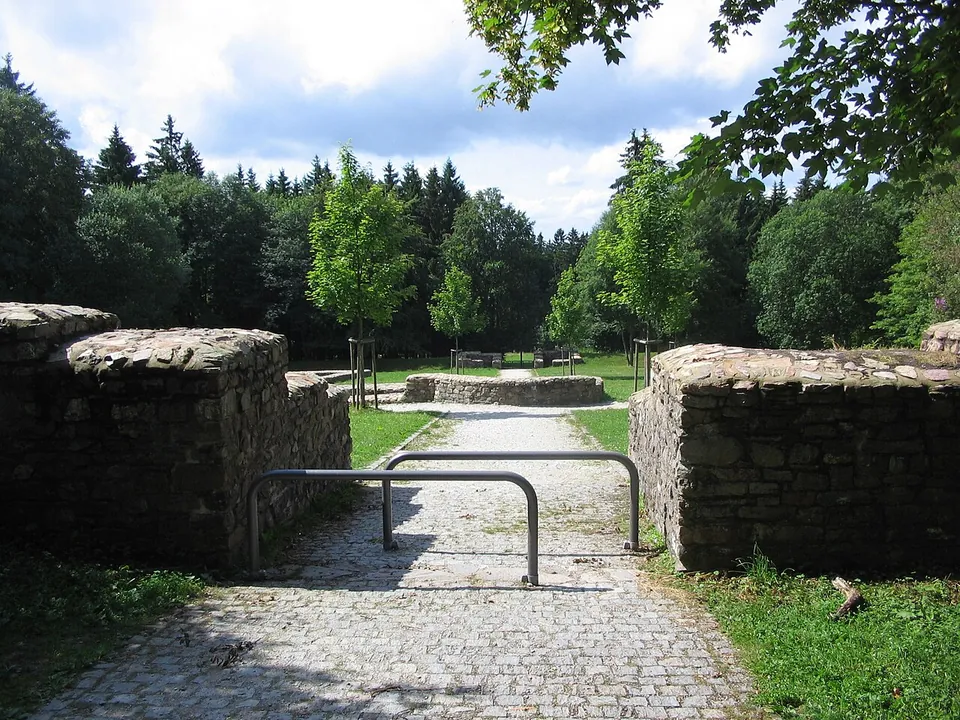
  • A cobbled path running between two thick, low stone walls that form a gateway, with a low curved wall standing in the grass beyond and spruce forest behind.

    Photo: Brühl · Public domain · Commons

    28 km · fort · Hesse

    Kastell Kleiner Feldberg

    The fort is a clearing in the forest with its complete ground plan laid out in low stone walls: a rectangle of 78 by 93 m with rounded corners and gateways in its sides, and, at the centre, the headquarters building (principia) with the curved apse of its shrine of the standards (de.wikipedia; the operator).

Straight-line distances.