What is there today
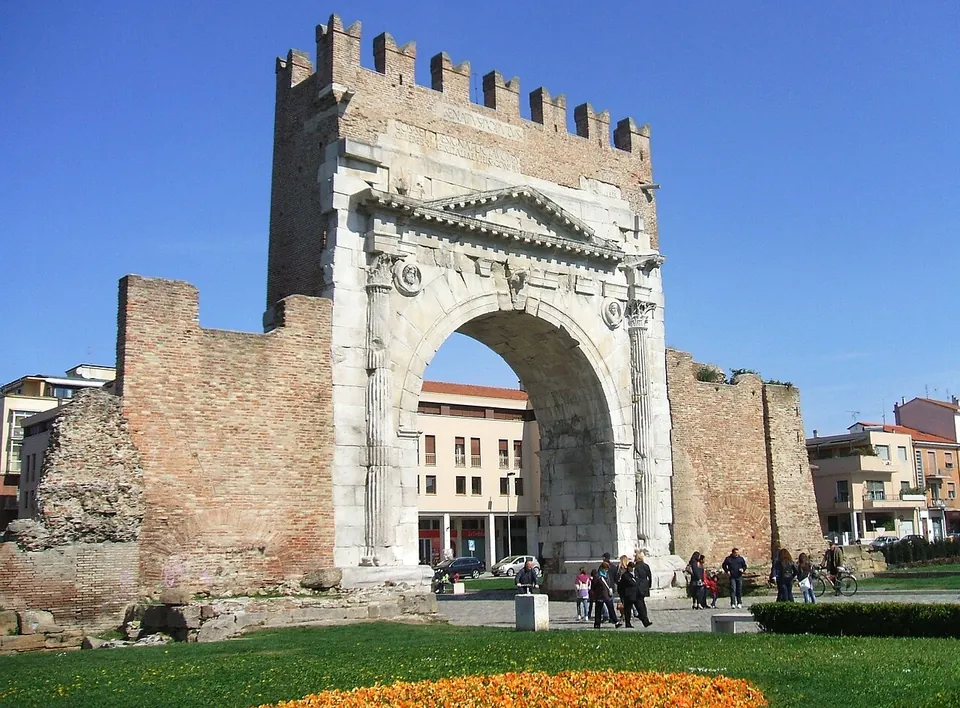
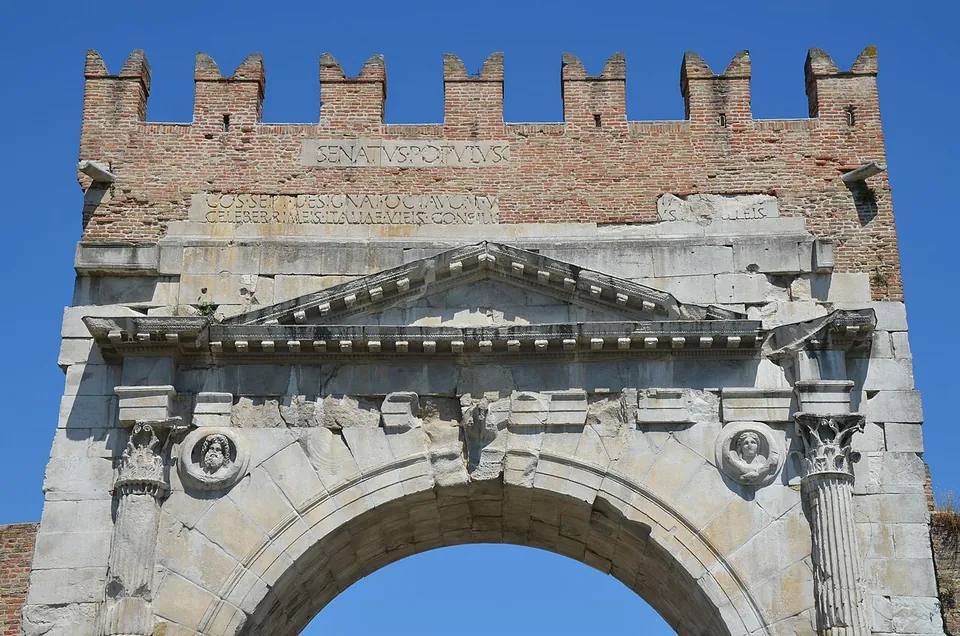
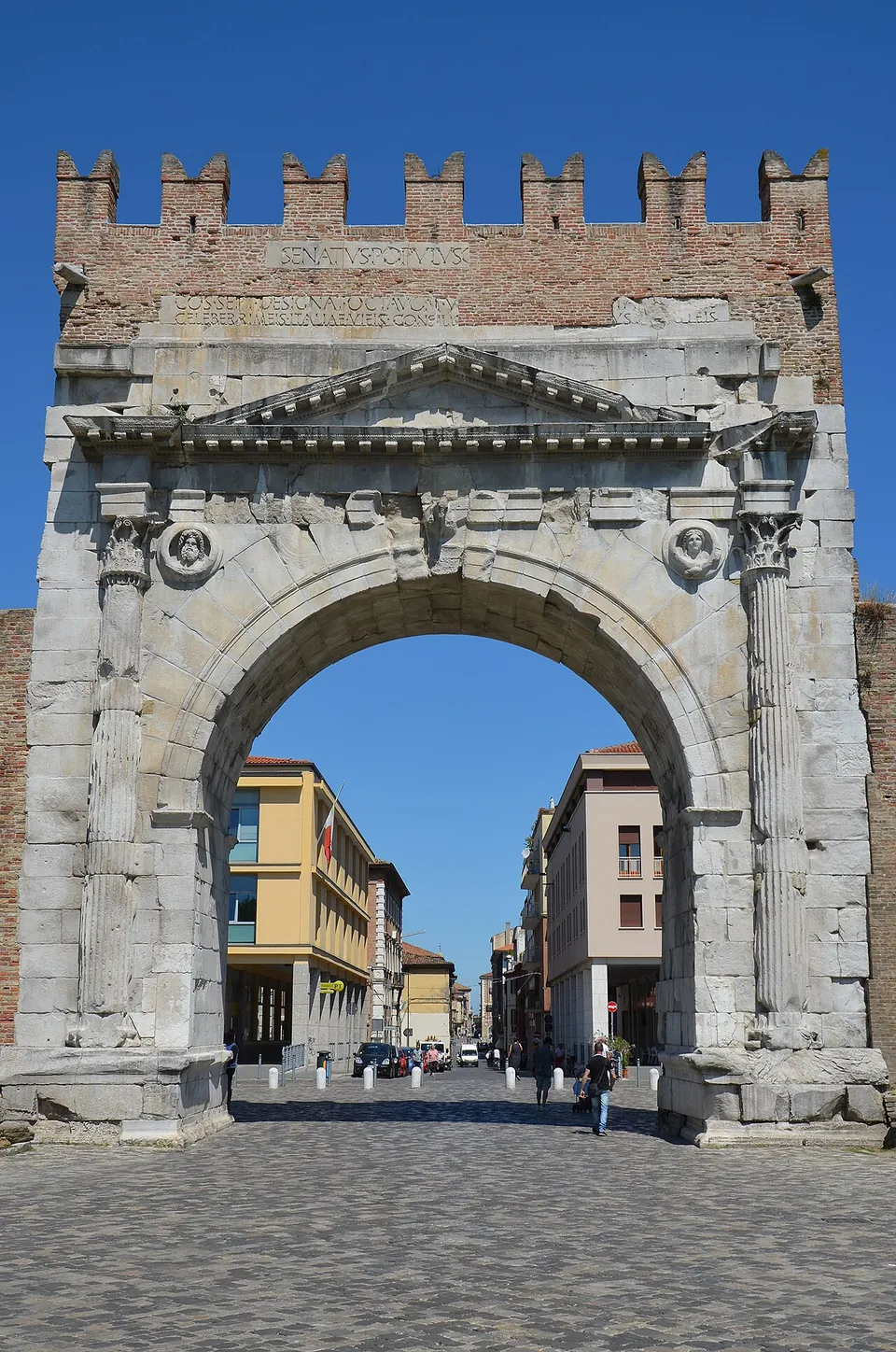
A single arch, faced in pale stone (Istrian stone in en.wikipedia and de.wikipedia; it.wikipedia and italia.it call it travertine). Published heights range from 17 to 19 m (italia.it, fr.wikipedia, en.wikipedia), and the opening alone is about 9 m wide and 10.4 m high (en.wikipedia; de.wikipedia). Fluted half-columns with Corinthian capitals flank the opening, and a low triangular pediment sits between them. In the four corners above the curve of the arch, round medallions carry the heads of gods: Jupiter and Apollo on the side facing the road from Rome, Neptune and a goddess on the side facing the town, read as Roma, Minerva or Venus depending on the source. A bull’s head projects from the keystone on both faces (en.wikipedia; de.wikipedia; it.wikipedia).
What is not Roman is the top. The original attic, and the statue of Augustus that stood above it according to Cassius Dio, are gone (en.wikipedia; it.wikipedia). The brick battlements are medieval: it.wikipedia and italia.it date them to the 10th century, while en.wikipedia puts them in the late Middle Ages, with the oldest surviving merlons probably of the 13th. Part of the dedicatory inscription is still up there, beginning SENATVS POPVLVS, “the Senate and People” (fr.wikipedia; italia.it); the lettering on the battlement was restored in 1912 (en.wikipedia).
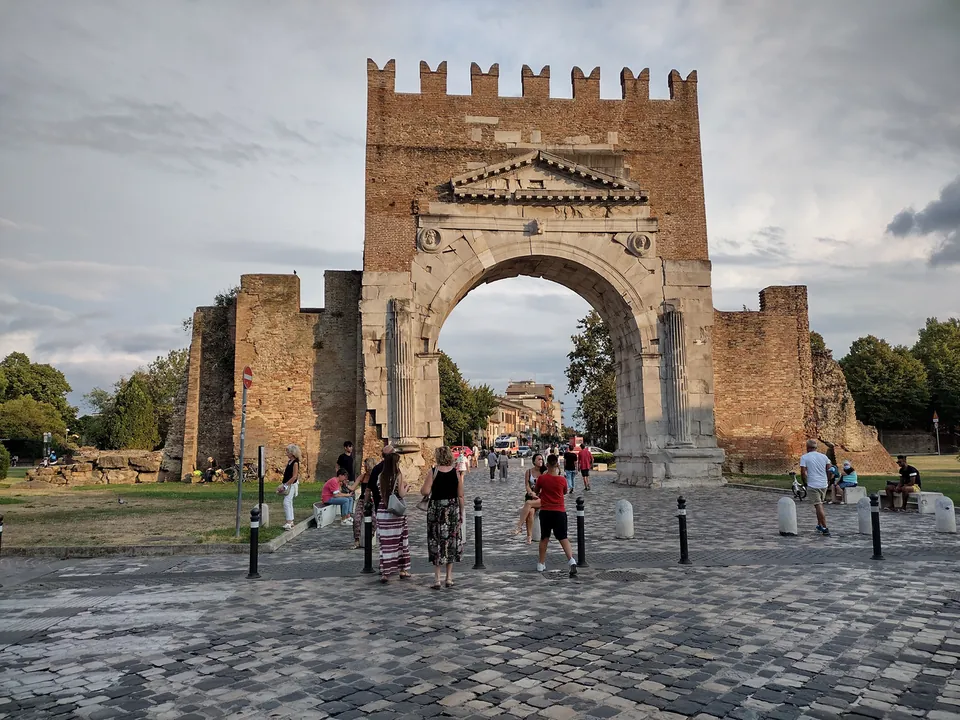
Traces of the town wall the arch was set into survive low down on either side (it.wikipedia; italia.it), and of the towers that flanked it only some of the facing of the eastern one is still visible (en.wikipedia). The arch now stands alone in a pedestrian square with lawns around it (en.wikipedia; OpenStreetMap).
Is it worth the trip?
As part of a walk round Roman Rimini, yes, and it costs nothing. it.wikipedia and italia.it call it the oldest Roman arch still standing; de.wikipedia, more cautiously, one of the oldest, and an important monument of early Augustan architecture because it is well preserved and firmly dated. Look up as well as through: the columns, the medallions and the bull’s head are Roman work, the battlements are not.
On its own it is one monument, so it is a reason to stop in Rimini rather than a reason to travel there. Pair it with the Ponte di Tiberio at the other end of the same street and with the Domus del Chirurgo, the town’s other Roman stops.
Getting there
The arch is in the centre of Rimini, on Largo Giulio Cesare at the south-eastern end of Corso d’Augusto (riviera.rimini.it; OpenStreetMap), where de.wikipedia places the Roman town’s south-eastern gate. A public-transport stop named Arco d’Augusto is mapped about 60 m away. The other Roman stops are a walk: the amphitheatre is about 0.5 km away, the Domus del Chirurgo 0.6 km and the Ponte di Tiberio 0.9 km, in a straight line (candidate records).
There is no ticket and no opening time: the arch stands in an open square and can be seen at any hour. The car parking mapped beside it is private; free motorcycle and bicycle parking is mapped within 50 m (OpenStreetMap).
Visiting details
- Opening hours
- Stands in an open, pedestrianised square and can be seen at any time; there is no gate and no ticket office.
- Tickets
- Free.
- Parking
- The street-side car parking mapped beside the arch is private; free motorcycle and bicycle parking is mapped within 50 m (OpenStreetMap).
Hours and prices checked 19 October 2026 on the operator's own site. Confirm before travelling.
History
The Senate and People of Rome voted the arch in 27 BC to honour Augustus, who received that title in the same year, for restoring the Via Flaminia during his seventh consulship; Augustus records the work himself in his Res Gestae (de.wikipedia). The inscription extends the credit to the other busiest roads of Italy (fr.wikipedia). The arch stood where the Via Flaminia ended and the town’s main street, the decumanus maximus, began, and its building coincided with the colony’s renaming as Colonia Augusta Ariminensis (en.wikipedia).
Scholars regard it as a city gate rather than a triumphal arch (en.wikipedia). It was set into a town wall of the 3rd century BC, between existing towers, probably in place of an earlier gate (en.wikipedia; de.wikipedia). Its opening was too wide to be closed with doors, which de.wikipedia and it.wikipedia read as an expression of the Augustan peace: a town that feared no attack had no need to shut its gate. From at least the 3rd century AD further defensive gates were built in front of and behind it, and at some point between the 3rd and 7th centuries the original towers were replaced by seven-sided ones (en.wikipedia).
It stayed a gate for centuries. A codex of the 8th to 10th centuries calls it the Gate of Saint Gaudentius, and the battlements were added in the Middle Ages (en.wikipedia). In the late 1930s the Fascist government demolished the houses and the flanking towers to leave it standing alone, and during the Battle of Rimini in the Second World War a German officer refused an order to blow it up (en.wikipedia). A restoration in 2022 cleared weeds from the stone and coated the lower parts against graffiti (en.wikipedia). With the Ponte di Tiberio, it appears on the city’s coat of arms (en.wikipedia; it.wikipedia).
More photographs
Nearby
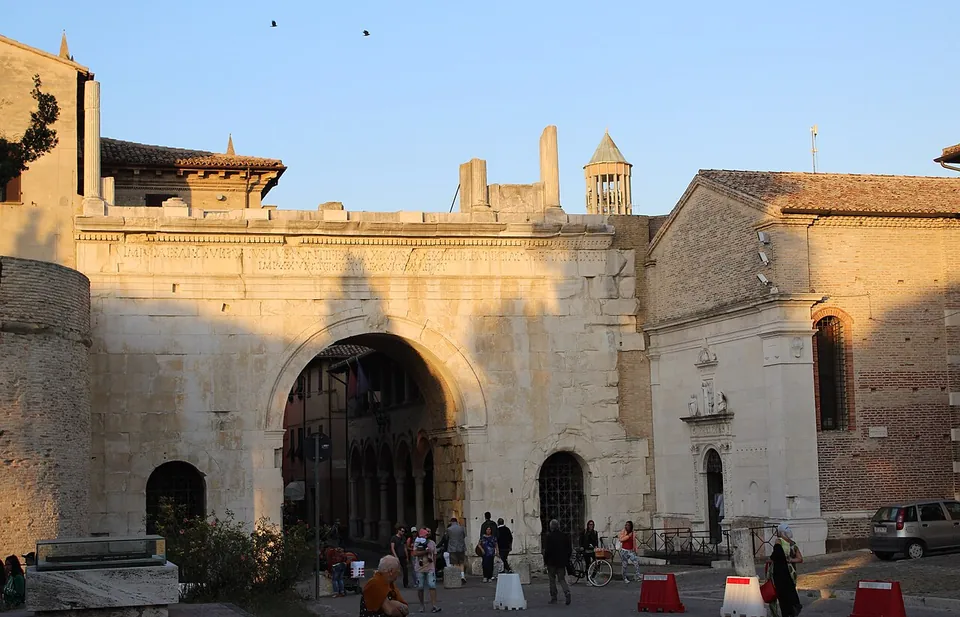
Photo: Giompaola · CC BY-SA 4.0 · Commons
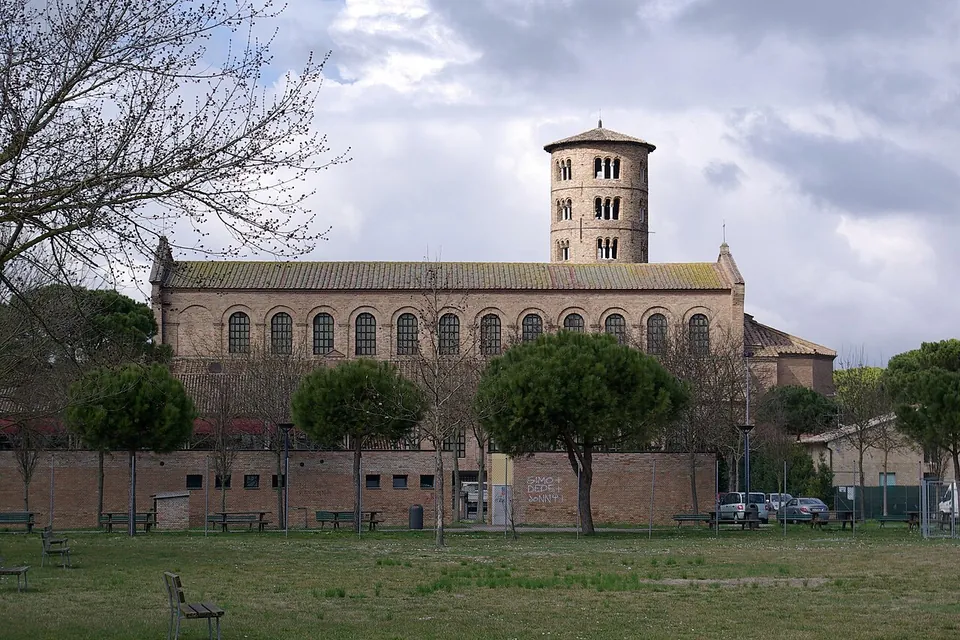
Photo: Berthold Werner · Public domain · Commons
45 km · church · Emilia-Romagna
Basilica of Sant'Apollinare in Classe
Outside, a plain brick church with a tall round bell tower (Musei Italiani); inside, what UNESCO called "an outstanding example of the early Christian basilica in its purity and simplicity of its design and use of space" (en.wikipedia).


Straight-line distances.
Sources
Every fact on this page comes from the records below, each used under the licence noted.
| Source | Licence |
|---|---|
| Pleiades 368355544 | CC BY |
| Wikidata Q1072853 | CC0 |
| OpenStreetMap way/1081796634 | ODbL |
| Wikipedia (en) — Arch of Augustus (Rimini) | CC BY-SA 4.0 |
| Wikipedia (de) — Augustusbogen (Rimini) | CC BY-SA 4.0 |
| Wikipedia (it) — Arco di Augusto (Rimini) | CC BY-SA 4.0 |
| Wikipedia (fr) — Arc d'Auguste (Rimini) | CC BY-SA 4.0 |
| Italia.it (Ministry of Tourism) — Arco di Augusto | licence not recorded |
| Riviera di Rimini (official tourism site) — Arch of Augustus | licence not recorded |