Photo: Il Malatestiano · CC BY-SA 4.0 · Commons
arch · Emilia-Romagna
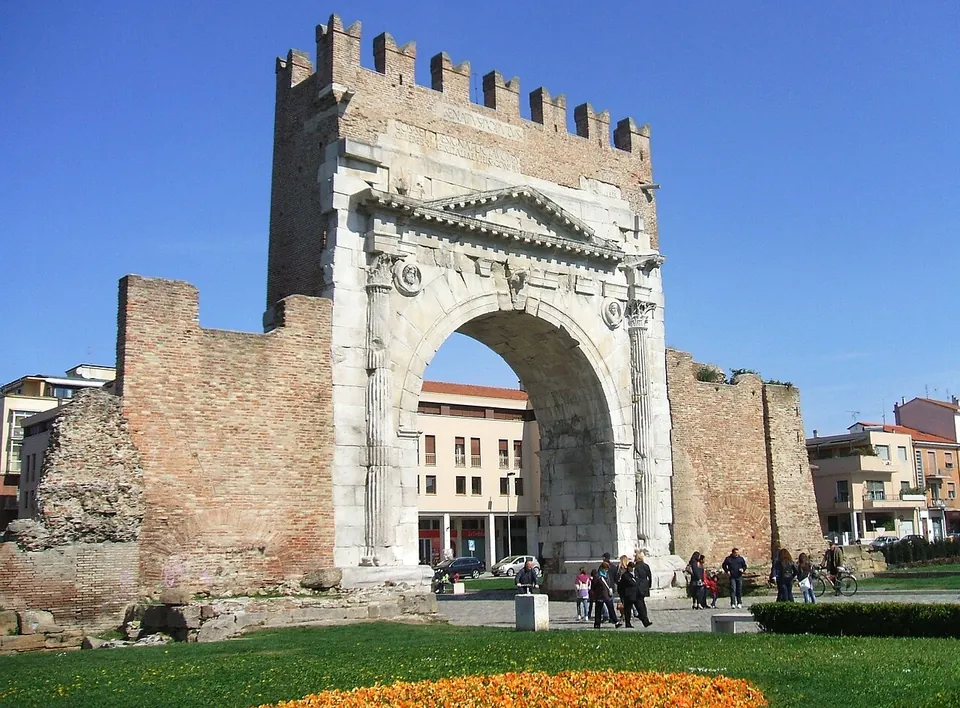
Arch of Augustus
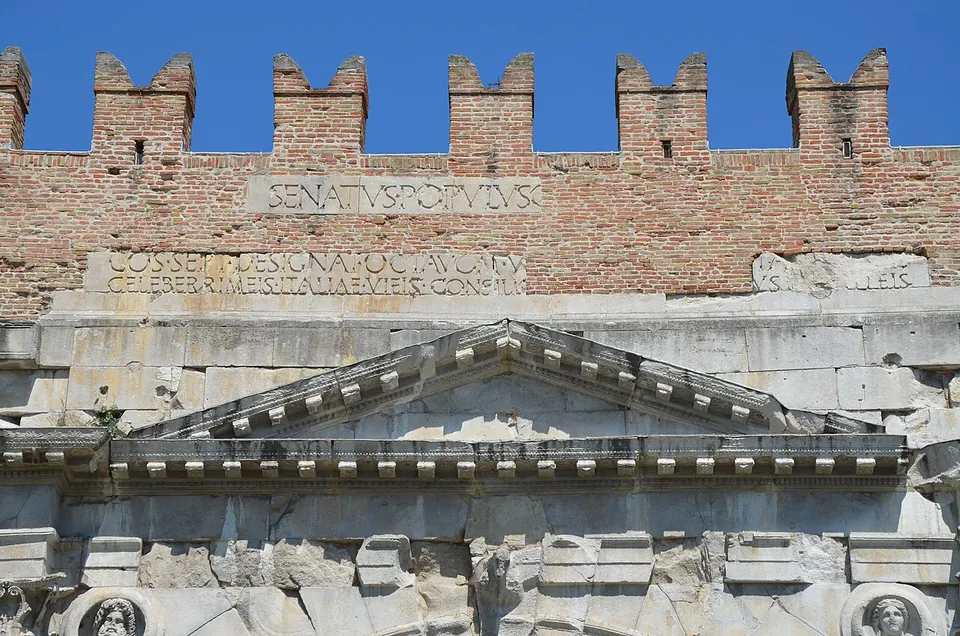
A single arch, faced in pale stone (Istrian stone in en.wikipedia and de.wikipedia; it.wikipedia and italia.it call it travertine).
Free
Ariminum, Colonia Augusta Ariminensis, Arimino, Ariminon
city · Emilia-Romagna, Italy
4 places to see, the best preserved and best known first.
Photo: Il Malatestiano · CC BY-SA 4.0 · Commons
arch · Emilia-Romagna
A single arch, faced in pale stone (Istrian stone in en.wikipedia and de.wikipedia; it.wikipedia and italia.it call it travertine).
Photo: Flying Russian · CC BY-SA 3.0 · Commons
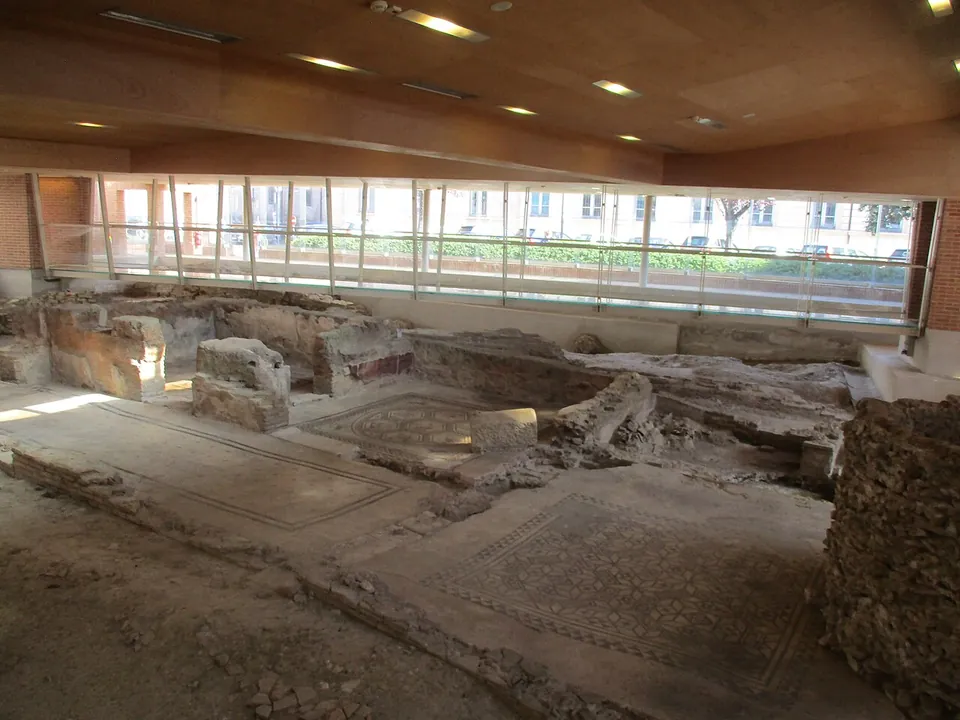
Photo: Capvalerio85 · CC BY-SA 4.0 · Commons
town house · Emilia-Romagna
The excavation covers about 700 m², and the first mosaics lay some 2.5 m below the modern ground (it.wikipedia).
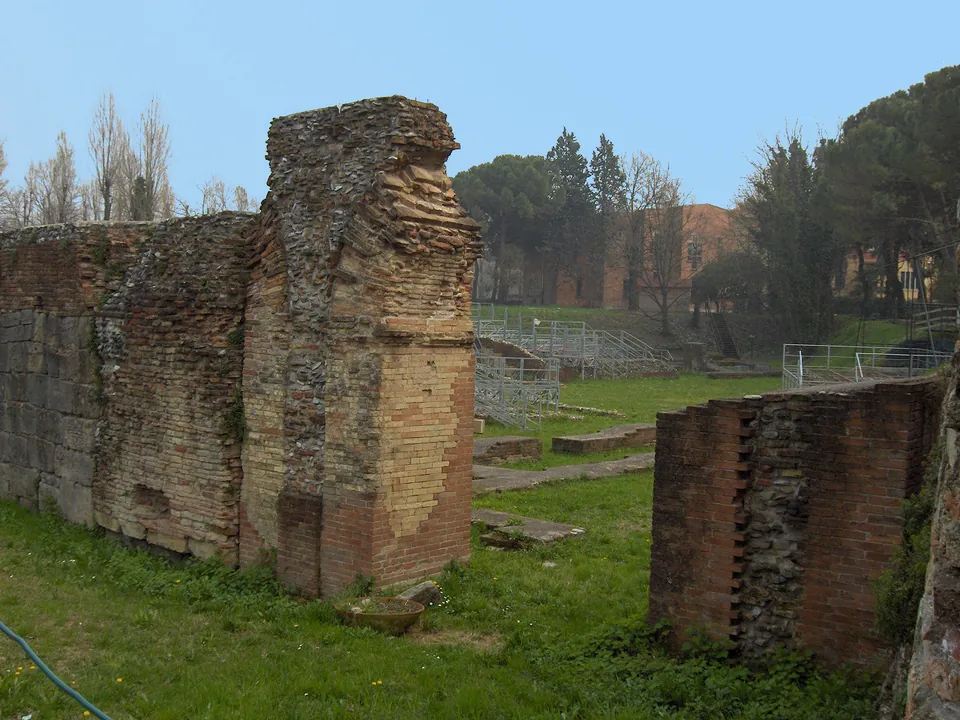
Photo: Georges Jansoone ( JoJan ) · CC BY-SA 4.0 · Commons
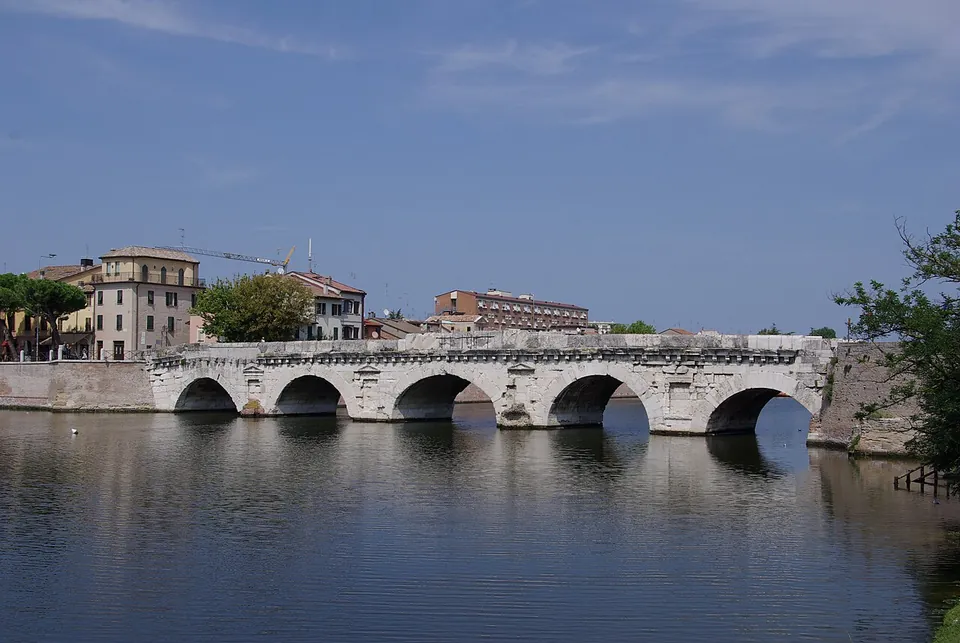
The historic centre keeps the Roman town’s street plan (en.wikipedia, Rimini), and its monuments are a short walk apart. The Arch of Augustus, built in 27 BC, is 19 m high and faced in Istrian stone; the battlements on top were added in the Middle Ages. It was a city gate rather than a triumphal arch, and has stood alone in its square since the buildings and walls beside it were cleared in 1937–39 (en.wikipedia). The Ponte di Tiberio, begun under Augustus in AD 14 and finished under Tiberius in AD 21, crosses the Marecchia channel on five arches of white Istrian stone and has been closed to traffic since May 2020 (en.wikipedia). Corso d’Augusto, the street between them, follows the line of the Roman town’s main street, the decumanus maximus (en.wikipedia).
Two excavated sites fill in the rest. The Domus del Chirurgo on Piazza Ferrari is a Roman house of the later 2nd century AD, found in 1989 and opened in 2007 under a protective building, where you look down on mosaics and walls from transparent walkways; it is named after the set of surgical instruments found in it, which is shown in the Museo della Città a short walk away (it.wikipedia). The amphitheatre, east of the centre towards the sea, was built in the 2nd century AD; of a building whose outer ellipse measured about 118 by 88 m, two arches of the outer portico and part of the arena and seating are visible (riviera.rimini.it, the official tourism site). Porta Montanara, a gate of the 1st century BC, was put back together on its original spot after the destruction of the Second World War, and the city’s own Roman walking route stops at Piazza Tre Martiri for the ancient forum (riviera.rimini.it).
Yes, and it costs a morning rather than a day. An arch and a bridge from the reigns of Augustus and Tiberius stand about a kilometre apart on one street, and both are free to see at any hour. The Domus del Chirurgo is the paid part and the best reason to go inside. The amphitheatre is the weakest of the stops: a fragment of the building rather than a standing arena. If you are on the Adriatic coast anyway, Rimini is an easy Roman half-day; on its own it is not a destination for a long detour.
Rimini railway station is on the Bologna–Ancona line, and Federico Fellini airport lies in the southern suburb of Miramare (en.wikipedia). Every stop above is within about a kilometre of the others in a straight line, so the Roman town is a walk.
The arch and the bridge have no ticket and no hours. The Domus del Chirurgo and the Museo della Città open Tuesday to Sunday and on public holidays, 10.00–13.00 and 16.00–19.00, and are closed on Mondays that are not holidays; in July, August and the first week of September they also open on Wednesday evenings, 21.00–23.00. Last entry is 30 minutes before closing. One ticket covers both, €7 (€5 reduced, including for over-65s and for everyone on Wednesdays that are not holidays); the ART CARD adds the Fellini Museum for €14 (€10 reduced) and is valid five days (museicomunalirimini.it, read 18 October 2026). Neither the museums nor the tourism site publish visiting arrangements for the amphitheatre.
Before you go
Hours and prices checked 18 October 2026 on the operator's own site. Confirm before travelling.
Rome founded Ariminum in 268 BC at the mouth of the river Ariminus, the modern Marecchia, as a colony with Latin rights, a bulwark against the Gauls and a base for pushing north into the Po plain (it.wikipedia, Storia di Rimini). It became a road junction: the Via Flaminia from Rome, built in 220 BC, ended here, the Via Aemilia (187 BC) ran on to Piacenza, and the Via Popilia (132 BC) went north along the coast (it.wikipedia; en.wikipedia, Ponte di Tiberio). The town received Roman citizenship in 90 BC, and in 49 BC, after crossing the Rubicon, Julius Caesar addressed his legions in its forum (it.wikipedia; en.wikipedia).
Augustus marked the place as his own. The arch of 27 BC coincided with a restoration of the Via Flaminia and the renaming of the colony as Colonia Augusta Ariminensis, and the bridge at the other end of the main street, finished after his death, completed the programme (en.wikipedia). In the imperial period Ariminum lay at the southern edge of regio VIII Aemilia; Augustus, Tiberius and Hadrian promoted its great public works, among them a theatre and the amphitheatre (it.wikipedia). The Domus del Chirurgo was destroyed by a sudden fire, dated by the latest of the coins found in its ruins to after 257–258 (it.wikipedia).
From the 3rd century the town declined, and against the first invasions it was given a new circuit of walls under Aurelian (it.wikipedia); in the late empire the amphitheatre was built into the town walls and became a fort (it.wikipedia, Anfiteatro romano di Rimini). Rimini was a bishop’s see, and in 359 it hosted a council of more than 300 western bishops (it.wikipedia). In 552 the Gothic commander Usdrila damaged the Ponte di Tiberio to stop the Byzantine army of Narses, which got across with the help of a fleet of ships (en.wikipedia).
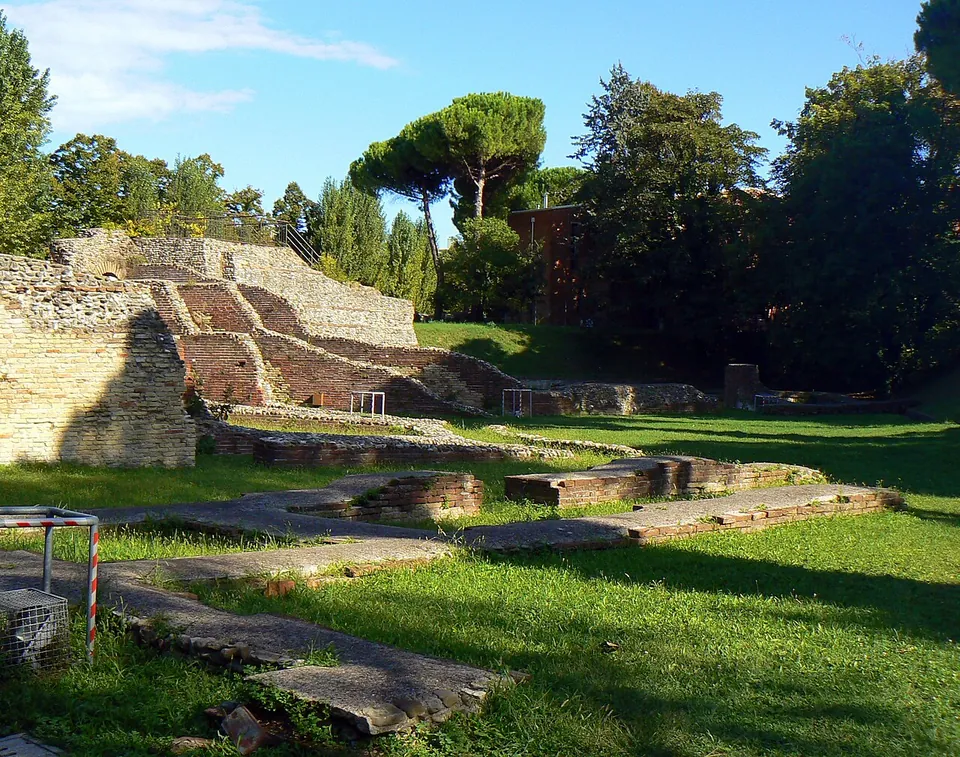
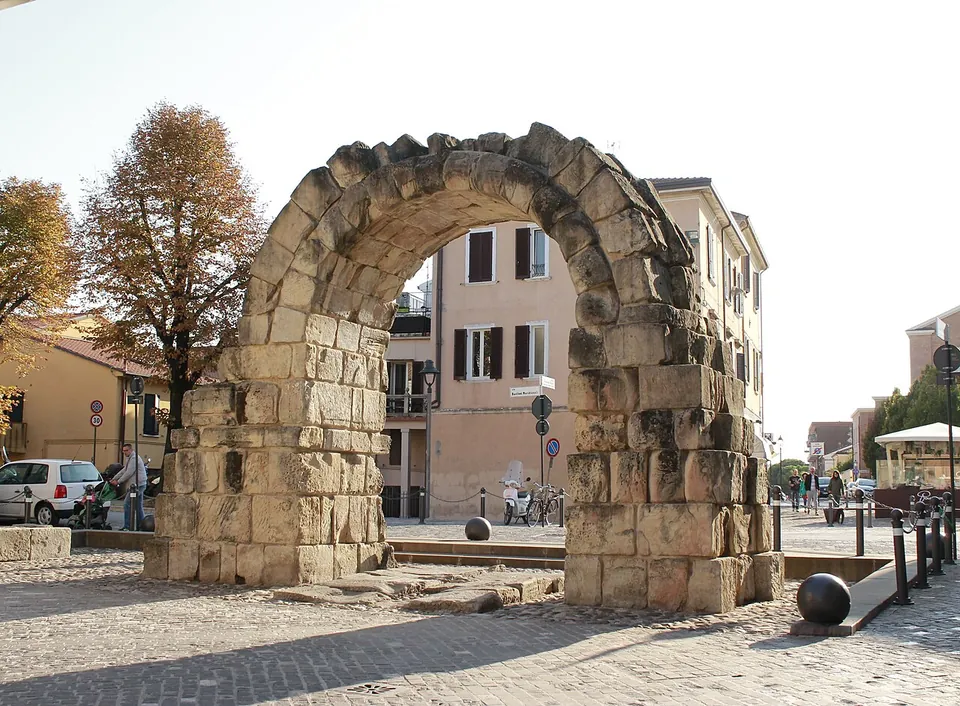
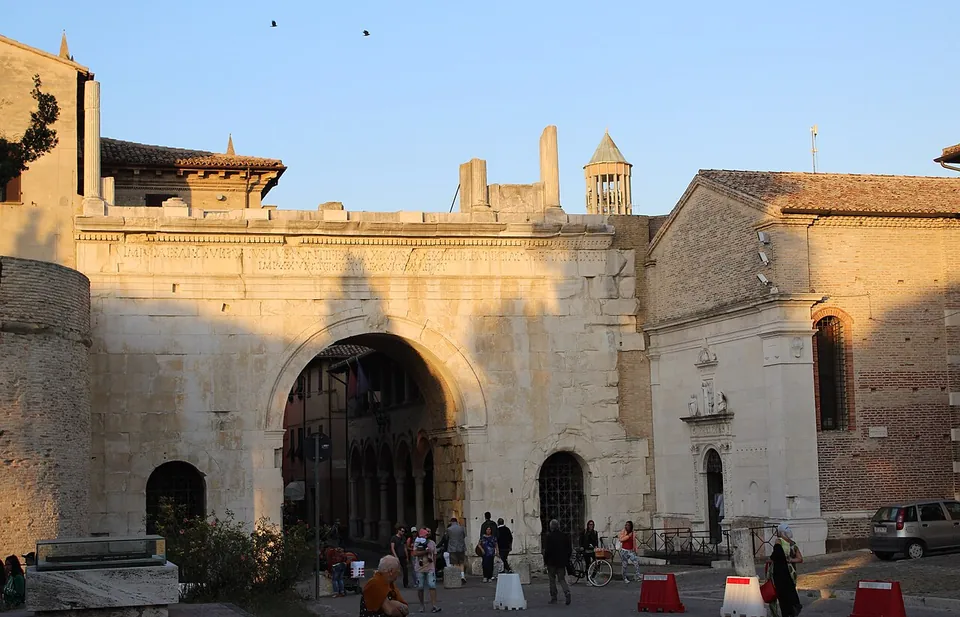
Photo: Giompaola · CC BY-SA 4.0 · Commons
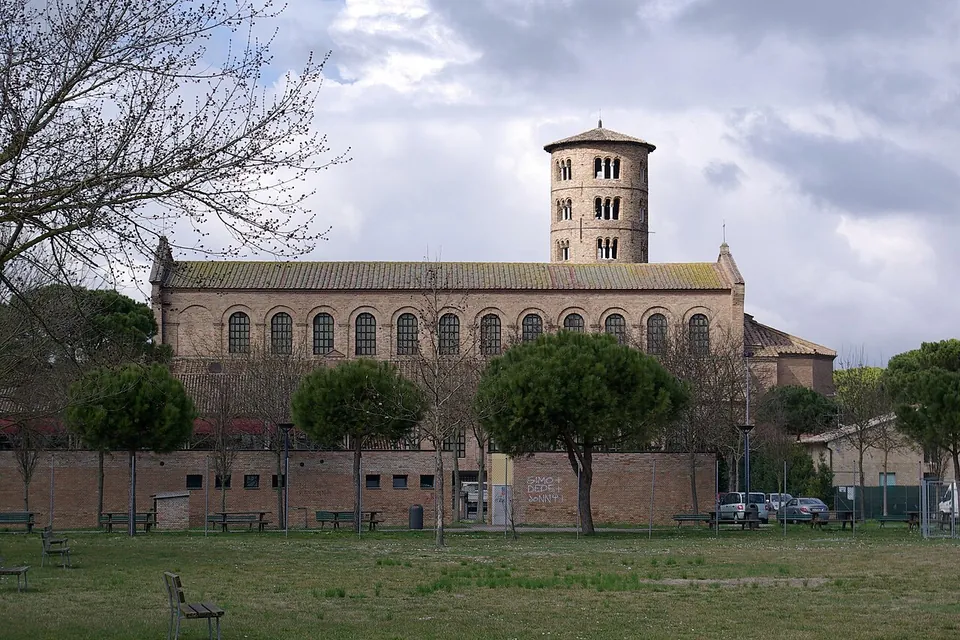
Photo: Berthold Werner · Public domain · Commons
44 km · church · Emilia-Romagna
Outside, a plain brick church with a tall round bell tower (Musei Italiani); inside, what UNESCO called "an outstanding example of the early Christian basilica in its purity and simplicity of its design and use of space" (en.wikipedia).
Straight-line distances.
Every fact on this page comes from the records below, each used under the licence noted.
| Source | Licence |
|---|---|
| Pleiades 393379 | CC BY |
| Wikidata Q105495122 | CC0 |
| Vici.org 1652 | CC BY-SA (text), CC0 (metadata) |
| Wikipedia (en) — Rimini | CC BY-SA 4.0 |
| Wikipedia (it) — Storia di Rimini | CC BY-SA 4.0 |
| Wikipedia (en) — Arch of Augustus (Rimini) | CC BY-SA 4.0 |
| Wikipedia (en) — Ponte di Tiberio (Rimini) | CC BY-SA 4.0 |
| Wikipedia (it) — Domus del chirurgo | CC BY-SA 4.0 |
| Wikipedia (it) — Anfiteatro romano di Rimini | CC BY-SA 4.0 |
| Pleiades — Porta Montanara | licence not recorded |
| Musei di Rimini — opening hours (the operator of the Domus del Chirurgo and the Museo della Città) | licence not recorded |
| Musei di Rimini — individual tickets | licence not recorded |
| Riviera di Rimini (official tourism site) — Roman amphitheatre | licence not recorded |
| Riviera di Rimini (official tourism site) — Roman route in the historical centre | licence not recorded |