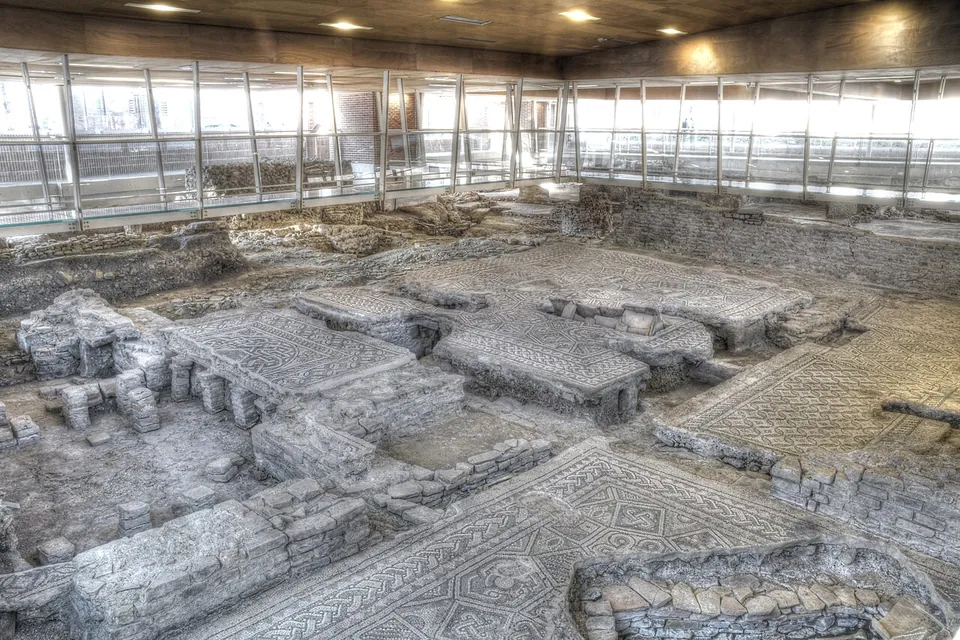
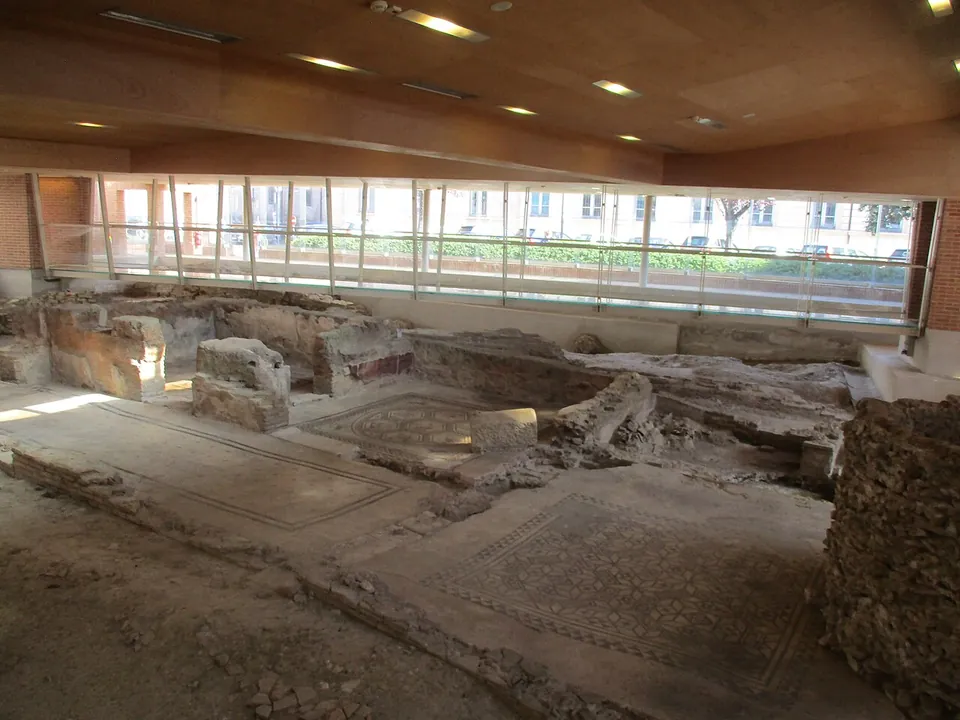
The Domus del Chirurgo is a Roman house in the middle of Rimini that was the home and surgery of a doctor. Fire destroyed it in the 3rd century, and today you walk on transparent walkways over its mosaic floors and low walls, inside a modern building on Piazza Ferrari.
What is there today
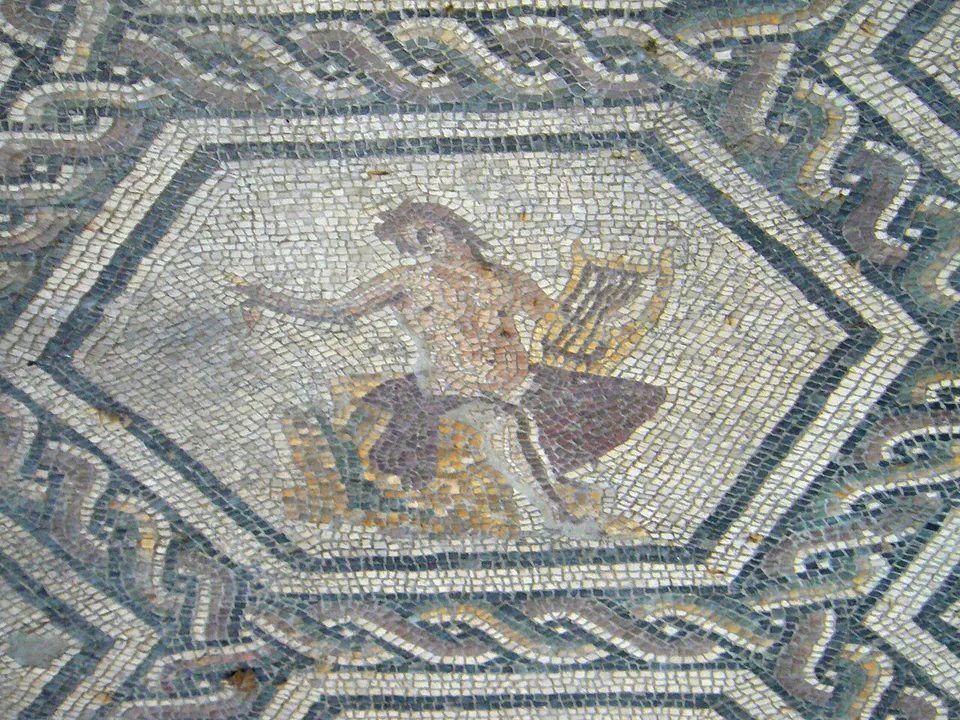
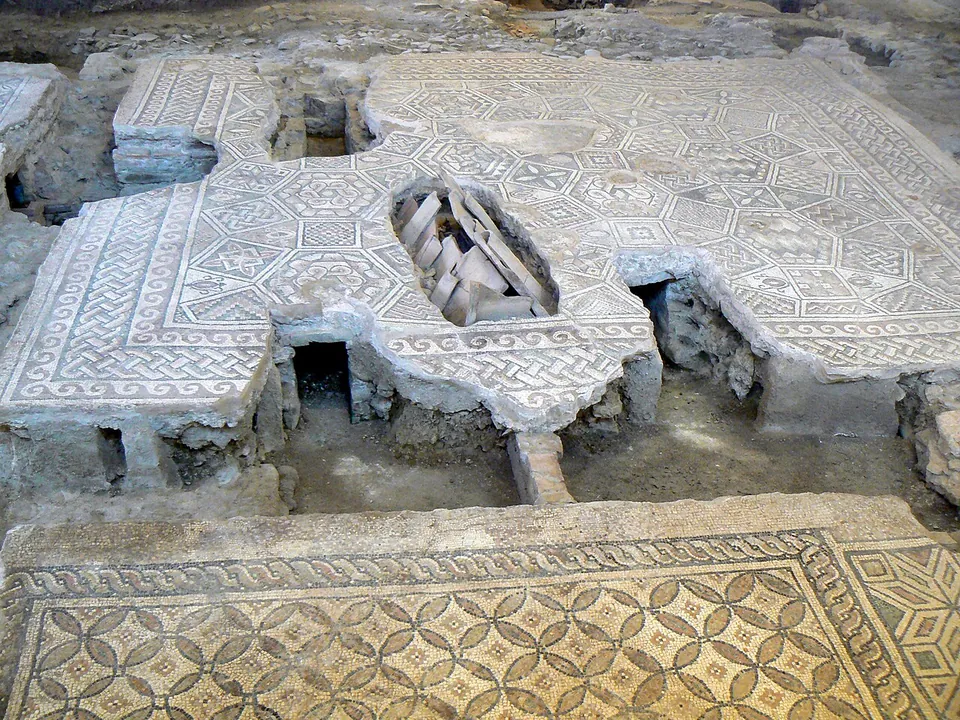
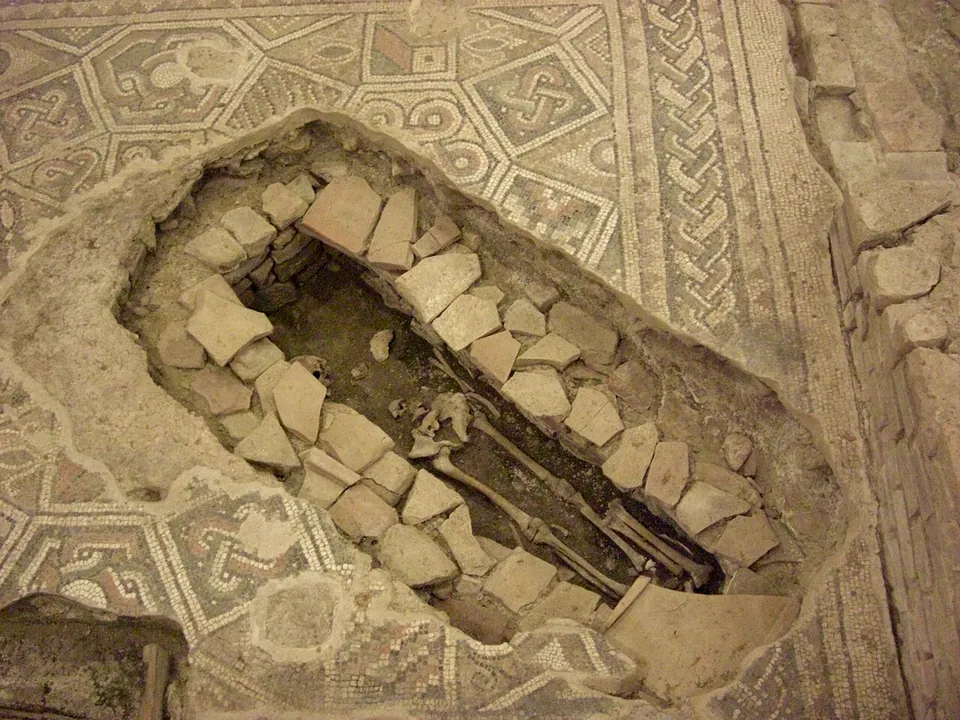
The excavation covers about 700 m², and the first mosaics lay some 2.5 m below the modern ground (it.wikipedia). The rooms of the house can be read in plan: the entrance on a minor Roman street, now Corso Giovanni XXIII; a courtyard garden; a dining room; the doctor’s rooms, with a bedroom for patients and the “room of Orpheus” where the instruments were found; and service rooms, among them a latrine and a sweating room heated from under the floor (it.wikipedia). Many mosaics were found still intact, and the best known, Orpheus among the animals, was found in the doctor’s rooms (it.wikipedia). The same site also exposes later layers: a stretch of imperial-period wall, a grand late Roman to Gothic-era residence and part of an early medieval Byzantine house (it.wikipedia).
The finds are not on site. The surgical kit, about 150 pieces and described as the richest collection of ancient surgical instruments in the world, is in the Museo della Città a short walk away, together with a glass-paste panel of three sea creatures from the dining room (it.wikipedia). The museum also has reconstructions of the surgery, the bedroom and the dining room with their furniture (Ministero della Cultura).
Is it worth the trip?
Yes, as part of a visit to Rimini. This is the town’s best chance to see inside a Roman building: whole floors of mosaic in place, and the story of one doctor told by what he left behind. Be clear about what it is, though: floors and low walls seen from above, not standing rooms, since the upper storey came down in the fire (it.wikipedia). It is half of a pair. The ticket also covers the Museo della Città, where the instruments are, and the house makes far more sense with them. On its own, without the rest of Roman Rimini, it is not worth a long detour.
Getting there
The Domus is on Piazza Luigi Ferrari in the historic centre of Rimini (it.wikipedia). The museums’ own page lists five car parks serving the centre (Italo Flori, Ponte di Tiberio, Largo Gramsci, Area Sartini and Parcheggio Scarpetti) and notes that the city is reached by rail from Bologna, Ancona and Ferrara and through Federico Fellini airport (museicomunalirimini.it). Public transport stops are mapped about 250 m away (OpenStreetMap). The Ponte di Tiberio is about 0.4 km away in a straight line, the Arch of Augustus and the amphitheatre about 0.7 km (candidate records).
The Domus and the Museo della Città open Tuesday to Sunday and on public holidays, 10.00–13.00 and 16.00–19.00, and are closed on Mondays that are not public holidays; in July, August and the first week of September they also open on Wednesday evenings, 21.00–23.00. Last entry is 30 minutes before closing. One ticket covers both: €7, or €5 reduced, including for over-65s and for everyone on Wednesdays that are not public holidays. Entry is free for visitors aged 30 and under, for residents of the province of Rimini and on your birthday. The ART CARD adds the Fellini Museum for €14 (€10 reduced) and is valid five days (museicomunalirimini.it, read 21 October 2026). The official tourism site adds that a guided visit of about an hour runs on Sundays, booked through the museums (riviera.rimini.it).
Visiting details
- Opening hours
- Tuesday to Sunday and public holidays 10.00–13.00 and 16.00–19.00; closed on Mondays that are not public holidays. In July, August and the first week of September also every Wednesday 21.00–23.00. Last entry 30 minutes before closing.
- Tickets
- €7 (€5 reduced, including for over-65s and for everyone on Wednesdays that are not public holidays), one ticket for the Domus and the Museo della Città. Free for visitors aged 30 and under, for residents of the province of Rimini and on your birthday. The ART CARD adds the Fellini Museum, €14 (€10 reduced), valid five days from first entry.
- Parking
- The museums list five car parks serving the historic centre - Italo Flori, Ponte di Tiberio, Largo Gramsci (not on Wednesday and Saturday mornings), Area Sartini (not on Friday mornings) and Parcheggio Scarpetti. Only bicycle and motorcycle parking is mapped on Piazza Ferrari itself (OpenStreetMap).
Hours and prices checked 21 October 2026 on the operator's own site. Confirm before travelling.
History
The house stood near the harbour basin at the mouth of the Marecchia, before the river was diverted to the north and the coastline moved 1.5 km out to sea (it.wikipedia). It was built around a trapezoidal plan about 30 m wide and up to 21 m deep, covering 450 m², half of it open to the sky; with the residential block in front it reached more than 1,000 m². It was remodelled in the second half of the 2nd century AD (it.wikipedia).
The doctor is thought to have been called Eutyches, from a graffito in 3rd-century script scratched into the plaster of the bedroom wall where the bed stood, probably by a grateful patient. Greek writing on the pottery, two jars labelled in Greek with the names of medicinal herbs, the foot of a statue of Hermarchus, the philosopher who succeeded Epicurus, and a bronze votive hand of Jupiter Dolichenus suggest he came from the Greek East. His instruments were mostly for wounds and broken bones, among them the “spoon of Diocles” for pulling out arrowheads, which is why he is taken to have been a military surgeon; the absence of obstetric tools suggests he treated men only (it.wikipedia).
The end was sudden. A fire destroyed the house so quickly that a wooden box of 89 coins, almost all silver, was left in the rubble and the instruments show signs of melting; the latest coins date to 257 and 258 (it.wikipedia). The remains came to light in 1989, when work in the gardens of Piazza Ferrari turned up fragments of fresco and mosaic, and the excavation lasted about ten years (it.wikipedia; riviera.rimini.it). The site opened to the public on 7 December 2007 (it.wikipedia).
More photographs
Nearby
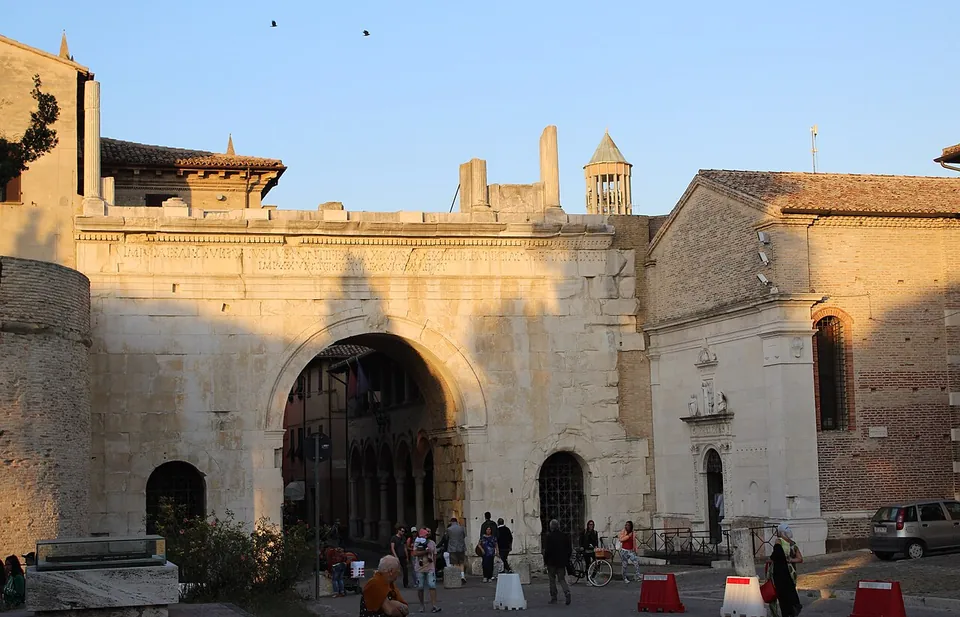
Photo: Giompaola · CC BY-SA 4.0 · Commons
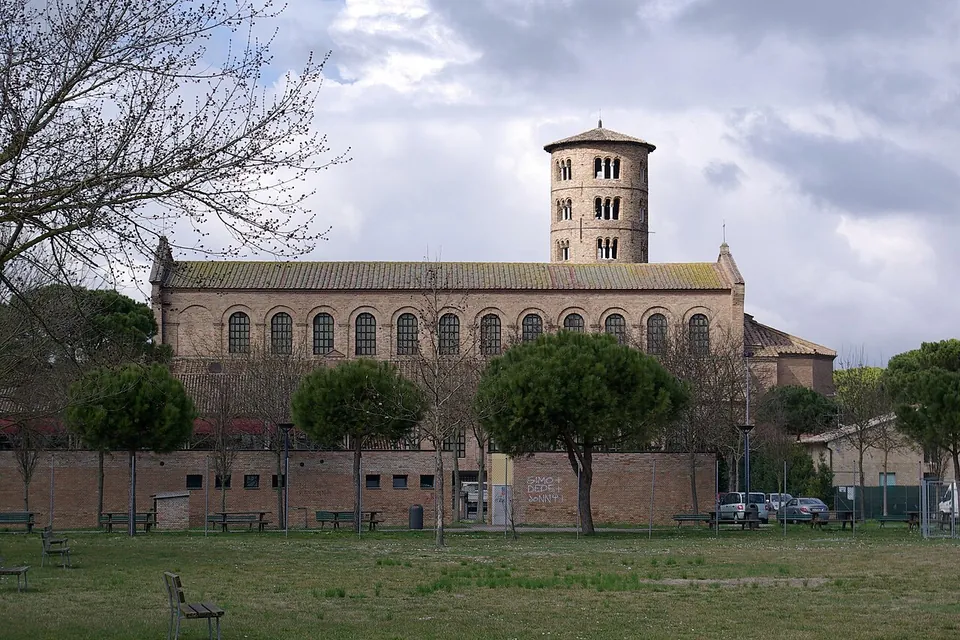
Photo: Berthold Werner · Public domain · Commons
44 km · church · Emilia-Romagna
Basilica of Sant'Apollinare in Classe
Outside, a plain brick church with a tall round bell tower (Musei Italiani); inside, what UNESCO called "an outstanding example of the early Christian basilica in its purity and simplicity of its design and use of space" (en.wikipedia).


Straight-line distances.
Sources
Every fact on this page comes from the records below, each used under the licence noted.
| Source | Licence |
|---|---|
| Pleiades 983289921 | CC BY |
| Wikidata Q3713399 | CC0 |
| OpenStreetMap way/321725450 | ODbL |
| Wikipedia (it) — Domus del chirurgo | CC BY-SA 4.0 |
| Musei di Rimini — opening hours (the operator) | licence not recorded |
| Musei di Rimini — individual tickets (the operator) | licence not recorded |
| Musei di Rimini — how to get there (the operator) | licence not recorded |
| Ministero della Cultura — Domus del Chirurgo | licence not recorded |
| Riviera di Rimini (official tourism site of the Province of Rimini) — The Surgeon's Domus | licence not recorded |