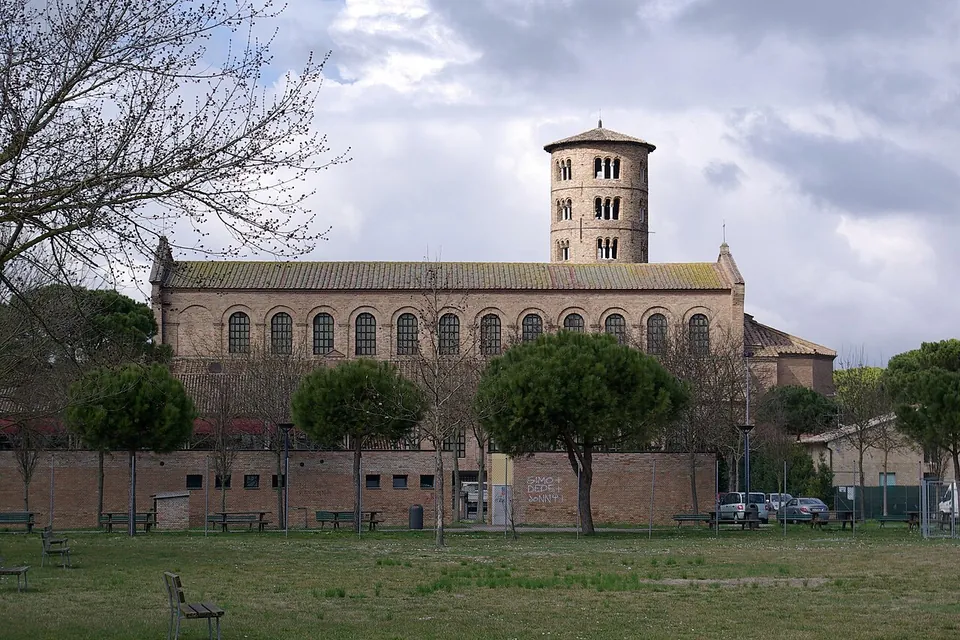
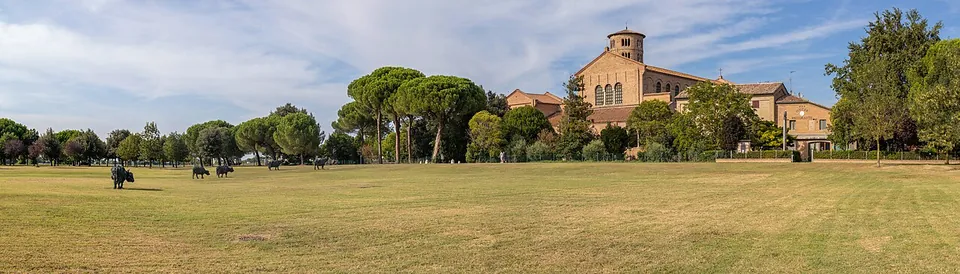


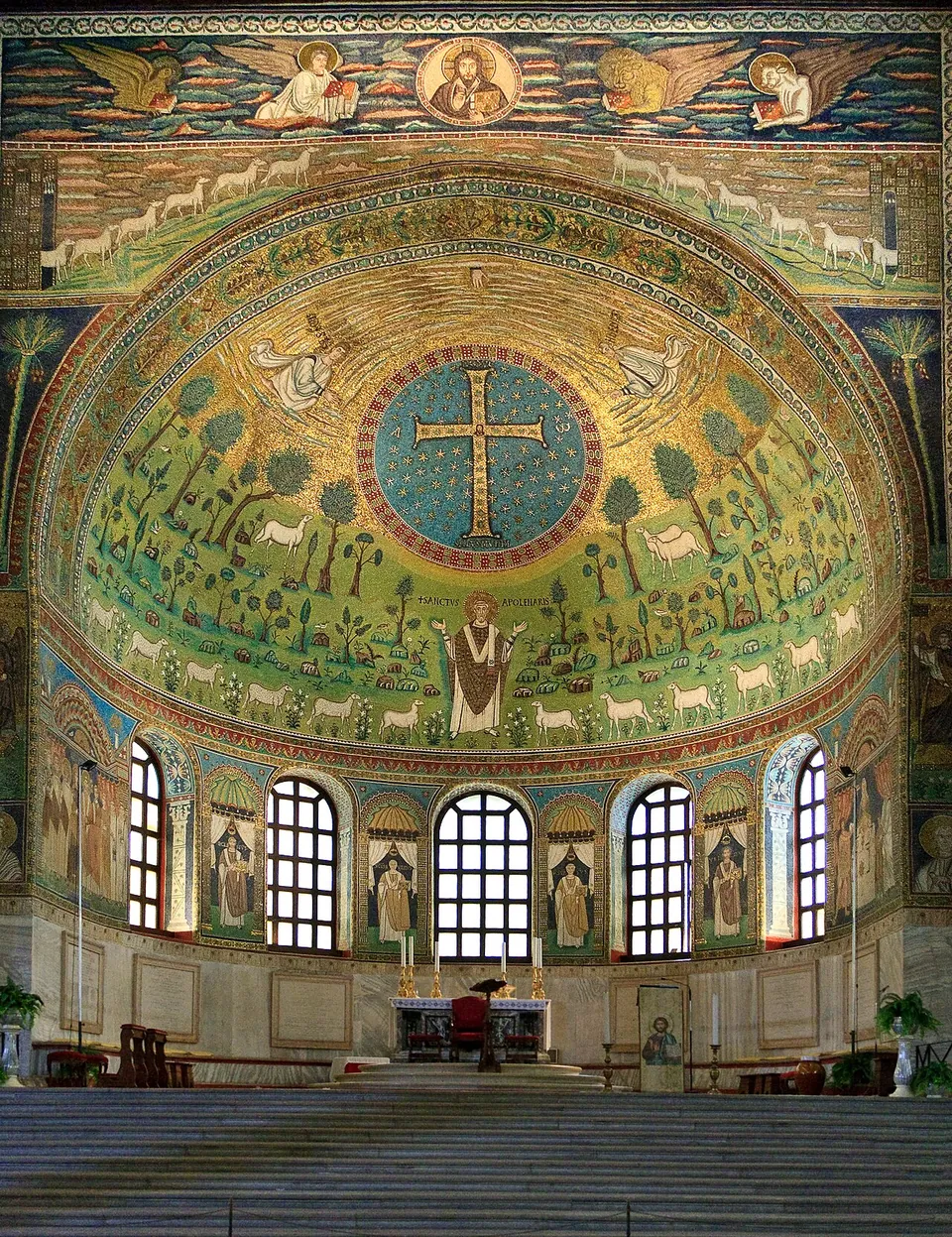
Sant’Apollinare in Classe is a brick church of the 6th century at Classe, about 5 km south of Ravenna’s centre, known above all for its mosaics (RavennAntica; de.wikipedia): in the apse, Saint Apollinaris stands at prayer in a green meadow beneath a starry sky with a jewelled cross (Ministero della Cultura; en.wikipedia). The Ministry of Culture runs it, and a ticket is €6.
It is a church of the very end of antiquity, not a classical Roman building. Work began under Bishop Ursicinus in the 530s (published dates run from 532 to 538), and Bishop Maximian, who also consecrated San Vitale, consecrated it on 9 May 549 (RavennAntica; it.wikipedia; en.wikipedia). What is Roman about the place is the ground it stands on. Classe takes its name from the Latin classis, “fleet”: a permanent fleet of the Roman navy was based at the port of Classis nearby (RavennAntica). The church was built over a cemetery of the imperial period just outside that town (Musei Italiani), and the Via Popilia, the Roman road from Rimini to Aquileia, ran past the colonnaded forecourt that once stood in front of it (RavennAntica).
What is there today
Outside, a plain brick church with a tall round bell tower (Musei Italiani); inside, what UNESCO called “an outstanding example of the early Christian basilica in its purity and simplicity of its design and use of space” (en.wikipedia). The church has a nave and two aisles, about 56 by 30 m inside (de.wikipedia), divided by twenty-four columns of veined marble from Proconnesus, whose capitals carry acanthus leaves that look blown by the wind (Ministero della Cultura; it.wikipedia). The walls are bare: Sigismondo Malatesta stripped the marble facing of the aisle walls in the 15th century for his Tempio Malatestiano in Rimini (RavennAntica; en.wikipedia), and the portrait medallions of Ravenna’s archbishops painted along the nave are mostly 18th-century (Musei Italiani; it.wikipedia).
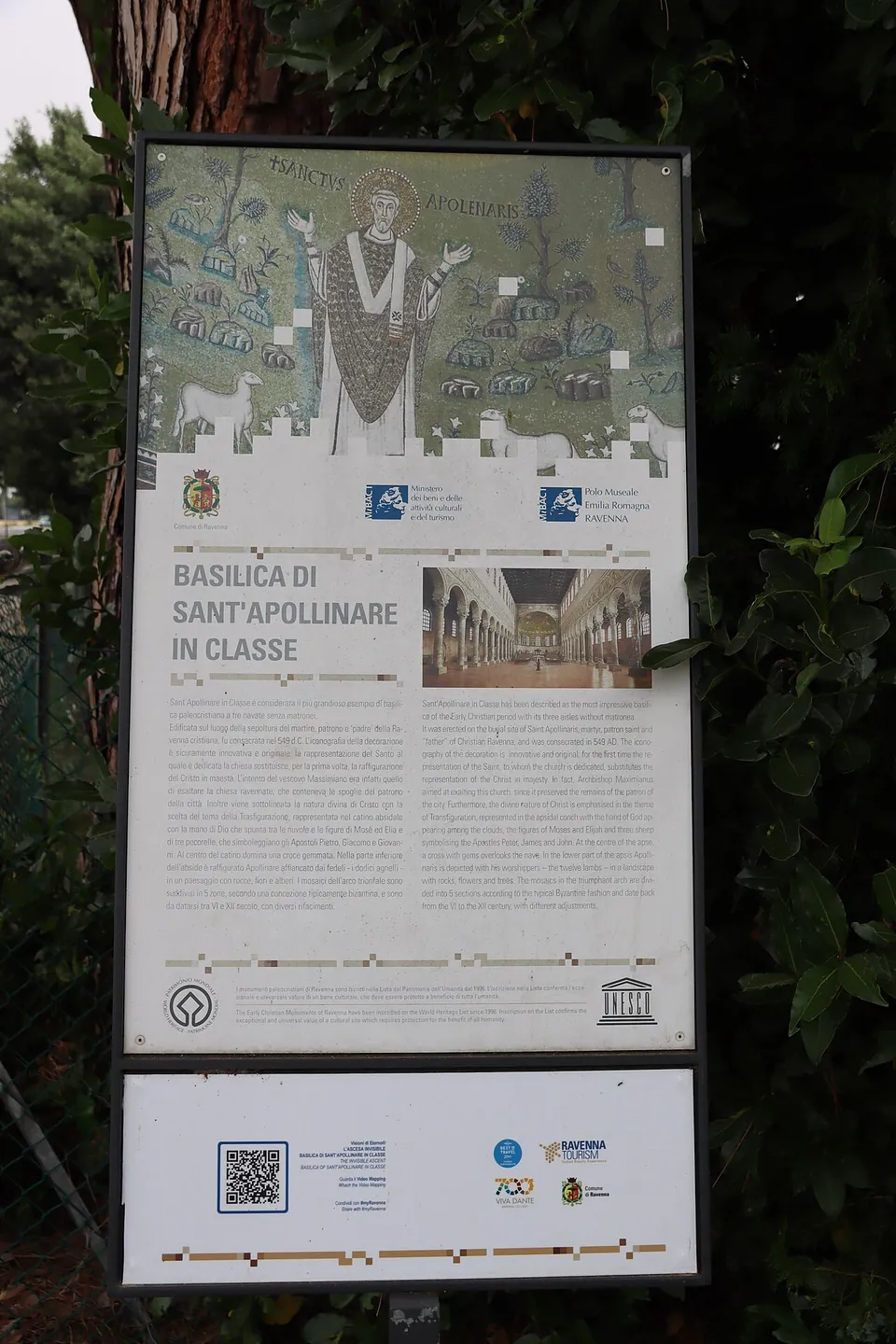
The apse mosaic is the reason to come. RavennAntica calls the half-dome and the arch in front of it one of the largest surfaces of mosaic to have survived from antiquity. At the top, a great disc of stars holds a jewelled cross with the face of Christ at its centre, the hand of God reaching down from the clouds above it, Moses and Elijah at either side and three lambs below, probably a symbolic picture of the Transfiguration (en.wikipedia; it.wikipedia; RavennAntica). Underneath, Saint Apollinaris, the first bishop of Ravenna, stands with his arms raised in prayer in a meadow of trees, rocks, flowers and birds, between twelve white lambs (Ministero della Cultura; en.wikipedia). Between the windows, in 6th-century mosaic, stand four bishops of Ravenna, and at the sides two 7th-century panels: the Byzantine emperor Constantine IV granting privileges to the church of Ravenna, and Abraham, Abel and Melchizedek offering sacrifice at an altar (Ministero della Cultura; RavennAntica). Parts of the arch above are later: published dates for its mosaics run from the 6th to the 12th century (de.wikipedia; it.wikipedia).
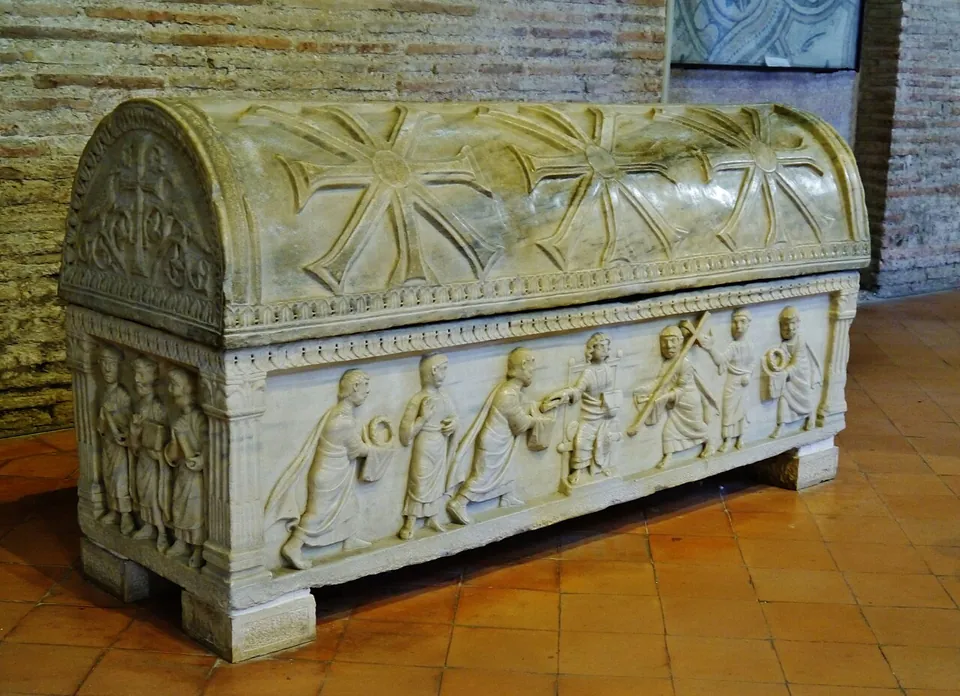
The sarcophagi. Along the aisles stand marble sarcophagi of the 5th to the 8th century, most of them reused for the burials of Ravenna’s bishops and archbishops, with fragments of the church’s original mosaic floor (it.wikipedia; Musei Italiani; RavennAntica). Side by side they show the carving change from the human figures of Roman reliefs to Byzantine symbols, ever more abstract (en.wikipedia; it.wikipedia).
The round bell tower is medieval: published dates run from the 9th century (Musei Italiani; it.wikipedia) to the 11th or 12th (de.wikipedia). The narthex at the entrance was largely rebuilt in the restorations of 1897–1911 (it.wikipedia).
Is it worth the trip?
Yes, if Ravenna’s mosaics are why you came. Little changed since the 6th century, it gives a good idea of how a church of late antiquity looked (fr.wikipedia), and it is a different experience from the centre: a long colonnaded hall with bare walls and one great mosaic at the end. The detour is short, too, with a railway station and a bus stop a few minutes’ walk away.
Two things to plan around. On Sundays and religious holidays it opens only in the afternoon, and visits stop during services. And it is not on the diocese’s tickets for San Vitale and the churches in the centre: the state runs it, with tickets of its own. Do not expect Roman ruins here: the Roman port of Classis is a separate stop, the ancient port excavation about 2 km towards the town, which opens only to booked groups (RavennAntica). The basilica is one stop of Ravenna.
Getting there and what it costs
The basilica is on Via Romea Sud at Classe (the operator). Classe railway station, a one-track stop on the Ferrara–Rimini line, is about 300 m away, and a bus stop named Classe Basilica about 200 m (OpenStreetMap; RFI). RavennAntica gives buses 4 and 176 from Ravenna railway station for the ancient port, without saying whether they also call at Classe Basilica. A cycle path, the Pista Ciclabile dell’Archeologia, passes about 70 m from the church (OpenStreetMap), and RavennAntica describes the area as linked to the city by cycle path. Drivers have a free car park about 100 m from the entrance (the operator).
It opens Monday to Saturday 08.30–19.30, and on Sundays and religious holidays 13.30–19.30, with last entry half an hour before closing (RavennAntica’s ticket office; Ministero della Cultura). A ticket is €6, €5 in a group and €2 for visitors aged 18 to 25; entry is free for the categories in the ministry’s rules, and for everyone on the first Sunday of each month. Two combined tickets, each valid seven days, add more of Ravenna’s state sites: €9 with the Museo Classis Ravenna, and €14 with the Mausoleum of Theodoric, the Arian Baptistery, the National Museum and the Palazzo di Teodorico. Booking is optional; online sales add a 10% fee. Audio guides in five languages can be hired at the ticket office, and there are ramps at the main entrance (Ministero della Cultura; RavennAntica; Musei Italiani, read 14 October 2026).
Visiting details
- Opening hours
- Monday–Saturday 08.30–19.30; Sundays and religious holidays 13.30–19.30. Last entry 30 minutes before closing. Visits stop during church services.
- Tickets
- €6; groups €5; €2 for visitors aged 18–25; free for the categories in the Ministry of Culture's rules, and for everyone on the first Sunday of each month. Combined tickets valid seven days - €9 with the Museo Classis Ravenna; €14 with the Mausoleum of Theodoric, the Arian Baptistery, the National Museum and the Palazzo di Teodorico. Online sales add a 10% fee.
- Parking
- A free car park lies about 100 m from the entrance (the operator; OpenStreetMap way/103122503), with toilets for disabled visitors.
Before you go
- On Sundays and religious holidays the basilica opens only in the afternoon.
- Visits are suspended during services, including Sunday and holiday masses and funerals.
- The diocese's tickets for San Vitale and the churches in the centre do not cover this basilica, which the state runs.
Hours and prices checked 14 October 2026 on the operator's own site. Confirm before travelling.
History
The church was built in honour of Saint Apollinaris, who by tradition founded Ravenna’s first Christian community and was its first bishop, and his relics were brought into it (it.wikipedia; RavennAntica). Bishop Ursicinus began it with money from the banker Iulianus Argentarius (en.wikipedia), who also paid for San Vitale (en.wikipedia, San Vitale). When it was built it stood near the sea: silt has since moved the coastline about 9 km east (en.wikipedia; RavennAntica). It stood next to a Christian cemetery, and ancient tombstones reused in its construction suggest an older pagan one on the spot (en.wikipedia).
From the late 6th century it was the burial church of Ravenna’s archbishops, and in the 9th century the presbytery was raised over a crypt for the saint’s relics (it.wikipedia; RavennAntica). Monks looked after it from the 8th century, the last of them until the Napoleonic invasion of 1798 (it.wikipedia). In the Second World War its tall bell tower served as an observation post; when the retreating Germans prepared to mine the tower in November 1944, partisans and the British officer Wladimir Peniakoff (“Popski”) helped keep the basilica from being blown up (it.wikipedia). Pope John XXIII made it a minor basilica in 1960, and in 1996 it was inscribed on UNESCO’s World Heritage List with seven other early Christian monuments of Ravenna (it.wikipedia; en.wikipedia).
More photographs


Nearby
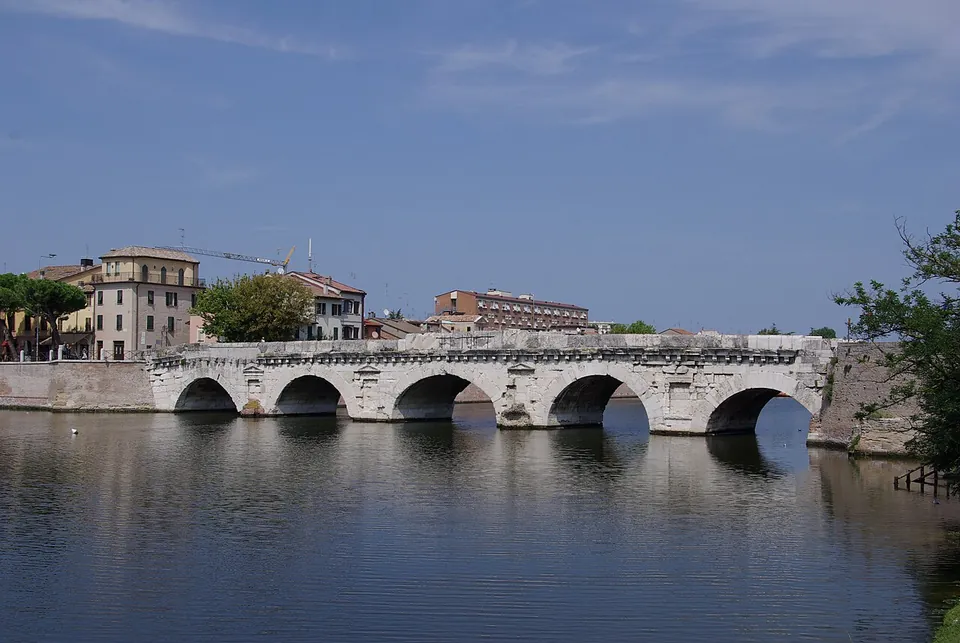
Photo: Flying Russian · CC BY-SA 3.0 · Commons
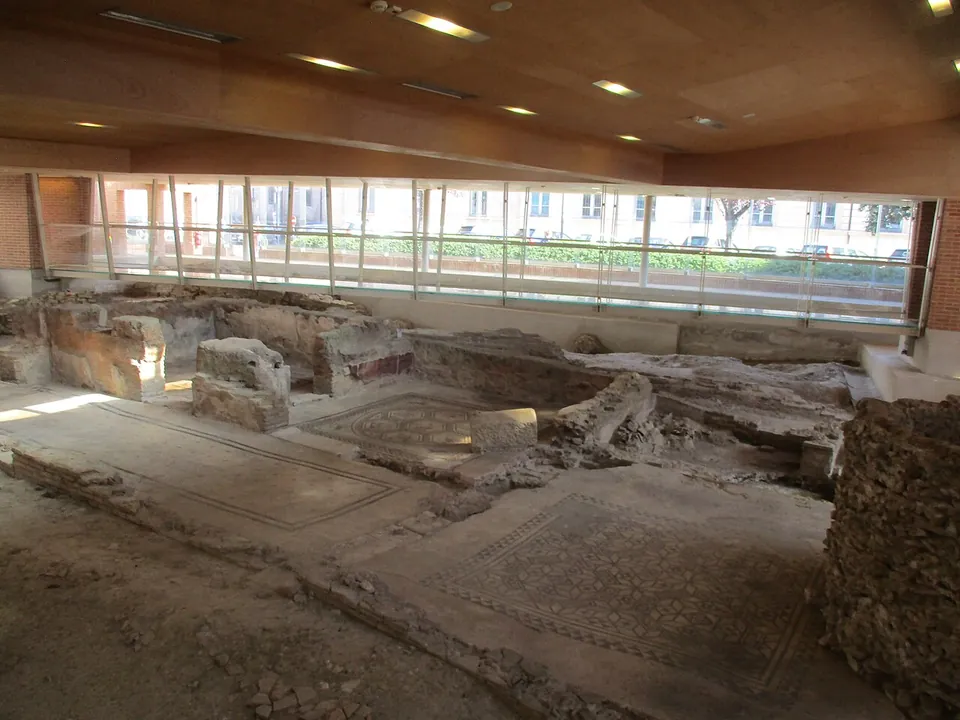
Photo: Capvalerio85 · CC BY-SA 4.0 · Commons
44 km · town house · Emilia-Romagna
Domus del Chirurgo
The excavation covers about 700 m², and the first mosaics lay some 2.5 m below the modern ground (it.wikipedia).
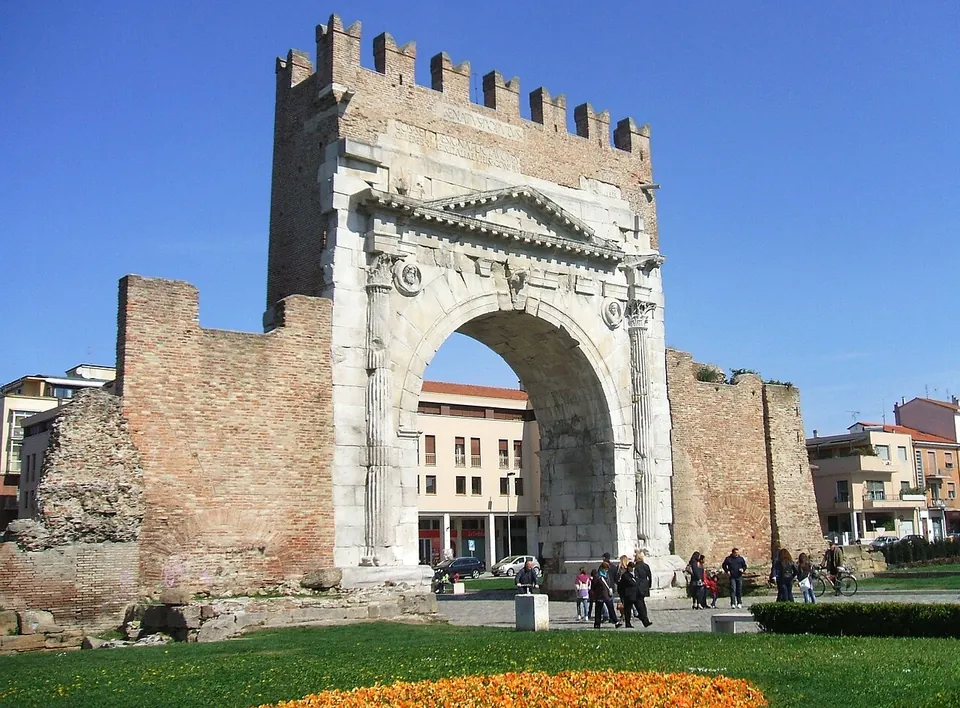
Photo: Il Malatestiano · CC BY-SA 4.0 · Commons
44 km · city · Emilia-Romagna
Ariminum – Rimini
The historic centre keeps the Roman town's street plan (en.wikipedia, Rimini), and its monuments are a short walk apart.


Straight-line distances.
Sources
Every fact on this page comes from the records below, each used under the licence noted.