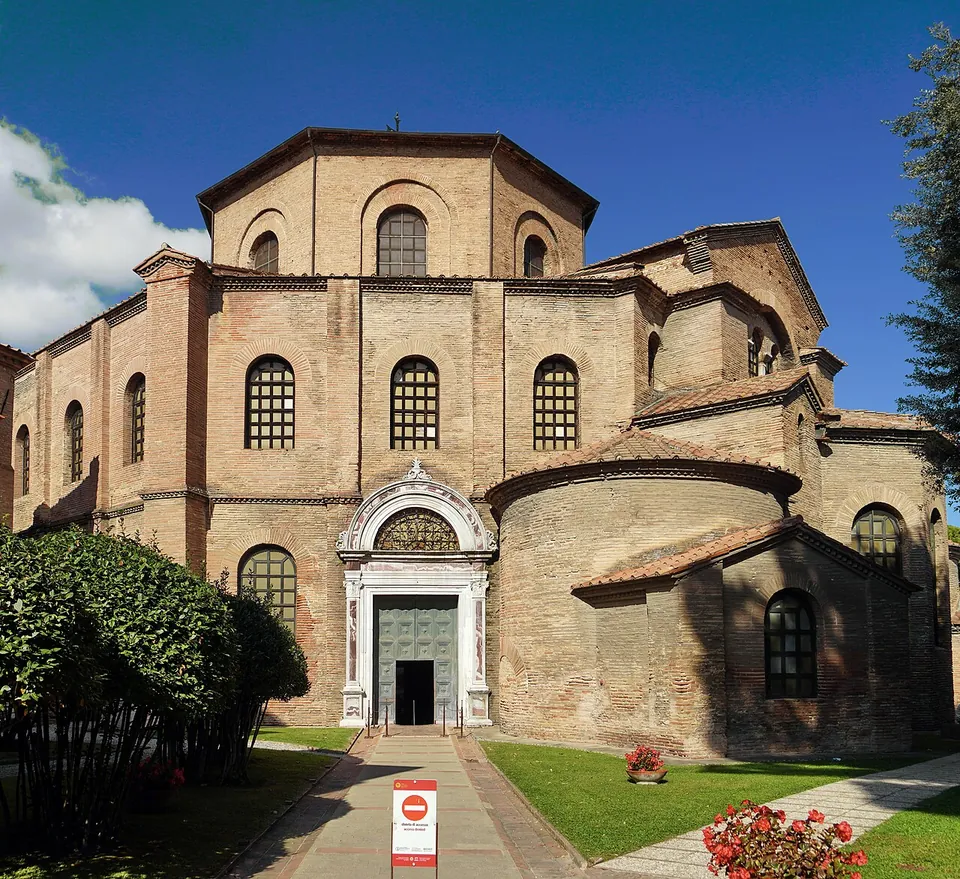


San Vitale is a 6th-century church in the centre of Ravenna, a brick octagon whose sanctuary holds some of the most-studied mosaics in Byzantine art, among them the portraits of the emperor Justinian and the empress Theodora (en.wikipedia; de.wikipedia). In the same garden stands the Mausoleum of Galla Placidia, a small 5th-century building lined with mosaic. Both are on the diocese’s recommended four-monument ticket, €12.50, the cheapest that covers them both.
It is a late antique church rather than a classical Roman building. It was begun between 526 and the late 530s (published dates differ), while the Ostrogoths ruled Ravenna, and completed in 547 after the conquest of Italy by Justinian I, emperor of the Eastern Roman Empire. English Wikipedia describes the building as a mix of Roman and Byzantine elements - the dome, the shape of the doorways and the stepped towers Roman, the polygonal apse, the capitals and the narrow bricks Byzantine - and its mosaics as works in the Hellenistic-Roman tradition.
What is there today
Two buildings in one enclosure: the church, whose 6th-century mosaics cover the sanctuary around the altar, and the small Mausoleum of Galla Placidia, its interior lined with 5th-century mosaic (the operator; en.wikipedia).
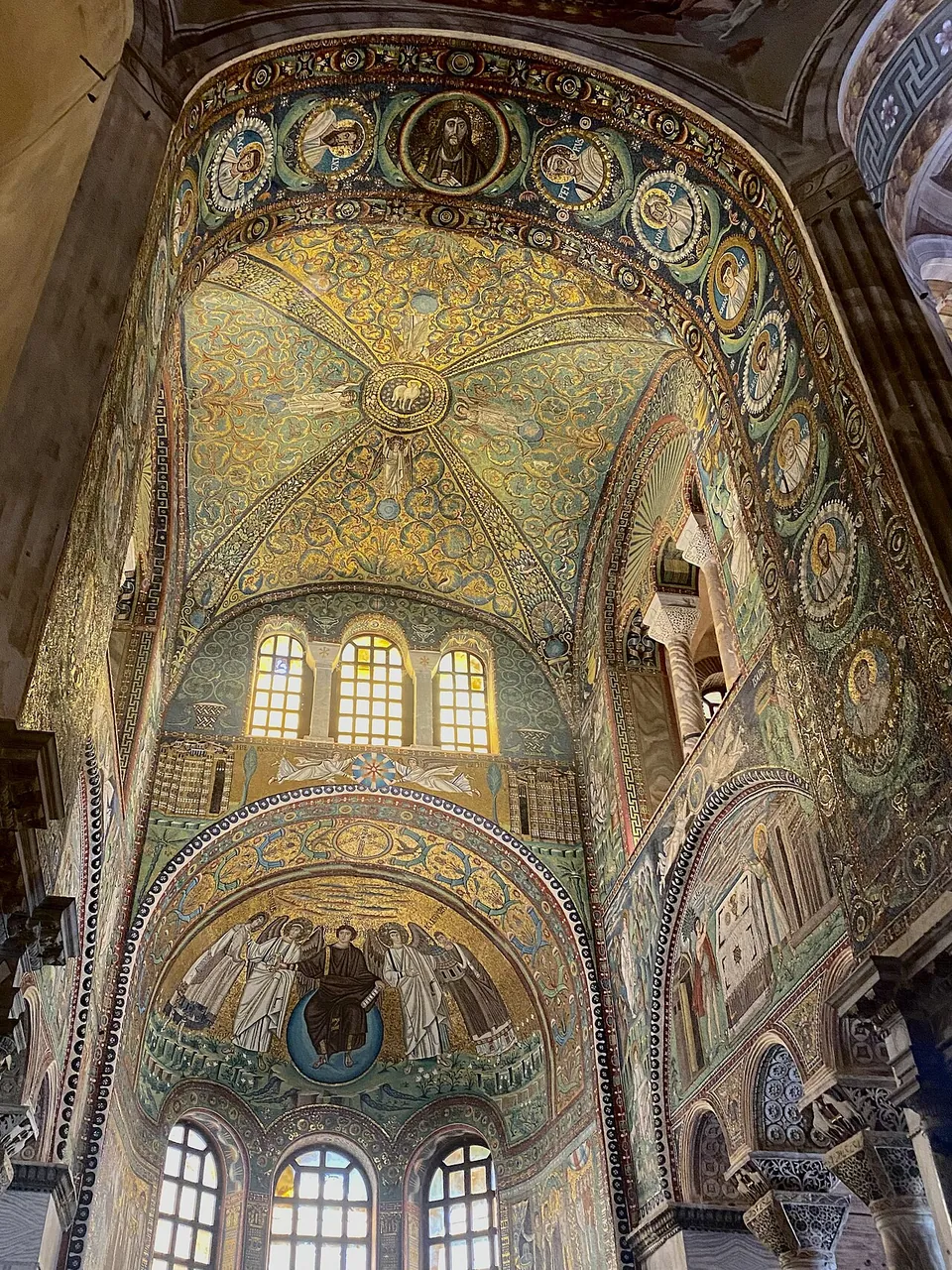
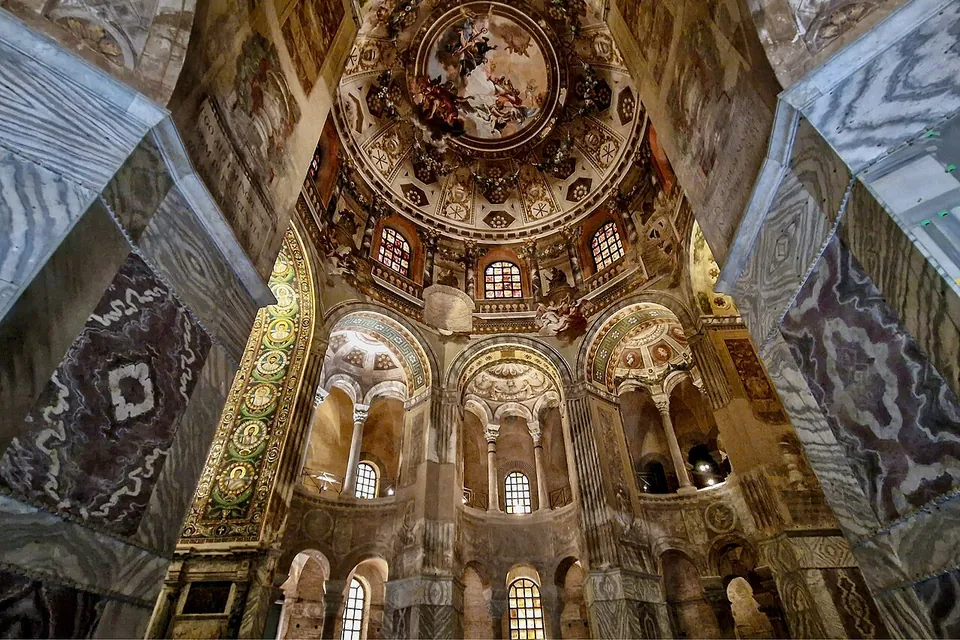
The church. The main building is an octagon, a “double-shelled” design in which the central space is ringed by two storeys of ambulatories (en.wikipedia). The mosaics are concentrated in the presbytery and the choir, reached through a high triumphal arch (the operator). The arch’s underside carries fifteen medallions with Christ, the Twelve Apostles and Saints Gervasius and Protasius; the vault above the altar is covered in garlands of leaves, fruit and flowers, peacocks and other birds and animals, converging on a wreath around the Lamb of God that four angels hold up (en.wikipedia; the operator). Scenes from the Old Testament face each other on the side walls: Abraham receiving the three angels and the sacrifice of Isaac on one side, Abel and Melchizedek on the other (the operator). In the apse a young, beardless Christ sits on a blue globe and offers the martyr’s crown to Saint Vitalis, while Bishop Ecclesius holds out a model of the church (en.wikipedia; the operator).
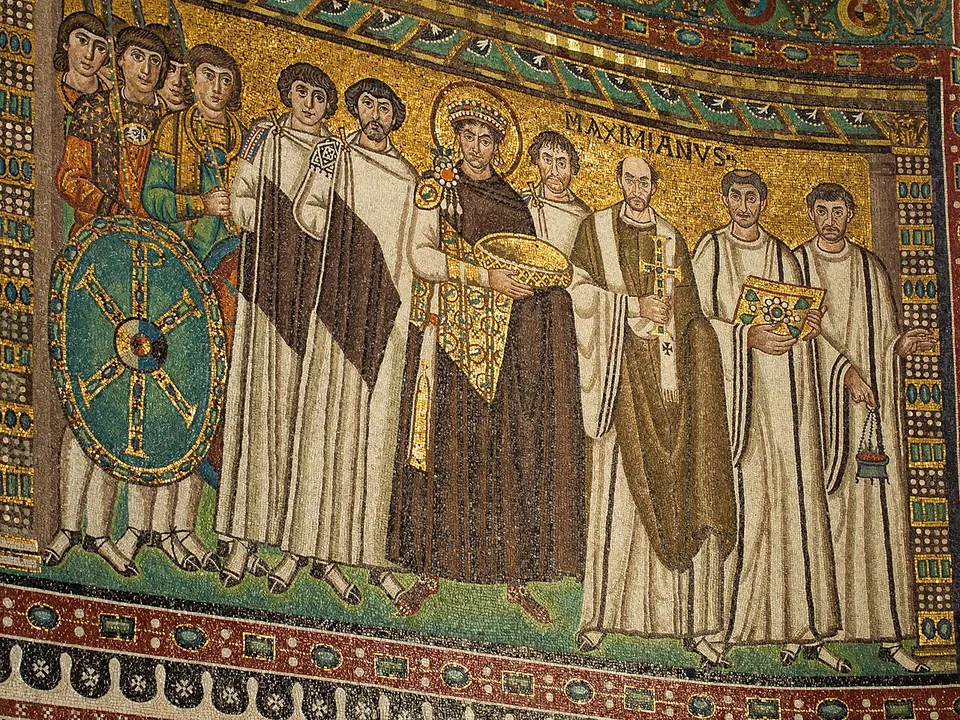
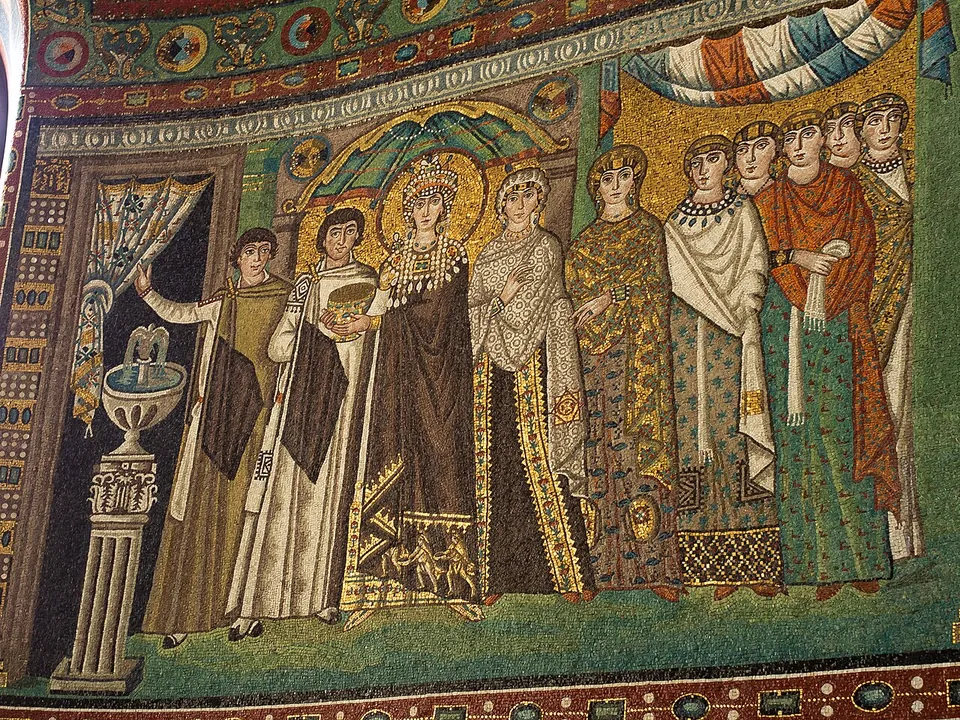
On the walls at the foot of the apse are the two famous panels, completed by 547: Justinian with his court, soldiers and clergy, Bishop Maximian among them, and opposite him Theodora with her court women, holding a golden chalice (en.wikipedia; the operator). English Wikipedia calls the Theodora panel the only certain image of the empress; the operator points out that neither of them ever came to Ravenna.
Not everything inside is 6th-century. The dome is painted, with Baroque frescoes of 1778–1782, and the ambulatory and gallery were only vaulted in the Middle Ages (en.wikipedia), so the great mosaics are at the altar end, and the painting overhead in the octagon is 18th-century work.
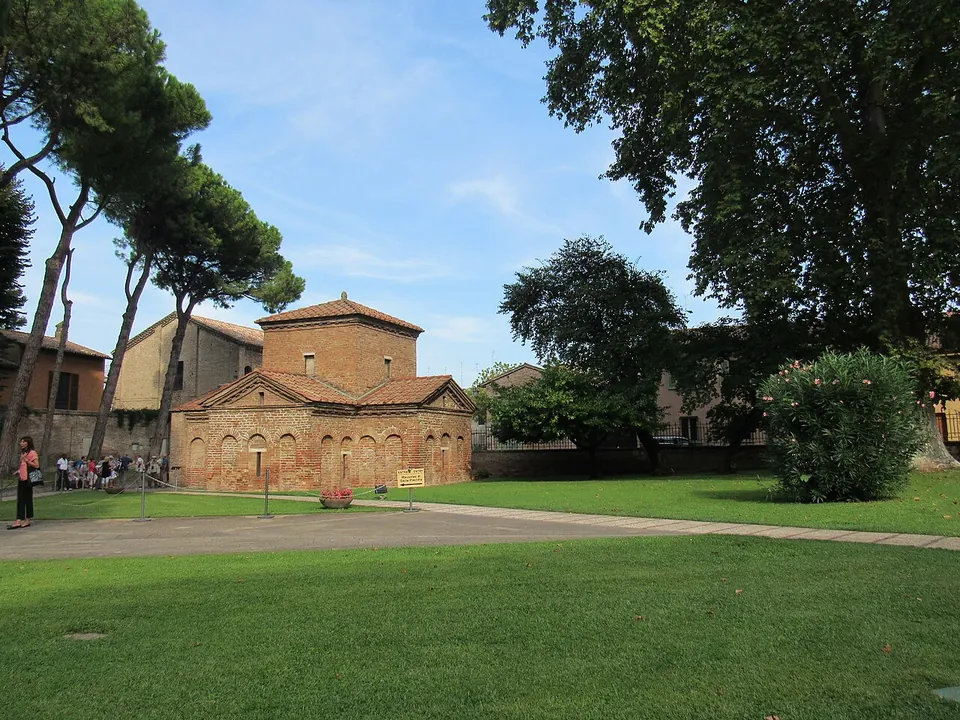
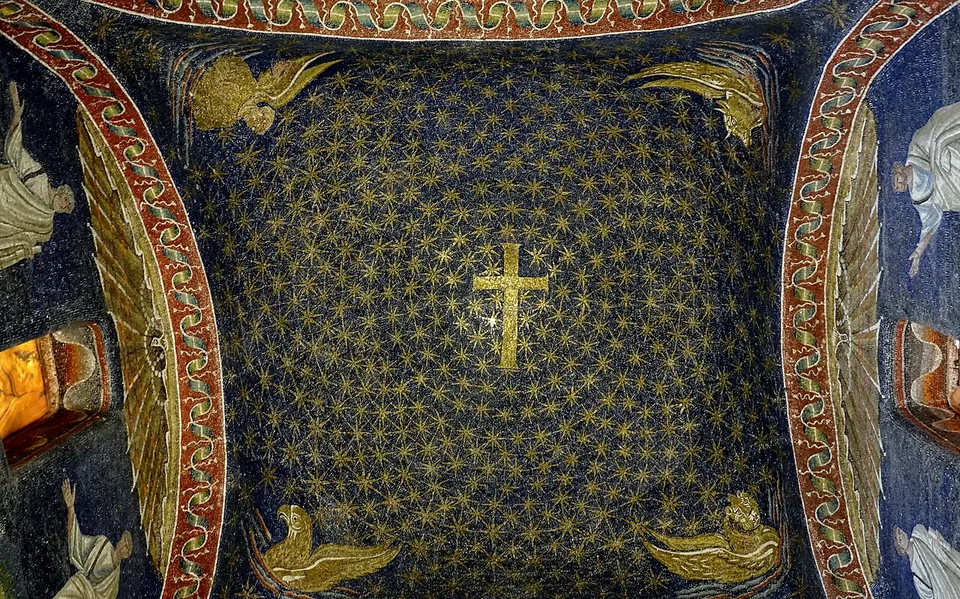
The Mausoleum of Galla Placidia. A few steps away, inside the same enclosure (the operator), stands a small cross-shaped brick building with a dome hidden inside a square tower and blind arches on its walls (en.wikipedia). It is 5th-century; published dates run from about 417 to the middle of the century (Pleiades; en.wikipedia; it.wikipedia; the operator). The outside is plain, the inside covered in mosaic: a dome of gold stars on dark blue with a gold cross at its top and the symbols of the four Evangelists in its corners, Christ as the Good Shepherd among his sheep above the entrance, deer at a spring, and a saint carrying a cross beside a burning gridiron, whom the operator names as Saint Lawrence and some scholars as Saint Vincent (en.wikipedia). Three sarcophagi stand inside (en.wikipedia).
The name is a tradition rather than a fact. Galla Placidia, daughter of the emperor Theodosius and regent of the Western Roman Empire for her young son Valentinian III, is the likely patron, but she died in Rome in 450 and was buried there (en.wikipedia; the operator), and the building’s use as a tomb is not certain. It was built onto the narthex of the church of Santa Croce, and separated from it in 1602 (the operator); it.wikipedia gives the generally accepted reading as an imperial mausoleum attached to that church, but notes that it may have been a simple chapel.
Is it worth the trip?
Yes. English Wikipedia calls San Vitale the only major church of Justinian’s reign to survive virtually intact, with the largest and best-preserved Byzantine mosaics outside Istanbul. The Mausoleum, a few steps away, is on the same ticket.
Two things to know. It is the busiest monument in the city (the operator), and the Mausoleum is tiny: it is entered at a booked time, and at busy times a visit inside is limited to five minutes. And neither building is a Roman ruin: the classical Roman town survives mainly as the excavated port at Classe, which opens only to booked groups and school parties (RavennAntica; see the Ravenna page).
Getting there and what it costs
San Vitale is in the historic centre, entered from Via Argentario 22, a side street off Via Cavour (the operator). Ravenna railway station is about 1 km away in a straight line, and the pay car park at Largo Imperatore Giustiniano, about 360 spaces, is roughly 150 m from the church (OpenStreetMap). The church and the Mausoleum have alternative routes for visitors with reduced mobility, and a fixed ramp leads up the two steps into the presbytery (the operator).
There is no ticket for San Vitale alone. The diocese (Opera di Religione della Diocesi di Ravenna) sells combined itineraries, valid seven days with one entry per monument (the operator, read 14 October 2026):
- €10.50: San Vitale and Sant’Apollinare Nuovo. This one does not include the Mausoleum.
- €12.50: those two plus the Mausoleum of Galla Placidia and the Baptistery of Neon.
- €14.50: all five, adding the Archbishop’s Museum and Chapel.
Students and groups of more than 20 pay €1 less on each; children aged 6 to 10 pay €2 or €4 on the larger tickets and nothing on the two-church one, and under-sixes go free. Both buildings open daily 09.00–19.00 until 2 November 2026 and 10.00–17.00 from 3 November to 6 March 2027, with last entry half an hour before closing at San Vitale and a quarter of an hour at the Mausoleum; they close on Christmas Day and New Year’s Day.
Buying online (until two hours before your slot) is the safest way to get in, since same-day tickets are sold only while places last. San Vitale’s own page lists a ticket office at Via Argentario 22, while the diocese’s current price page names same-day ticket offices only at Sant’Apollinare Nuovo and the Archbishop’s Museum. Flash, tripods and selfie sticks are not allowed (the operator).
Visiting details
- Opening hours
- Daily 09.00–19.00 from 8 March to 2 November 2026 (last entry 18.30 at San Vitale, 18.45 at the Mausoleum of Galla Placidia), then 10.00–17.00 from 3 November 2026 to 6 March 2027 (last entry 16.30 and 16.45). Closed on 25 December and 1 January.
- Tickets
- Combined tickets only, from €10.50. The diocese sells no single-monument ticket, only itineraries valid seven days with one entry per monument - €10.50 for San Vitale and Sant'Apollinare Nuovo; €12.50 adding the Mausoleum of Galla Placidia and the Baptistery of Neon; €14.50 adding also the Archbishop's Museum and Chapel. Students and groups of more than 20 pay €1 less; children 6-10 pay €2 (four monuments) or €4 (five) and go free on the two-church ticket; under-sixes free.
- Parking
- Largo Imperatore Giustiniano, a pay car park of about 360 spaces, lies about 150 m from the church (OpenStreetMap way/26692616).
Before you go
- The Mausoleum of Galla Placidia is entered at a booked time, and at busy times, and for groups, a visit inside it is limited to five minutes.
- Online tickets are sold until two hours before the visit; tickets for the same day are sold only while places last.
- Flash, tripods and selfie sticks are not allowed in the monuments.
Hours and prices checked 14 October 2026 on the operator's own site. Confirm before travelling.
History
Bishop Ecclesius commissioned the church on his return from a journey to Constantinople in 525, over a 5th-century chapel dedicated to Saint Vitalis (the operator). Construction began in 526 according to English Wikipedia and Pleiades; other published dates are 532 (it.wikipedia) and, probably, 537 (de.wikipedia). It was paid for by Julianus Argentarius (Giuliano Argentario in Italian; the operator; it.wikipedia; de.wikipedia), a banker of whom little is known, who also funded Sant’Apollinare in Classe; the cost came to 26,000 solidi, about 16 kg of gold (en.wikipedia). The central vault was built not of brick but of hollow terracotta tubes fitted into one another (en.wikipedia).
Bishop Maximian consecrated the church in 547 and commissioned its interior decoration (the operator). By then Justinian’s general Belisarius had taken Ravenna, in 540 (en.wikipedia, Ravenna). Its foundation inscription calls it a basilica, though its central plan is not a basilica’s (en.wikipedia); Pope John XXIII gave it the honorary title of minor basilica in 1960 (de.wikipedia). With the Mausoleum and six other early Christian buildings in Ravenna it was added to UNESCO’s World Heritage List in 1996 (en.wikipedia; de.wikipedia).
The diocese tells that Gustav Klimt, who came to Ravenna twice in 1903, began his “golden” period of painting after seeing Ravenna’s mosaics.
More photographs




Nearby
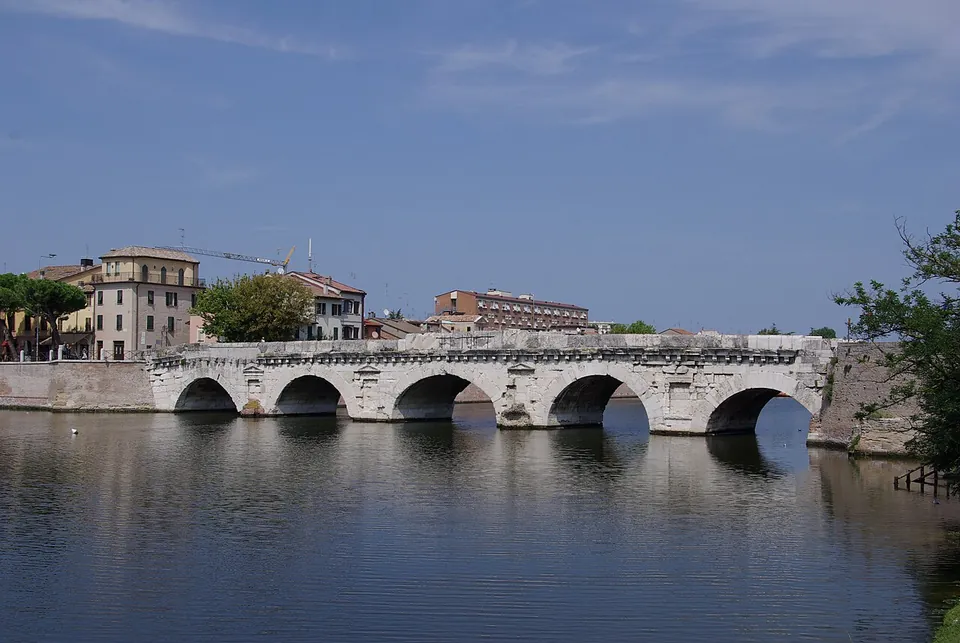
Photo: Flying Russian · CC BY-SA 3.0 · Commons
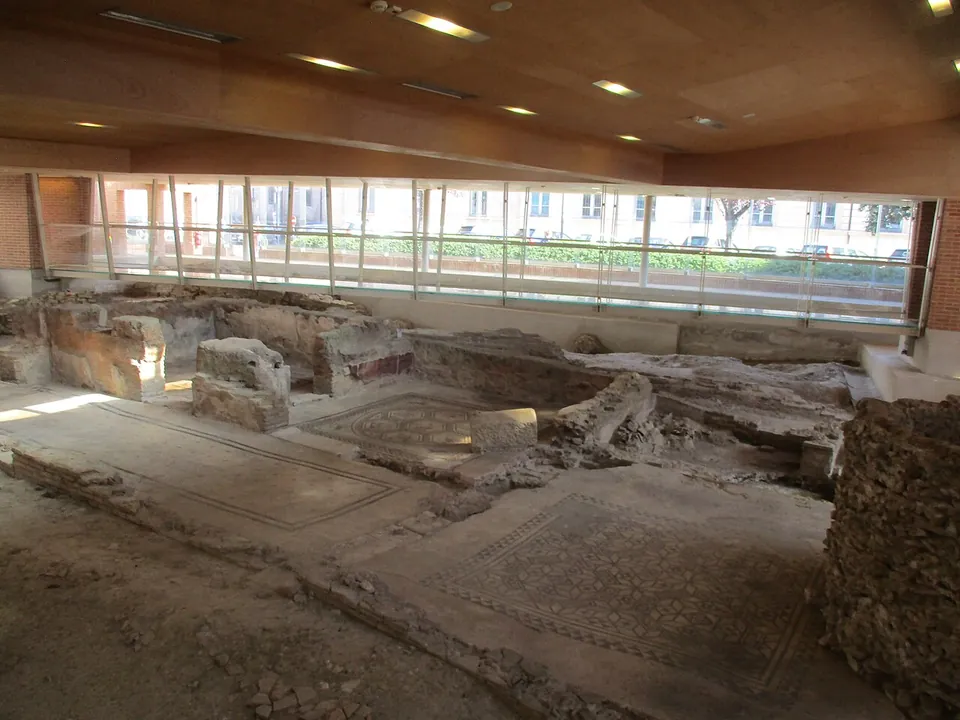
Photo: Capvalerio85 · CC BY-SA 4.0 · Commons
50 km · town house · Emilia-Romagna
Domus del Chirurgo
The excavation covers about 700 m², and the first mosaics lay some 2.5 m below the modern ground (it.wikipedia).
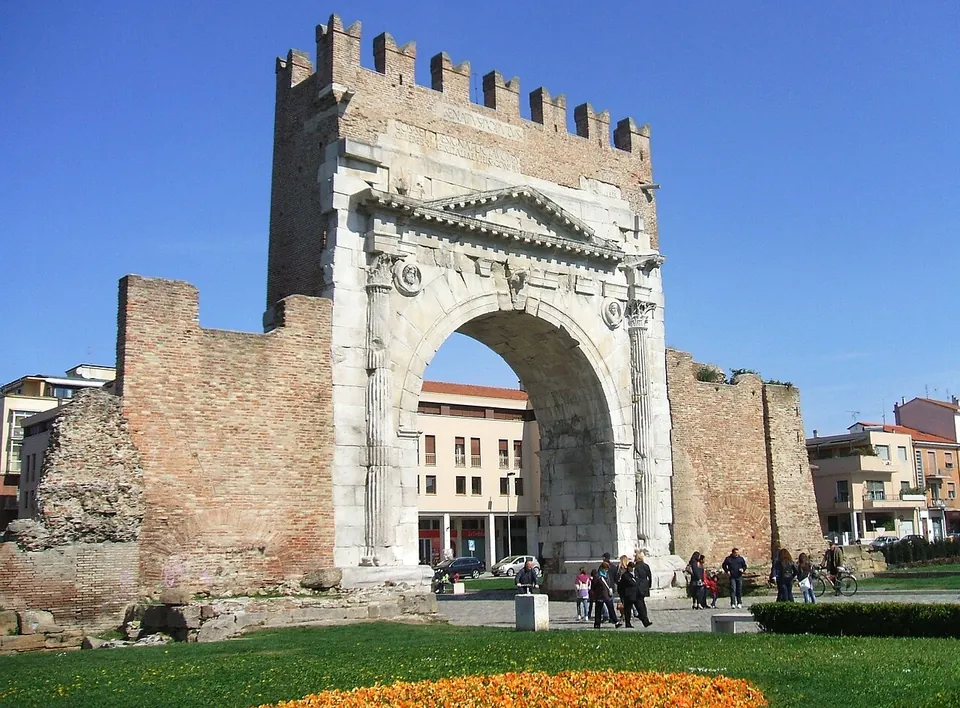
Photo: Il Malatestiano · CC BY-SA 4.0 · Commons
50 km · city · Emilia-Romagna
Ariminum – Rimini
The historic centre keeps the Roman town's street plan (en.wikipedia, Rimini), and its monuments are a short walk apart.


Straight-line distances.
Sources
Every fact on this page comes from the records below, each used under the licence noted.