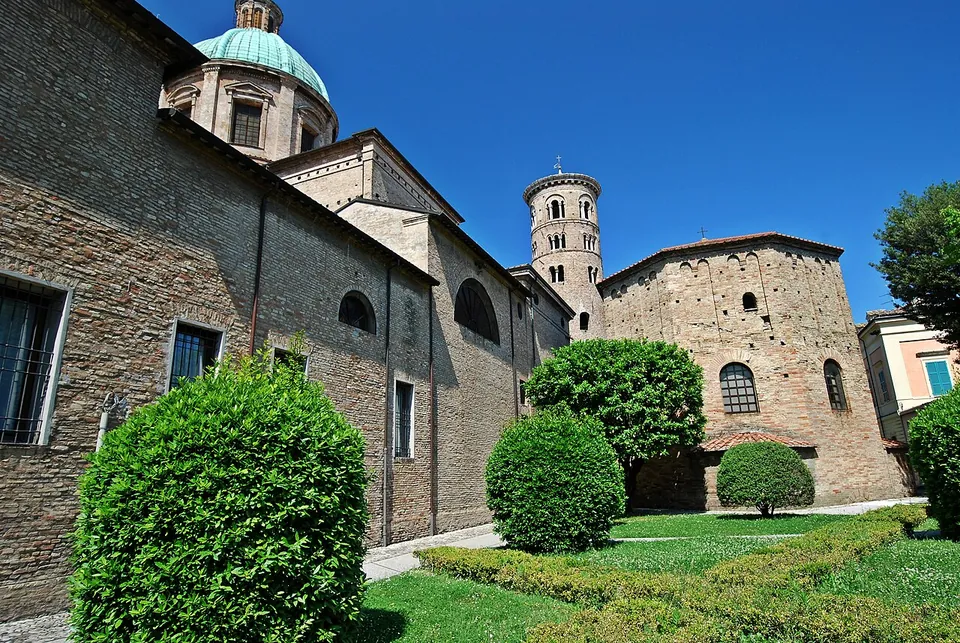


The Baptistry of Neon is the baptistery of Ravenna’s cathedral, a small octagonal brick building begun in the last decades of the Western Roman Empire, and the oldest monument still standing in the town (en.wikipedia; de.wikipedia). From outside it is plain brick. Inside, its dome is covered in 5th-century mosaic. The operator calls it the best-preserved baptistery in the world. It is entered only on the diocese’s combined ticket, from €12.50.
What is there today
Outside, plain brick walls with an arched window on each side and pairs of blind arches above, in a small garden between Piazza Duomo and Piazza Arcivescovado (it.wikipedia; the operator). The four small apses that stick out from the walls were added in the 10th or 11th century (it.wikipedia; fr.wikipedia). The ground has risen around the building: the original floor lies 2 to 3 m below today’s level (published figures differ), so you walk down a ramp to go in, and the building’s original proportions can no longer be seen (it.wikipedia; en.wikipedia; de.wikipedia; the operator).
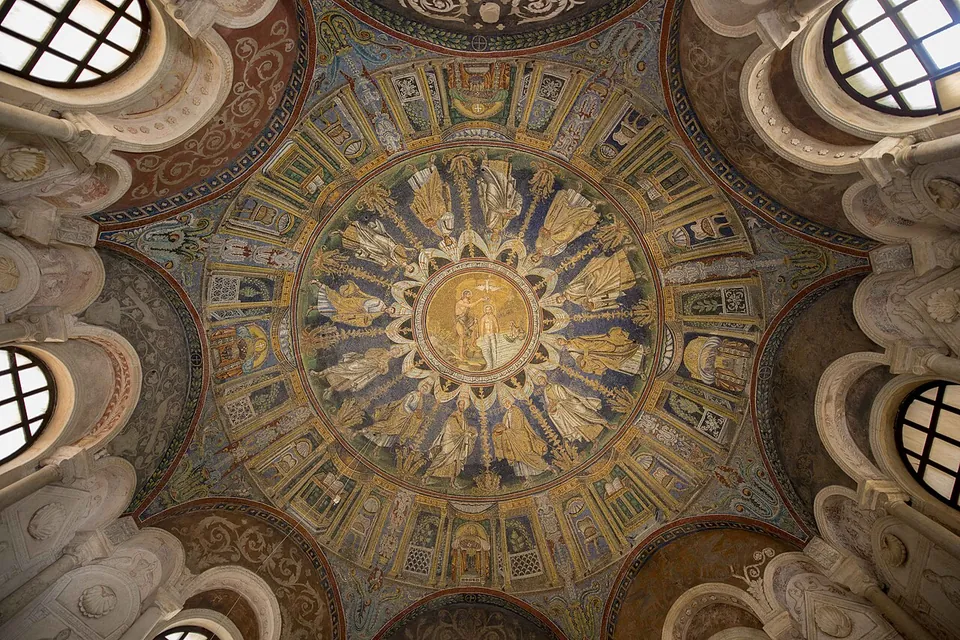
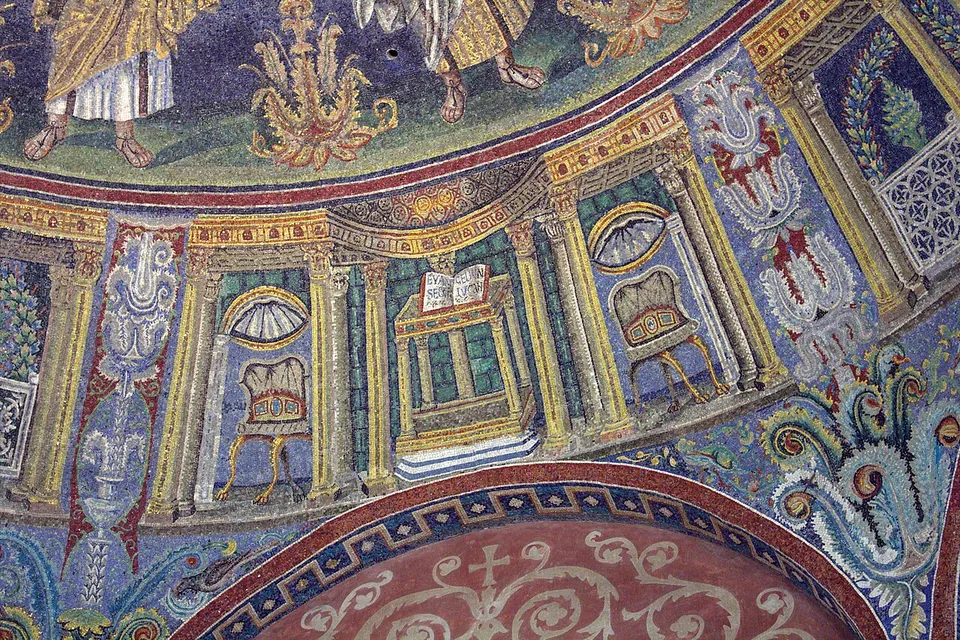
The dome is the reason to come. Bishop Neon replaced the original flat ceiling with it, building it light from terracotta tubes, and its mosaic is laid out as a central medallion with two rings around it (it.wikipedia; de.wikipedia; the operator). At the centre, on gold, John the Baptist baptises Christ, who stands waist-deep in the Jordan; the river itself appears as an old man rising from the water with a green reed, named by an inscription (the operator; it.wikipedia). Around them the twelve apostles, in white and gold robes on blue, walk in two files led by Peter and Paul, holding out crowns. In the outer ring, painted architecture frames altars bearing the open Gospels, alternating with empty thrones made ready for the Last Judgement (the operator; it.wikipedia; de.wikipedia; en.wikipedia for the two files of apostles).
Part of the medallion is not original. The heads of Christ and the Baptist and the bowl from which the Baptist pours water were remade in a later restoration, and the paler tesserae show where. Published accounts date that work to the 18th or the mid-19th century, and say the Baptist’s hand originally rested on Christ’s head (it.wikipedia; de.wikipedia; the operator).
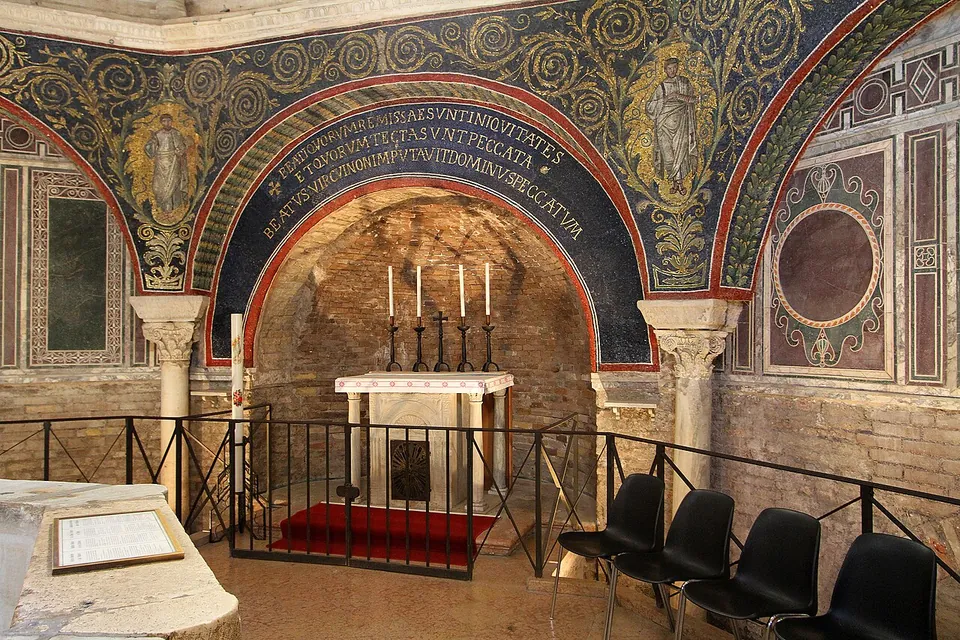
The walls are decorated in the same campaign. Around the windows stand sixteen prophets in stucco relief, once painted; low down, panels of porphyry and green marble fill blind arches, with vine scrolls in mosaic and four Latin inscriptions above the niches (it.wikipedia; de.wikipedia). Some of the stucco you see is a reconstruction: a restoration of 1897–1906 removed pieces it wrongly took for later additions (it.wikipedia). In the middle stands the octagonal marble font, put together in the 16th century from older pieces; only its small pulpit, the ambo from which the priest performed the baptism, carved from a single block of marble, is of the 5th century (de.wikipedia; it.wikipedia).
Is it worth the trip?
Yes, for anyone who has come to Ravenna for its mosaics. Of the earliest baptisteries, at Antioch, Constantinople, Ephesus, Trier, Milan, Aquileia and Rome, the operator notes, only the outer walls or the ground plan survive; here the architecture, the marble, the stucco and the mosaics are all in place. It is a room you take in by looking up.
It is also small, and the visit is short. Entry is at a booked time, and at busy times you may stay only five minutes inside (the operator). There is no ticket for the baptistery alone: it comes on the diocese’s combined itinerary with San Vitale, Sant’Apollinare Nuovo and the Mausoleum of Galla Placidia. It is one stop of Ravenna, and the Archbishop’s Museum and Chapel is next door.
Do not expect Roman ruins of the classical kind. This is a church building of the 5th century, the Roman world turned Christian.
Getting there and what it costs
The baptistery stands beside the cathedral in the pedestrian centre, reached on foot from Via Gioacchino Rasponi or from Piazza Arcivescovado, and the entrance is accessible to visitors with limited mobility, over a 2 cm threshold and down a ramp (the operator). Bus stops named Guerrini-INPS and p.zza Kennedy are about 110–120 m away, and Ravenna railway station is about 1 km away (OpenStreetMap). The nearest large car park, Largo Imperatore Giustiniano by San Vitale, is about 700 m away (OpenStreetMap).
It opens daily, 09.00–19.00 until 2 November 2026 and 10.00–17.00 from 3 November 2026 to 6 March 2027, with last entry 15 minutes before closing; it is closed on Christmas Day and New Year’s Day. Tickets are the diocese’s combined itineraries, valid seven days with one entry per monument: €12.50 with San Vitale, Sant’Apollinare Nuovo and the Mausoleum of Galla Placidia, or €14.50 adding the Archbishop’s Museum and Chapel. Students and groups of more than 20 pay €1 less; children aged 6 to 10 pay €2 (€4 on the larger ticket), and under-sixes go free. Book the entry time online, up to two hours ahead, or buy on the day at the ticket office in the Archbishop’s Museum, Piazza Arcivescovado 1, about 70 m away, while places last. Photographs for personal use are allowed, without flash (Opera di Religione della Diocesi di Ravenna, read 20 October 2026).
Visiting details
- Opening hours
- Daily 09.00–19.00 from 8 March to 2 November 2026 (last entry 18.45), and 10.00–17.00 from 3 November 2026 to 6 March 2027 (last entry 16.45). Closed on 25 December and 1 January. Entry is at a booked time.
- Tickets
- No single ticket - the baptistery is sold only on the diocese's combined itineraries, valid seven days with one entry per monument. €12.50 with San Vitale, Sant'Apollinare Nuovo and the Mausoleum of Galla Placidia (€11.50 for students and groups of more than 20; €2 for children aged 6–10 and other listed categories; free under 6), or €14.50 adding the Archbishop's Museum and Chapel (€13.50; €4).
- Parking
- The baptistery stands in a public garden in the pedestrian zone (the operator); cycle racks lie about 30 m away. The nearest large car park, Largo Imperatore Giustiniano by San Vitale (360 spaces, paid), is about 700 m away (OpenStreetMap way/26692616).
Before you go
- The entry time must be booked, online up to two hours ahead or at the ticket office in the Archbishop's Museum on the day, while places last.
- At busy times, and for groups, a visit inside is limited to five minutes.
- The 2026 tariff has no ticket for the baptistery alone; the cheapest that includes it is €12.50.
Hours and prices checked 20 October 2026 on the operator's own site. Confirm before travelling.
History
At the end of the 4th century the bishop’s seat moved from Classe to Ravenna, and Bishop Ursus began a new cathedral, the Basilica Ursiana; the baptistery was built beside it at the end of the 4th or the start of the 5th century (it.wikipedia; en.wikipedia). The cathedral was destroyed in 1734 and rebuilt in the 18th century (en.wikipedia; the operator); a few remains of Ursus’s church are built into today’s cathedral and the Archbishop’s Museum (it.wikipedia).
The baptistery is often said to stand partly on the site of a Roman bath (en.wikipedia), but it.wikipedia calls the story an old tradition without historical foundation.
It takes its name from Bishop Neon, who held the see from about 450 to the 470s (the operator gives 450–475, de.wikipedia 450–473). He replaced the flat timber-framed roof with the dome and had the interior decorated (it.wikipedia; fr.wikipedia; de.wikipedia). Published dates for the work differ: it.wikipedia puts the dome at about 458, en.wikipedia the completion and the mosaics at the end of the 5th century. Its other name, the Orthodox Baptistery, sets it apart from the Arian Baptistery that the Ostrogothic king Theodoric had built for his Arian Christians a few decades later (en.wikipedia; it.wikipedia).
It is still a working baptistery. It belongs to the cathedral parish, originally dedicated to St John; on his feast day in summer a Mass is said inside, and baptisms still take place here (the operator). It was inscribed on UNESCO’s World Heritage List in 1996 with seven other early Christian monuments of Ravenna (Pleiades; en.wikipedia).
More photographs

Nearby
Photo: Flying Russian · CC BY-SA 3.0 · Commons
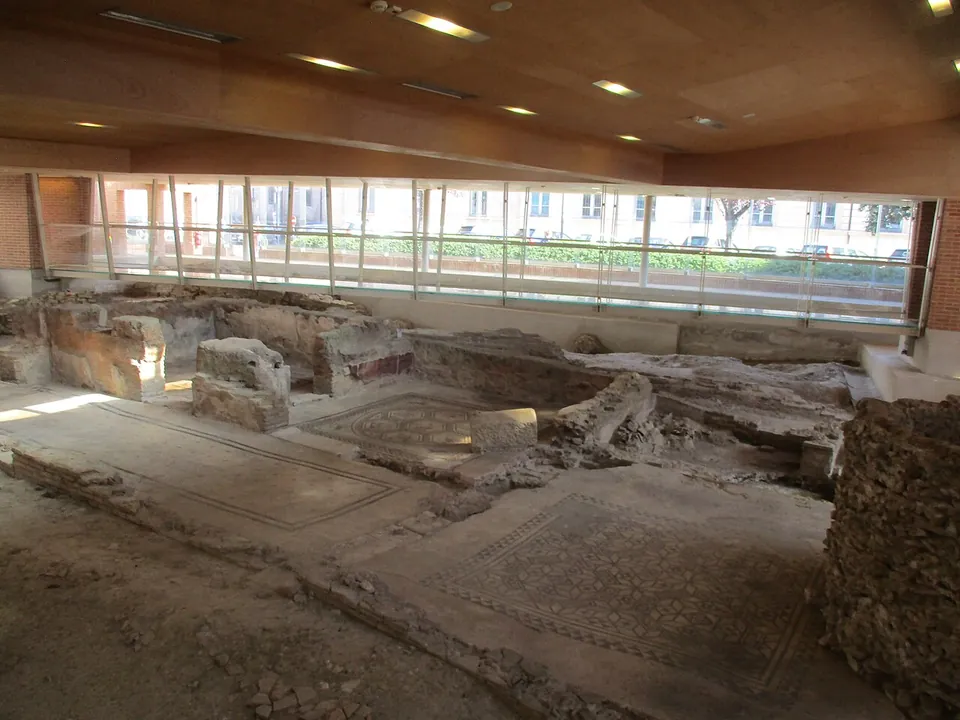
Photo: Capvalerio85 · CC BY-SA 4.0 · Commons
49 km · town house · Emilia-Romagna
Domus del Chirurgo
The excavation covers about 700 m², and the first mosaics lay some 2.5 m below the modern ground (it.wikipedia).
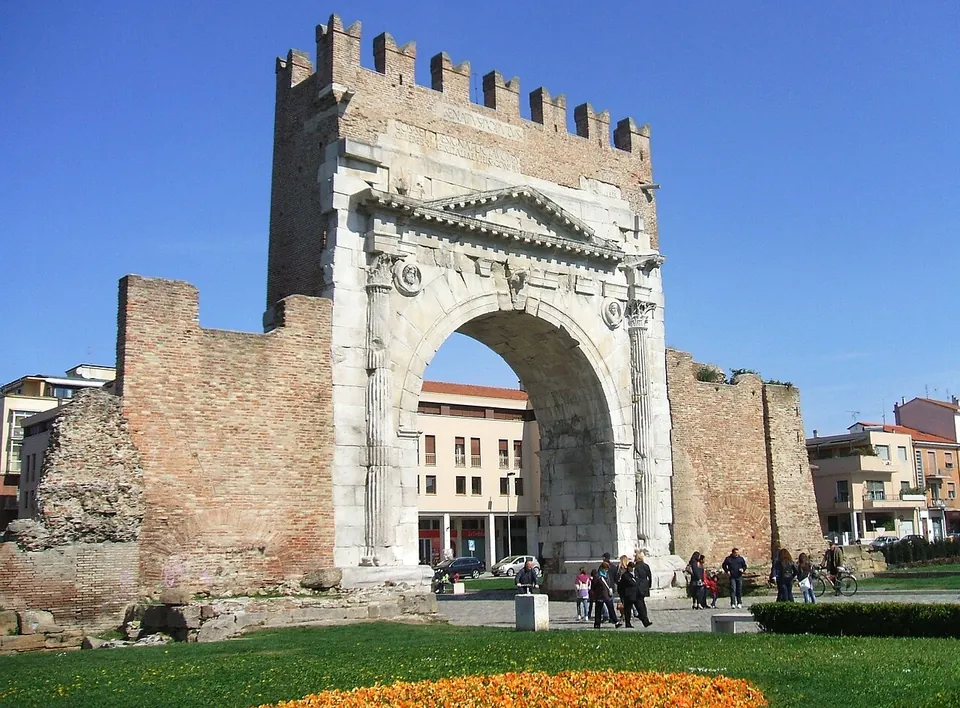
Photo: Il Malatestiano · CC BY-SA 4.0 · Commons
49 km · city · Emilia-Romagna
Ariminum – Rimini
The historic centre keeps the Roman town's street plan (en.wikipedia, Rimini), and its monuments are a short walk apart.


Straight-line distances.
Sources
Every fact on this page comes from the records below, each used under the licence noted.
| Source | Licence |
|---|---|
| Pleiades 529754545 | CC BY |
| Wikidata Q1256487 | CC0 |
| OpenStreetMap way/157923784 | ODbL |
| Pleiades — Ravenna | licence not recorded |
| Wikipedia (en) — Baptistery of Neon | CC BY-SA 4.0 |
| Wikipedia (it) — Battistero Neoniano | CC BY-SA 4.0 |
| Wikipedia (de) — Baptisterium der Kathedrale (Ravenna) | CC BY-SA 4.0 |
| Wikipedia (fr) — Baptistère des Orthodoxes | CC BY-SA 4.0 |
| Wikipedia (sl) — Neonova krstilnica | CC BY-SA 4.0 |
| Opera di Religione della Diocesi di Ravenna — Battistero Neoniano (the operator) | licence not recorded |
| Opera di Religione della Diocesi di Ravenna — hours and prices (the operator) | licence not recorded |
| Opera di Religione della Diocesi di Ravenna — FAQ (ticket validity, photography) | licence not recorded |