

What is there today
A cross-shaped room with a small vestibule in front of it, lined with marble below and mosaic above (en.wikipedia; it.wikipedia). Over the door into the vestibule, Christ is shown as a warrior in a purple cloak and breastplate, a long cross on his shoulder, treading on a lion and a serpent; the book in his hand reads Ego sum via, veritas et vita, “I am the way, the truth and the life”. The vestibule’s barrel vault is a pergola, in mosaic and paint, full of birds - doves, partridges, ducks, parrots, small peacocks (the operator).
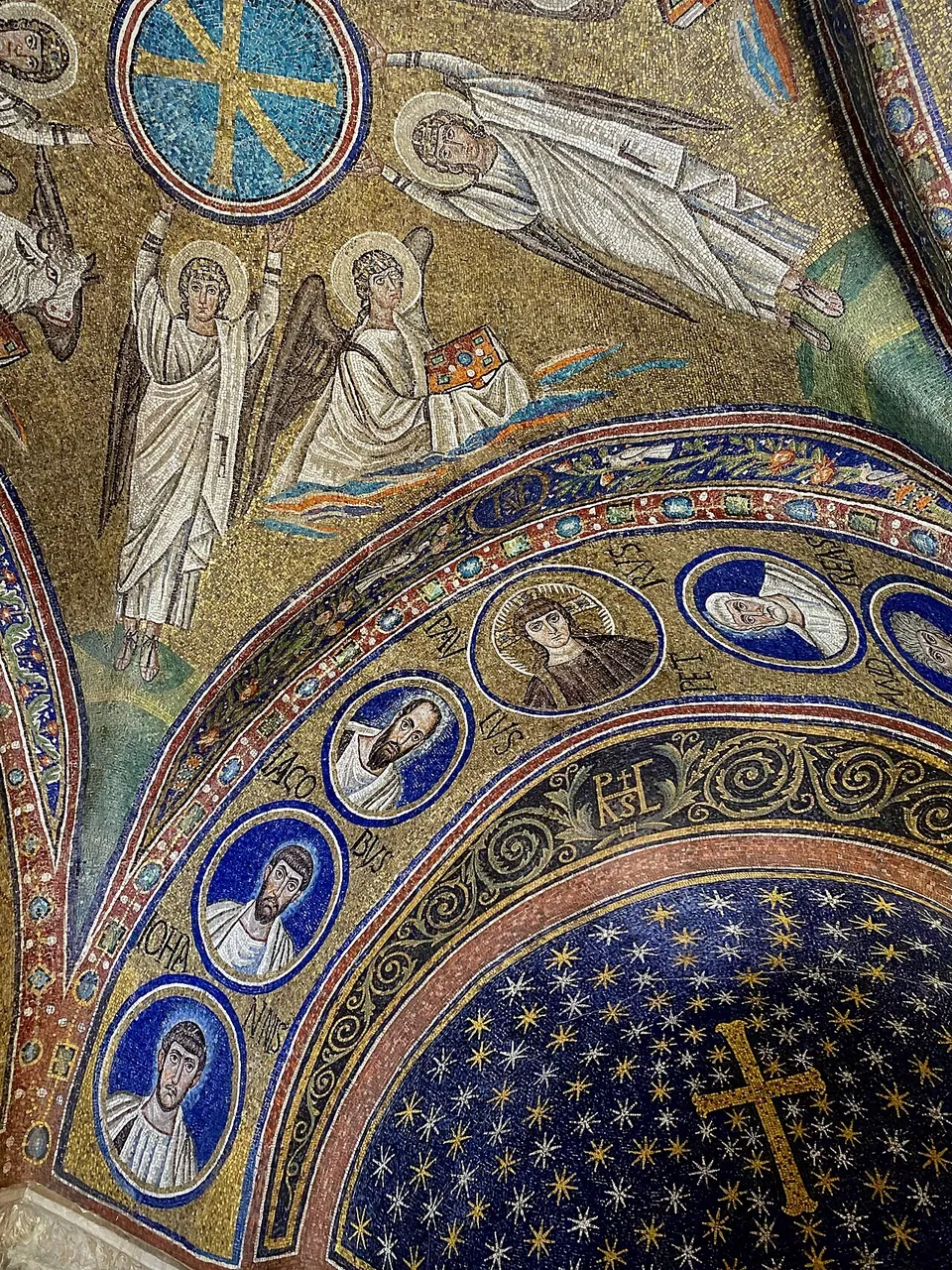
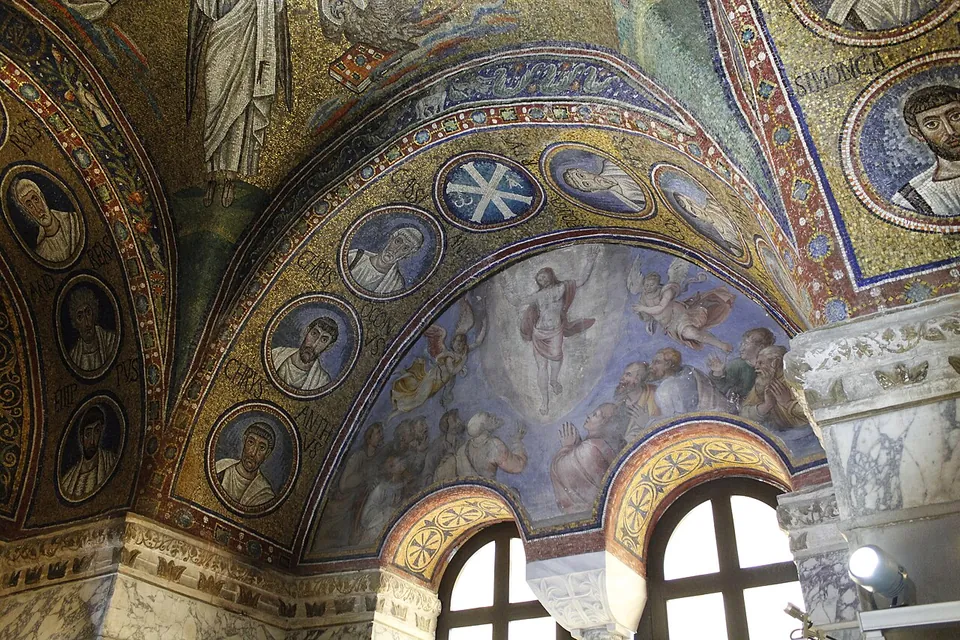
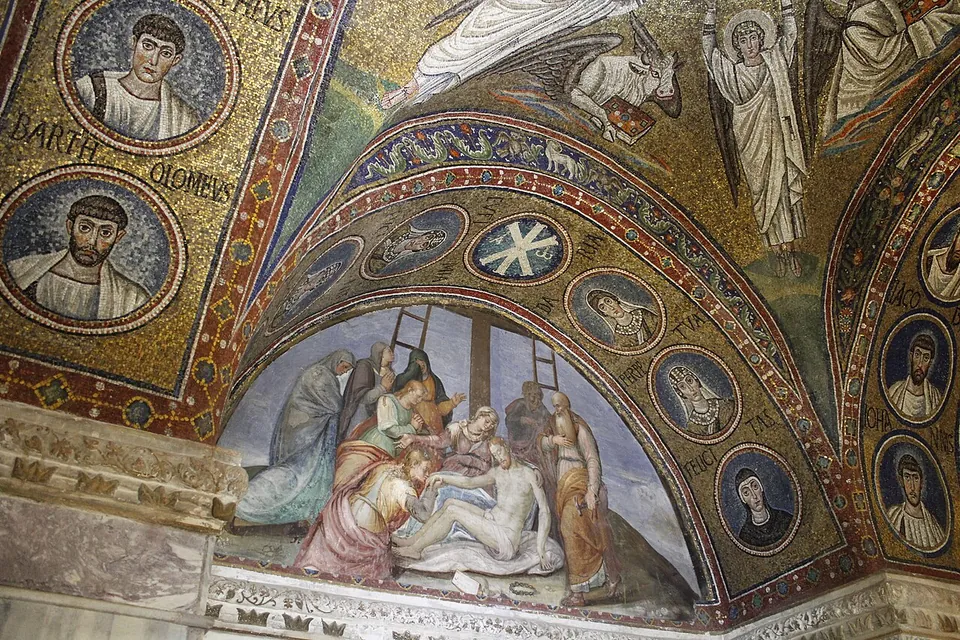
In the chapel itself, four white-robed angels hold up the monogram of Christ at the top of the vault, with the symbols of the four Evangelists between them; on the undersides of the four arches are medallion portraits of Christ, the apostles and martyrs (the operator; it.wikipedia). Not everything is from the 490s. Much of the wall mosaic was replaced in the 16th century with paintings by Luca Longhi, among them the two side lunettes, and the arm of the cross that holds the apse was rebuilt in 1917 (en.wikipedia; it.wikipedia).
The chapel is reached through the museum, which takes up two floors of the palace. Its best-known piece is the ivory throne of Bishop Maximian; it also keeps a headless porphyry statue, probably of an emperor, a 6th-century marble Easter calendar, the silver cross of Bishop Agnellus and mosaics from the apse of the old cathedral (the operator).
Is it worth the trip?
As part of a day in Ravenna, yes - it is next door to the Baptistery of Neon, and it belongs to the same UNESCO listing as the city’s famous mosaic buildings (it.wikipedia). Not as a trip of its own: en.wikipedia calls it the smallest of Ravenna’s mosaic sites, one small room and its vestibule, and at busy times, and for groups, the operator limits a visit to the whole museum to 25 minutes.
It also cannot be bought on its own. The chapel and museum are only on the diocese’s five-monument ticket, €14.50, which is €2 more than the four-monument ticket for San Vitale, Sant’Apollinare Nuovo, the Mausoleum of Galla Placidia and the Baptistery of Neon (the operator). For €2 it is an easy addition; it is not a reason to come to Ravenna.
Getting there and what it costs
The chapel is in the Archbishop’s Palace on Piazza Arcivescovado, next to the cathedral and the Baptistery of Neon; the museum’s ticket office is at Piazza Arcivescovado 1 (the operator). The nearest bus stops, Guerrini-INPS and Piazza Kennedy, are about 110-120 m away, and the railway station square about 1 km (OpenStreetMap). No car park is mapped close by, only bicycle racks about 30 m away; drivers can use the large car park at Largo Imperatore Giustiniano, by the Mausoleum of Galla Placidia (OpenStreetMap).
It is open daily, 09.00 to 19.00 (last entry 18.30) until 2 November 2026, and 10.00 to 17.00 (last entry 16.30) from 3 November 2026 to 6 March 2027; closed on Christmas Day and New Year’s Day. The five-monument ticket is €14.50, €13.50 for students and groups of more than 20, €4 for children aged 6 to 10, and free under 6; it is valid for seven days, one entry per monument. Entry to the museum is at a booked time; tickets for the same day are sold at the museum’s ticket office while places last. The way in is by the bookshop and up a staircase; visitors with limited mobility are taken to a goods lift through the garden, and there are two steps into the chapel (the operator, read 24 October 2026 - check before travelling).
Visiting details
- Opening hours
- Daily 09.00–19.00 (last entry 18.30) from 8 March to 2 November 2026; daily 10.00–17.00 (last entry 16.30) from 3 November 2026 to 6 March 2027. Closed on Christmas Day and New Year's Day.
- Tickets
- Only on the diocese's five-monument ticket, €14.50 (with San Vitale, Sant'Apollinare Nuovo, the Mausoleum of Galla Placidia and the Baptistery of Neon), valid seven days, one entry per monument. €13.50 for students and groups of more than 20; €4 for children aged 6 to 10 and other listed categories; free under 6.
- Parking
- No car park is mapped near the chapel, only bicycle racks about 30 m away (OpenStreetMap); the large car park at Largo Imperatore Giustiniano, by the Mausoleum of Galla Placidia, is the one for drivers (OpenStreetMap).
Before you go
- Entry to the Archbishop's Museum and the chapel is at a booked time; tickets for the same day are sold at the museum while places last.
- At busy times, and for groups, a visit to the museum is limited to 25 minutes.
- The way in is up a staircase; visitors with limited mobility are taken to a goods lift through the garden, and two steps lead into the chapel.
Hours and prices checked 24 October 2026 on the operator's own site. Confirm before travelling.
History
The chapel is commonly attributed to Peter Chrysologus, archbishop from 433 to 450, but it was built by Peter II, archbishop from 494 to 519, shortly after he took office (en.wikipedia; de.wikipedia). The mosaics date from the building or soon after (en.wikipedia). This was the reign of the Ostrogothic king Theodoric, an Arian Christian, and the chapel is the only building for the Catholic (Nicene) faith put up in Ravenna in those years (it.wikipedia; the operator). Its imagery says so: ICOMOS singles out its “strongly anti-Arian symbolism”, Christ trampling the beasts over the door among it (en.wikipedia; it.wikipedia).
Today the chapel is dedicated to Saint Andrew, but it was first dedicated to Christ the Saviour, as the warrior Christ over the door shows (en.wikipedia; de.wikipedia). It became part of the museum in the early 18th century, when Archbishop Maffeo Nicolò Farsetti, having demolished and rebuilt the old Ursiana cathedral, gathered its mosaics, inscriptions and capitals in one place (the operator). With the city’s other early Christian monuments it was inscribed on UNESCO’s World Heritage List in 1996 (it.wikipedia; Pleiades).
Nearby
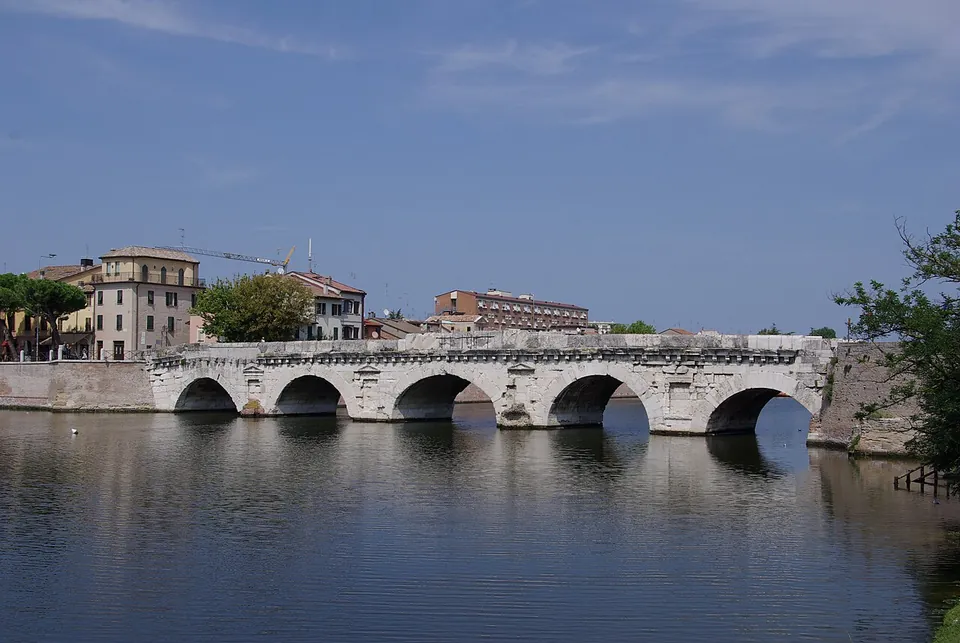
Photo: Flying Russian · CC BY-SA 3.0 · Commons
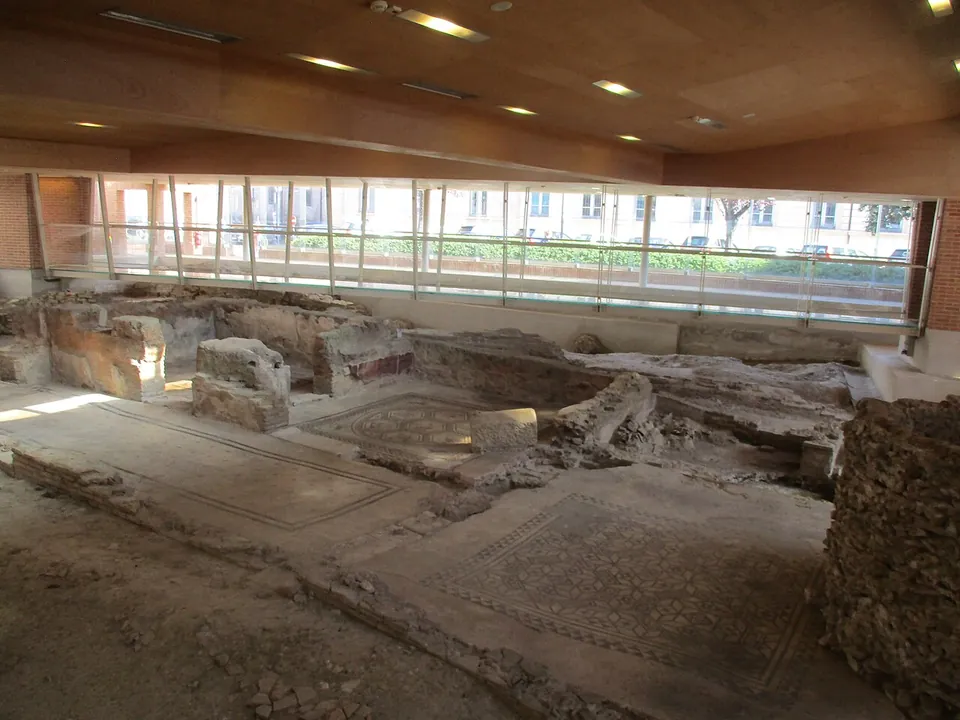
Photo: Capvalerio85 · CC BY-SA 4.0 · Commons
49 km · town house · Emilia-Romagna
Domus del Chirurgo
The excavation covers about 700 m², and the first mosaics lay some 2.5 m below the modern ground (it.wikipedia).
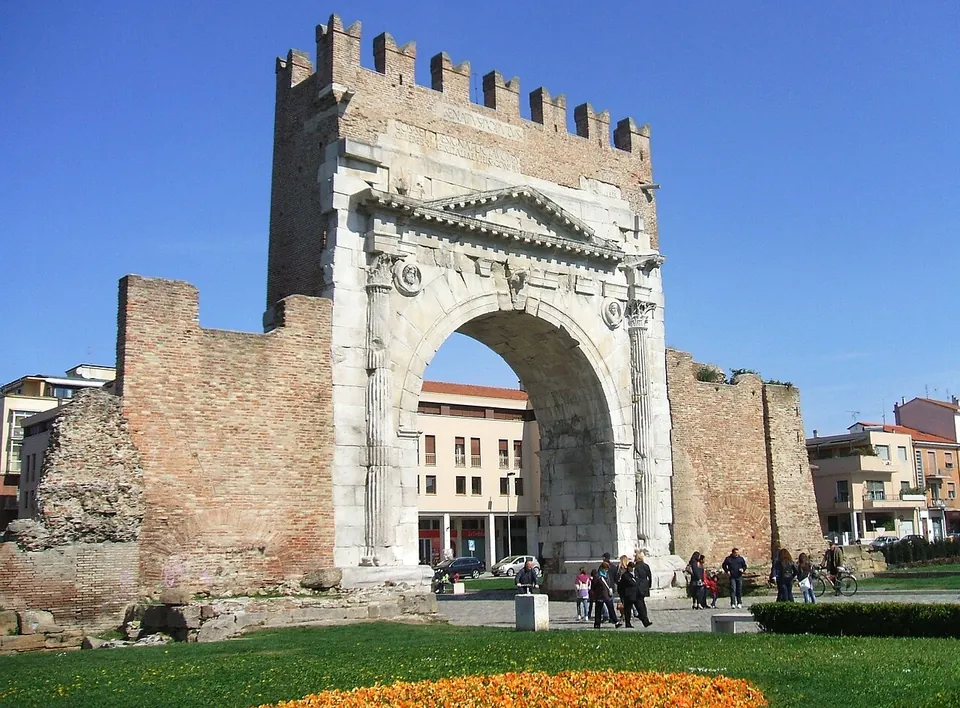
Photo: Il Malatestiano · CC BY-SA 4.0 · Commons
49 km · city · Emilia-Romagna
Ariminum – Rimini
The historic centre keeps the Roman town's street plan (en.wikipedia, Rimini), and its monuments are a short walk apart.


Straight-line distances.
Sources
Every fact on this page comes from the records below, each used under the licence noted.
| Source | Licence |
|---|---|
| Pleiades 51062012 | CC BY |
| Wikidata Q600062 | CC0 |
| Wikipedia (en) — Archbishop's Chapel | CC BY-SA 4.0 |
| Wikipedia (de) — Erzbischöfliche Kapelle (Ravenna) | CC BY-SA 4.0 |
| Wikipedia (it) — Cappella Arcivescovile | CC BY-SA 4.0 |
| Wikipedia (fr) — Chapelle archiépiscopale (Ravenne) | CC BY-SA 4.0 |
| UNESCO World Heritage Centre — Early Christian Monuments of Ravenna | licence not recorded |
| Opera di Religione della Diocesi di Ravenna — Cappella di Sant'Andrea e Museo Arcivescovile (the operator) | licence not recorded |
| Opera di Religione della Diocesi di Ravenna — hours and prices (the operator) | licence not recorded |
| Opera di Religione della Diocesi di Ravenna — FAQ (ticket validity) | licence not recorded |