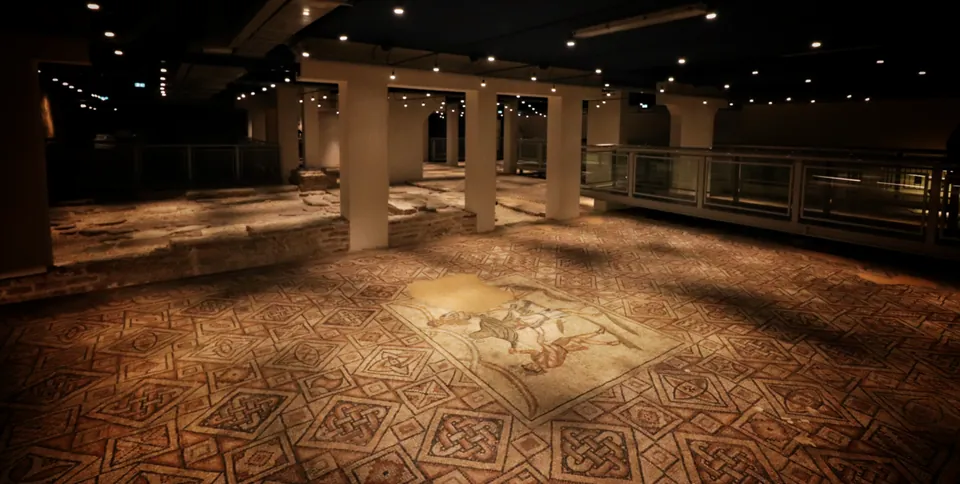
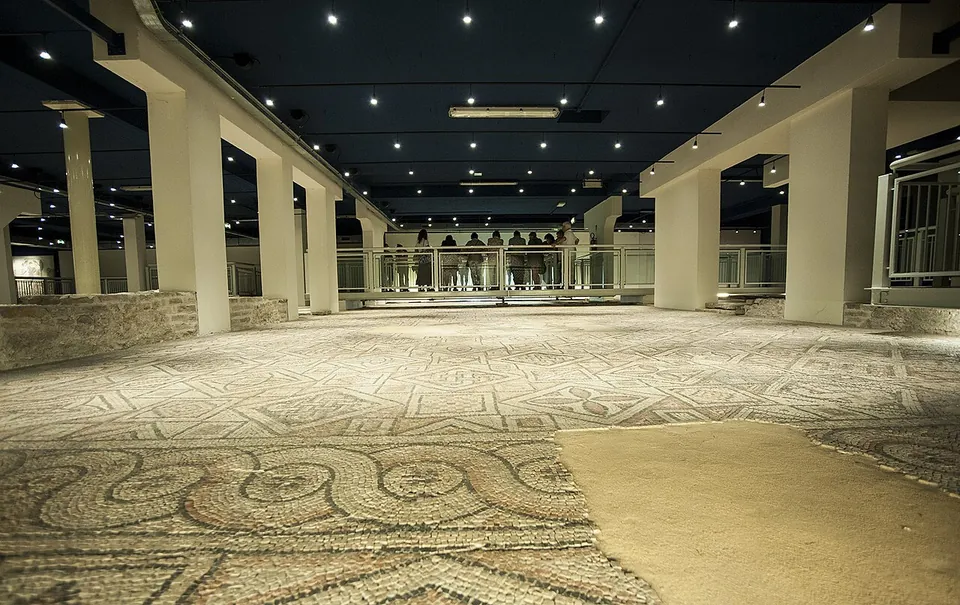


The Domus dei Tappeti di Pietra, the “house of the stone carpets”, is a late Roman house in the centre of Ravenna whose mosaic floors were found in 1993 and are now shown in a modern hall about 3 m below today’s street level (it.wikipedia; de.wikipedia). More than 400 square metres of polychrome mosaic and marble flooring survive, from a residence of the 5th–6th century AD (RavennAntica).
What is there today
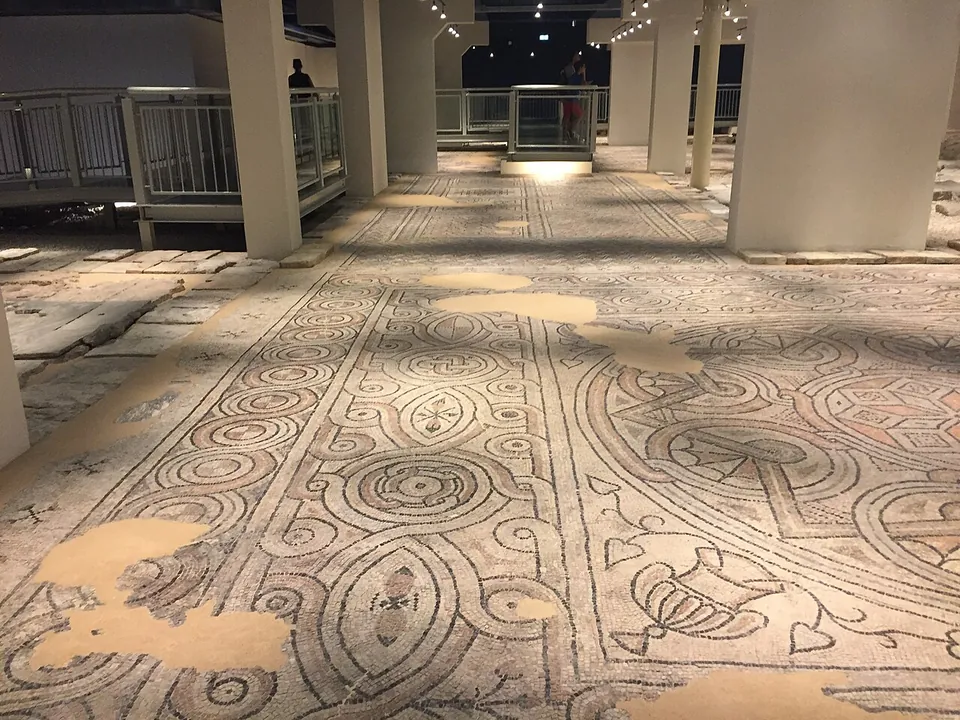
You go in through the small 18th-century church of Sant’Eufemia and down into a modern underground hall, then follow a raised walkway along the rooms of the house, close to the floors: the reception hall where visitors were received, and private rooms, corridors, courtyards and nymphaea, or fountain rooms (RavennAntica). Published figures for the area of the mosaics run from 400 to 700 square metres (RavennAntica; it.wikipedia); either way, this is a large spread of floor, decorated with geometric and plant motifs and a few figured scenes (de.wikipedia; it.wikipedia).
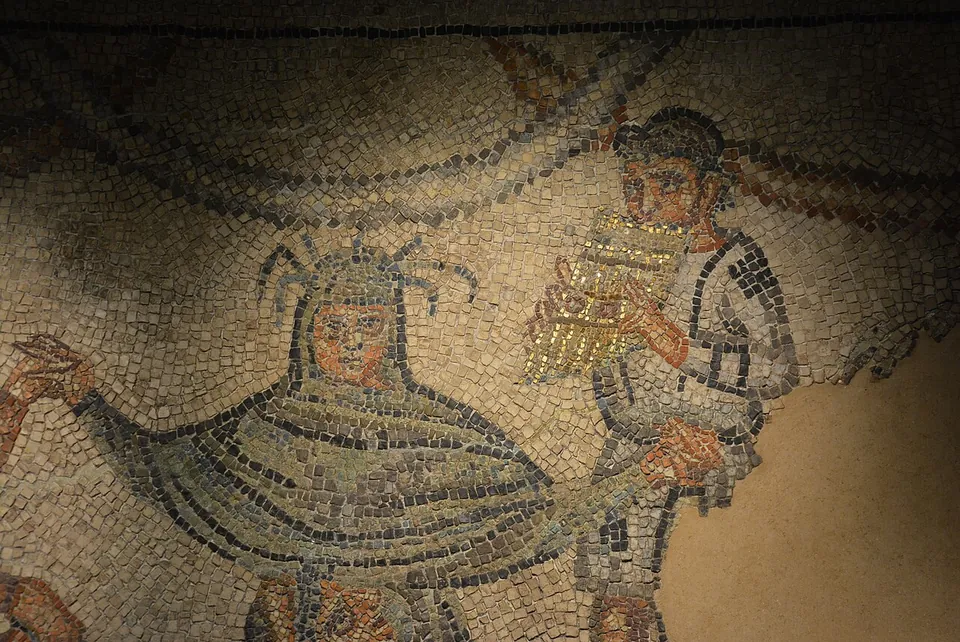
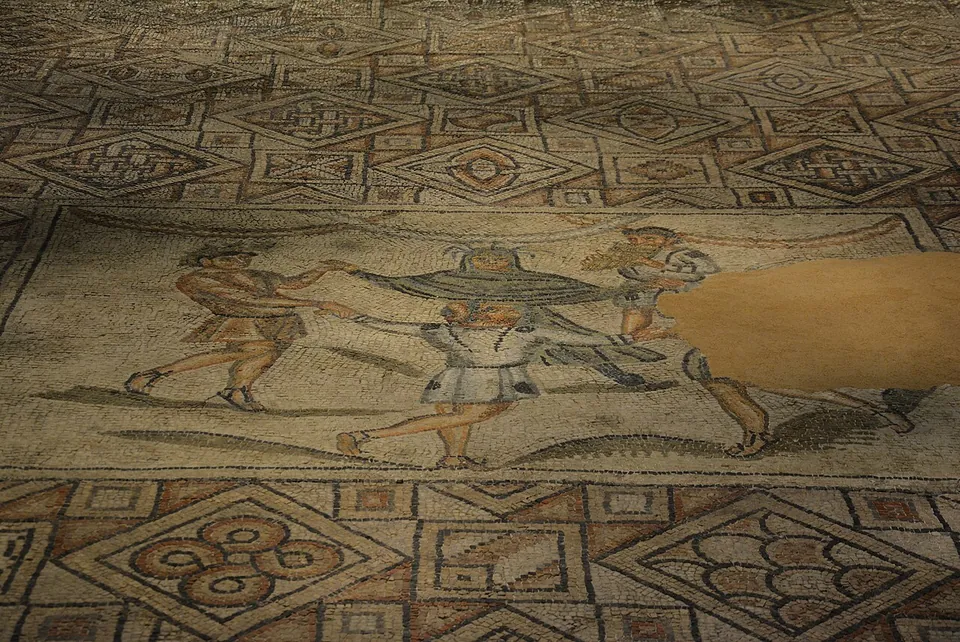
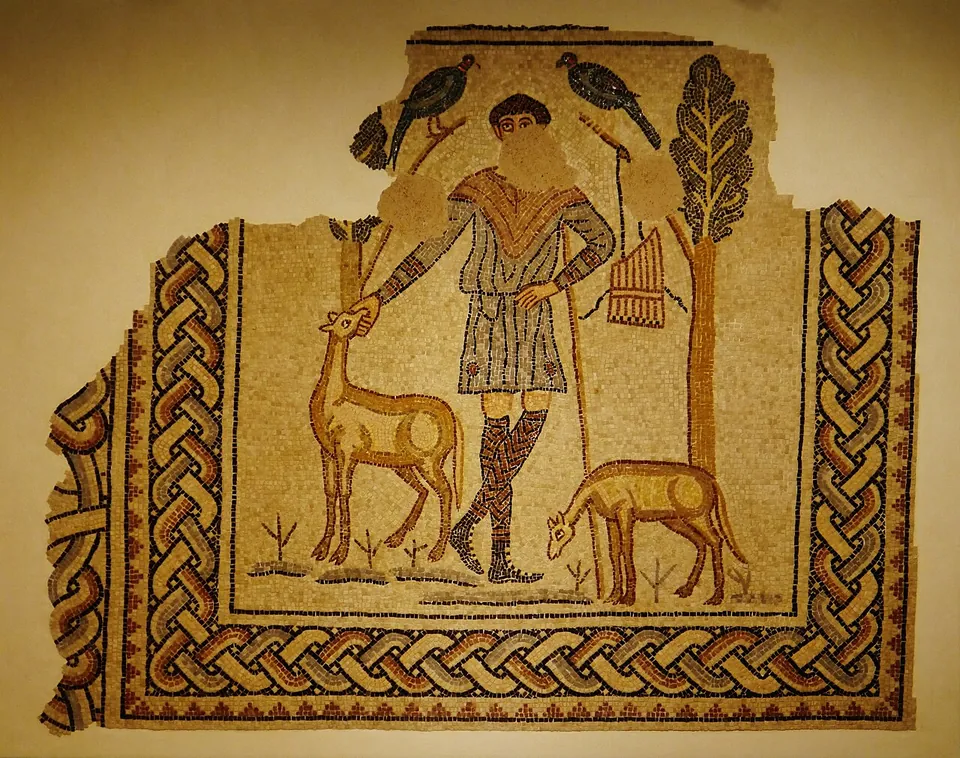
Two figured mosaics are the ones people come for. The Dance of the Genii of the Seasons, the central panel of a large floor, shows the Seasons dancing hand in hand in a ring to the music of a pan pipe, a very rare way of showing them (RavennAntica). Spring wears red and a crown of roses, Autumn white and Winter a green cloak; Summer, whose hands the other two hold, is lost, and a piper stands at the upper right (it.wikipedia). The Good Shepherd is a young, short-haired figure in a tunic between two fawns, drawn on the model of Orpheus; the operator notes that it lacks some of the marks of a sacred image but may still have had a Christian meaning (RavennAntica). It is more damaged than the Dance, with half the face lost, and the panel on display is a copy: the original is in the museum at Classe (it.wikipedia). The visit begins and ends in the church, which holds paintings from the Barbiani workshop (the site’s own website).
Is it worth the trip?
If you are in Ravenna for the mosaics, yes. It is a few minutes’ walk from San Vitale, it costs €6, and it shows mosaic as the flooring of a grand house, where the churches the town is famous for show it on their walls and vaults. The Dance of the Seasons alone is worth the detour. Be clear about what it is: a house reduced to its floors, seen from a walkway under a modern roof, not a building you walk through. It complements the town’s UNESCO monuments; it is not a reason on its own to travel to Ravenna.
Getting there and what it costs
The entrance is at Via Barbiani 16, through the church of Sant’Eufemia (RavennAntica), about 200 m from the Basilica of San Vitale and about 1 km in a straight line from Ravenna railway station (OpenStreetMap). Bus stops named p.zza Baracca and D’Azeglio are within about 120 m, and the nearest car park, the paying one in Piazza Francesco Baracca, is about 120 m away (OpenStreetMap).
It opens 10.00–17.00 every day until 8 November 2026; from 9 November it is open Tuesday to Sunday and closed on Mondays. Last entry is 20 minutes before closing. A ticket is €6, reduced €5 or €4; children under 6 go free, as do under-26s every Wednesday and disabled visitors with a companion, among others (RavennAntica’s official ticket office, read 23 October 2026 - check before travelling). Guided visits are arranged on request through RavennAntica’s booking office (RavennAntica). The Domus has its own ticket, sold by RavennAntica: the diocese’s combined tickets for San Vitale and the other churches do not include it (Opera di Religione della Diocesi di Ravenna).
Visiting details
- Opening hours
- 10.00–17.00, daily until 8 November 2026; from 9 November Tuesday to Sunday, closed on Mondays. Last entry 20 minutes before closing.
- Tickets
- €6; reduced €5, or €4 for the special reduced rate and school pupils; free for children under 6, for under-26s every Wednesday, and for disabled visitors with a companion, among other listed categories.
- Parking
- Piazza Francesco Baracca, a paying car park of about 65 spaces, is about 120 m from the entrance (OpenStreetMap way/249206740).
Before you go
- The entrance is through the small church of Sant'Eufemia at Via Barbiani 16; Via D'Azeglio 47, an address some descriptions give, is where the floors were excavated.
Hours and prices checked 23 October 2026 on the operator's own site. Confirm before travelling.
History
The site was found by chance in 1993, during building work for underground garages at Via D’Azeglio 47. What came to light was a palace decorated throughout with mosaics and marble inlay, dated to the Byzantine period (it.wikipedia); the operator dates the complex to the 5th–6th century and calls it late antique, while de.wikipedia narrows it to the 6th century. The name, “stone carpets”, was coined by Federico Zeri (RavennAntica).
Of the complicated archaeology the dig uncovered, it was decided to present the rooms and mosaic floors of the late antique house, in a modern installation (RavennAntica). The Domus was opened on 30 October 2002 by the President of the Republic, Carlo Azeglio Ciampi, during the celebrations of 1,600 years since Ravenna became capital of the Western Roman Empire (it.wikipedia). It won the Premio Bell’Italia in 2004 and the Premio Francovich in 2017 (RavennAntica).
More photographs



Nearby
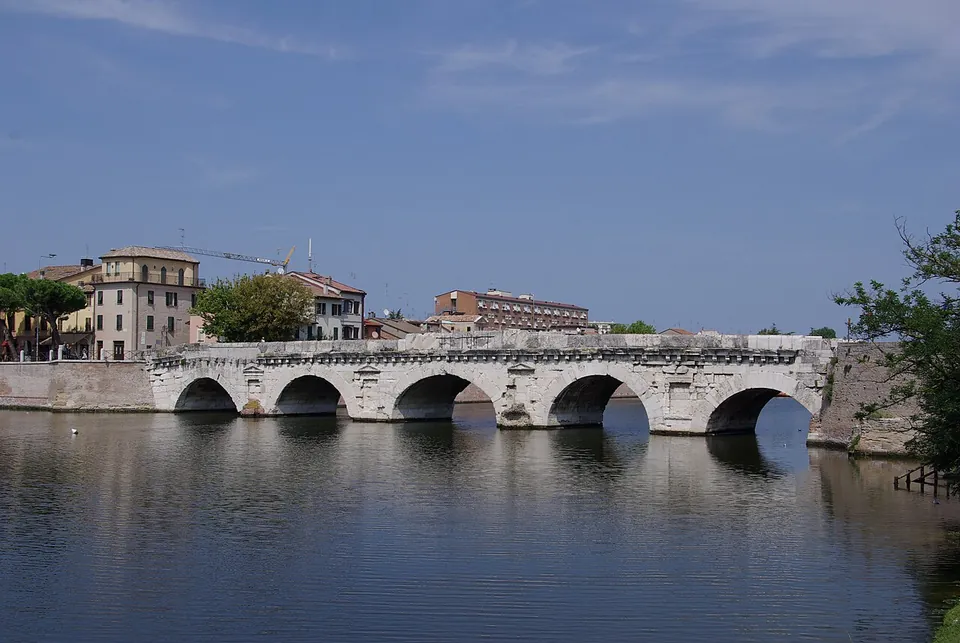
Photo: Flying Russian · CC BY-SA 3.0 · Commons
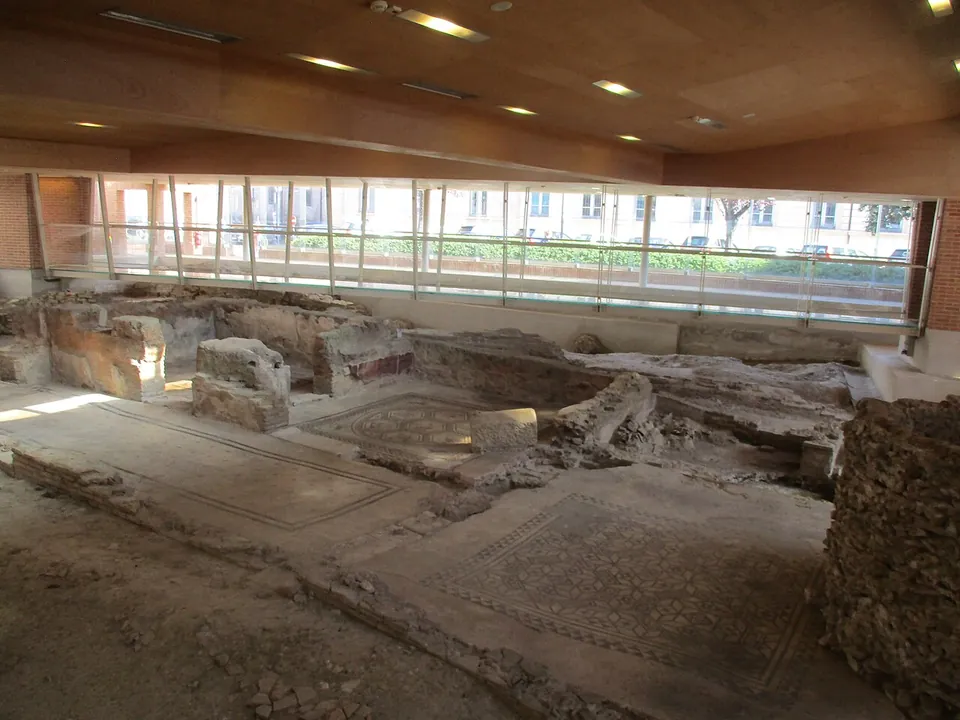
Photo: Capvalerio85 · CC BY-SA 4.0 · Commons
50 km · town house · Emilia-Romagna
Domus del Chirurgo
The excavation covers about 700 m², and the first mosaics lay some 2.5 m below the modern ground (it.wikipedia).
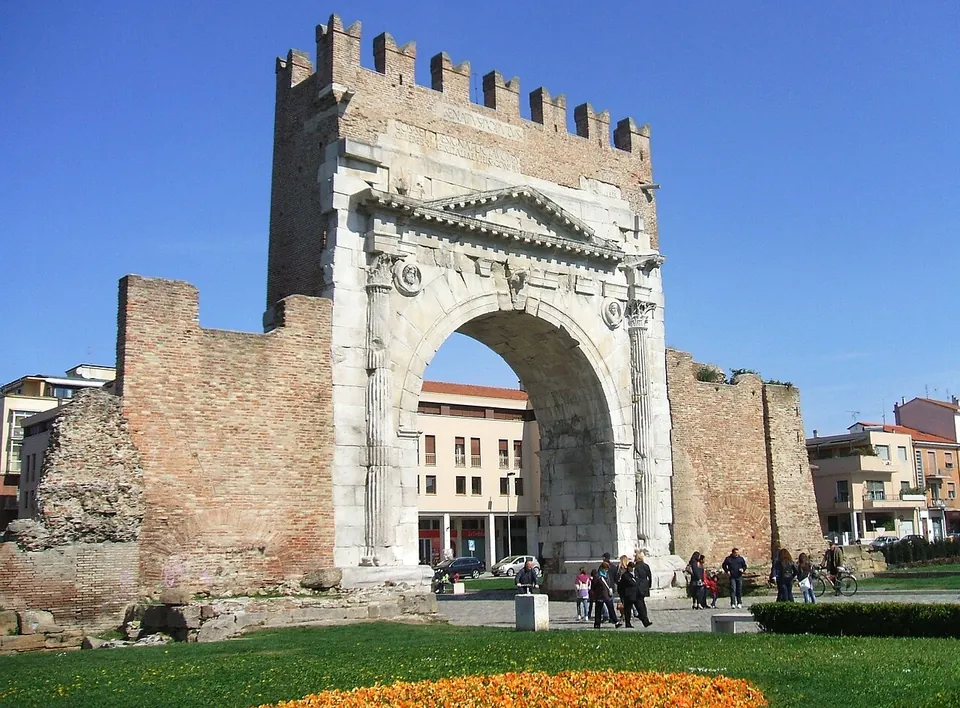
Photo: Il Malatestiano · CC BY-SA 4.0 · Commons
50 km · city · Emilia-Romagna
Ariminum – Rimini
The historic centre keeps the Roman town's street plan (en.wikipedia, Rimini), and its monuments are a short walk apart.


Straight-line distances.
Sources
Every fact on this page comes from the records below, each used under the licence noted.
| Source | Licence |
|---|---|
| Wikidata Q1238780 | CC0 |
| Vici.org 100448 | CC BY-SA (text), CC0 (metadata) |
| OpenStreetMap node/4031165344 | ODbL |
| Wikipedia (it) — Domus dei tappeti di pietra | CC BY-SA 4.0 |
| Wikipedia (de) — Domus dei Tappeti di Pietra | CC BY-SA 4.0 |
| RavennAntica — Domus dei Tappeti di Pietra (the operator) | licence not recorded |
| Domus dei Tappeti di Pietra — the site's own website (RavennAntica) | licence not recorded |
| RavennAntica — Domus dei Tappeti di Pietra, hours and tickets (official ticket office) | licence not recorded |
| Opera di Religione della Diocesi di Ravenna — hours and prices (its combined tickets) | licence not recorded |