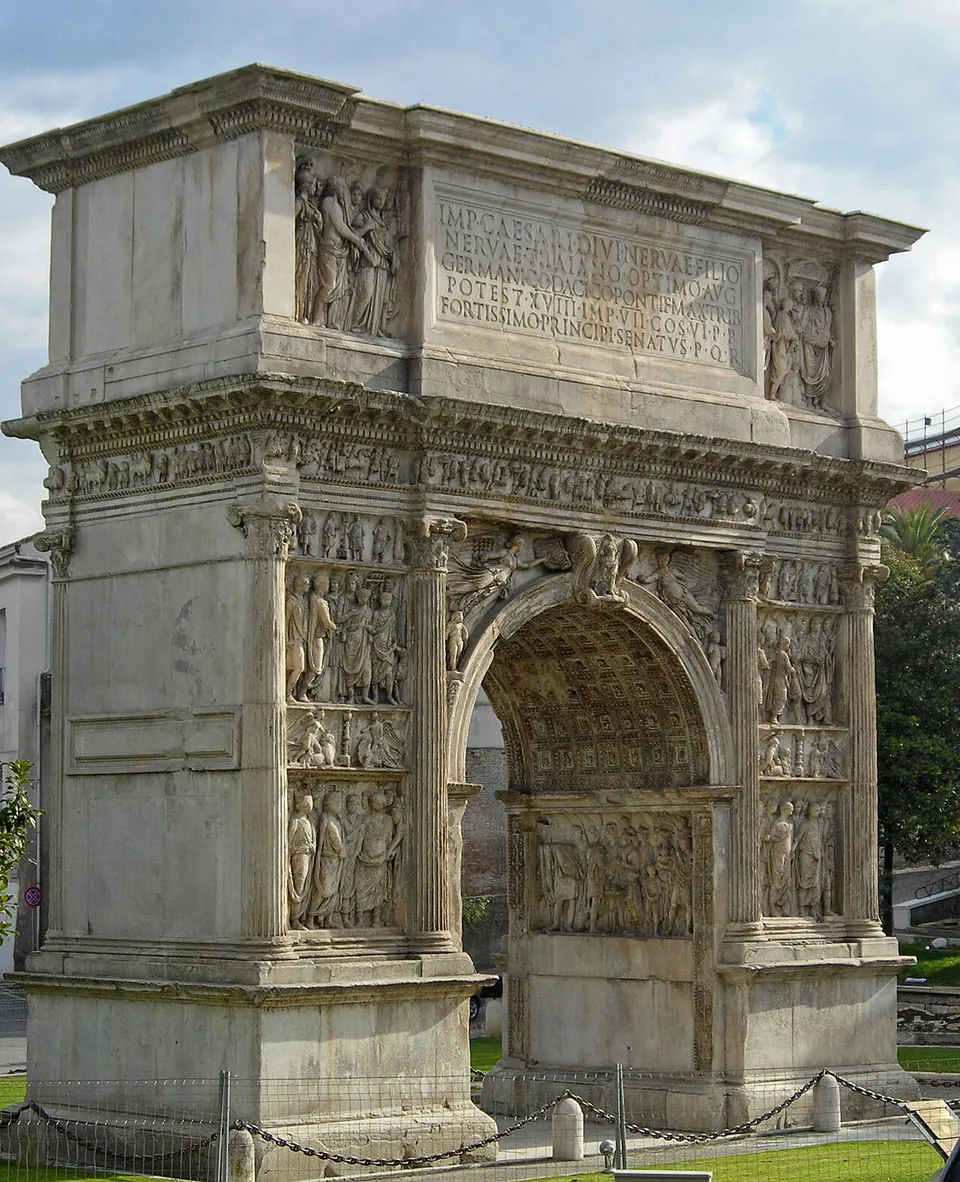
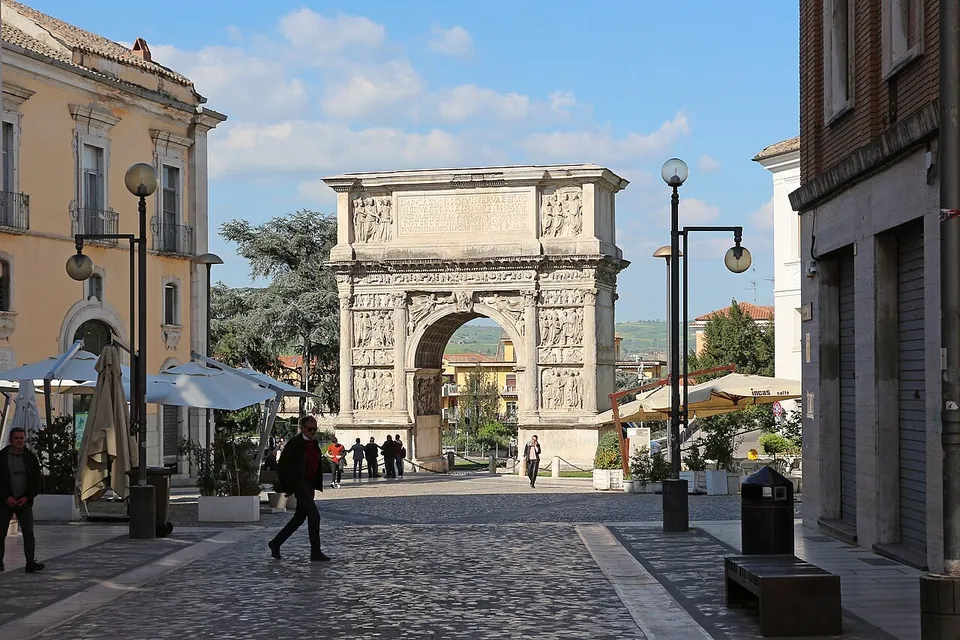
The Arch of Trajan is a single-arched Roman honorary arch at the edge of Benevento’s old town, put up between 114 and 117 at the start of the Via Traiana, Trajan’s shorter variant of the Via Appia to Brindisi, and it has come down substantially intact, its reliefs included (it.wikipedia; de.wikipedia). Until about March 2027, though, it stands in restoration scaffolding (the Ministry of Culture; a press report).
What is there today
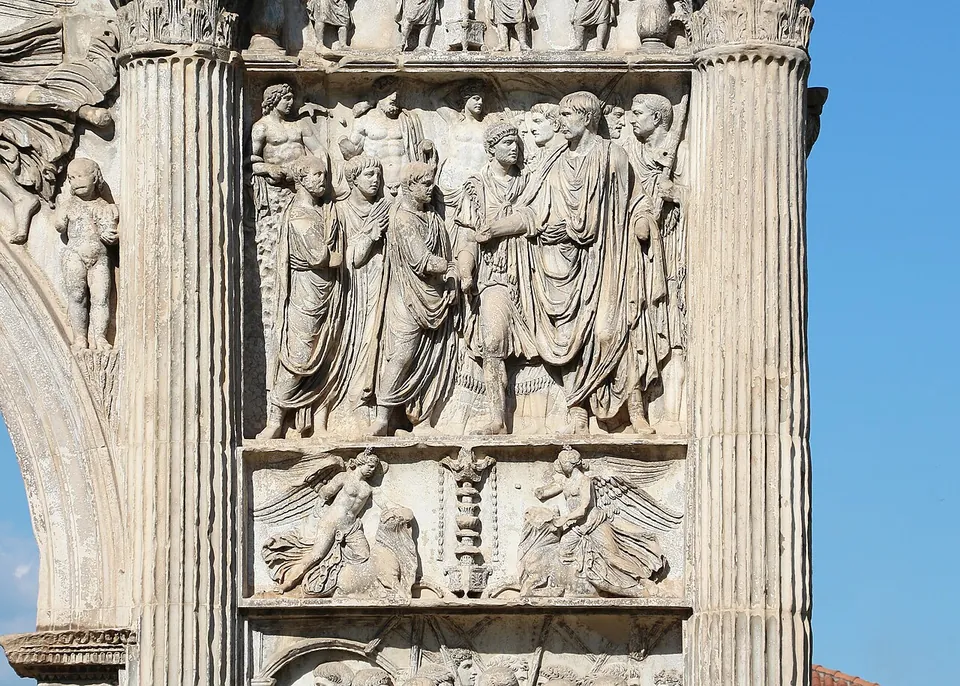
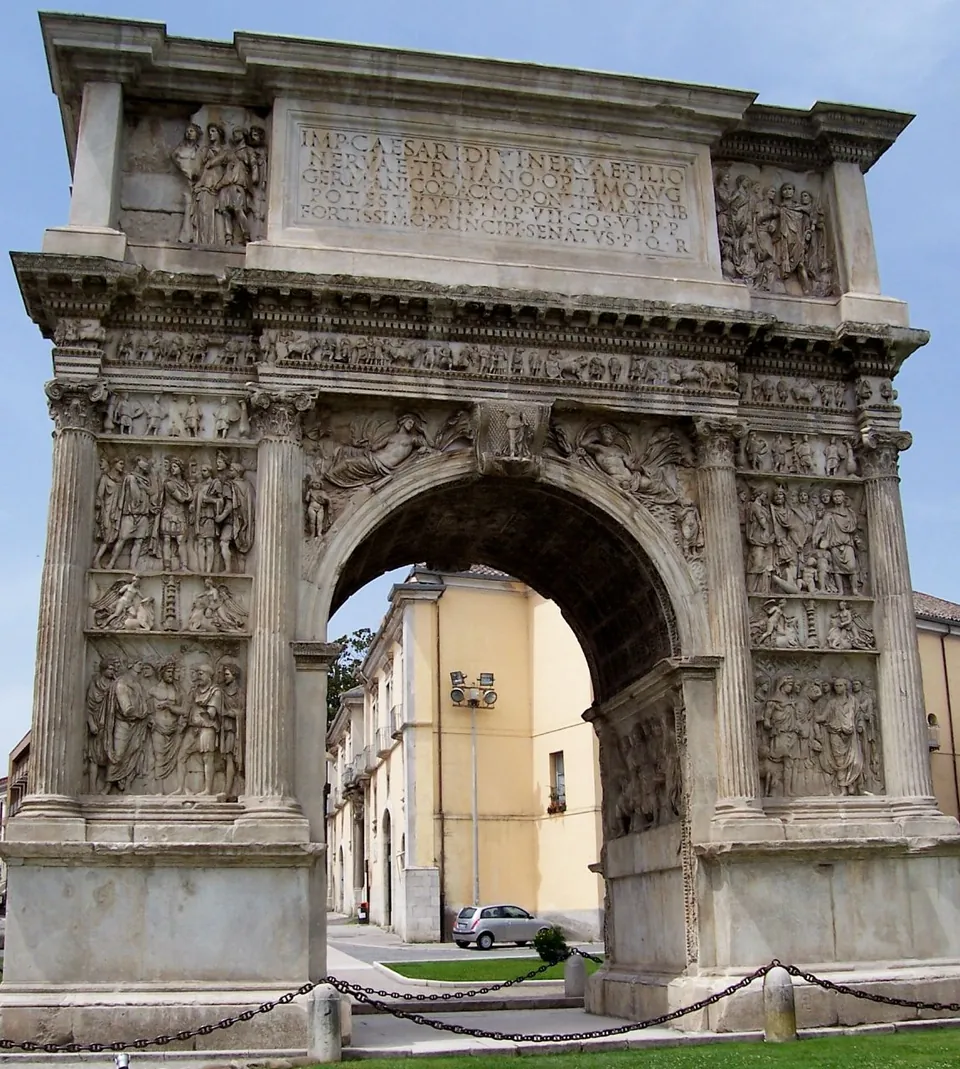
One arch, 15.6 m high and 8.6 m wide, built of limestone blocks faced with Parian marble, and richly carved on both main faces and inside the archway (it.wikipedia). The two main faces carry different programmes: the side facing the town shows Trajan’s works of peace and his gifts to the citizens of Italy, the side facing the countryside his campaigns and his care for the provinces (it.wikipedia; the Ministry of Culture). In the attic the same dedication to Trajan is cut on both sides, and the titles it gives him date the arch’s founding to between late August and early December 114 (de.wikipedia). Below it runs a small frieze of his triumph over the Dacians, which de.wikipedia calls the only Roman triumphal frieze preserved complete, giving it, after the archaeologist Bernard Andreae, 41 m and 160 figures. Inside the archway two large panels show Trajan in Benevento itself, at a sacrifice usually read as the opening of the Via Traiana, and founding the alimenta, his scheme for the children of Roman Italy, and the coffered vault shows the emperor crowned by Victory (it.wikipedia; en.wikipedia). It.wikipedia judges the pier panels not of the highest artistic level and the two in the passage more accomplished, and notes the hypothesis that those two came from the Roman workshop of the “Master of Trajan’s Deeds”, the sculptor of Trajan’s Column.
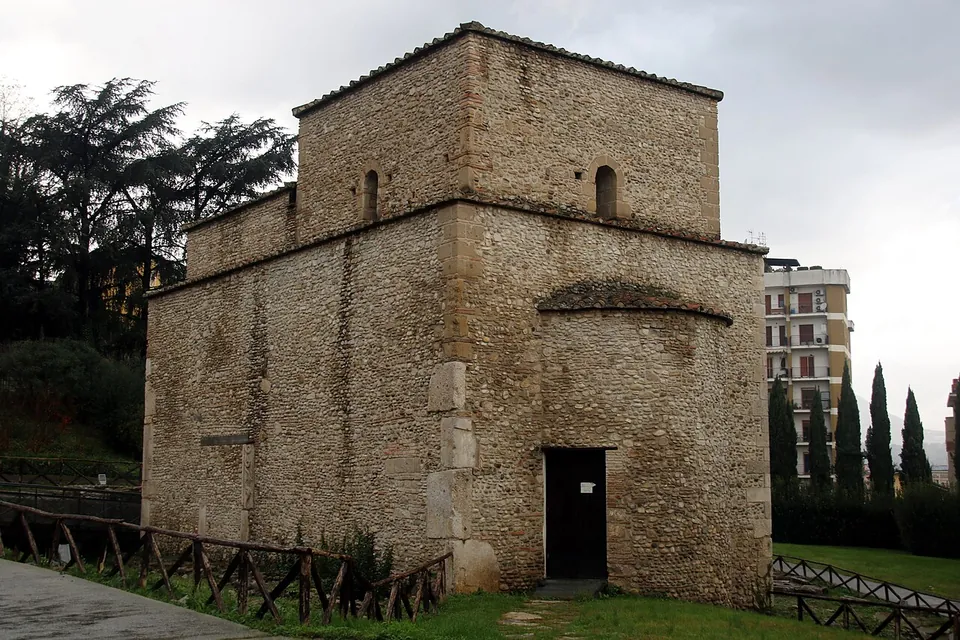
About 70 m away, the former church of Sant’Ilario a Port’Aurea, built between the late 7th century and the first half of the 8th beside the remains of a 2nd-century building, has held the Museo dell’Arco since 2004: a video that tells Trajan’s campaigns and programme through the arch’s reliefs. A guided visit of the complex is free, and there is information material in English (the province’s museum network).
Is it worth the trip?
Yes, once the restoration scaffolding comes down, which a press report expects by March 2027; until then, only if you are in Benevento anyway. Restoration of the stone began on 11 May 2026 (the Ministry of Culture), and a press report of 1 June 2026 shows the arch in scaffolding and gives the works ten months (Fanpage). How much of the carving stays visible during the works is not published. Meanwhile the Museo dell’Arco next door tells the reliefs’ story on video, and the theatre is open as usual.
Once it is uncovered, it is worth a journey of its own. It.wikipedia counts it among the best-preserved Roman triumphal arches in the world, its many reliefs included, and it stands in the open, free, about 700 m from Benevento’s Roman theatre (OpenStreetMap).
Getting there and what it costs
The arch stands at the end of Via Traiano, a short pedestrian street off Corso Garibaldi, the main street of the old town (it.wikipedia; OpenStreetMap). Benevento’s railway station is about 1.3 km away; a bus stop named Arco Traiano is about 60 m from the arch, and there are car parks about 70 m away (OpenStreetMap).
The arch itself is free, with no ticket office. The Ministry of Culture’s page for it lists hours, Tuesday to Sunday 10.00–18.30 and closed on Mondays, without saying what they cover; the page was last updated in 2021. The Museo dell’Arco in Sant’Ilario is open Tuesday to Sunday, 09.00–19.00, and costs €2 (reduced €1), or it is included in the province’s museum ticket, €6 (reduced €4) and valid for two days, which also covers the Museo del Sannio, the cloister of Santa Sofia, Palazzo Casiello and the Egyptian section at Arcos (the province’s museum network, read 17 October 2026). Benevento’s other Roman stops are on the Benevento page.
Visiting details
- Opening hours
- The arch stands in the open at the top of Via Traiano, a pedestrian street. The Ministry of Culture's page for it lists Tuesday–Sunday 10.00–18.30, closed on Mondays, without saying what those hours apply to (page last updated 2021). The Museo dell'Arco in the Sant'Ilario complex next to it is open Tuesday–Sunday 09.00–19.00, closed on Mondays.
- Tickets
- The arch is free; there is no ticket office. Museo dell'Arco (Sant'Ilario complex) €2, reduced €1, or the province's two-day museum ticket, €6 (reduced €4), which also covers the Museo del Sannio, the cloister of Santa Sofia, Palazzo Casiello and the Egyptian section at Arcos.
- Parking
- Car parks about 70 m from the arch (OpenStreetMap way/440463255 and way/444612295).
Before you go
- The arch has been under restoration since 11 May 2026. A press report of 1 June 2026 shows it in scaffolding, gives the works ten months and expects the scaffolding gone by March 2027; the Ministry's notice gives no end date.
- The Museo dell'Arco and the province's other museums close on Mondays.
Hours and prices checked 17 October 2026 on the operator's own site. Confirm before travelling.
History
The arch was begun in 114, while Trajan was emperor, and finished in 117, probably already under his successor Hadrian (it.wikipedia). When the Goths under Totila took Benevento in 545 and razed its walls, they spared the arch. The Lombards then built it into the town walls as a gate, the Porta Aurea, which helped preserve it so well (it.wikipedia; the province’s museum network).
It was studied by Sebastiano Serlio in the Renaissance and drawn by Giovanni Battista Piranesi in the 18th century (en.wikipedia). Time and earthquakes made repairs necessary under Pope Urban VIII and again in 1661, 1688, 1713 and 1792; in 1713, while it was still in use as a town gate, its marble architrave crumbled and fell. In the 1750s, when Charles of Bourbon visited the town, the view painter Antonio Joli painted it; the picture is in the Royal Palace of Caserta. In 1850, on the orders of Pope Pius IX during his visit, the houses built up against it were demolished, leaving it free-standing (it.wikipedia). A restoration of its carved surfaces was completed in 2002 (the Ministry of Culture), and in 2024 the arch and the town centre around it became part of UNESCO’s “Via Appia. Regina Viarum” World Heritage site (it.wikipedia).
More photographs
Nearby
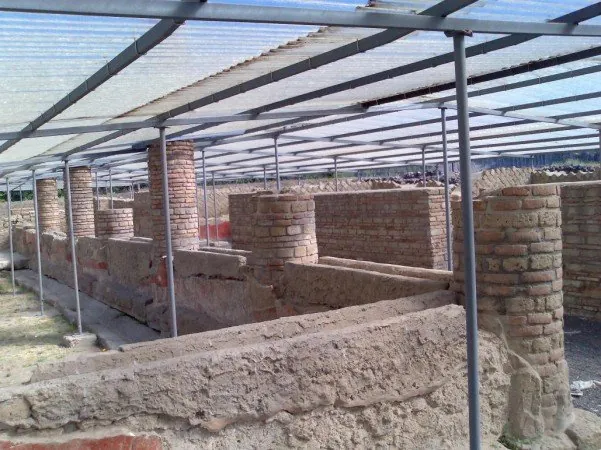
Photo: Razzairpina at Italian Wikipedia · Public domain · Commons
24 km · city · Campania
Abellinum
At the entrance, on the north side of the plateau, part of the Roman town wall still stands, built in opus reticulatum, a facing of small stones set in a diagonal net (the operator).
36 km · city · Molise
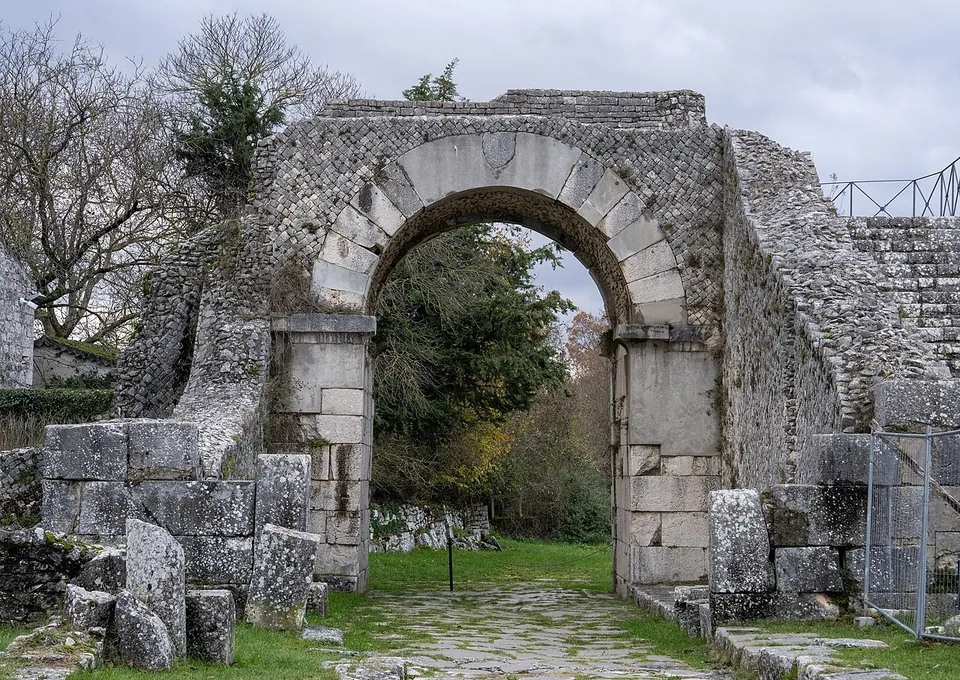
Saepinum
The walls are the first thing you see: a circuit of about 1,270 m in small-stone net-pattern masonry, punctuated by round towers, enclosing about 12 hectares, with a monumental gate at each end of the two main streets (it.wikipedia).
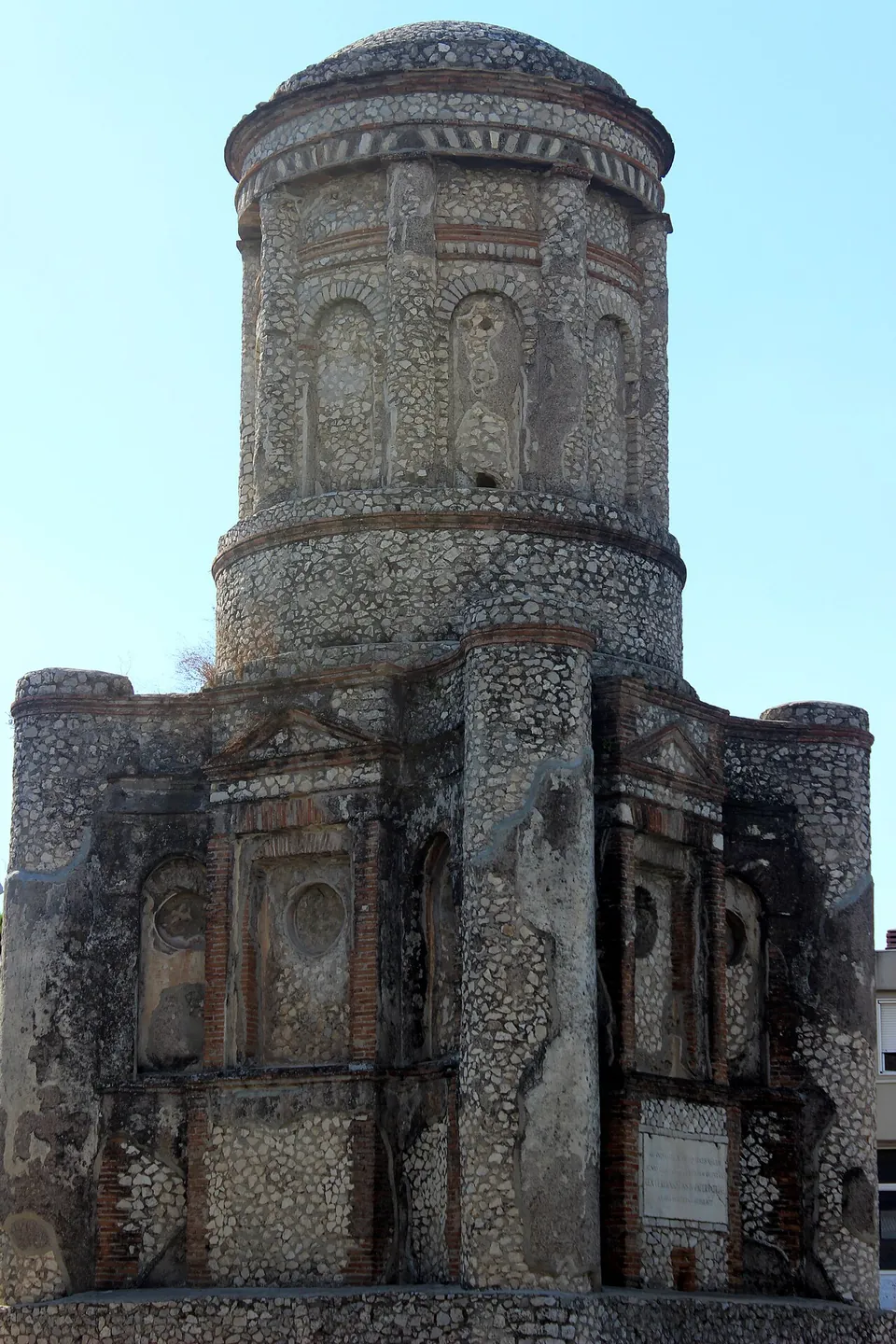
Photo: Miguel Hermoso Cuesta · CC BY-SA 4.0 · Commons
42 km · tomb · Campania
Mausoleum of the Conocchia
What you see is the outside of the tomb, standing on its own by a main road among modern buildings.


Straight-line distances.
Sources
Every fact on this page comes from the records below, each used under the licence noted.
| Source | Licence |
|---|---|
| Pleiades 568637774 | CC BY |
| Wikidata Q2142241 | CC0 |
| OpenStreetMap way/122652341 | ODbL |
| Wikipedia (it) — Arco di Traiano (Benevento) | CC BY-SA 4.0 |
| Wikipedia (en) — Arch of Trajan (Benevento) | CC BY-SA 4.0 |
| Wikipedia (de) — Trajansbogen von Benevent | CC BY-SA 4.0 |
| Wikipedia (fr) — Arc de Trajan (Bénévent) | CC BY-SA 4.0 |
| Ministero della Cultura — Arco di Traiano (hours, description) | licence not recorded |
| Ministero della Cultura — start of the restoration of the Arch of Trajan (2026) | licence not recorded |
| Fanpage — L'Arco di Traiano di Benevento è entrato in restauro (1 June 2026) | licence not recorded |
| Rete Museale della Provincia di Benevento — Complesso di Sant'Ilario a Port'Aurea (hours and tickets) | licence not recorded |