

What is there today
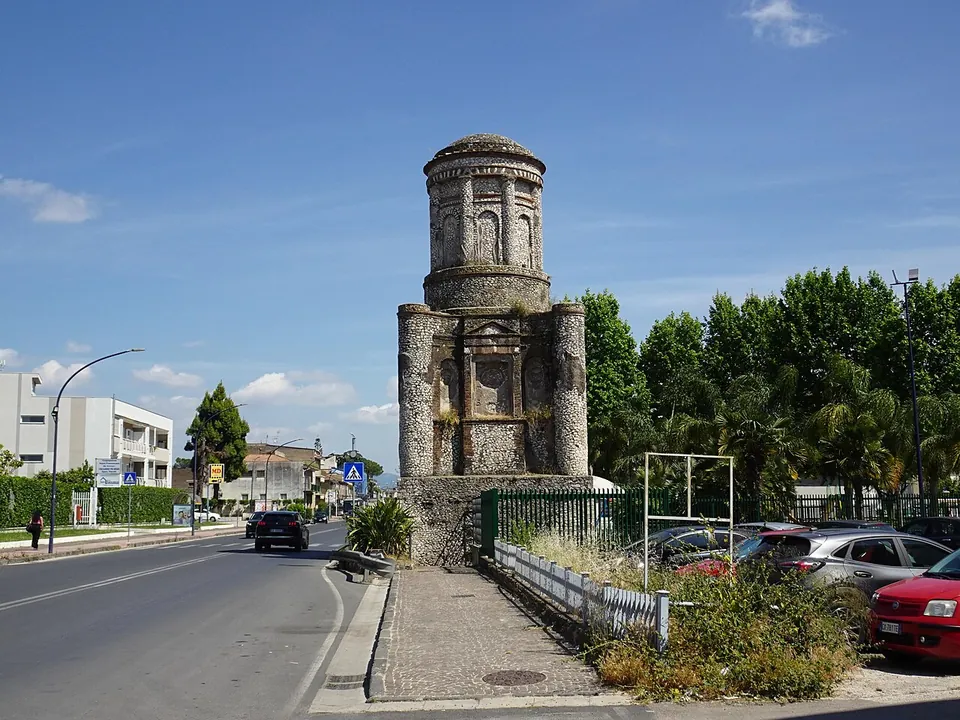
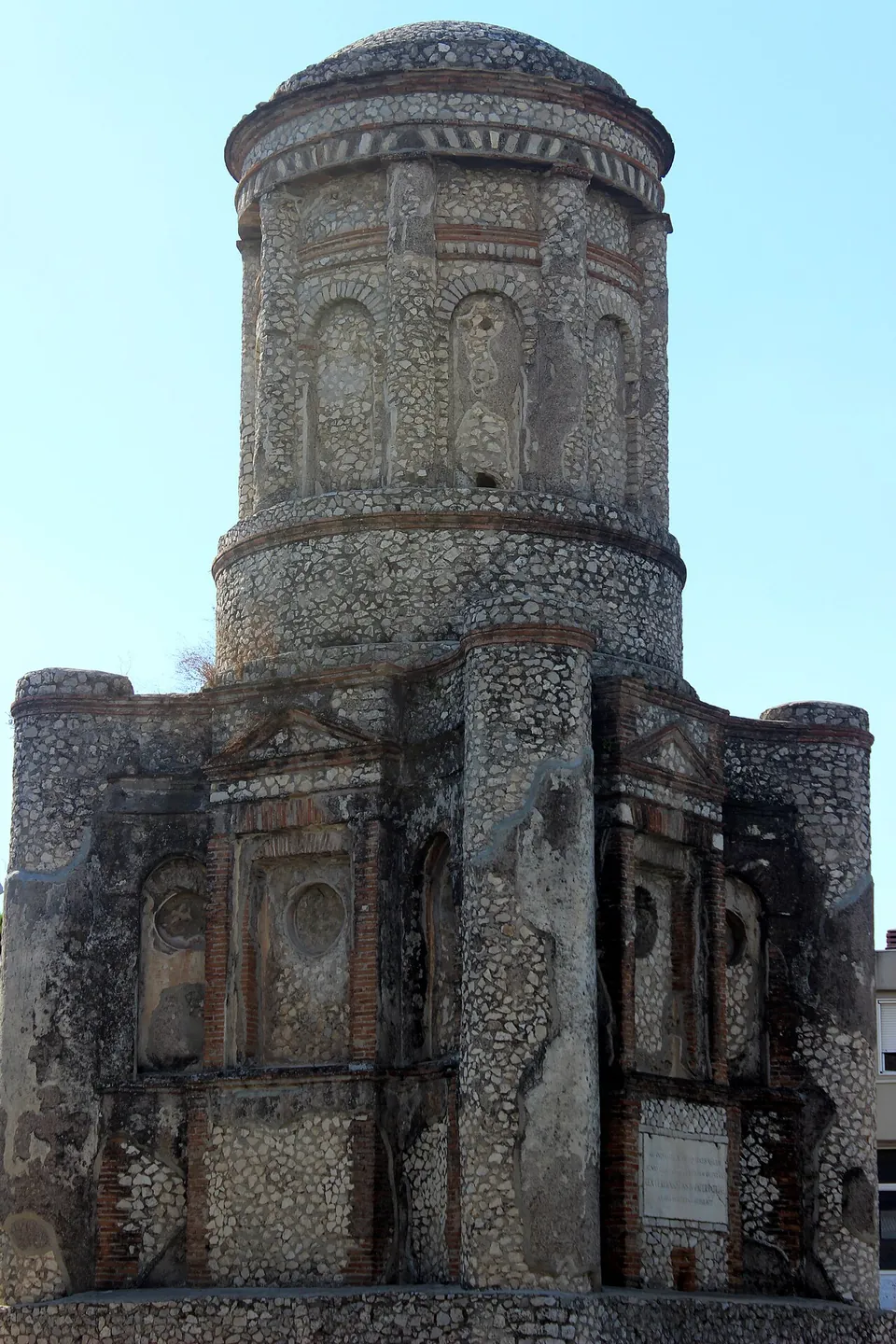
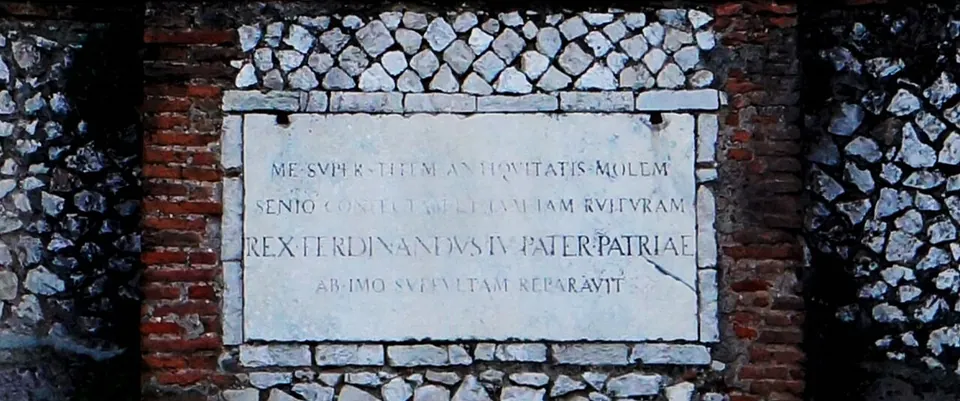
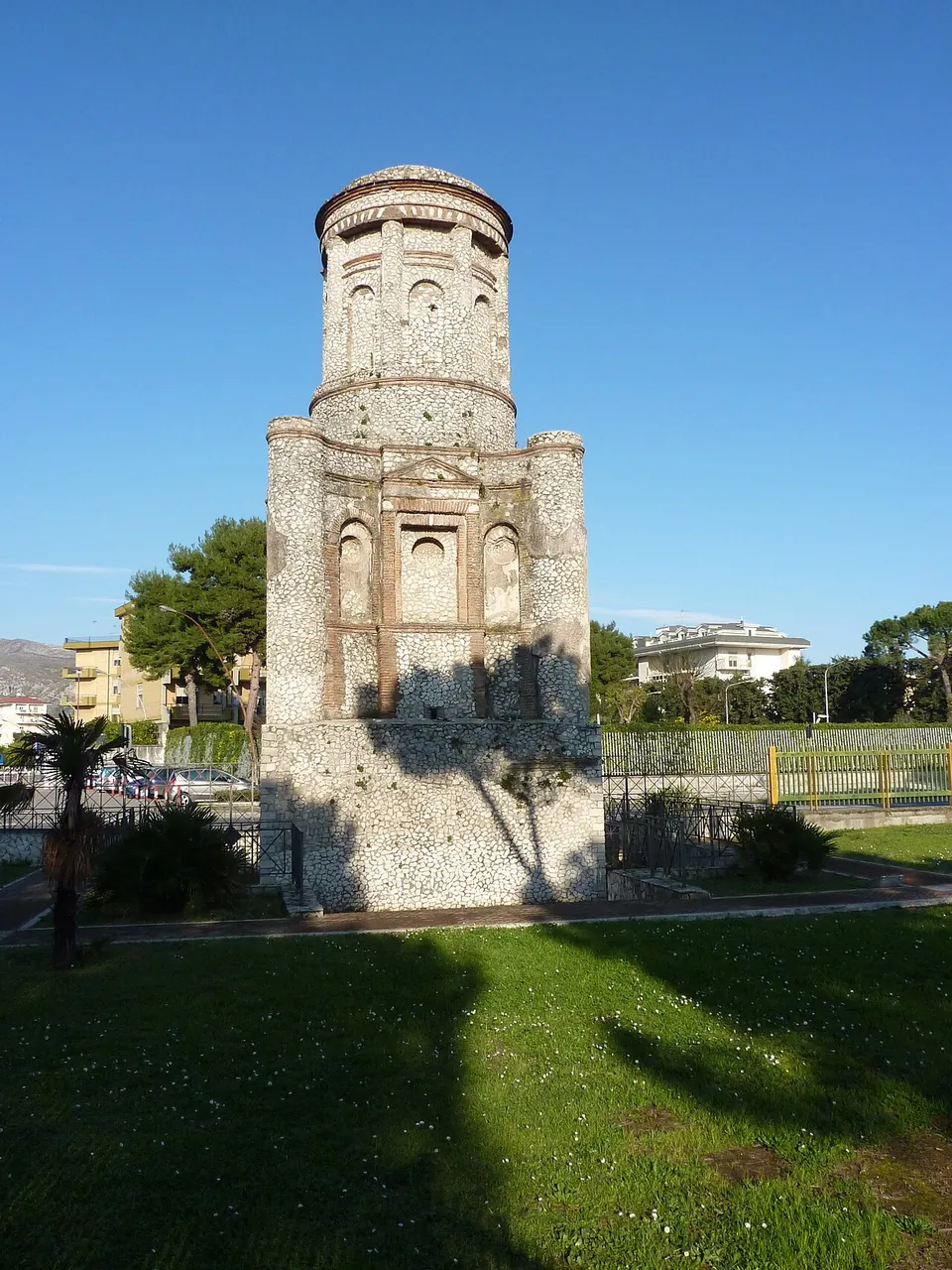
What you see is the outside of the tomb, standing on its own by a main road among modern buildings. It is built as a stack of shapes: a cube-shaped base, a middle storey with convex sides, and above it a round drum ringed with columns whose spaces are walled in, finished by a small crowning shrine or round top (it.wikipedia). The photographs show the walls faced with small grey stones and edged with red brick. The tomb is among the most significant monuments to have come down with their sculptural form almost whole (it.wikipedia), but part of that is the work of a restoration in 1792 by Carlo Vanvitelli for King Ferdinand IV of Bourbon, which changed the original structure in places (it.wikipedia; the Soprintendenza). An inscription over the entrance to the burial chamber records the restoration.
Inside is a burial chamber with eleven niches for cinerary urns, three on each side and two on the entrance side. The masonry is in good condition, but all the decoration that probably lined the room has gone (it.wikipedia). The chamber is normally closed.
Is it worth the trip?
As a short stop, yes. It costs nothing to see from the road and takes a few minutes. It lies about 2.5 km east of the amphitheatre in Santa Maria Capua Vetere, so it fits easily into a day spent there, ideally together with the Carceri Vecchie, another Roman tomb on the Appia just over 600 m away. It is not worth a journey on its own: for most of the year you see the outside from the roadside, and only on a few announced days a year can you go inside.
Getting there
The tomb is on the Via Nazionale Appia at Curti. OpenStreetMap shows two bus stops served by AIR Campania within 40 m and a free car park about 100 m away.
There is no regular opening. The Soprintendenza for the provinces of Caserta and Benevento opens the burial chamber on days it announces: every year from 2023 to 2026 for the European Heritage Days at the end of September (in 2026 on 26 and 27 September, 09.00-13.00, and on the Saturday also 17.00-21.00), and in 2026 also for the European Archaeology Days on 12 June, 15.00-18.00. The Heritage Days openings of 2024, 2025 and 2026 were free with no booking needed, and in 2025 and 2026 they came with guided visits (cultura.gov.it, read 21 October 2026). Watch the ministry’s event listings if you want to see the chamber. The Carceri Vecchie can be visited on request by phoning +39 0823 844206 (cultura.gov.it).
Visiting details
- Opening hours
- No regular opening. The tomb stands beside the Via Nazionale Appia and its outside can be seen from the road; the burial chamber opens only on days the Soprintendenza announces, such as the European Heritage Days in late September (26-27 September 2026, 09.00-13.00, and 17.00-21.00 on the Saturday) and the European Archaeology Days (12 June 2026, 15.00-18.00).
- Tickets
- Free. The European Heritage Days openings of 2024, 2025 and 2026 were free, with no booking required.
- Parking
- A free car park about 100 m away (OSM way/1085681922, fee=no).
Before you go
- The burial chamber is normally closed; outside the announced openings only the exterior can be seen.
Hours and prices checked 21 October 2026 on the operator's own site. Confirm before travelling.
History
Pleiades dates the tomb most likely to the second century AD; published dates range between the first and the second century (it.wikipedia). Its form follows the tomb also called La Conocchia at Pozzuoli, a century older, but the Curti tomb is more finely finished (it.wikipedia).
Tradition names Flavia Domitilla, a woman of Vespasian’s family persecuted by Domitian as a Christian; other accounts claim the ashes of Appius Claudius Caecus, who built the Via Appia in 312 BC (it.wikipedia), centuries before this tomb was put up. The popular name comes from the shape, which recalls a distaff (conocchia), a tool used in spinning (it.wikipedia).
Artists and travellers took an interest in the tomb from the Renaissance on, and between April and August 1792 Carlo Vanvitelli restored it for Ferdinand IV of Bourbon, partly modifying its original configuration (the Soprintendenza, 2025 notice).
More photographs

Nearby
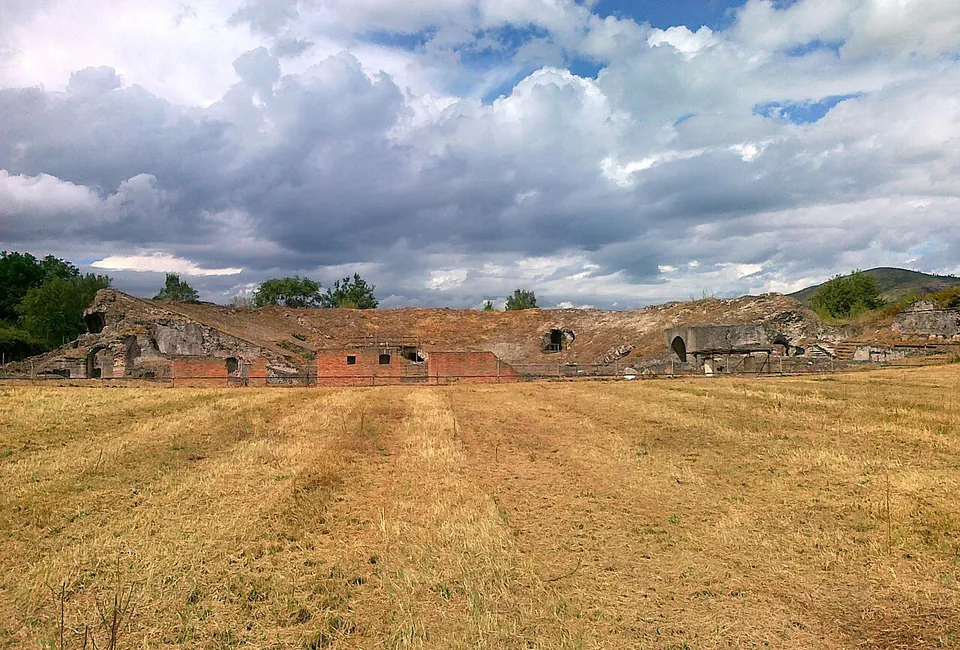
Photo: PietroCifone · CC BY-SA 3.0 · Commons
18 km · city · Campania
Cales
The ancient town survives across its whole extent, though the motorway runs through it, and the Ministry of Culture says plainly that its remains are not easy to read on the ground (cultura.gov.it).
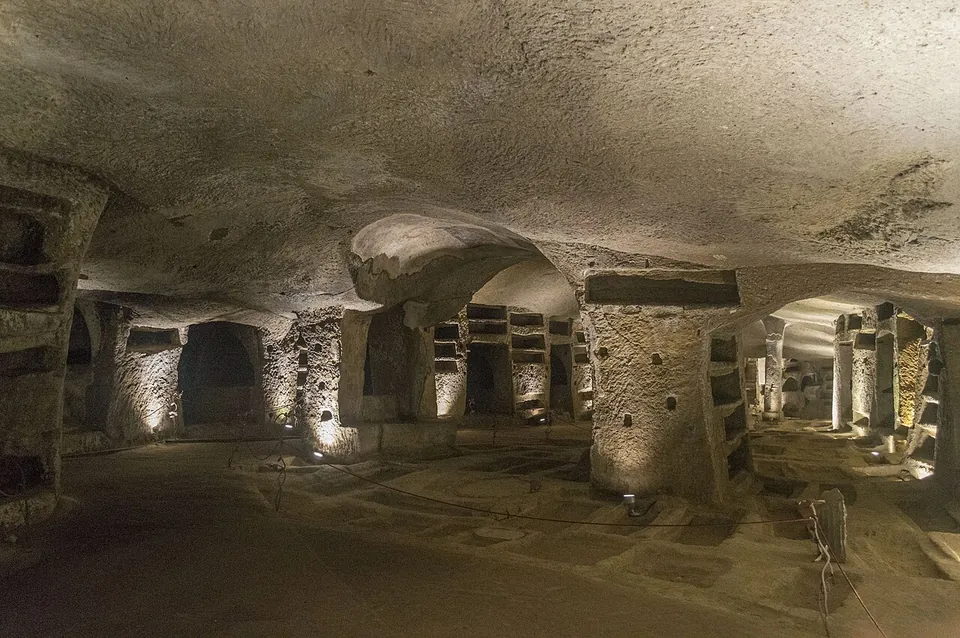
Photo: Dominik Matus · CC BY-SA 4.0 · Commons
24 km · necropolis · Campania
Catacombs of San Gennaro
The catacombs lie on two levels, side by side rather than stacked, and both are unusually spacious, unlike the better-known catacombs of Rome, because the tuff was easy to cut and strong enough to stand (the operator).
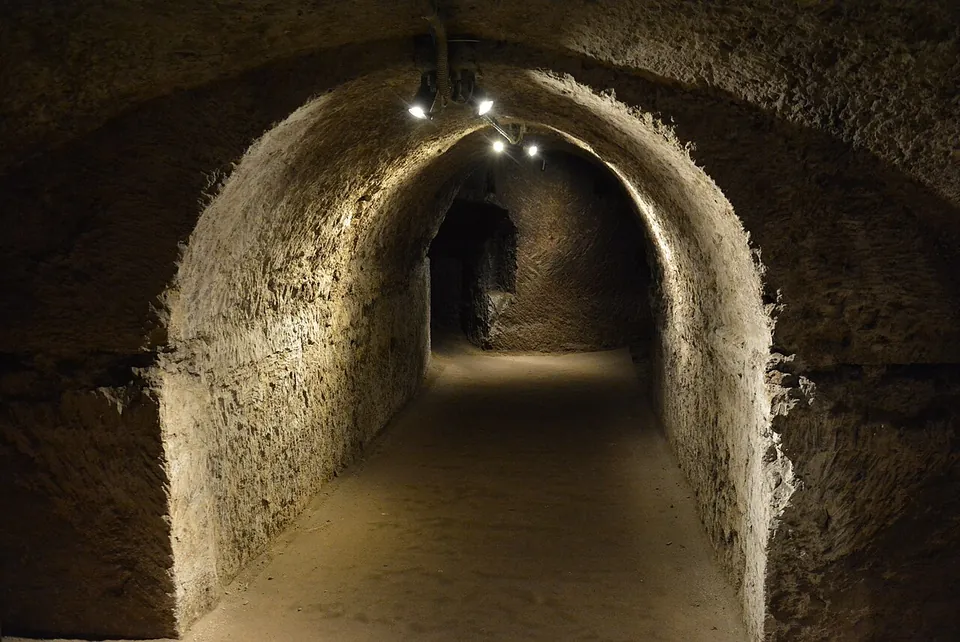
Photo: Mentnafunangann · CC BY-SA 4.0 · Commons
24 km · necropolis · Campania
Catacombs of Saint Gaudiosus
The visit starts in the crypt under the church's raised choir, which was once a corridor of the catacomb and is now a chapel with ten side altars, painted with stories of the martyrs by Bernardino Fera (it.wikipedia; the operator).


Straight-line distances.
Sources
Every fact on this page comes from the records below, each used under the licence noted.