

What is there today
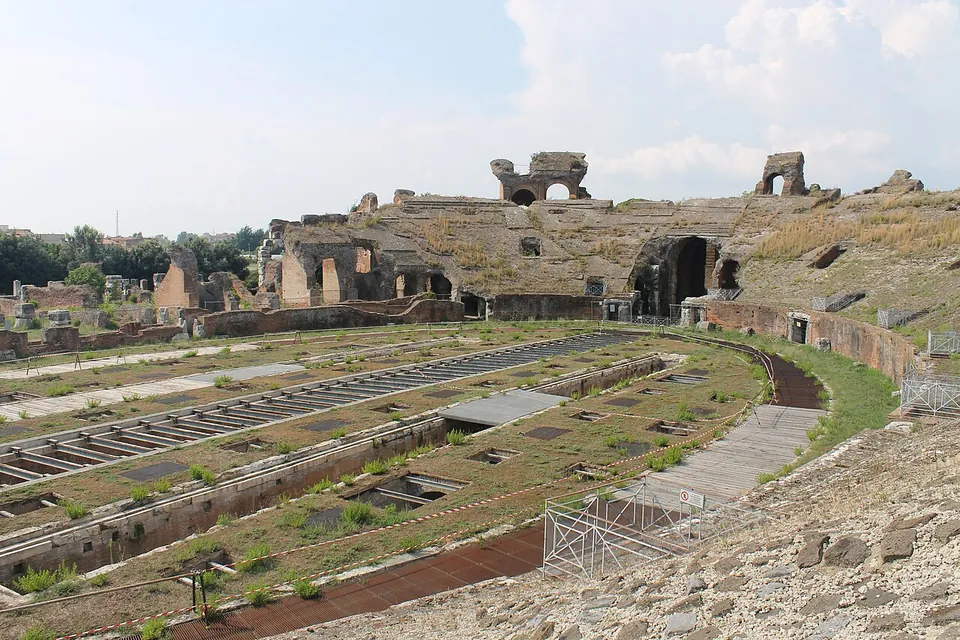
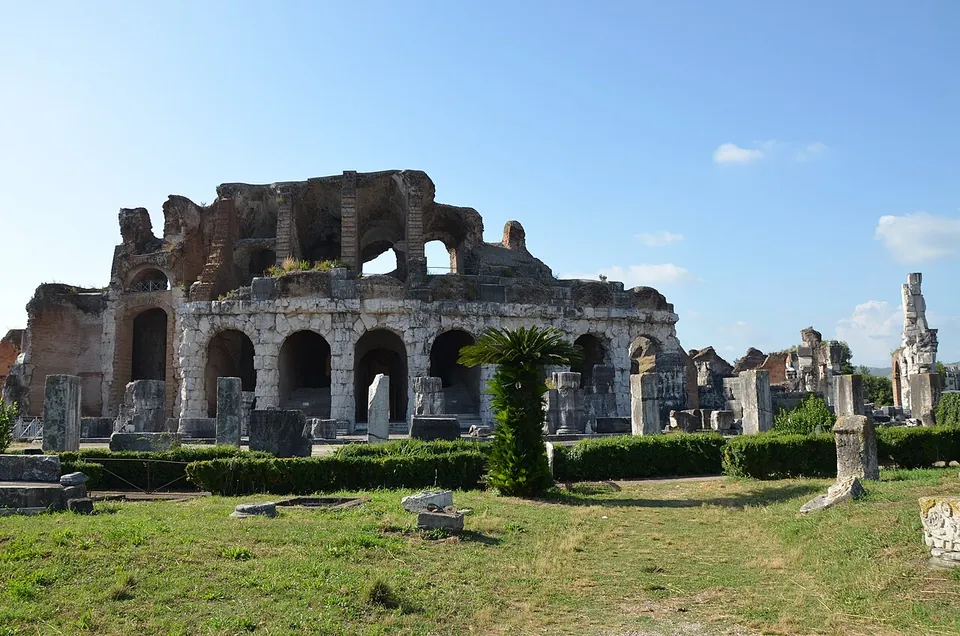
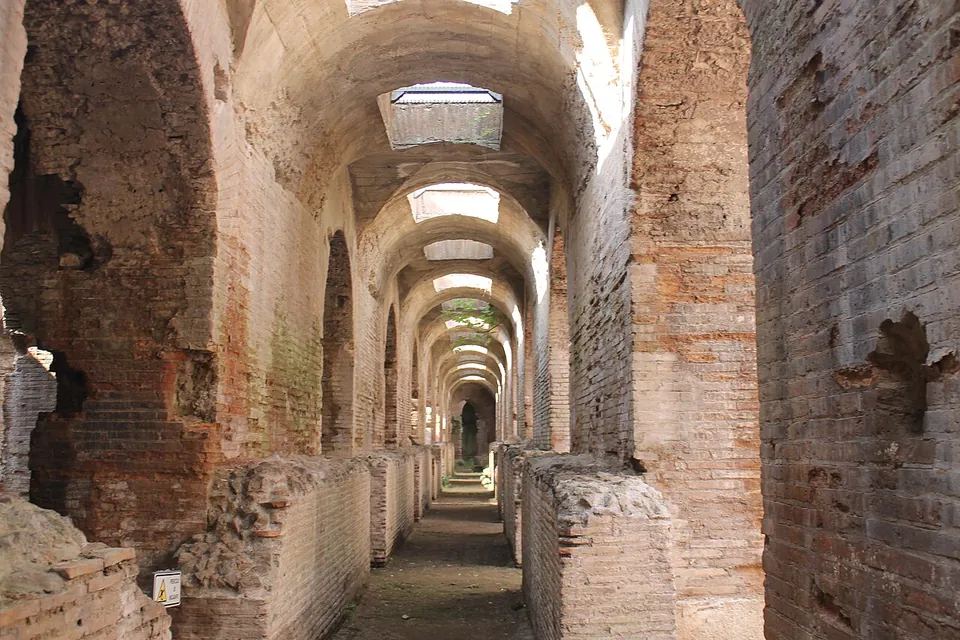
Much of the building is ruin. The seating has gone and the outer ring of arcades stands only in sections, but the arena and the network of passages beneath it are well preserved (fr.wikipedia). The underground is the best-kept part: vaulted brick corridors run under the whole arena, with forty vaulted rooms that served as cages for animals, two covered service galleries and the slots for the lifts that raised animals and scenery onto the arena floor (fr.wikipedia; the operator).
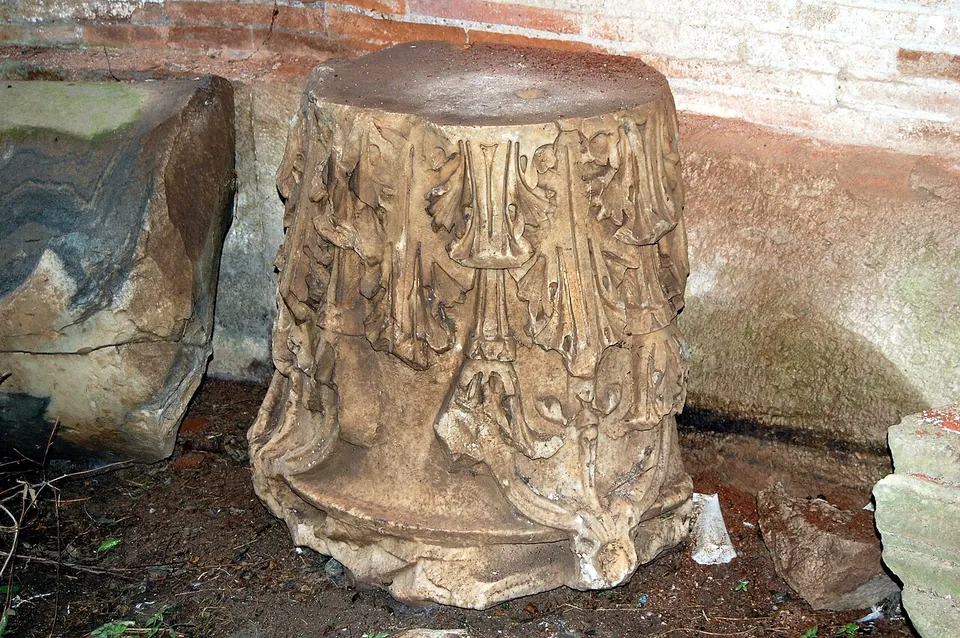
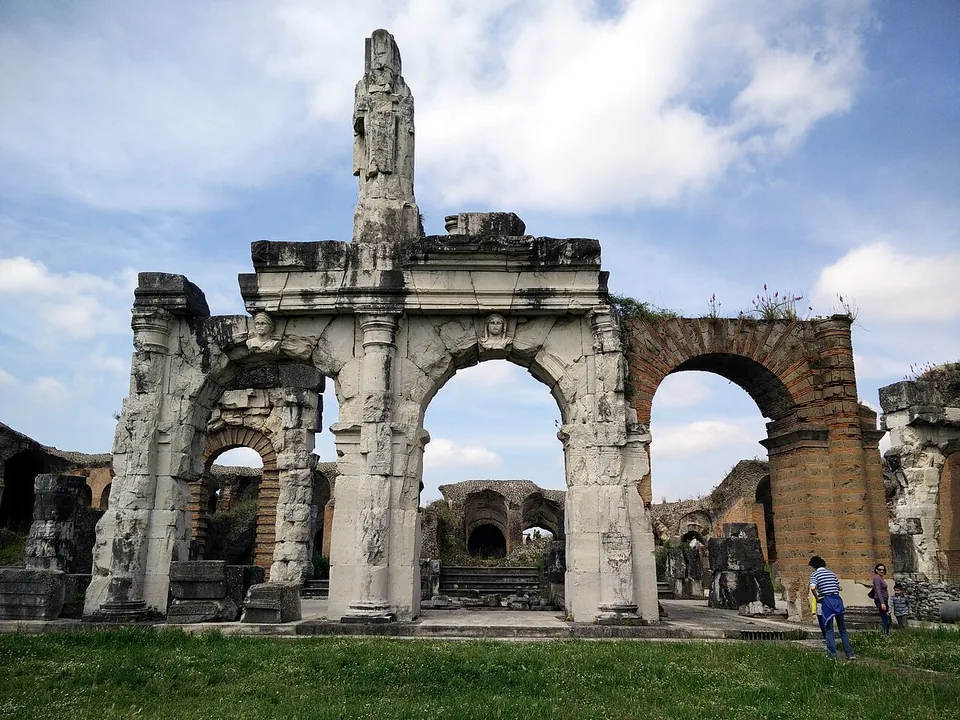
Published figures for the outside of the building range from 165 to 170 m along the long axis and 135 to 140 m across. Estimates of the crowd it held differ even more: the operator says up to 60,000 spectators, while the figures fr.wikipedia reports put it nearer 37,000 to 40,000. The keystones of the ground-floor arches were carved with heads of gods, which told spectators which arch led to their seats, and two arches of the outer arcade still carry theirs, Diana and Juno (fr.wikipedia; the operator).
The amphitheatre stands in a park with other remains of the Roman town: the earlier, Republican amphitheatre, probably the first Roman amphitheatre built in masonry, an octagonal building of the imperial period and a curved portico in front of the great arena (the operator). Little of the first amphitheatre shows: its walls have been levelled to the ground (fr.wikipedia). About 110 m away (OpenStreetMap), the Museo dei Gladiatori, on the same ticket, has copies of gladiators’ armour found at Pompeii, a model of the amphitheatre and a reconstructed section of its seating with its marble decoration (the operator).
Is it worth the trip?
Yes. This is one of the largest buildings of its kind anywhere in the Roman world, and the walk through the passages under the arena is the reason to come. Since 2024 it has been part of the UNESCO World Heritage site of the Via Appia (en.wikipedia). Come for the scale of the plan and the underground rather than for a standing façade: the walls above ground are a broken shell, not a second Colosseum.
One ticket covers the amphitheatre, the Republican amphitheatre, the Museo dei Gladiatori and the Mithraeum, an underground shrine of Mithras with a painted cult room about 700 m to the south, which the operator calls the most fascinating stop on the circuit. It opens only by booking and takes no more than twenty visitors a day, so book before you go. The Arch of Hadrian stands in the street 300 m away (the Capua page covers the rest of the ancient city). Two practical points: there is no staffed ticket office, so you pay by card at a machine or buy online, and it is closed on Mondays.
Getting there
The amphitheatre is in the centre of Santa Maria Capua Vetere, in the province of Caserta. The Alifana railway, run by EAV, has a station called Anfiteatro that serves it (it.wikipedia), and OpenStreetMap shows a car park about 250 m away. The entrance is on Piazza Adriano, the square formerly called Piazza I Ottobre (the operator; it.wikipedia).
It is open Tuesday to Sunday from 09.00 and closed on Mondays. Closing time depends on the month: 16.50 in January, 17.30 in February, 18.00 in March and October, 18.50 in April, 19.30 from May to August, 19.00 in September, 17.00 in November and 16.40 in December, with last entry 50 minutes to an hour before closing. A ticket is €6, or €2 for visitors aged 18 to 25, with free entry for the categories set by Italian law. Buy it online or in the Musei Italiani app, or with a card at the ticket machine at the entrance. Audio guides are available at the amphitheatre. The Mithraeum opens Tuesday to Sunday by booking only, on +39 338 6353806 or through the booking link on the operator’s page, five visitors at a time and at most twenty a day. The amphitheatre also takes part in the ministry’s free-entry Domenica al Museo days (the latest notice: 7 June 2026) (cultura.gov.it, read 21 October 2026 - check before travelling).
Visiting details
- Opening hours
- Tuesday to Sunday, closed Monday. Opens 09.00; closes 16.50 in January, 17.30 in February, 18.00 in March and October, 18.50 in April, 19.30 from May to August, 19.00 in September, 17.00 in November and 16.40 in December. Last entry 50 minutes to an hour before closing. The Mithraeum opens Tuesday to Sunday by booking only (+39 338 6353806, or online through the operator's page), five visitors at a time and at most twenty a day.
- Tickets
- €6; €2 for visitors aged 18 to 25; free for the categories set by Italian law. The ticket also covers the Republican amphitheatre, the Museo dei Gladiatori and the Mithraeum (by booking only). There is no staffed ticket office - buy online or in the Musei Italiani app, or pay by card at the ticket machine at the entrance in Piazza I Ottobre (now Piazza Adriano). The amphitheatre takes part in the ministry's free-entry Domenica al Museo days (latest notice 7 June 2026).
- Parking
- A car park, also mapped as a camper stop, about 250 m from the amphitheatre (OSM way/160570599).
Before you go
- There is no staffed ticket office; bring a card or buy online.
- The Mithraeum can be seen only by booking ahead, and no more than twenty visitors a day get in.
- The Museo archeologico dell'antica Capua, also on the ticket, has been closed for works since 2 February 2026.
Hours and prices checked 21 October 2026 on the operator's own site. Confirm before travelling.
The Arch of Hadrian
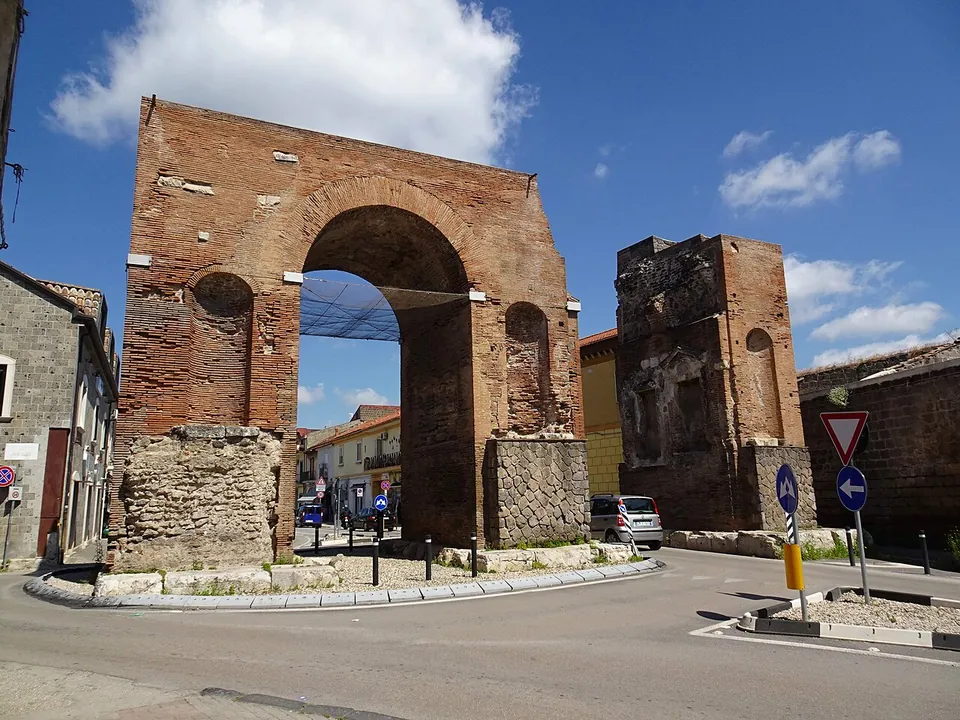
About 300 m from the amphitheatre, the Arch of Hadrian stands at a road junction between Corso Moro and Via del Lavoro (en.wikipedia). It spanned the Via Appia and marked an entrance to the city, perhaps on the line of its sacred boundary. It had three openings; three piers and one of the side arches survive, up to 10 m high and 18.5 m wide. It is built of brick and was faced with white limestone, now lost; blocks of the same stone still line the base of the piers, and holes in the brickwork suggest that columns once framed the niches in them (it.wikipedia).
The name is a misattribution: an inscription naming Hadrian was once linked to the arch and later judged a forgery. It was built between the second half of the first century and the first half of the second, and its dedication is unknown; one suggestion is that it went up under the Flavian emperors, when the city became a Flavian colony. It has been restored several times, in 1851, after damage in the Battle of the Volturno in 1860 (a plaque on one pier commemorates the battle), and after the Second World War, so part of the brickwork is modern (it.wikipedia).
The Mithraeum
About 700 m south of the amphitheatre (OpenStreetMap), on Vico Mitreo near the archaeological museum, a shrine of the god Mithras lies underground. The operator counts it among the most important Mithraic sites and says it is held to be the oldest Mithraeum in the West. It was found by chance in 1922, during digging for a new building, and has been open to visitors since 1937 (it.wikipedia; the operator).
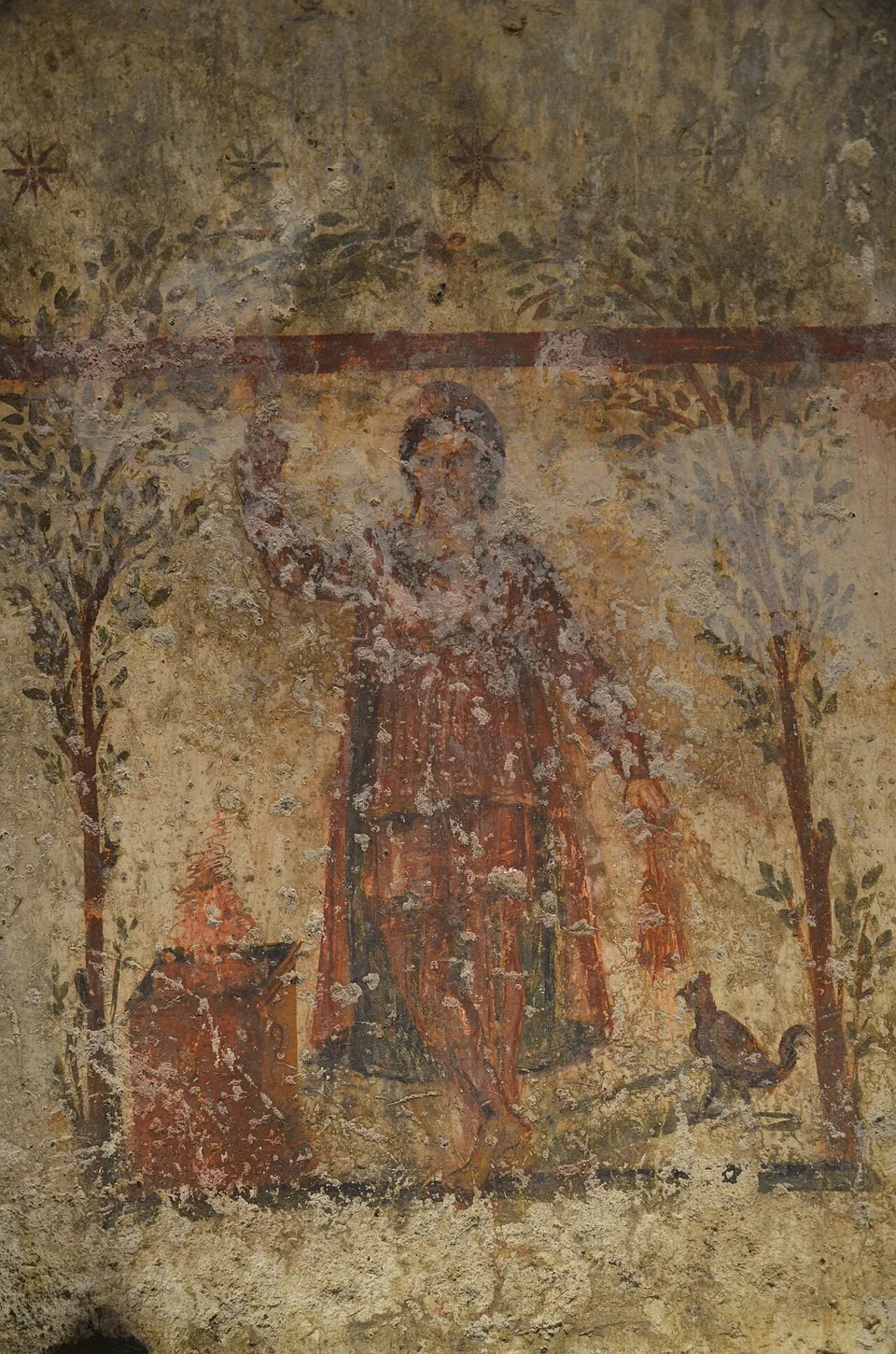
You go down from a small tower-like building into underground rooms that recall the cave where Mithras was born and captured the bull (the operator). A flight of steps leads to a narrow corridor that served as an anteroom; on the right, through an arch, is a room where those taking part prepared, and on the left the cult room itself, a barrel-vaulted chamber about 12 m long and 3 m wide with skylights, and benches along its sides for the worshippers. The vault is painted yellow and scattered with green and red stars, with shiny glass paste at their centres that probably made it look like a starry sky by the light of the worshippers’ torches (it.wikipedia).
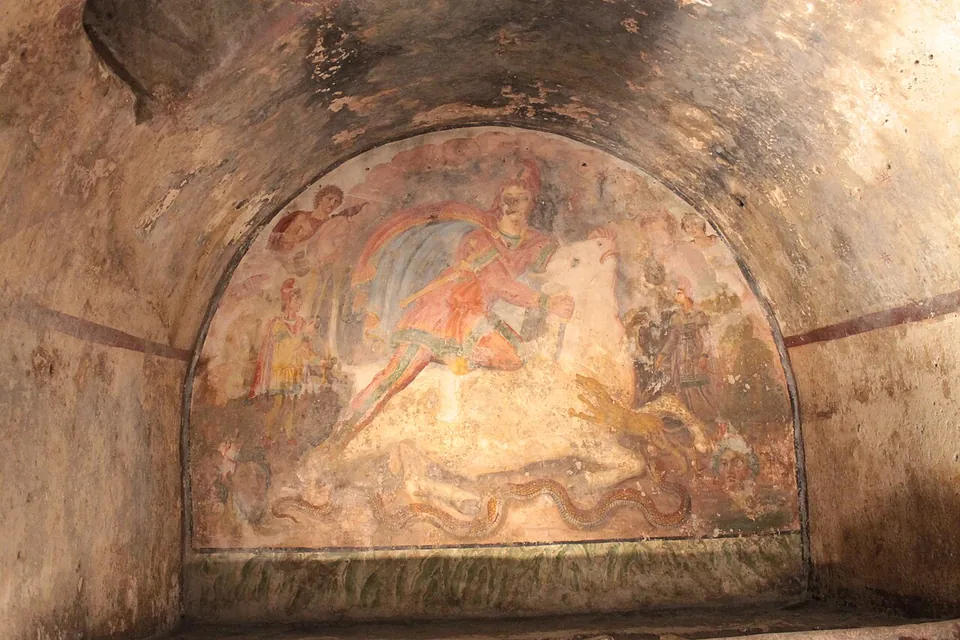
Behind the altar at the far end is the large painting of Mithras killing the bull. Against a rocky background the god, in a Phrygian cap and a red garment edged in green, with a billowing cloak red outside and blue inside, drives a dagger into the bull’s neck. The Sun watches from the upper left, the Moon from the upper right, the torch-bearers Cautes and Cautopates stand at the sides, and a dog, a scorpion and a snake help Mithras below. A lunette on the east wall shows the Moon in a two-horse chariot, and a marble relief of Cupid and Psyche is on the south wall. The whole room was once painted with scenes of initiation into the cult, but almost nothing of them is left, and marks found on the walls have not been deciphered (it.wikipedia).
The ministry dates the Mithraeum to the end of the first century AD; it.wikipedia gives the second century. Mithras came to Campania with slaves and merchants arriving from the port of Delos at Puteoli, today’s Pozzuoli, and in the West his cult spread above all among soldiers, slaves and gladiators. It took hold early in Capua, home of one of the best-known gladiator schools, and Mithras is among the gods carved on the keystones of the amphitheatre’s arches (the operator).
History
Capua had spectacle buildings well before this one. The first amphitheatre, beside it, probably dates to the third century BC (fr.wikipedia); the operator dates it to 130-90 BC. The gladiator school from which Spartacus led his revolt in 73 BC stood by this earlier arena (it.wikipedia; the operator). Which of the two arenas Spartacus himself may have fought in cannot be known (fr.wikipedia).
When the present building went up is disputed. A damaged inscription found in front of its southern gate in 1726 reads, as completed by the archaeologist Alessio Simmaco Mazzocchi, that the colony of Capua built it, Hadrian restored it and added columns, and Antoninus Pius dedicated it (it.wikipedia; en.wikipedia). Read as the Augustan colony, it puts the building under Augustus, which is Pleiades’ date. A reading of the late 1990s restores the name as the Flavian colony, which puts it under the Flavian emperors and makes Hadrian’s work a complete rebuilding; Jean-Claude Golvin dates it to the late first or early second century AD (fr.wikipedia). It shares so much with the Colosseum that one was probably the model for the other, but which way round is disputed too (en.wikipedia; fr.wikipedia). The Ministry of Culture follows the Flavian date (cultura.gov.it).
Its later history is better recorded. Hadrian’s restoration, around 119, added reliefs and statues, and ceremonies were still held there in 387. The Vandals under Genseric damaged it in 455, and it was repaired in 530 (fr.wikipedia). In the 9th century it became a fortress, known as Berelais (it.wikipedia; fr.wikipedia). Once the city had moved to Casilinum, today’s Capua, its stone was quarried from the end of that century for the new town’s castle, cathedral and palaces (it.wikipedia). Seven of the carved keystone heads are now set in the façade of the town hall of modern Capua (it.wikipedia). The plundering ended in 1826, when King Francis I of the Two Sicilies ordered the ruins cleared and excavated (fr.wikipedia). Published dates for its declaration as a national monument differ (1822 by the operator, 1880 in fr.wikipedia); it has been open to the public since 1913 (the operator).
More photographs





Nearby
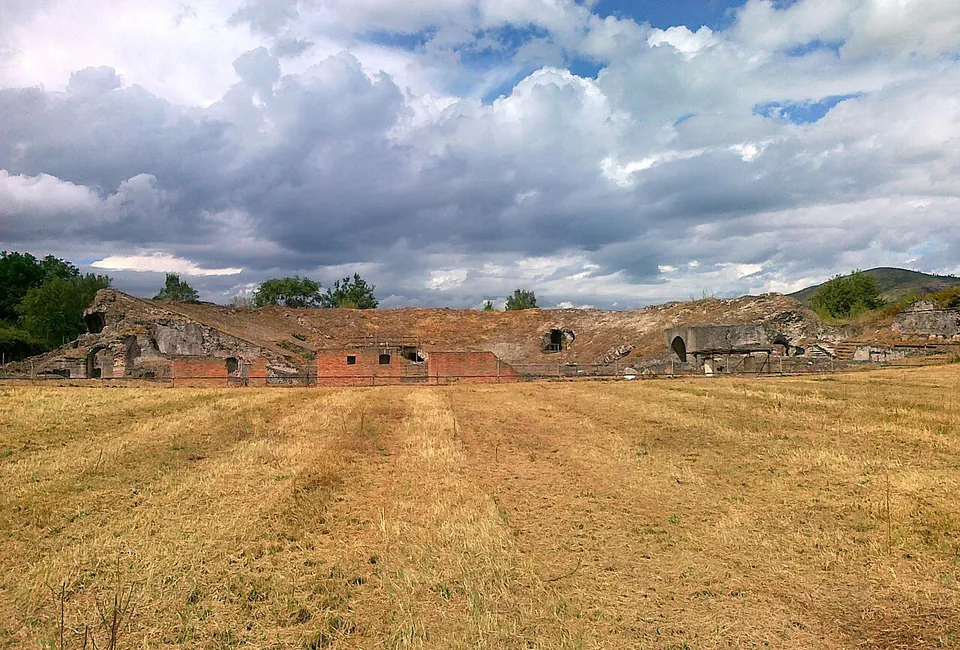
Photo: PietroCifone · CC BY-SA 3.0 · Commons
16 km · city · Campania
Cales
The ancient town survives across its whole extent, though the motorway runs through it, and the Ministry of Culture says plainly that its remains are not easy to read on the ground (cultura.gov.it).
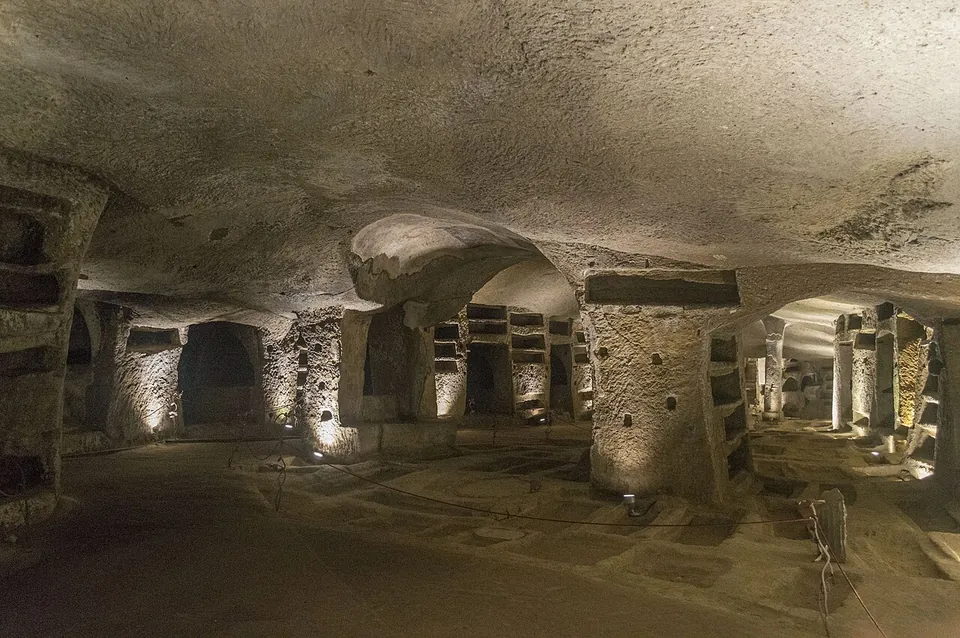
Photo: Dominik Matus · CC BY-SA 4.0 · Commons
25 km · necropolis · Campania
Catacombs of San Gennaro
The catacombs lie on two levels, side by side rather than stacked, and both are unusually spacious, unlike the better-known catacombs of Rome, because the tuff was easy to cut and strong enough to stand (the operator).
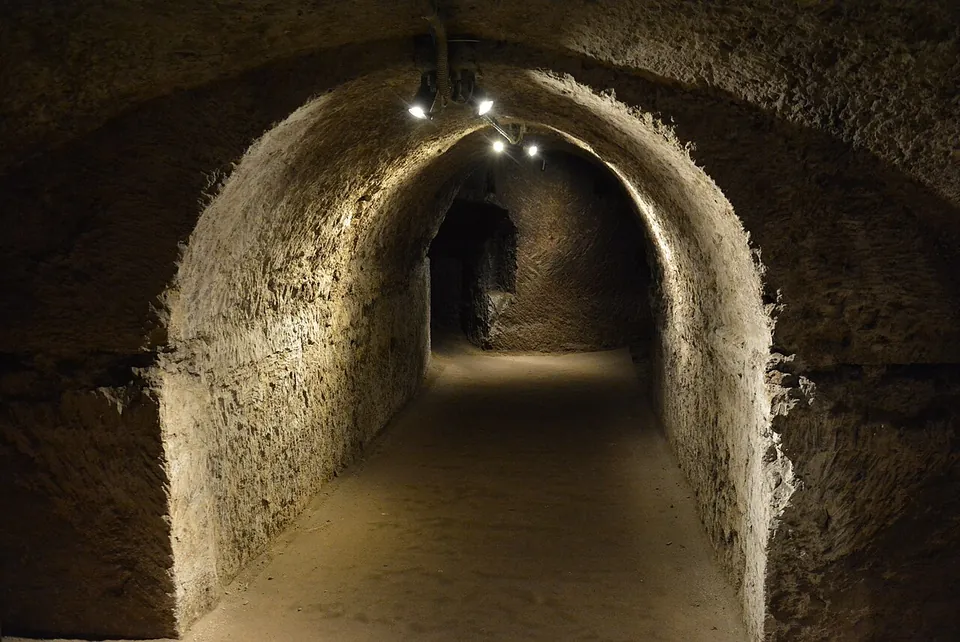
Photo: Mentnafunangann · CC BY-SA 4.0 · Commons
25 km · necropolis · Campania
Catacombs of Saint Gaudiosus
The visit starts in the crypt under the church's raised choir, which was once a corridor of the catacomb and is now a chapel with ten side altars, painted with stories of the martyrs by Bernardino Fera (it.wikipedia; the operator).


Straight-line distances.
Sources
Every fact on this page comes from the records below, each used under the licence noted.
| Source | Licence |
|---|---|
| Pleiades 93820013 | CC BY |
| Wikidata Q474970 | CC0 |
| Vici.org 4214 | CC BY-SA (text), CC0 (metadata) |
| OpenStreetMap relation/18389981 | ODbL |
| Ministero della Cultura — Anfiteatro campano (hours, tickets; the operator's listing) | licence not recorded |
| Wikipedia (fr) — Amphithéâtre de Capoue | CC BY-SA 4.0 |
| Wikipedia (it) — Anfiteatro campano | CC BY-SA 4.0 |
| Wikipedia (en) — Amphitheatre of ancient Capua | CC BY-SA 4.0 |
| Wikipedia (de) — Amphitheater (Capua) | CC BY-SA 4.0 |
| Pleiades — So-called Arch of Hadrian (Capua) | licence not recorded |
| Wikipedia (it) — Arco di Adriano (Capua) | CC BY-SA 4.0 |
| Ministero della Cultura — Mitreo di Santa Maria Capua Vetere (booking, description; the operator's listing) | licence not recorded |
| Ministero della Cultura — Domenica al Museo at the Anfiteatro Campano, 7 June 2026 | licence not recorded |
| Wikipedia (it) — Mitreo di Santa Maria Capua Vetere | CC BY-SA 4.0 |
| Wikipedia (fr) — Mithraeum de Santa Maria Capua Vetere | CC BY-SA 4.0 |