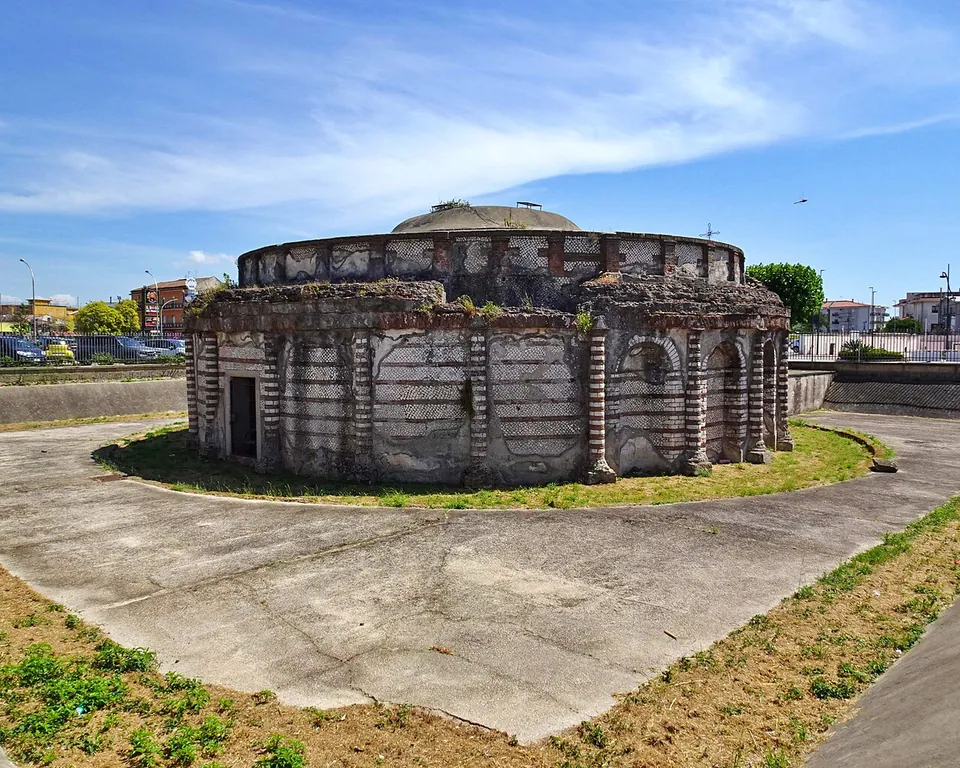
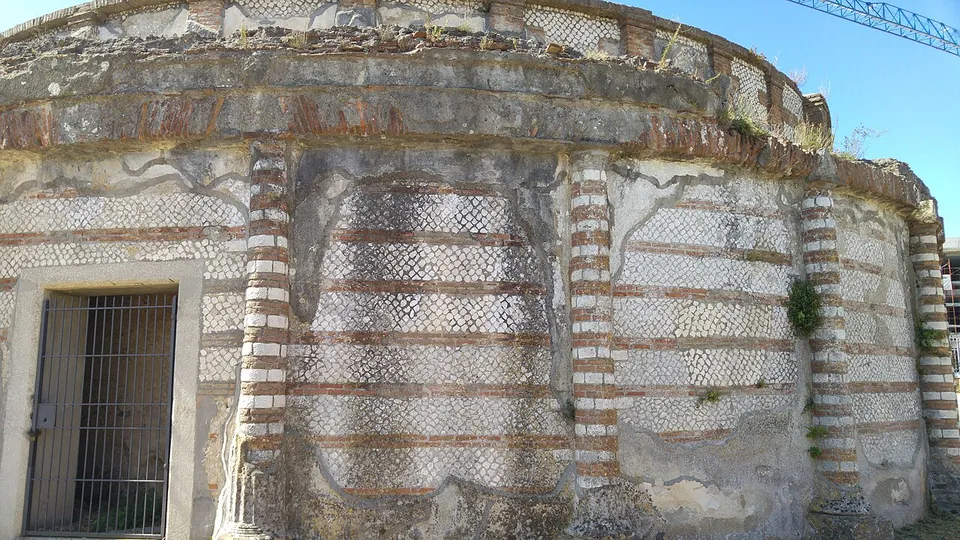
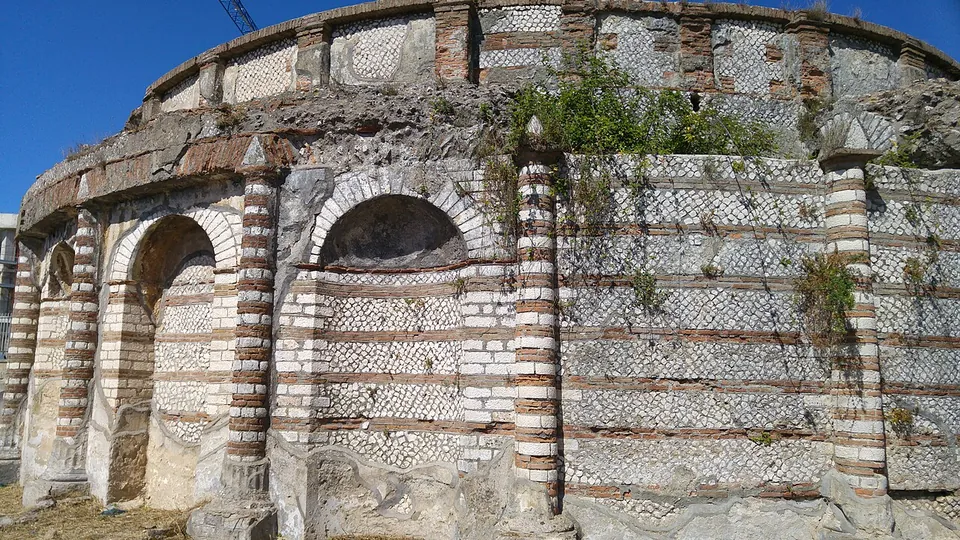


The Carceri Vecchie (“Old Prisons”) is a round Roman tomb of the first century AD on the Via Appia at San Prisco, just outside ancient Capua (Santa Maria Capua Vetere). Its lower storey still stands with its columns and niches, and the burial chamber inside keeps its vaults.
What is there today
The tomb sits below today’s ground level, in a sunken enclosure next to a shopping centre car park. It is built as an outer ring around an inner cylinder, in two storeys (it.wikipedia). The lower storey stands on a base of crushed-tile mortar edged with tuff blocks. It is faced with small stones in a net pattern (opus reticulatum) and ringed with columns on plinths with Tuscan capitals, with rectangular and semicircular niches between them. The upper storey has the same shape, smaller and without decoration, and survives only in part (it.wikipedia). The Ministry of Culture calls the plan circular; it.wikipedia calls it elliptical, with the long axis at right angles to the road.
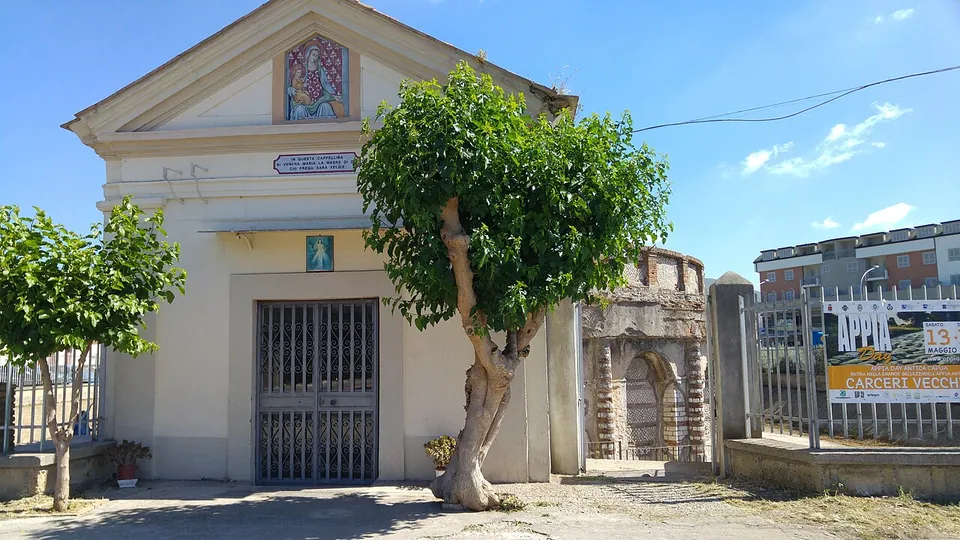
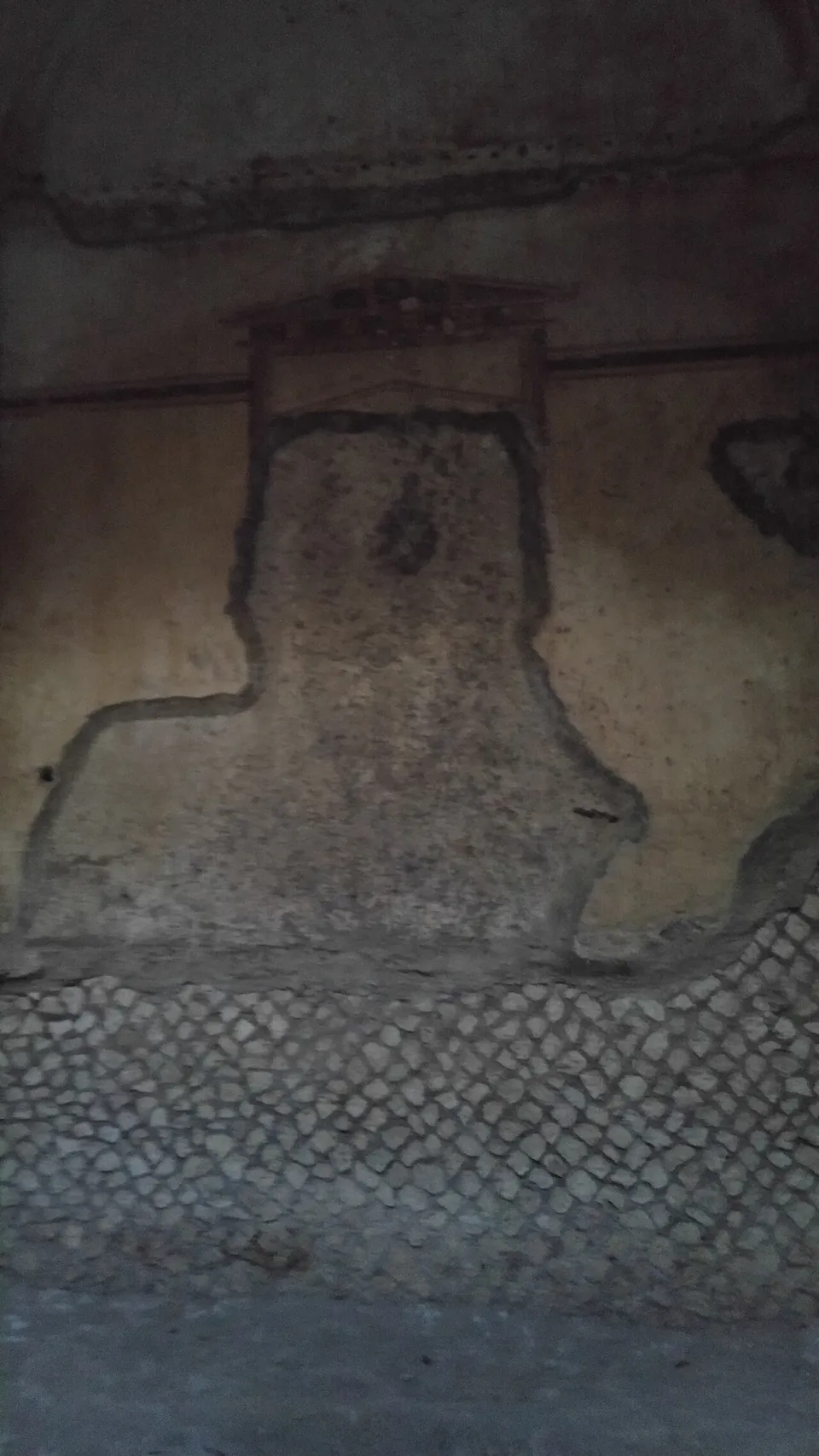
On the road side stands the small chapel of Santa Maria della Libera, built in place of the tomb’s original entrance, a long corridor down from the Via Appia, so the way in is now on the left side of the tomb (it.wikipedia). Inside, the burial chamber is laid out as a Greek cross, with barrel-vaulted arms meeting under a pointed cross vault. Fragments of painted plaster survive from a rich decoration that the article dates to the age of Augustus and Tiberius; the rest was stripped at some unknown time. A trapdoor in the arm towards the chapel leads down to an underground burial room (it.wikipedia). The ministry mentions remains of stucco decoration.
Is it worth the trip?
As an extra stop on a day at Santa Maria Capua Vetere, yes, if you book. It is about 2 km east of the amphitheatre and just over 600 m from the Conocchia, another Roman tomb on the Appia, so the two make one short outing. Without a booking you see the outside from beyond the railings, which takes a few minutes; with one you go down into the vaulted burial chamber with traces of its painted decoration. It is not worth a journey on its own.
Getting there
The tomb is on the Via Appia (Via Nazionale Appia) in San Prisco, next to the Centro Commerciale Le Corti. OpenStreetMap shows a free car park on the Via Appia about 40 m away. The railway station of Santa Maria Capua Vetere is about 1.7 km away, and no bus stop is mapped within 500 m, so a car or a bike is easiest.
Visits are by appointment. The Ministry of Culture lists the tomb as open on request every day, with booking required on +39 0823 844206, and publishes no admission price (cultura.gov.it, read 21 October 2026). It has also opened on announced days: guided visits for Appia Day on 2 October 2022, the first week of January 2024 (by telephone booking), and the European Heritage Days on 28 and 29 September 2024, 09.15-13.00 with no booking needed (cultura.gov.it).
Visiting details
- Opening hours
- By appointment only. The Ministry of Culture lists the tomb as open on request every day of the week, with booking required by telephone on +39 0823 844206. It has also opened on announced days, such as the European Heritage Days of 28-29 September 2024 (09.15-13.00, last entry 12.15, no booking needed).
- Tickets
- No admission price is published; the ministry's listing gives only the booking number.
- Parking
- A free car park on the Via Appia about 40 m away (OSM way/512687024, fee=no, 100 spaces).
Before you go
- Visits are by telephone booking only; without one you see the outside from beyond the railings.
- OpenStreetMap marks the site as not wheelchair accessible.
Hours and prices checked 21 October 2026 on the operator's own site. Confirm before travelling.
History
The tomb was built in the imperial period, almost certainly in the first century AD, outside the walls of Capua along the Via Appia (it.wikipedia; Pleiades). Popular tradition took it for the prison of the gladiators who fought in the city’s amphitheatre, which gave it the name Carceri Vecchie. It is in fact a burial chamber (it.wikipedia).
Drawings of the 19th century show that for at least two centuries the tomb has stood well below the level of the road. The underground burial chamber is thought to have been part of the original design, while the rest ended up below the road as the road surface was raised over time (it.wikipedia). Around the middle of the 19th century, certainly after 1839, the original entrance was removed and the chapel of Santa Maria della Libera built in its place (it.wikipedia).
More photographs


Nearby
Photo: PietroCifone · CC BY-SA 3.0 · Commons
18 km · city · Campania
Cales
The ancient town survives across its whole extent, though the motorway runs through it, and the Ministry of Culture says plainly that its remains are not easy to read on the ground (cultura.gov.it).
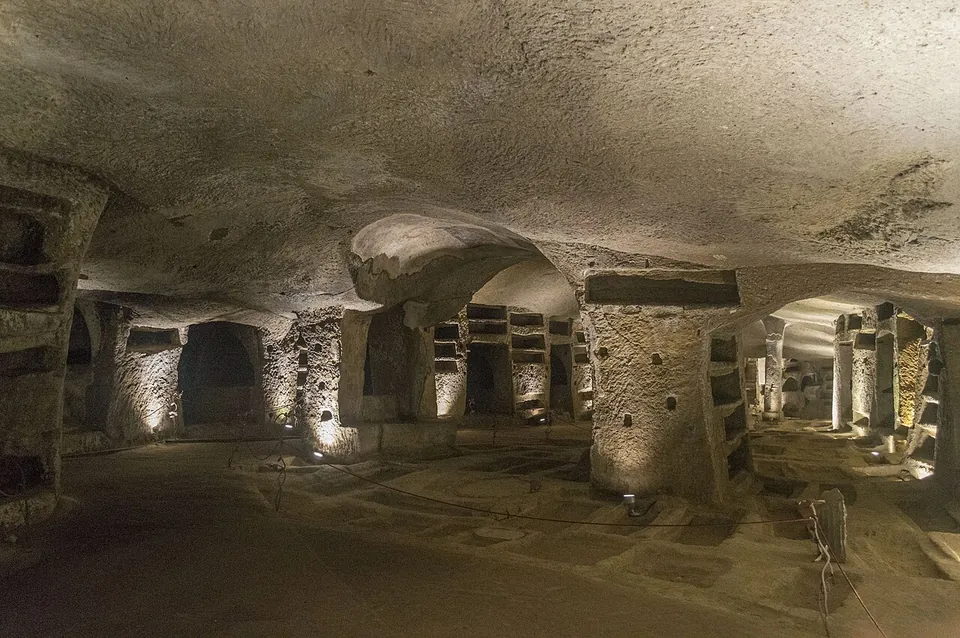
Photo: Dominik Matus · CC BY-SA 4.0 · Commons
24 km · necropolis · Campania
Catacombs of San Gennaro
The catacombs lie on two levels, side by side rather than stacked, and both are unusually spacious, unlike the better-known catacombs of Rome, because the tuff was easy to cut and strong enough to stand (the operator).
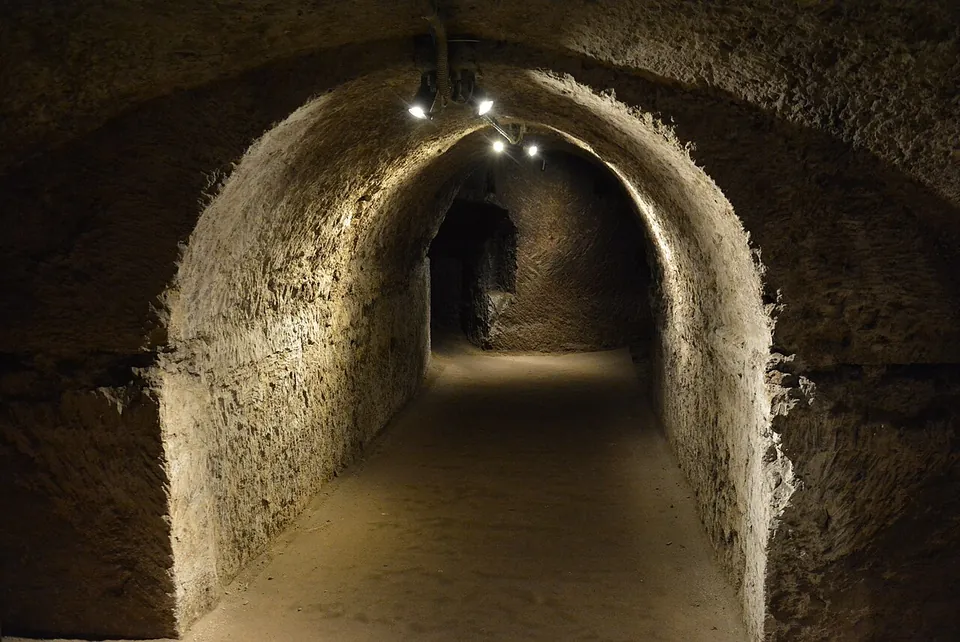
Photo: Mentnafunangann · CC BY-SA 4.0 · Commons
25 km · necropolis · Campania
Catacombs of Saint Gaudiosus
The visit starts in the crypt under the church's raised choir, which was once a corridor of the catacomb and is now a chapel with ten side altars, painted with stories of the martyrs by Bernardino Fera (it.wikipedia; the operator).


Straight-line distances.
Sources
Every fact on this page comes from the records below, each used under the licence noted.
| Source | Licence |
|---|---|
| Pleiades 868114456 | CC BY |
| Wikidata Q48801957 | CC0 |
| OpenStreetMap way/568280643 | ODbL |
| Wikipedia (it) — Mausoleo delle Carceri Vecchie | CC BY-SA 4.0 |
| Ministero della Cultura — Mausoleo delle Carceri Vecchie (visits on request, booking) | licence not recorded |
| Ministero della Cultura — European Heritage Days 2024 at the Mausoleo delle Carceri Vecchie | licence not recorded |
| Ministero della Cultura — special opening of the Mausoleo delle Carceri Vecchie, 1-6 January 2024 | licence not recorded |
| Ministero della Cultura — Appia Day 2022, guided visits to the Carceri Vecchie | licence not recorded |