

The forum of Praeneste was the civic centre of the Roman town under today’s Palestrina. On and above its main square, Piazza Regina Margherita, stand the remains of a basilica of the late 2nd century BC, a cave fitted out as a fountain room whose fish mosaic is still in place, and the apsed hall where the Nile mosaic was found (the Ministry of Culture; it.wikipedia).
What is there today
The square follows the ancient forum, and the great buildings of the 2nd century BC stood on the level above it (the operator). Part of what survives is built into later buildings, the former Seminario and the cathedral, and part lies beneath them (the Ministry of Culture; Pleiades), so this is a visit made up of separate pieces rather than an open ruin field.
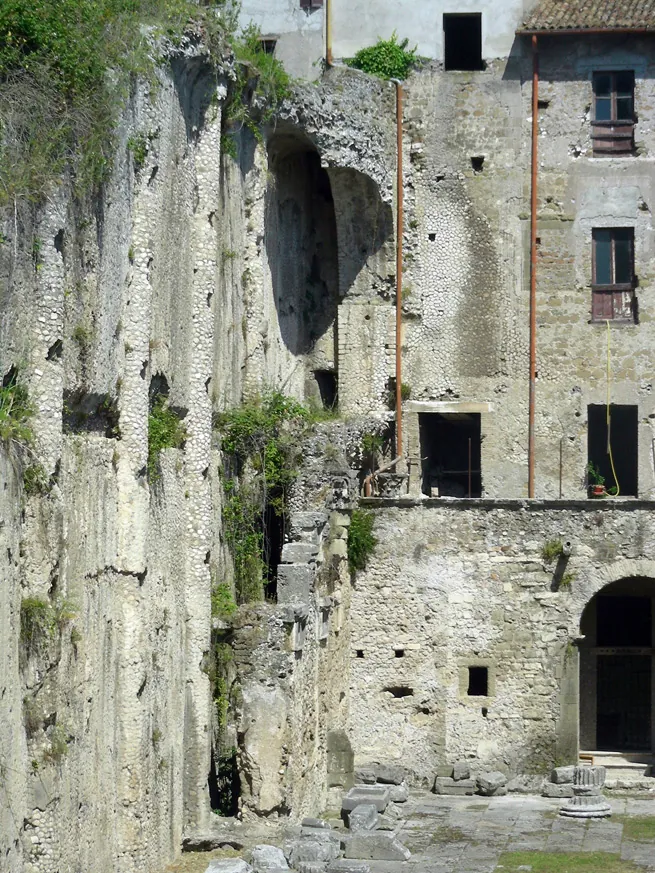
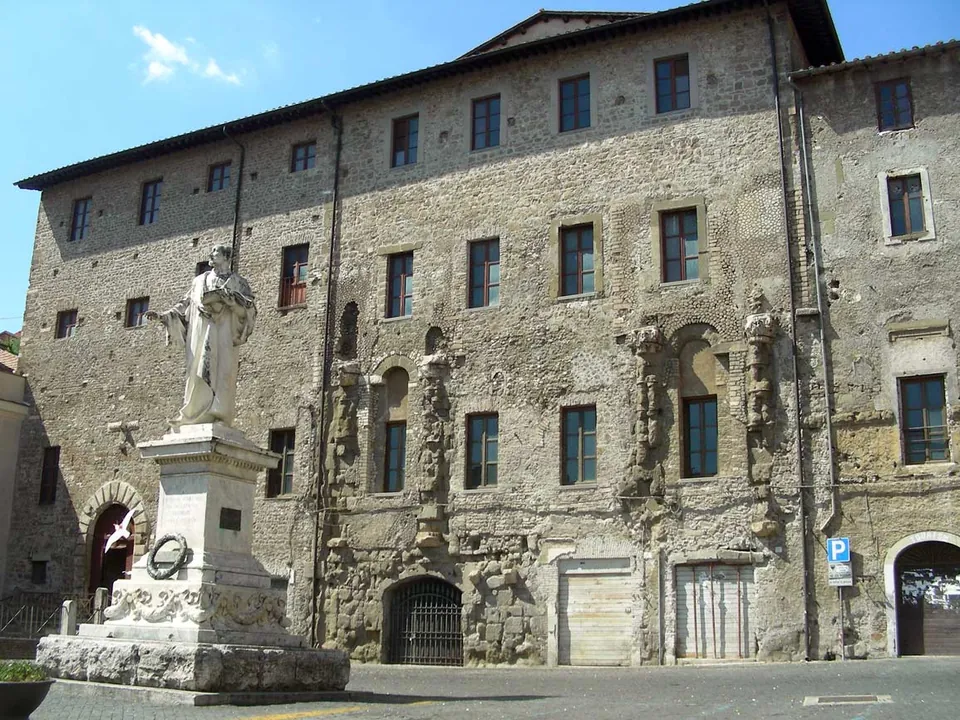
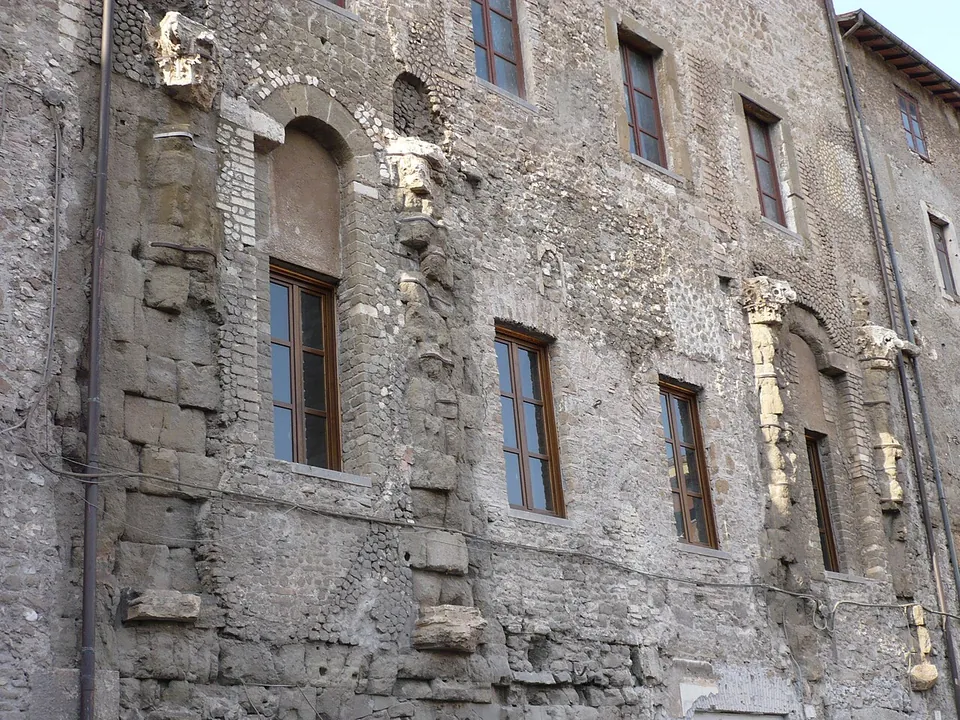
The basilica. The main building was the basilica, a large colonnaded hall where justice was administered and business was done (the Ministry of Culture). Inside it had four aisles, almost certainly roofed (it.wikipedia); en.wikipedia describes it as two storeys high and an open space today. Its back wall still carries its decoration of half-columns framing false windows, and a gap separates it from the terrace wall behind (it.wikipedia). The front was a portico in two orders, Doric columns below and Corinthian above, and part of it is built into the facade of the former Seminario, the palace on the square (it.wikipedia; the Ministry of Culture). A sundial on the facade was described by Varro, and traces of it can still be seen (en.wikipedia).
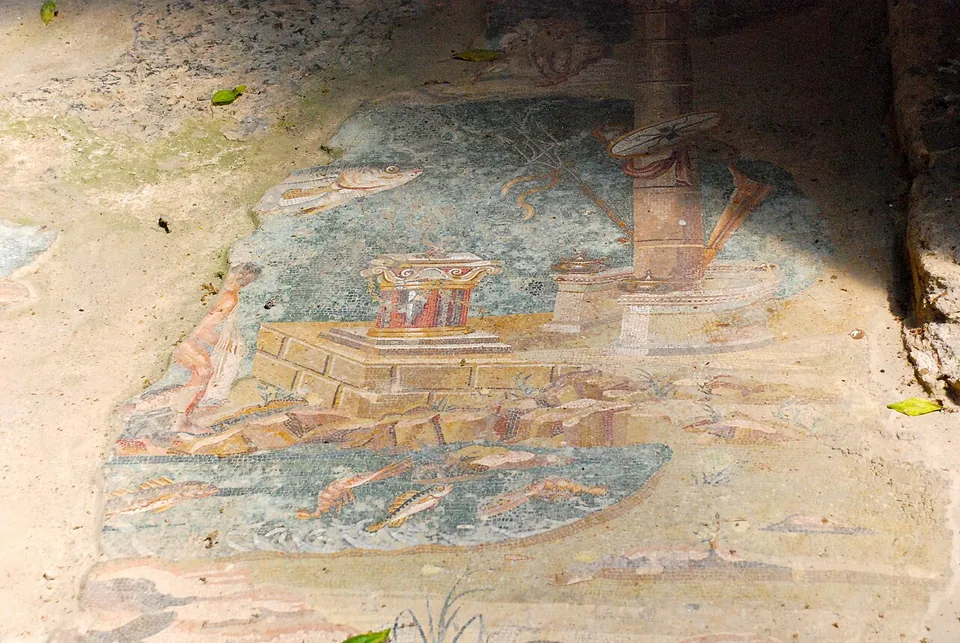
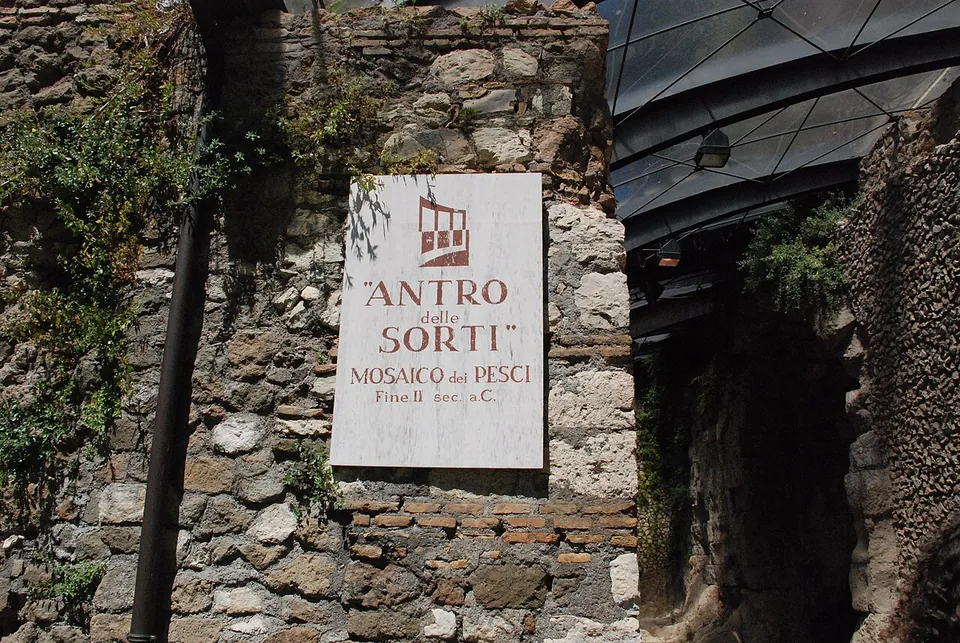
The Cave of the Fates. On the basilica’s western side is the so-called Antro delle Sorti, which the Ministry calls the Nymphaeum of the Fish: a natural cave fitted out as a fountain room (the Ministry of Culture; it.wikipedia). en.wikipedia describes it as enlarged with three niches, with artificial stalactites on the roof and an arch of limestone blocks framing the entrance. Its floor is a mosaic of a seascape full of fish and crustaceans (the Ministry of Culture), with a temple of Poseidon on the shore marked by an altar and a tall column, and a trident and a rudder beside it (en.wikipedia). The middle of the mosaic is damaged and has gaps, because the room was used to burn lime in the last century (the Ministry of Culture). “Antro delle Sorti” and “Area Sacra” are traditional names, given to rooms once thought to be part of the sanctuary of Fortuna above (it.wikipedia).
The apsed hall. On the other side of the basilica is the Aula Absidata, a large rectangular hall whose purpose is uncertain. The floor of its apse held the Nile mosaic, now on the top floor of the museum in the Palazzo Barberini (the Ministry of Culture). Fragments of an Egyptian obelisk were found nearby, which led to the suggestion that the hall was a shrine of Isis; it may also have been a twin of the fountain room, or a religious building tied to the sanctuary (it.wikipedia).
On the square. The public treasury, the town’s strongroom for tax money, opens onto Piazza Regina Margherita. Beside it is a stretch of the forum’s original paving and part of a temple of Jupiter from the end of the 4th century BC, built into the cathedral of Sant’Agapito (the Ministry of Culture).
Is it worth the trip?
As part of a day in Palestrina, yes. The forum is on the same ticket as the Sanctuary of Fortuna Primigenia and the museum, at the foot of the sanctuary. The fish mosaic is a Hellenistic-period floor still in the room it was made for (it.wikipedia), and standing in the hall where the Nile mosaic lay makes sense of the museum’s top floor.
On its own it is not a reason to make the journey from Rome. It is fragments inside later buildings: a portico inside a palace front, a mosaic in a grotto, damaged in the middle. If time is short, give it to the sanctuary and the museum first. The sanctuary and the town are described on the Praeneste – Palestrina page.
Getting there and what it costs
Palestrina is about 35 km east of Rome (en.wikipedia), and the forum is on its main square, Piazza Regina Margherita. There is paid parking on the square itself, about 30 m away (OpenStreetMap). The square of the former railway station is a car park and bus terminus, with escalators up to Porta del Sole and the old centre (it.wikipedia); a COTRAL bus stop at Porta del Sole is about 150 m from the forum, and a stop named Cattedrale S. Agapito about 50 m (OpenStreetMap).
The forum is open Wednesday to Monday, 09.30–19.00, with last entry at 18.00, and is closed on Tuesdays. There is no forum-only ticket: the PRAENESTE ticket, €10 and valid for two consecutive days, covers the forum, the sanctuary and the museum. EU citizens aged 18 to 25 pay €2 and under-18s go free, as at all Italian state museums, and entry is free for everyone on the first Sunday of each month. Tickets are sold at the forum’s own ticket office or at the museum’s, and online through Musei Italiani. Until 31 October 2026 the ticket also covers the exhibition “Gabii: le origini” in the former Seminario (the operator; the Ministry of Culture, read 24 October 2026).
Visiting details
- Opening hours
- Wednesday–Monday 09.30–19.00, last entry 18.00. Closed on Tuesdays.
- Tickets
- No forum-only ticket is listed. The PRAENESTE ticket covers the forum, the Sanctuary of Fortuna Primigenia and the Museo archeologico nazionale Prenestino, €10, valid two consecutive days (bought on a Monday, it is valid until Wednesday); €2 for EU citizens aged 18–25; free under 18. Free for everyone on the first Sunday of the month and on 4 November 2026. Tickets are sold at the forum's ticket office or the museum's, and online through Musei Italiani. Until 31 October 2026 the ticket also includes the exhibition "Gabii: le origini" in the former Seminario on the forum.
- Parking
- Paid parking on Piazza Regina Margherita, the square in front of the forum, about 30 m away (OpenStreetMap way/204591812, operator Comune di Palestrina). The square of the former railway station is a car park and bus terminus, linked to Porta del Sole and the old centre by escalators.
Before you go
- Closed on Tuesdays (since August 2026).
- Last entry is at 18.00, an hour before closing, and the Ministry lists the ticket office as open until 18.00.
Hours and prices checked 24 October 2026 on the operator's own site. Confirm before travelling.
History
The forum was the centre of the ancient city and was used across several periods (Pleiades). A large Etrusco-Italic temple of the 4th century BC stood here and formed the backdrop to the later buildings (Pleiades; it.wikipedia). The basilica and the halls around it were built in the last decades of the 2nd century BC (the Ministry of Culture), in a period when trade with the eastern Mediterranean made Praeneste exceptionally rich and the whole town was remodelled, the sanctuary of Fortuna included (the Ministry of Culture). en.wikipedia dates the public treasury to about 150 BC by an inscription, and the two fountain rooms with their mosaics to perhaps around 110–100 BC; the mosaics are thought to be the work of artists from Alexandria.
Under Claudius the obelisks of Titus Sextius Africanus were erected in the forum area; they are now in the museum at Palestrina, in Munich and in Naples (en.wikipedia). A second forum may later have been built in the lower town, near today’s Madonna dell’Aquila (en.wikipedia).
The cathedral of Sant’Agapito rose on the foundations of the temple of Jupiter (it.wikipedia). The Nile mosaic was still in place when Federico Cesi examined it in 1614; the Barberini removed most of it between 1624 and 1626 and later put it on show in their palace at Palestrina, where it remains (en.wikipedia). For a long time the forum buildings were taken for a “lower sanctuary” of Fortuna (it.wikipedia); archaeologists in the 1950s identified the area around the cathedral and the square as the forum of ancient Praeneste (en.wikipedia).
More photographs


Nearby
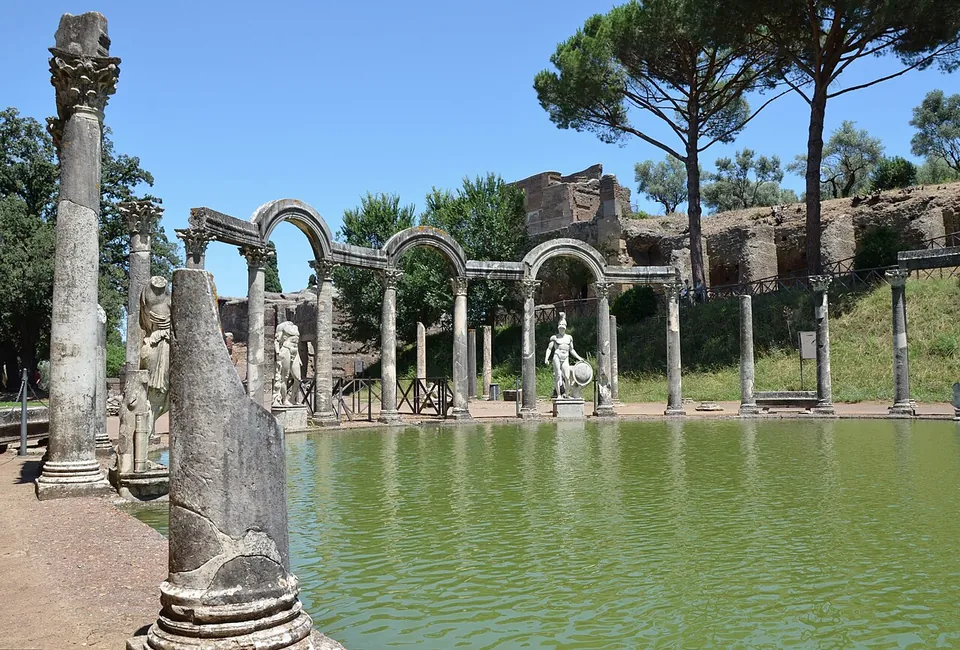
Photo: Carole Raddato from FRANKFURT, Germany · CC BY-SA 2.0 · Commons
15 km · villa · Lazio
Hadrian's Villa
A landscape of ruins among olive trees and cypresses rather than one building.
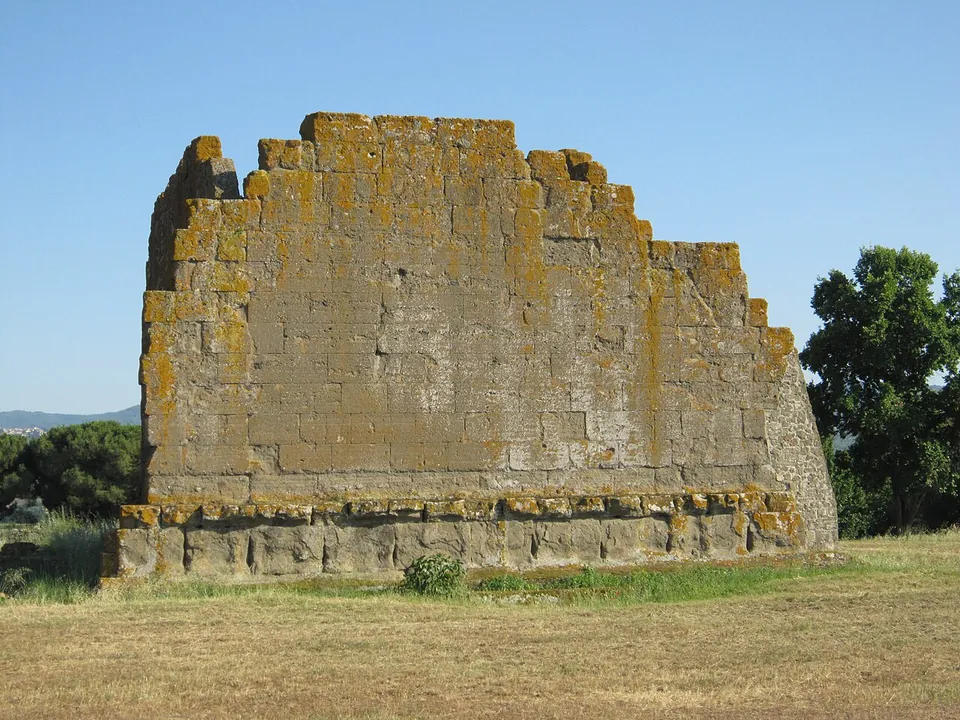
Photo: Carlomorino · CC BY-SA 3.0 · Commons
15 km · city · Lazio
Gabii
The park the state holds covers about 70 hectares on the southern rim of a volcanic crater whose lake was drained in the 19th century (the operator; en.wikipedia).
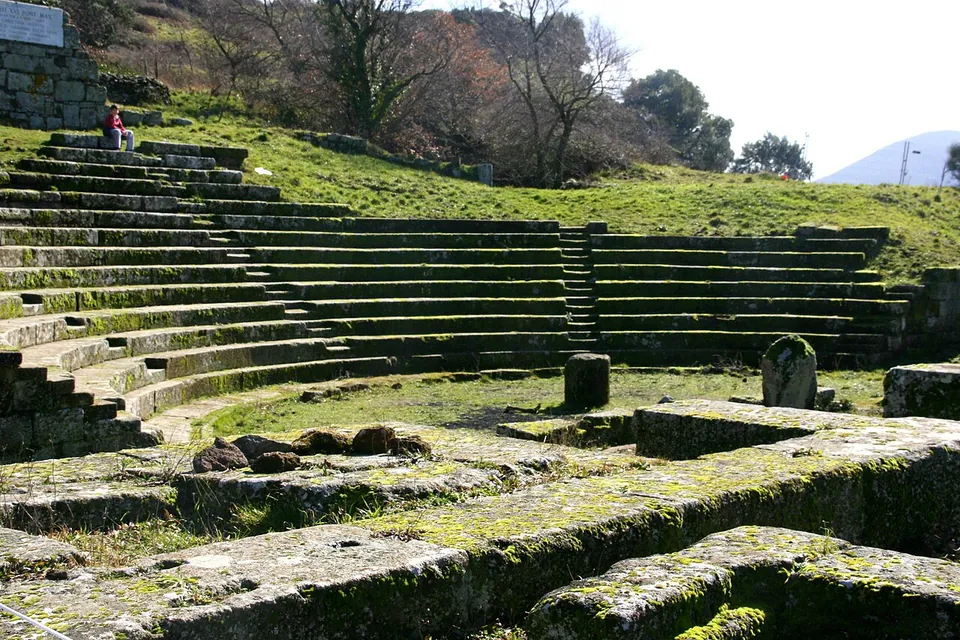
Photo: Luiza Serpa Lopes · Public domain · Commons
16 km · city · Lazio
Tusculum
The visitor route runs mainly through the forum, with the theatre halfway round (the operator).


Straight-line distances.
Sources
Every fact on this page comes from the records below, each used under the licence noted.
| Source | Licence |
|---|---|
| Pleiades 678434580 | CC BY |
| Wikidata Q3748440 | CC0 |
| OpenStreetMap way/444051314 | ODbL |
| Pleiades — Antro delle Sorti (Cave of the Fates) | licence not recorded |
| Wikidata — Cave of the Fates (Q55174210) | licence not recorded |
| Wikipedia (it) — Foro civile di Preneste | CC BY-SA 4.0 |
| Wikipedia (en) — Palestrina, Lazio | CC BY-SA 4.0 |
| Wikipedia (it) — Palestrina | CC BY-SA 4.0 |
| Wikipedia (en) — Nile mosaic of Palestrina | CC BY-SA 4.0 |
| Musei e Parchi archeologici di Praeneste e Gabii — hours and tickets (the operator) | licence not recorded |
| Ministero della Cultura — Museo archeologico nazionale Prenestino, Santuario della Fortuna Primigenia e Foro di Praeneste (hours, tickets, description) | licence not recorded |
| Ministero della Cultura — free and reduced admission to state museums | licence not recorded |