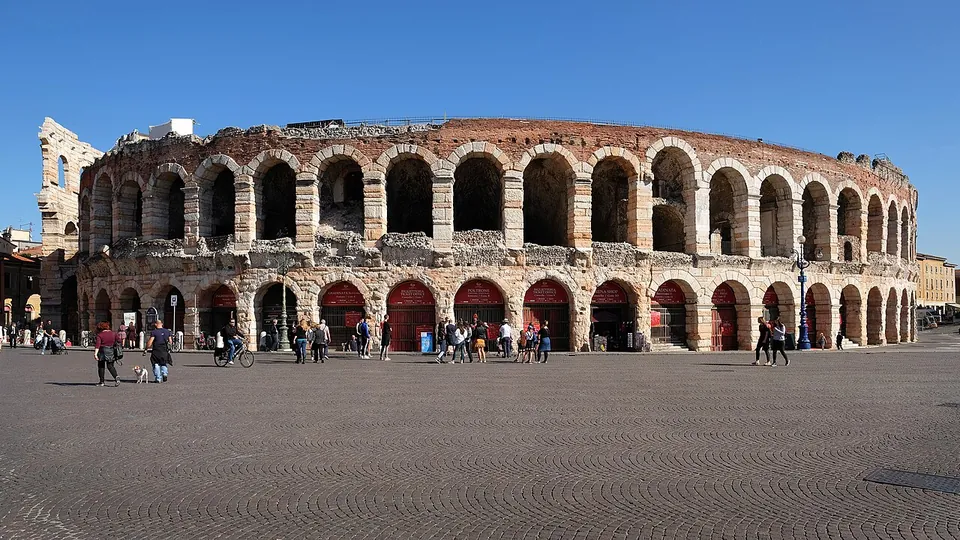


The Verona Arena is a Roman amphitheatre of the 1st century AD in the historic centre of Verona, and one of the best-preserved ancient amphitheatres: you can still walk through its galleries and up into its seating (en.wikipedia; it.wikipedia; Musei Civici). It costs €12, and it is worth it, with one caveat: from April to October it is also a working stage, and parts of it are closed to visitors.
What is there today
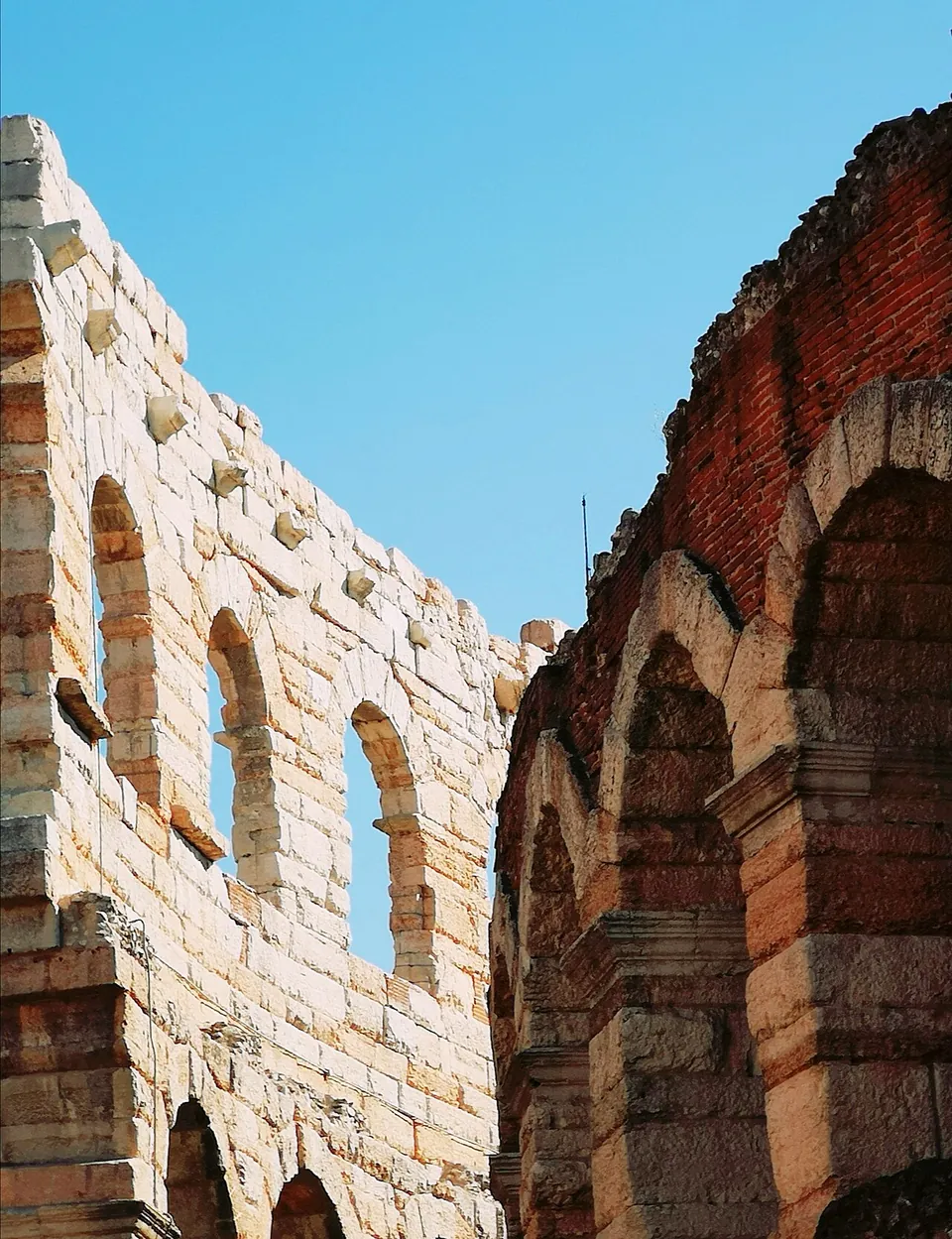
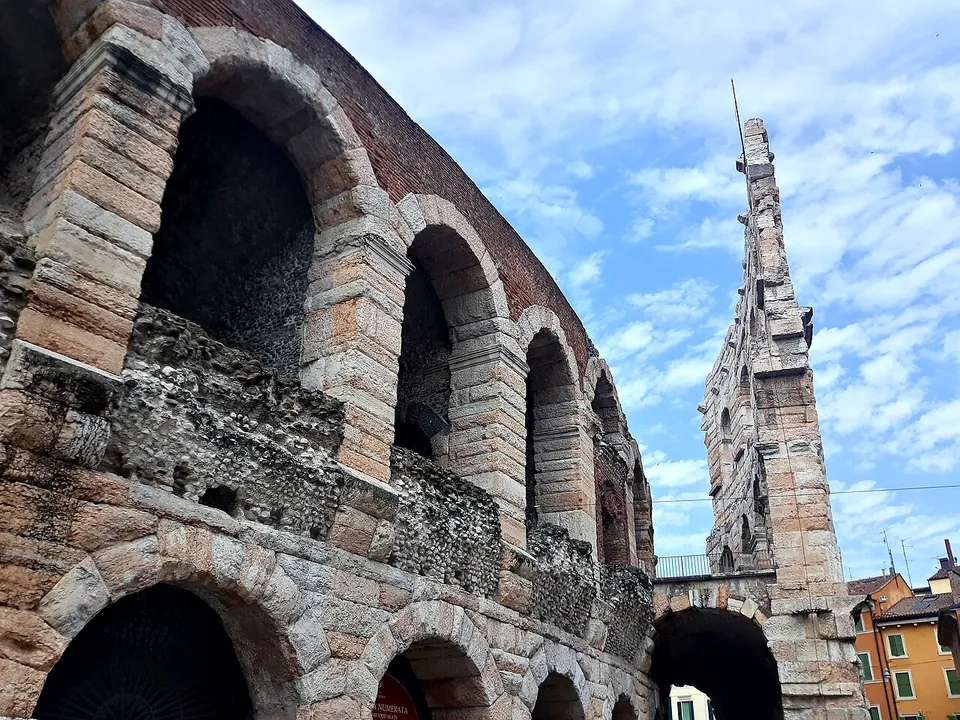
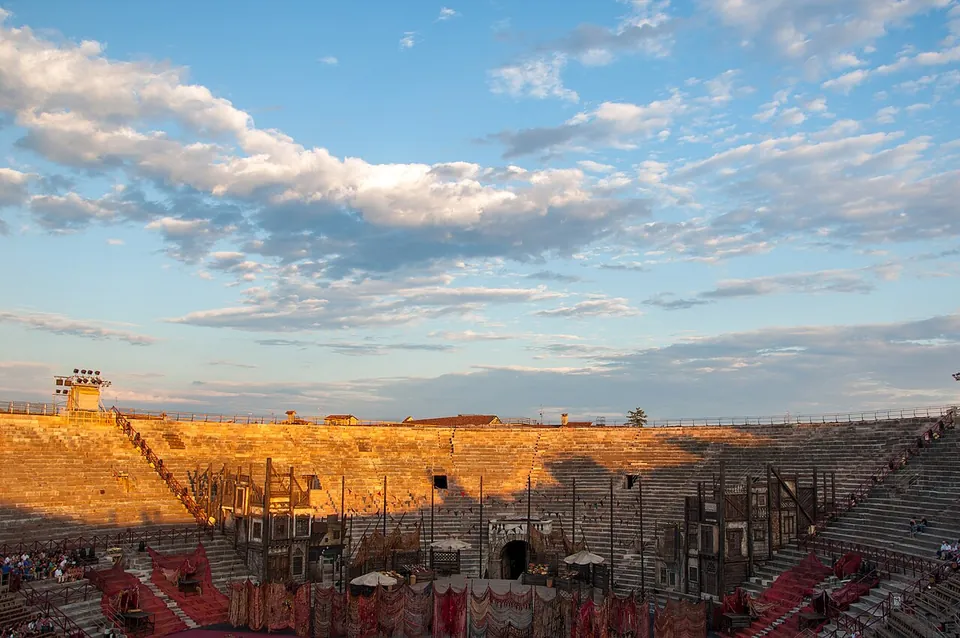
From Piazza Bra you see a long oval of two storeys of arches. That is the inner ring. The real facade, an outer ring almost 31 m high with three storeys of arches in rough-faced blocks of Valpolicella limestone, has gone except for one stretch of four arches called the Ala, “the wing”, which stands above the rest (Musei Civici; city leaflet); above its arches you can still read the Roman numerals LXIV to LXVII that numbered the entrances, out of 72 (city leaflet; it.wikipedia). The outer ring was partly pulled down under Theodoric (493–526) to build a new city wall, and the Arena served as a stone quarry until the Renaissance (Musei Civici).
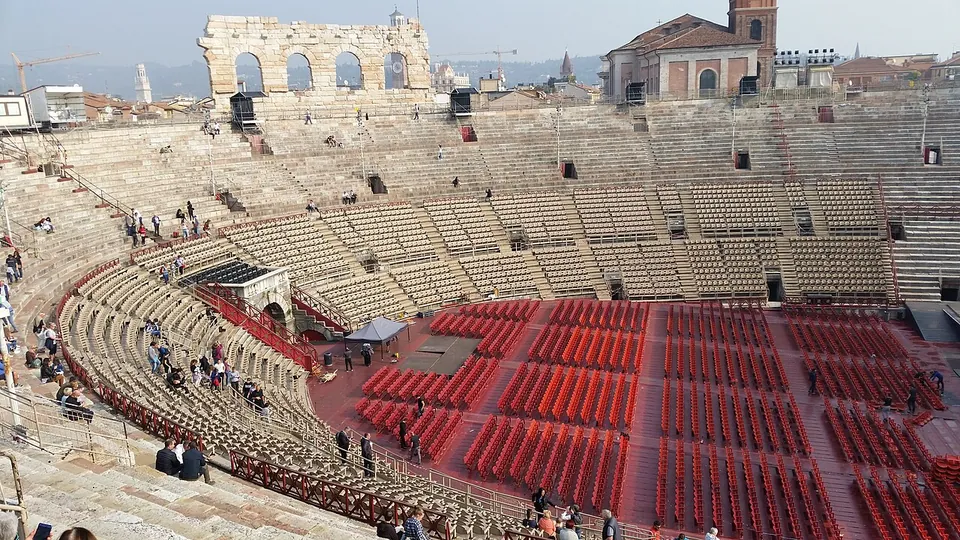
Inside, the seating sweeps round an oval arena floor of 75.68 by 44.43 m; the whole building measured 152.43 by 123.23 m, the eighth-largest amphitheatre of the Roman Empire and the fourth in Italy (city leaflet; it.wikipedia). Roman Verona fitted about 30,000 spectators in it; for safety and for the stage, today’s audiences are about half that (city leaflet). The stone tiers have been rebuilt (Musei Civici): the city began restoring the seating in 1568, and later campaigns, into the 19th century, put back missing steps (it.wikipedia). The visit follows a route with information panels through the vaulted galleries and up into the seating; the parts open vary with the events being staged (city leaflet). Statues found in the Arena are not here but in the Archaeological Museum at the Roman Theatre, across the river (city leaflet).
Is it worth the trip?
Yes. It is Verona’s most famous monument (Musei Civici), and despite all it has been through it lets a visitor easily grasp how a building of this kind was put together (it.wikipedia). The other Roman sights of Verona, from the theatre to the Arco dei Gavi, are on the Verona page.
Know what season you are coming in. From April to October the Arena holds performances, modern stage sets fill part of it and it cannot be seen in full, and the city publishes no visiting hours for performance days (Musei Civici). While sets go up or come down, access to the seating may be limited for safety; the level route through the ring galleries needs no special aids (Musei Civici). The city’s warning covers April to October; from November to March, entry on the first Sunday of the month costs €1.
Getting there and what it costs
The Arena stands on Piazza Bra, in the historic centre. Verona Porta Nuova railway station is about 1.4 km away, and the bus stop Piazza Bra Arena about 150 m (OpenStreetMap). Drivers have two paying underground car parks close by, Cittadella about 300 m away and Parcheggio Arena about 450 m (OpenStreetMap).
It is open Tuesday to Sunday, 09.00 to 19.00, except on performance days, and closed on Mondays. A ticket is €12; groups of 15 or more and over-65s pay €9, and 18–25-year-olds from the EU and a few other countries €3. Under-18s go free (under-14s only with an adult), as do disabled visitors with a companion and holders of the VeronaCard. Since 1 October 2026 the city’s only official online ticket office is verona.coopculture.it, and it warns that tickets bought elsewhere may not get you in (Musei Civici di Verona, read 17 October 2026; check before travelling).
Visiting details
- Opening hours
- Tuesday–Sunday 09.00–19.00, except on performance days, for which no hours are published; closed on Mondays (with a one-off Monday opening on 7 December 2026).
- Tickets
- €12; €9 for groups of 15 or more and over-65s; €3 for 18–25-year-olds from the EU, Norway, Switzerland, Liechtenstein, Iceland and Uruguay; free under 18 (under 14 only with an adult), for disabled visitors and one companion, and with the VeronaCard. €1 on the first Sunday of the month from November to March.
- Parking
- Underground car parks Cittadella (OpenStreetMap way/24895019, 750 spaces, fee) about 300 m from the Arena and Parcheggio Arena (way/138825310, 870 spaces, fee) about 450 m from it. The bus stop Piazza Bra Arena is about 150 m away.
Before you go
- From April to October the Arena holds performances and events, carries modern stage sets and cannot be seen in full; the city publishes no visiting hours for performance days.
- While stage sets are being put up or taken down, access to the seating may be limited for safety.
- Since 1 October 2026 the city's only official online ticket office is verona.coopculture.it; it says entry is not guaranteed with tickets bought elsewhere.
Hours and prices checked 17 October 2026 on the operator's own site. Confirm before travelling.
History
No written source records when the Arena was built. Datings once ran from the 1st to the 3rd century; it is now accepted that it is no later than the 1st century. The tuff head of a gladiator from its decoration wears a helmet of a type that came into use around AD 10–20 and had changed by 40, which led Pirro Marconi to date the building’s completion to about AD 30, while Luigi Beschi put it in the middle of the century (it.wikipedia); the city’s museums also say the middle of the century. It was standing by AD 69, when Vespasian’s forces had to dig a new ditch south of the town because the amphitheatre outside the walls made them useless (it.wikipedia). It was built outside the walls on purpose, so crowds from the town and the countryside did not jam the centre (Musei Civici).
The games were gladiator fights and hunts of wild and exotic animals (Musei Civici). Pliny the Younger wrote of a friend who gave the people of Verona a wild-beast hunt in memory of his wife, and tombstones of gladiators have been found in the city: one, Generosus, fought twenty-seven times without defeat and died of natural causes (it.wikipedia). In 265 Gallienus built a new stretch of wall to take the Arena inside the city’s defences, and in 312, when Constantine besieged Maxentius’s forces in Verona, it served the defenders as a bastion (it.wikipedia).
After antiquity the building lived on. Its outer arches were let by the city, to prostitutes until 1537 and then to craftsmen’s workshops, and its interior was used for trials by combat, festivals and races (Musei Civici; it.wikipedia); in 1278 nearly 200 Cathar heretics were burned here (it.wikipedia). The Ala was shored up in the Second World War and tied together with steel cables in 1953–1956 (it.wikipedia). Since a performance of Verdi’s Aida in 1913, marking the centenary of the composer’s birth, the Arena has held a summer opera season, interrupted only by wars (city leaflet; en.wikipedia), and in February 2026 it staged the closing ceremony of the Milan–Cortina Winter Olympics (it.wikipedia).
More photographs


Nearby
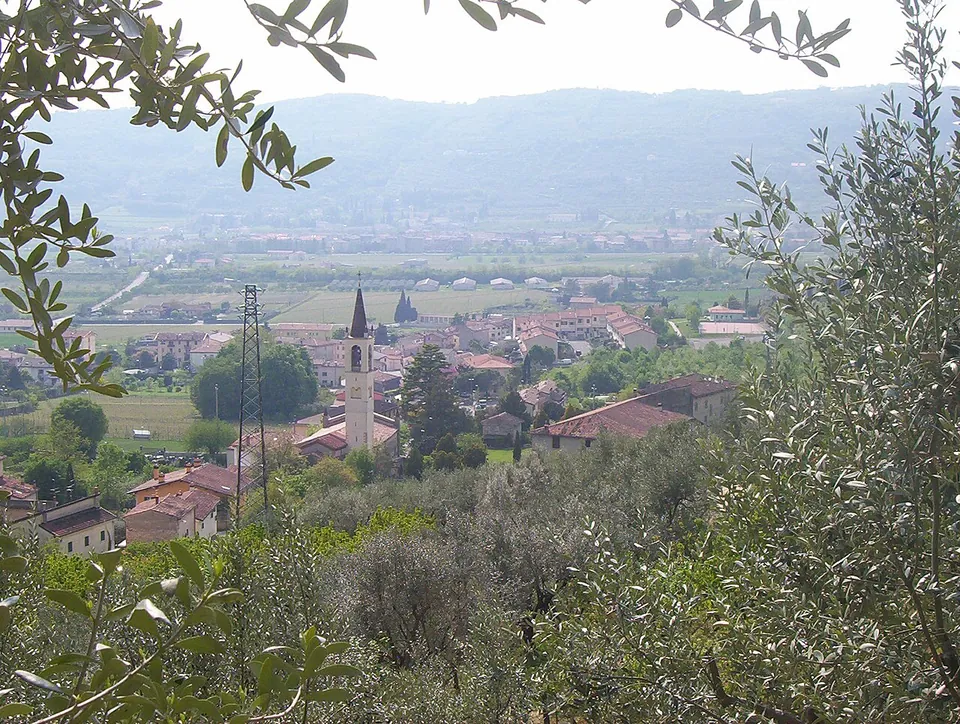
Photo: Adert · CC BY-SA 3.0 · Commons
7 km · site · Veneto
Ipogeo di Santa Maria in Stelle
The water of an underground spring collects in a semicircular settling basin cut in the rock and runs on along a low, narrow, barrel-vaulted channel 100 m long, with four shafts along it.
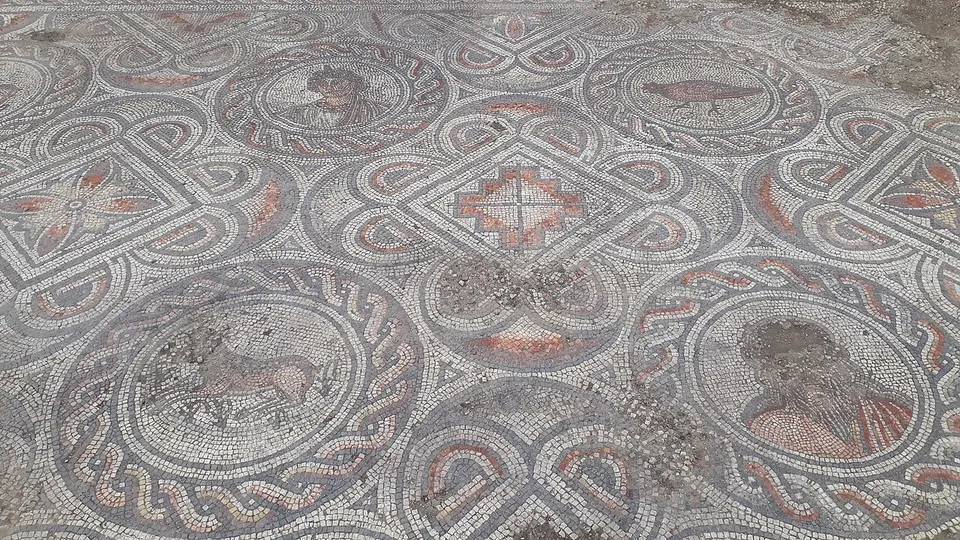
Photo: Piergiovanna Grossi · CC BY-SA 4.0 · Commons
12 km · villa · Veneto
Villa dei Mosaici
The villa has been brought to light almost entirely (it.wikipedia).
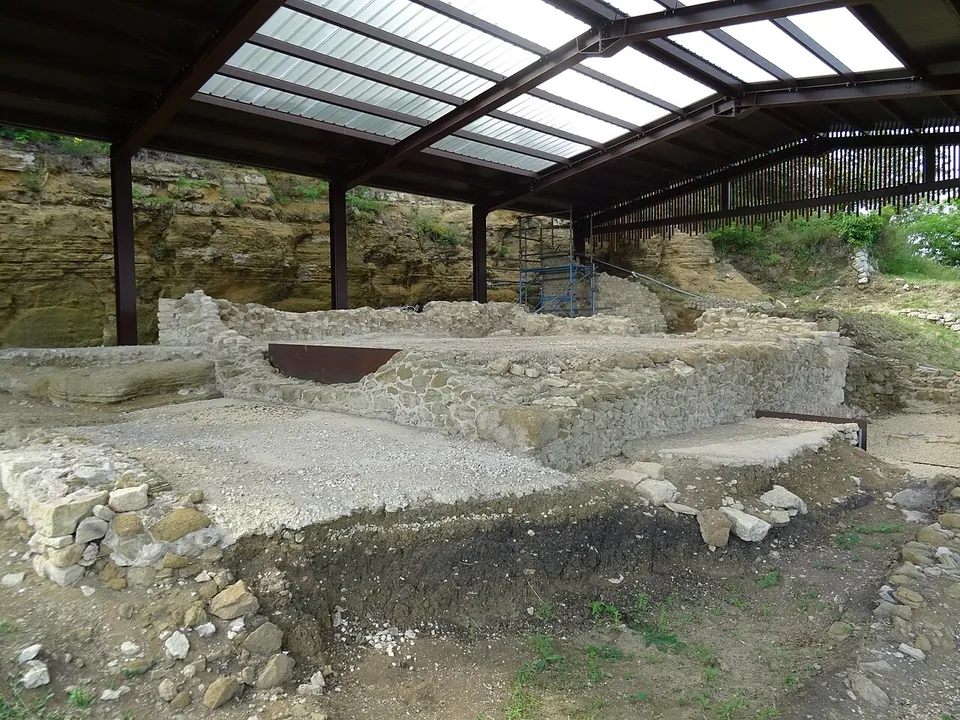
Photo: Syrio · CC BY-SA 4.0 · Commons
15 km · temple · Veneto
Temple of Minerva (Marano di Valpolicella)
What you see are the remains of the temple rebuilt in the Augustan age: the walls of its four-sided central chamber (the cella) and of the galleries that ran round it, under a modern shelter roof set against the rock face of the hill (the operator).


Straight-line distances.
Sources
Every fact on this page comes from the records below, each used under the licence noted.
| Source | Licence |
|---|---|
| Pleiades 771445424 | CC BY |
| Wikidata Q641556 | CC0 |
| Vici.org 4275 | CC BY-SA (text), CC0 (metadata) |
| OpenStreetMap relation/311873 | ODbL |
| Wikipedia (it) — Arena di Verona | CC BY-SA 4.0 |
| Wikipedia (en) — Verona Arena | CC BY-SA 4.0 |
| Wikipedia (fr) — Arènes de Vérone | CC BY-SA 4.0 |
| Wikipedia (hr) — Arena u Veroni | CC BY-SA 4.0 |
| Musei Civici di Verona — Anfiteatro Arena | licence not recorded |
| Musei Civici di Verona — Anfiteatro Arena, visiting information (hours and tickets) | licence not recorded |
| Musei Civici di Verona — Anfiteatro Arena, accessibility | licence not recorded |
| Musei Civici di Verona — The Arena amphitheatre (visitor leaflet, English, PDF) | licence not recorded |
| Musei Civici di Verona — new online ticket office (from 1 October 2026) | licence not recorded |