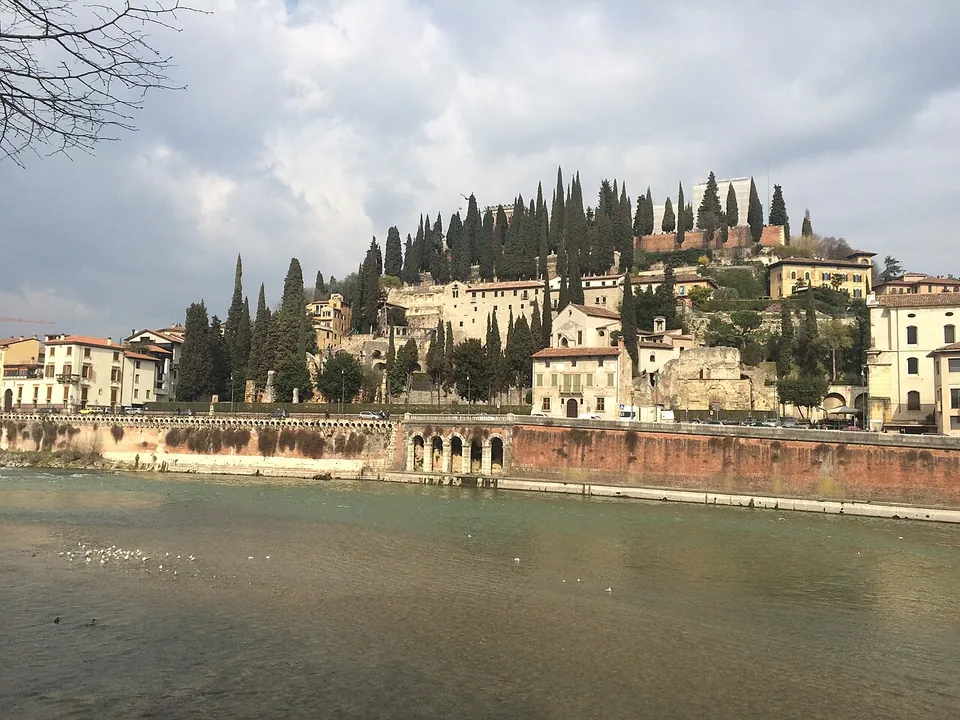
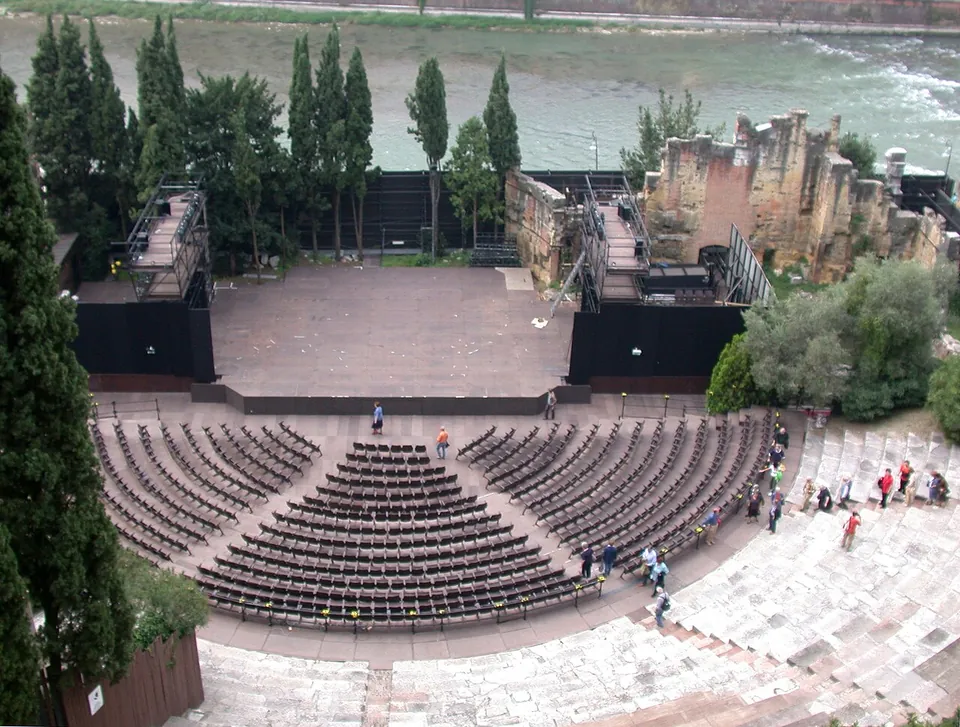


The Roman theatre of Verona was built at the end of the 1st century BC against the foot of the Colle San Pietro, on the left bank of the Adige beside the Ponte Pietra, and its semicircle of seating, 105 m across, still holds audiences every summer (it.wikipedia). It is worth the €9 ticket, which also buys the archaeological museum above it, though most of the seating was relaid or rebuilt in the early 20th century (the operator).
What is there today
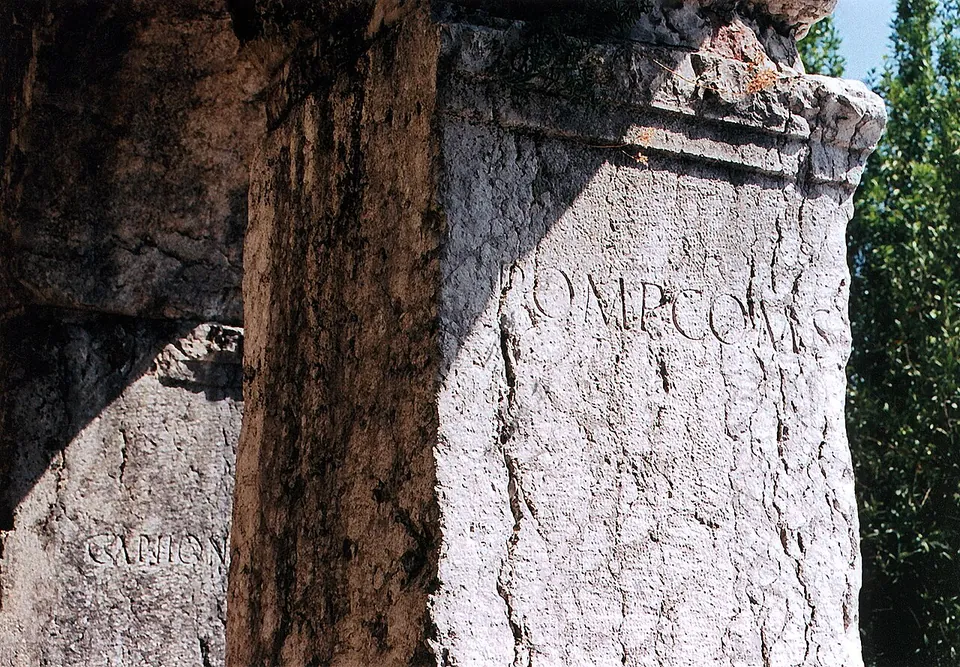
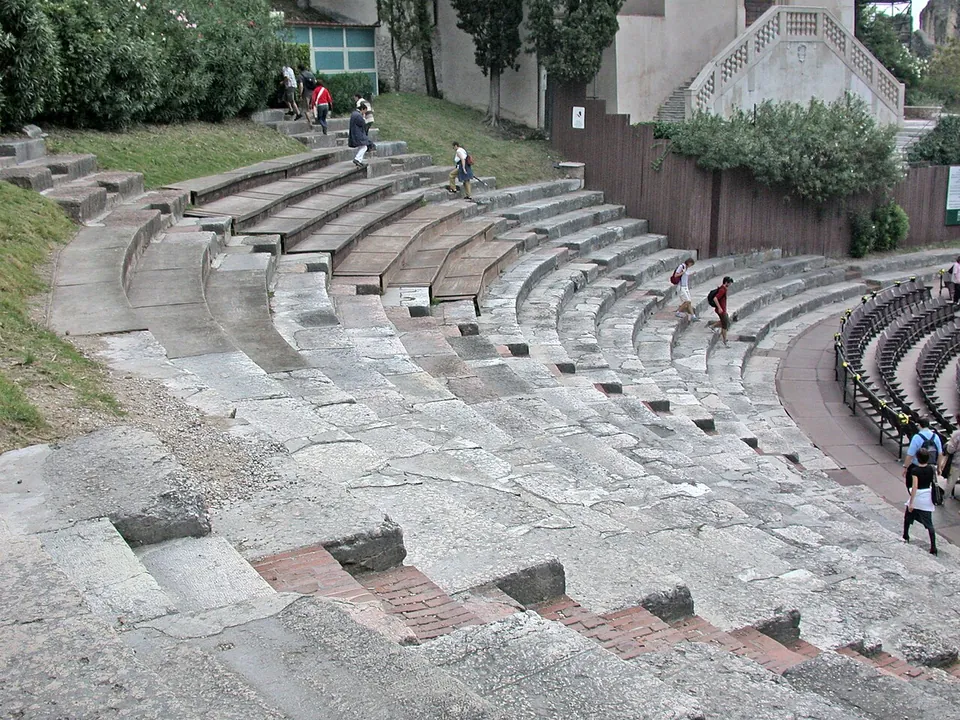
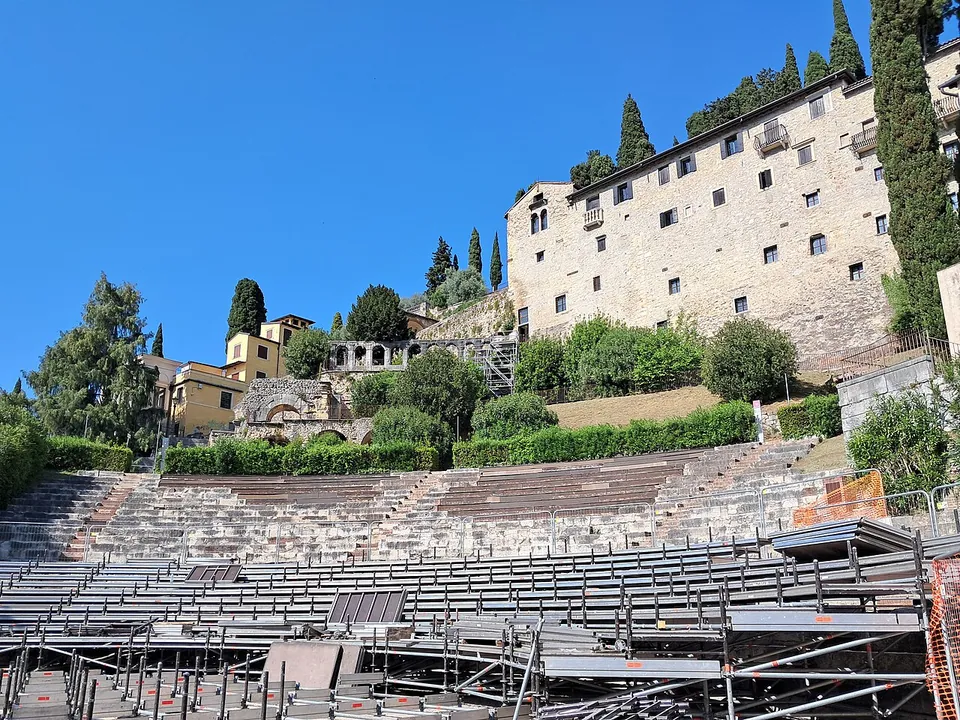
The seating (cavea) is the part you come for. Its centre rests on the slope of the hill and its two wings on radial walls of Roman concrete (it.wikipedia; the operator), and a deep channel cut into the rock runs round its whole edge to keep rainwater off it (it.wikipedia). The tiers themselves were largely relaid or rebuilt in the early 20th century (the operator), and inscriptions are cut into some of the topmost rows (Commons). Facing them, the semicircle of the orchestra lies in front of the stage. Of the stage building, 71 m long, the load-bearing walls of tufa blocks remain; three doors in them opened onto the stage for the actors, and beneath it, the scene pit holds the fittings for raising and lowering the curtain (the operator; it.wikipedia). These walls stand only to a modest height, where in Roman times they rose to the top of the seating (it.wikipedia). More of the stage building is built into Palazzo Fontana, the Renaissance building through which you enter, and can still be picked out (it.wikipedia).
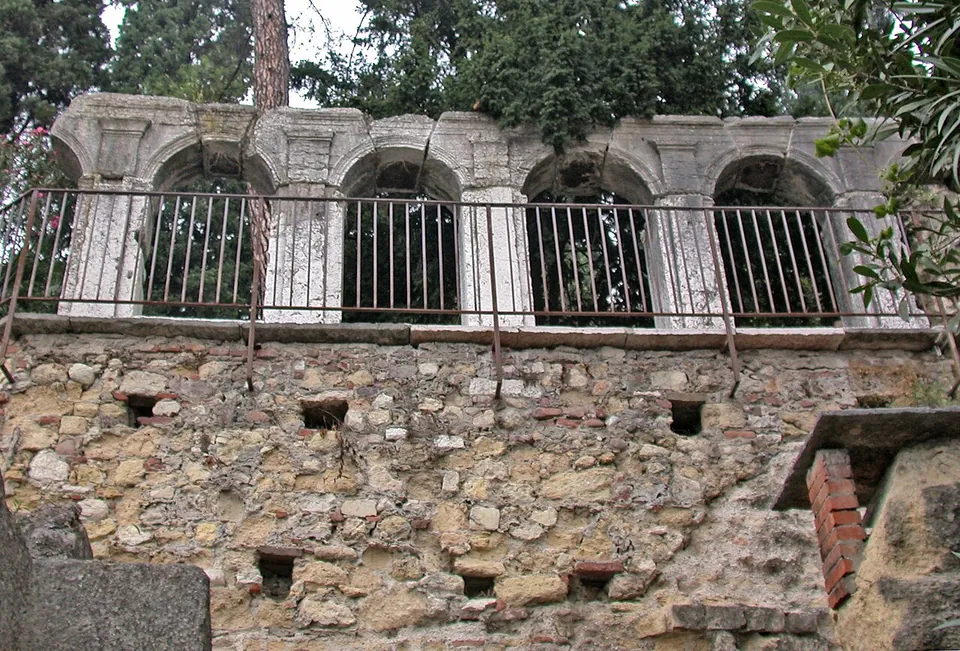
Above the seating ran a gallery with a row of small arches, now partly rebuilt on a terrace (the operator). Higher still, three terraces 123 m wide climbed the hill: the middle one has five niches framed by half-columns, the top one a single niche flanked by Tuscan half-columns, and at one end of the lowest are the remains of a nymphaeum (it.wikipedia). The whole complex rose about 60 m from the river to the top of the hill, about 150 m wide and 107 m deep, and was crowned by a temple whose remains were found in 1851 when the foundations of Castel San Pietro were dug (the operator); the castle now occupies the spot (it.wikipedia).
The archaeological museum fills the 15th-century convent of the Gesuati, which sits on the lowest terrace above the seating (it.wikipedia). Its rooms hold Roman Verona’s finds: bronze sculpture, Verona being among the Roman towns of northern Italy with the most bronze finds; a Roman copy of Phidias’s Venus from the pediment of the Parthenon; tombstones in the cloister; mosaics in the church of San Girolamo; and models of the Arena (1770–1780) and, in wood, of the Arco dei Gavi (1813) (it.wikipedia). A mosaic of three gladiator fights, found in 1935 in a house in Via Diaz, is shown beside the Arena model (it.wikipedia); en.wikipedia dates it to the 3rd century.
Is it worth the trip?
Yes, if you are in Verona: it is a short walk from the old town and the ticket includes the museum, whose top floor is laid out as an introduction to Roman Verona, its houses, cemeteries and public buildings (it.wikipedia). The setting does a great deal of the work, a hillside of terraces and cypresses facing the river and the Ponte Pietra.
Know what you are looking at. Most of the steps you sit on were put back in the 20th century, the stage building is a low ruin, and through the summer a modern stage and rows of seating stand in the theatre for the Estate Teatrale Veronese, a Shakespeare festival that has run every year since 1948 (the operator; it.wikipedia). In 2026 the stage went up from the end of March, and the operator notes that the visitor route changes while it is being built. The museum can only be reached by climbing the seating, so visitors who cannot manage steps see the theatre but not the museum.
Getting there and what it costs
The entrance is at Regaste Redentore 2, beside the Ponte Pietra (the operator), about 130 m from the bridge, 600 m from Piazza delle Erbe and 1.1 km from the Arena (distances from the sites’ points). The nearest bus stop, Santo Stefano / Ponte Pietra, is about 200 m away and is reached by city bus from Verona Porta Nuova station (the operator; OpenStreetMap). Drivers will find a paid car park in Piazza Martiri della Libertà, about 90 m from the theatre, with a space for disabled drivers next to the entrance; the museum lies outside the limited-traffic zone (the operator; OpenStreetMap). The entrance to the theatre is up a ramp. A funicular to Castel San Pietro leaves about 150 m away (OpenStreetMap).
The theatre and museum are open Tuesday to Sunday, 10.00–18.00, with last entry at 17.30, and closed on Mondays. A ticket is €9; groups of 15 or more, over-65s and holders of the Veneto MyCARD pay €6, and 18–25-year-olds from the EU and a few other countries €2. Under-18s (under-14s only with an adult), disabled visitors and one companion, and VeronaCard holders go free. On the first Sunday of the month from November to March entry is €1 (Musei Civici di Verona, read 18 October 2026). Since the city’s ticketing changed hands on 1 October 2026, its only official online ticket office is verona.coopculture.it; tickets are also sold at the museum entrance.
Visiting details
- Opening hours
- Tuesday–Sunday 10.00–18.00, last entry 17.30; closed on Mondays (open on Monday 7 December 2026).
- Tickets
- €9, which includes the archaeological museum; €6 for groups of 15 or more, over-65s and holders of the Veneto MyCARD; €2 for 18–25-year-olds (EU citizens and a few other nationalities); free under 18 (under 14 only with an adult), for disabled visitors and one companion, and with the VeronaCard. €1 on the first Sunday of the month from November to March.
- Parking
- A paid car park on Piazza Martiri della Libertà (OpenStreetMap way/299842307), about 90 m from the theatre, with a space for disabled drivers next to the entrance.
Before you go
- Every summer the theatre hosts the Estate Teatrale Veronese and other shows, and a modern stage and seating are built into it. From 31 March 2026 that stage was going up, with changes to the visitor route.
- The museum above the theatre is reached only by climbing the steps of the seating, so it cannot be visited in a wheelchair or by anyone who cannot manage stairs. The theatre itself is entered by a ramp from Regaste Redentore 2.
- Ticketing for the city museums changed operator on 1 October 2026; the city names verona.coopculture.it as the only official online ticket office.
Hours and prices checked 18 October 2026 on the operator's own site. Confirm before travelling.
History
When Roman Verona was laid out inside the bend of the Adige, the Colle San Pietro across the river, the site of the prehistoric Venetic settlement, was freed for a monumental scheme, and the theatre was part of it: a stage on the riverbank, terraces climbing above it and a temple on the summit, facing the new town (it.wikipedia). Before building began, embankment walls were raised along the river between the Ponte Pietra and the Ponte Postumio to protect the site from floods; they also gave the theatre a foundation and carried the road between the two bridges (it.wikipedia; en.wikipedia). The work went on for decades, the terraces and the temple coming last (it.wikipedia). The river front had half-columns of a different order on each floor: Tuscan below, Ionic above, and pilasters with richly carved capitals at the top (it.wikipedia).
The theatre fell out of use in the Middle Ages. From at least the 10th century houses and churches were built over it (the operator), until a whole quarter stood on its substructures, reached by the theatre’s old entrances and stairways, while the seating was farmed (it.wikipedia). The church of San Siro, built in the 10th century and restored in the 14th, took up part of the seating (en.wikipedia). Giovanni Caroto and Andrea Palladio drew reconstructions of it in the 16th century (it.wikipedia). The first clearance, in 1757, was the work of abbé Fontana (fr.wikipedia), of the family that lived in Palazzo Fontana in the 18th century and dug at the theatre (it.wikipedia).
The theatre owes its return to Andrea Monga (1794–1861), a wealthy merchant who bought the whole area (the operator). Between 1834 and 1844 he had some thirty houses pulled down and uncovered the two side stairways, part of the seating and the drainage channel (it.wikipedia). The city bought the site from his heirs in 1904 and dug on until 1914, clearing the whole of the seating and setting the ten arches of the gallery back up; the archaeological museum, founded in 1924, moved into the convent, the scene pit was excavated in the 1930s, and the last works, in 1970–1971, found a gallery under the stage (it.wikipedia). The museum was restored and its displays renewed between 2013 and 2016 (it.wikipedia).
More photographs



Nearby
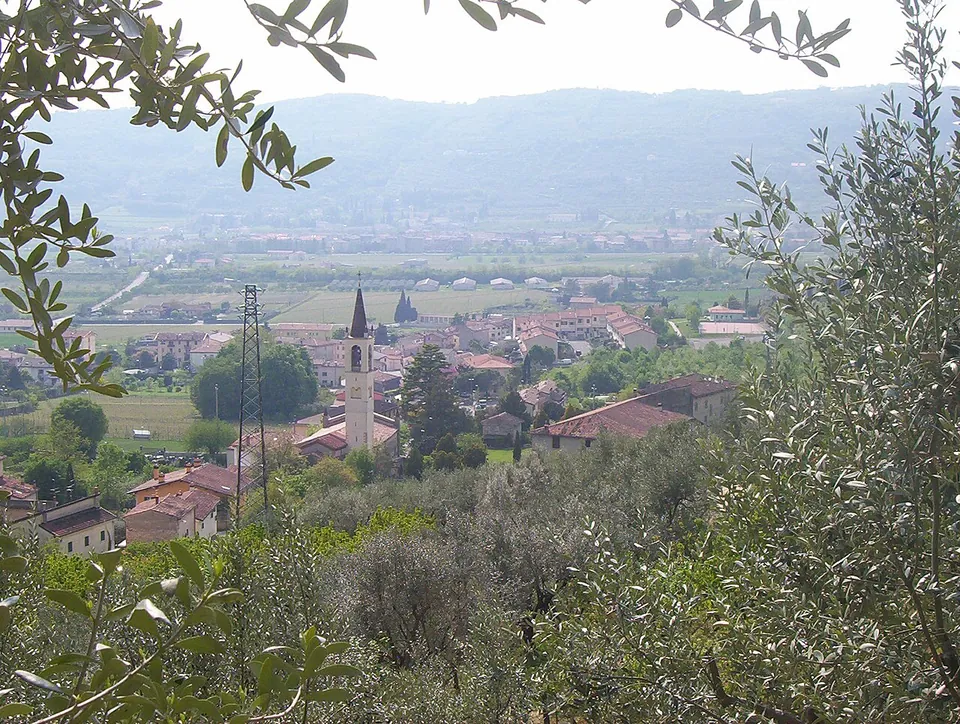
Photo: Adert · CC BY-SA 3.0 · Commons
6 km · site · Veneto
Ipogeo di Santa Maria in Stelle
The water of an underground spring collects in a semicircular settling basin cut in the rock and runs on along a low, narrow, barrel-vaulted channel 100 m long, with four shafts along it.
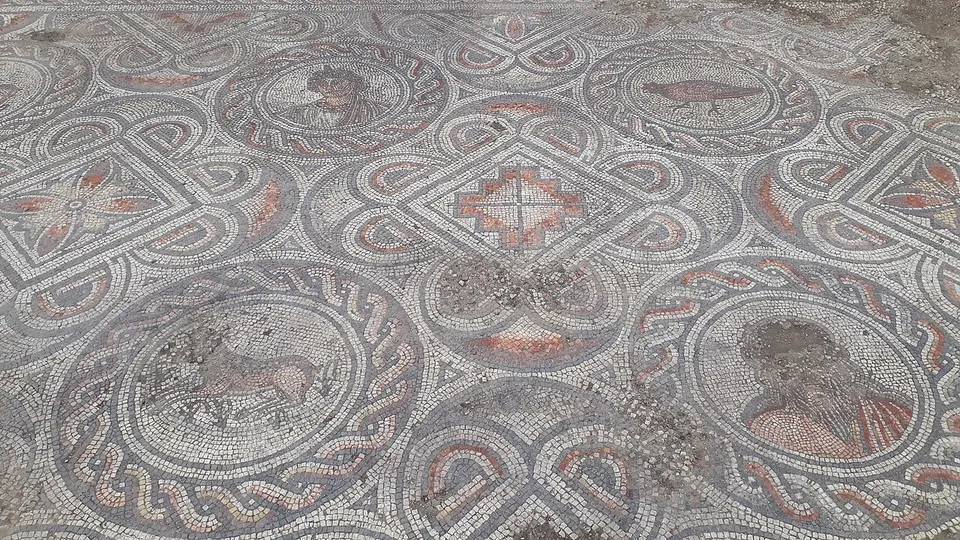
Photo: Piergiovanna Grossi · CC BY-SA 4.0 · Commons
11 km · villa · Veneto
Villa dei Mosaici
The villa has been brought to light almost entirely (it.wikipedia).
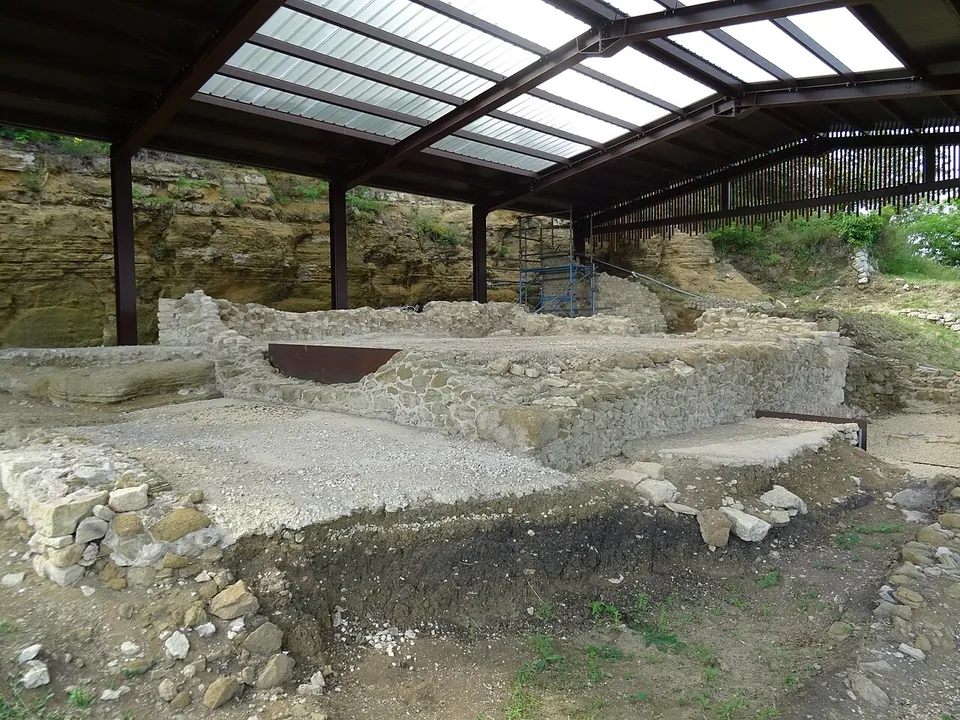
Photo: Syrio · CC BY-SA 4.0 · Commons
15 km · temple · Veneto
Temple of Minerva (Marano di Valpolicella)
What you see are the remains of the temple rebuilt in the Augustan age: the walls of its four-sided central chamber (the cella) and of the galleries that ran round it, under a modern shelter roof set against the rock face of the hill (the operator).


Straight-line distances.
Sources
Every fact on this page comes from the records below, each used under the licence noted.
| Source | Licence |
|---|---|
| Pleiades 24441049 | CC BY |
| Wikidata Q1477572 | CC0 |
| OpenStreetMap way/23164352 | ODbL |
| Pleiades — Verona (the Roman town) | licence not recorded |
| Wikipedia (it) — Teatro romano di Verona | CC BY-SA 4.0 |
| Wikipedia (it) — Museo archeologico al teatro romano | CC BY-SA 4.0 |
| Wikipedia (en) — Roman theatre, Verona | CC BY-SA 4.0 |
| Wikipedia (de) — Teatro Romano di Verona | CC BY-SA 4.0 |
| Wikipedia (fr) — Théâtre romain de Vérone | CC BY-SA 4.0 |
| Musei Civici di Verona — Museo Archeologico al Teatro Romano, visiting information (hours and tickets) | licence not recorded |
| Musei Civici di Verona — Il Teatro | licence not recorded |
| Musei Civici di Verona — Come raggiungerci (getting there) | licence not recorded |
| Musei Civici di Verona — Accessibilità | licence not recorded |
| Musei Civici di Verona — new online ticket office (from 1 October 2026) | licence not recorded |