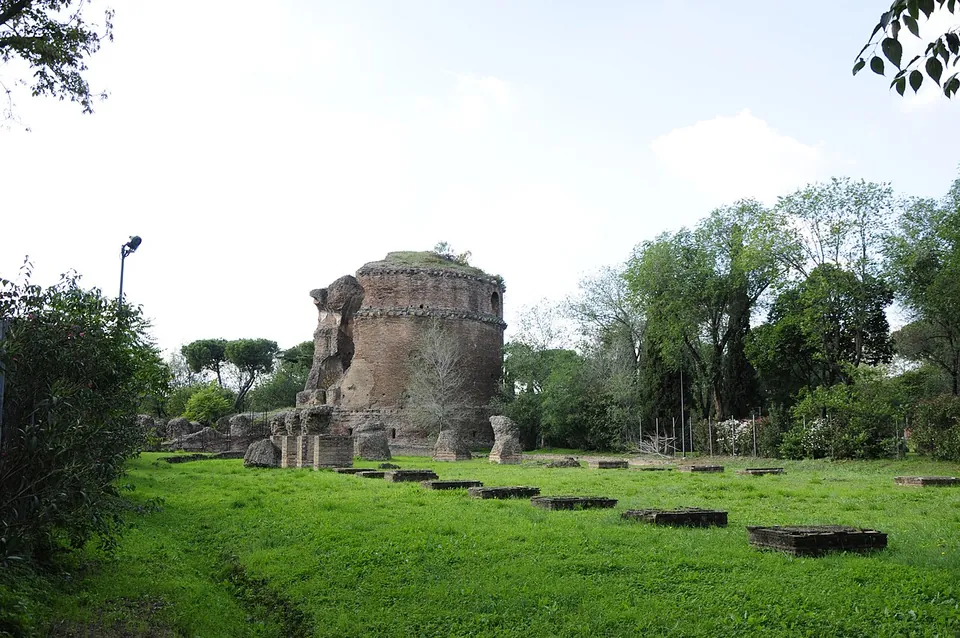
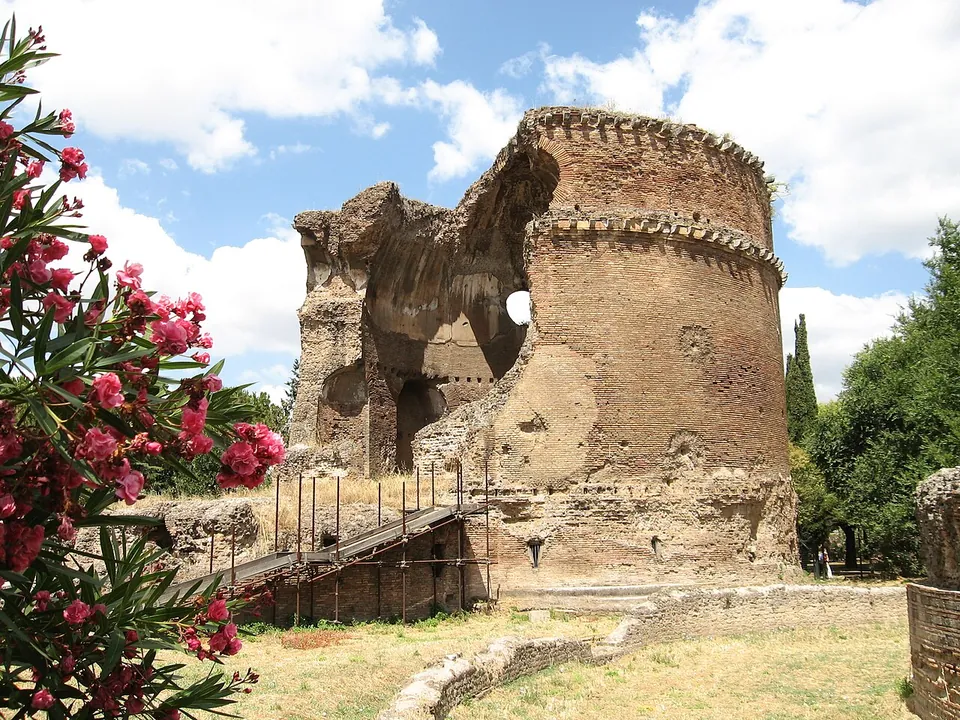


Villa Gordiani is a public park in Rome’s eastern suburbs, about 6 km from the centre on Via Prenestina, laid out over the remains of a large Roman villa traditionally linked with the Gordians, the family of three 3rd-century emperors. The villa itself lies buried, but brick ruins of its later buildings stand in the lawns, above all a round mausoleum about 18 m high (it.wikipedia; Sovrintendenza Capitolina).
What is there today
The park covers 8 hectares on both sides of Via Prenestina (Roma Capitale; it.wikipedia). The most monumental remains are on the north side of the road (Sovrintendenza Capitolina):
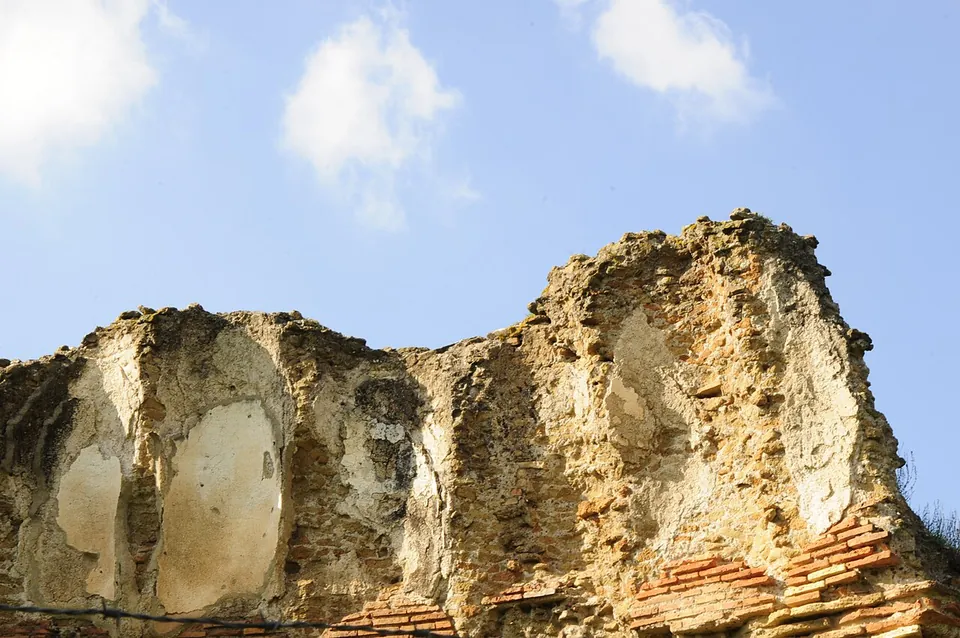
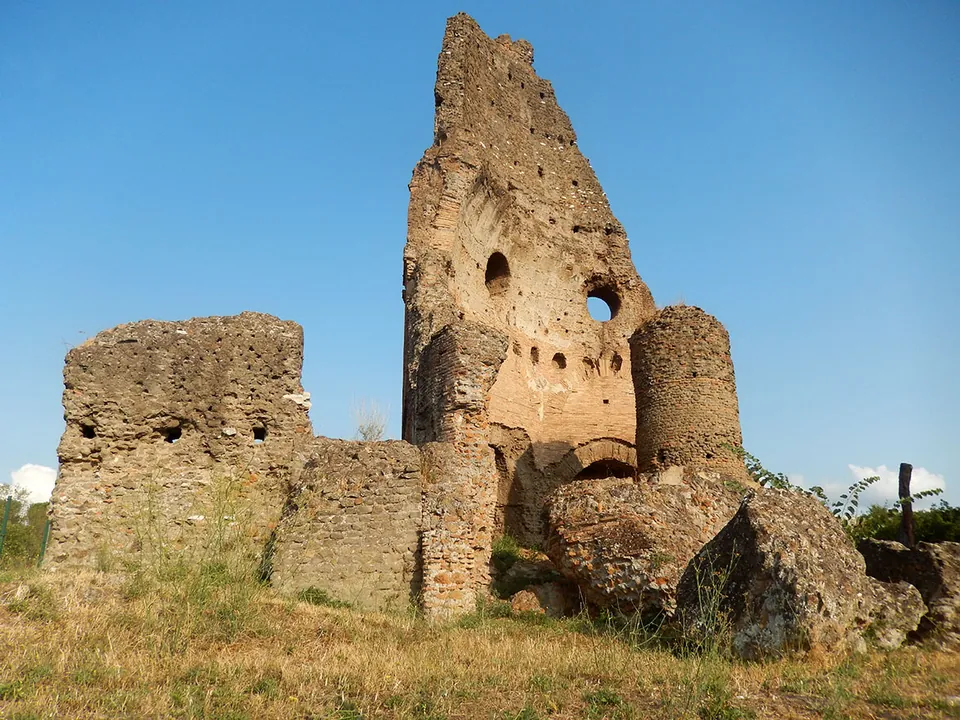
- The mausoleum, a round brick tomb about 17.7 m high and 19 m across, on two floors. The upper floor, where funeral ceremonies were held, keeps part of its original dome, with niches for statues inside and four round windows at the base of the dome, two of them still whole. The lower floor, for the burials, is a ring-shaped corridor around a central pier. The portico and stair on the front, towards the road, collapsed in the mid-18th century (Sovrintendenza Capitolina).
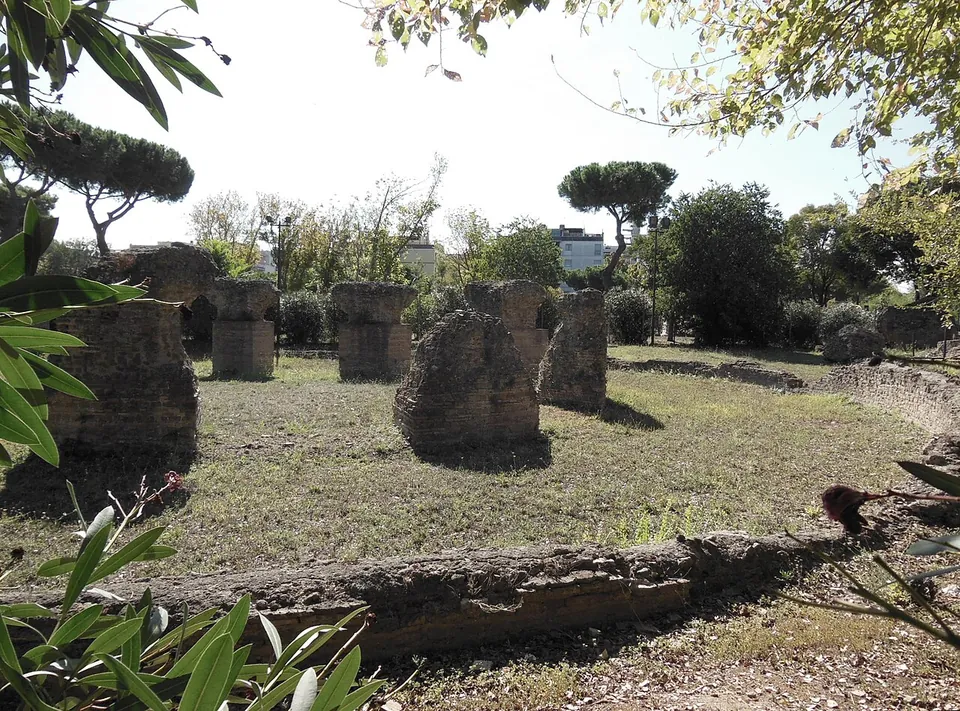
- The basilica beside it, built to the plan of a circus and about 67 m long. Some of its piers with arches above them and its outer wall survive (Sovrintendenza Capitolina).
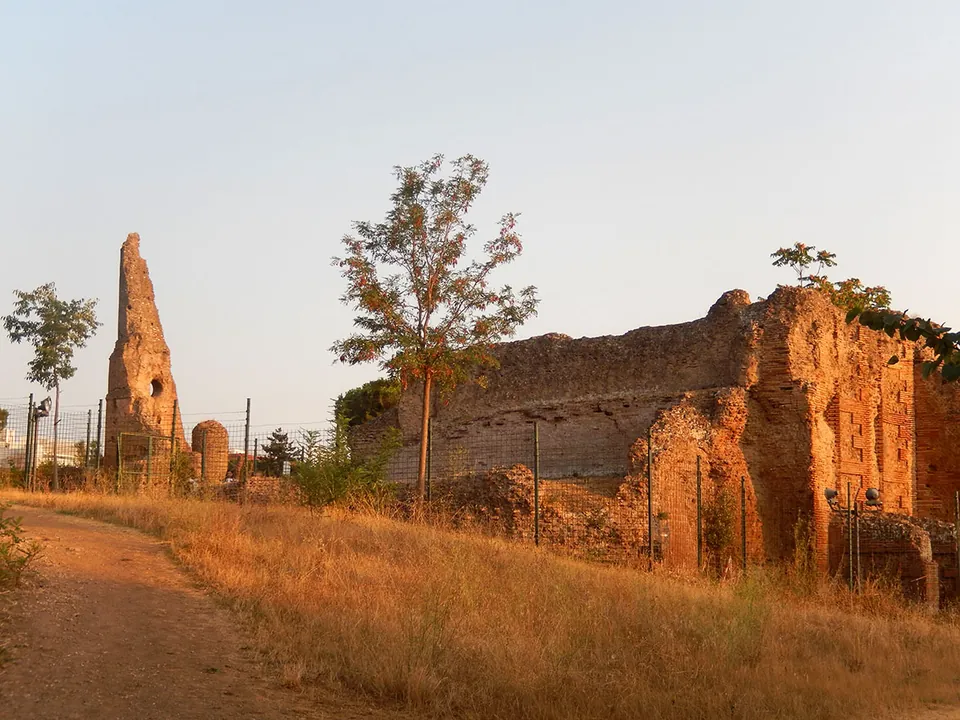
- Tor de’ Schiavi, the most striking silhouette in the park: the remains of a domed octagonal hall in brick, lit by round openings, its dome lightened with amphorae built into the concrete. A tower was raised on it in the 13th century (it.wikipedia; Turismo Roma).
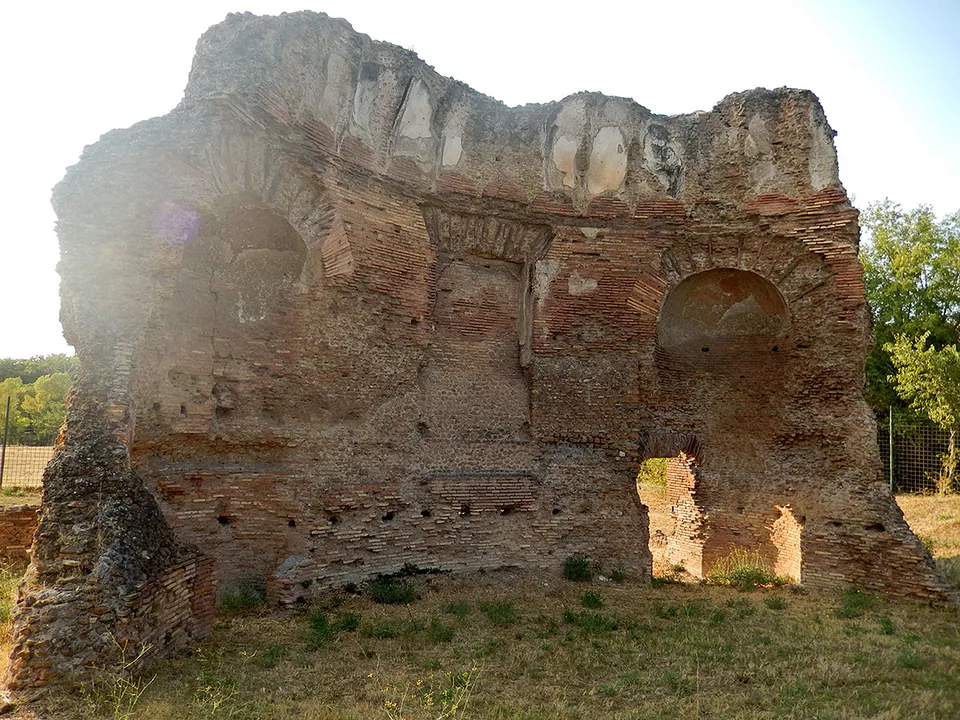
- The apsed hall, whose large apse with a shell-shaped vault and niches is still almost entirely visible, two large cisterns at the western end of the villa area, and other walls (Turismo Roma). One cistern, of the 2nd century, has two storeys, with two vaulted tanks (it.wikipedia).
The villa proper, the oldest part, was covered over again straight after its excavation to protect it, so very little of it shows (Turismo Roma). On the south side of the road, at the corner of Via Olevano Romano, a vaulted columbarium of the late 1st century BC or early 1st century AD survives from the tombs that lined Via Prenestina (it.wikipedia; Turismo Roma). None of the monuments can be entered: all are fenced, and you see them from the paths (Roma Capitale; Sovrintendenza Capitolina).
Is it worth the trip?
If you are curious about the Rome beyond the walls, yes: it is free, open from dawn to dusk, and a real ancient landscape, where a late Roman mausoleum and the shell of a domed hall stand in a neighbourhood park with a playground and running routes (Roma Capitale). It pairs naturally with the Mausoleum of Helena, 1.8 km away, the same kind of round tomb with a basilica beside it, which the city’s own tourism site uses as the comparison (Turismo Roma).
But be clear about what it is. Nothing can be entered, the villa itself is underground, and no source describes a museum or visitor centre. Roma Capitale lists guided visits among the park’s services without saying who runs them or when. If your time in Rome is short, the Forum, the Palatine and the Appian Way come first.
Getting there and what it costs
The park lies along Via Prenestina, with entrances at Via Prenestina 325, Via Romiti, Via Rovigno d’Istria and Via della Venezia Giulia. Roma Capitale lists buses 150F, 213, 314, 412, 544 and A10, trams 5, 14 and 19, Metro line C and the FL1 and FC1 railway lines among the ways to reach it, without naming the stops (Roma Capitale). A public-transport stop called Prenestina/Olevano Romano is mapped about 65 m from the park’s centre point, and a free car park about 180 m (OpenStreetMap).
It is open from dawn to dusk and entry is free (Roma Capitale, read 22 October 2026; check before travelling).
Visiting details
- Opening hours
- The park is open from dawn to dusk. The ancient monuments inside it are fenced off and cannot be entered; they are seen from outside the fences.
- Tickets
- Free.
- Parking
- A free car park is mapped about 180 m from the park's centre point, and bicycle stands about 155 m (OpenStreetMap). Entrances are on Via Prenestina (no. 325), Via Romiti, Via Rovigno d'Istria and Via della Venezia Giulia (Roma Capitale).
Before you go
- The mausoleum, the basilica, Tor de' Schiavi and the other ruins are fenced and not open to visitors; this is a walk around them, not through them.
Hours and prices checked 22 October 2026 on the operator's own site. Confirm before travelling.
History
The Historia Augusta describes the Gordians’ estate on Via Prenestina with a portico of two hundred columns, fifty each of Carian marble, red porphyry, Phrygian and Numidian marble, three basilicas a hundred feet long, and baths among the finest in Rome (it.wikipedia; fr.wikipedia). Whether this park is that estate is not proven: the ancient text names an imperial residence on Via Prenestina without saying where, so the identification is a hypothesis (Sovrintendenza Capitolina).
What the ground does show is a longer history. Excavations between 1954 and 1960 found a villa of the late Republic, with a residential part arranged around an atrium and a working part with storerooms, which seems to be the original core of the complex (Sovrintendenza Capitolina; Turismo Roma; it.wikipedia). Later, in the late imperial period, a separate group of brick rooms was built and joined to the villa by a long portico (Turismo Roma). Published dates for the main buildings differ: those for the octagonal hall run from the 3rd century to the early 4th (it.wikipedia; Turismo Roma), and it has been read as a bath building, a nymphaeum or the monumental entrance hall of the villa (it.wikipedia; fr.wikipedia; Pleiades; Turismo Roma). The mausoleum is dated to the early 4th century or later, on the evidence of the brick stamps in its walls; Pleiades leaves anything from Constantine to Theodoric open (Sovrintendenza Capitolina; Turismo Roma; Pleiades). The basilica belongs to the 4th century, a type of funerary basilica known from Constantine’s time, like those of Saints Marcellinus and Peter and of San Sebastiano; excavations in 1983-84 did not settle its exact date, its link with the mausoleum or whether it was Christian, but found many burials around it, most of them early medieval (Sovrintendenza Capitolina; Turismo Roma). A small two-storey catacomb found in 1953 at the eastern end of the park is not open (Turismo Roma). A further Roman cistern of the 2nd or 3rd century stands about 400 m west of the centre of the park, in Piazza Ronchi (Pleiades).
In the Middle Ages parts of the villa were fortified, and between the 12th and 17th centuries the defences became farmhouses of the Roman noble families who owned the land (Sovrintendenza Capitolina). The tower on the octagonal hall served as a lookout: in 1347 the Colonna’s troops camped here on their way from Palestrina to fight Cola di Rienzo, and in 1422 the Colonna bought it (it.wikipedia). The name Tor de’ Schiavi comes from the family of Vincenzo Rossi dello Schiavo, who acquired it in 1571 (fr.wikipedia; en.wikipedia). The park was planned in the city’s 1931 master plan and restored in the 1960s (it.wikipedia; en.wikipedia); the Gordiani borgata, a housing estate built beside it in 1928-30, was cleared completely in 1980 (Sovrintendenza Capitolina).
More photographs




Nearby
Photo: MumblerJamie · CC BY-SA 2.0 · Commons
13 km · villa · Lazio
Villa of Livia
The operator describes the private wing with the bedrooms of Livia and the emperor, an atrium and a small inner garden, and the large reception rooms that open onto a peristyle; the rooms once had painted walls and floors of mosaic and cut marble (Soprintendenza Speciale di Roma).
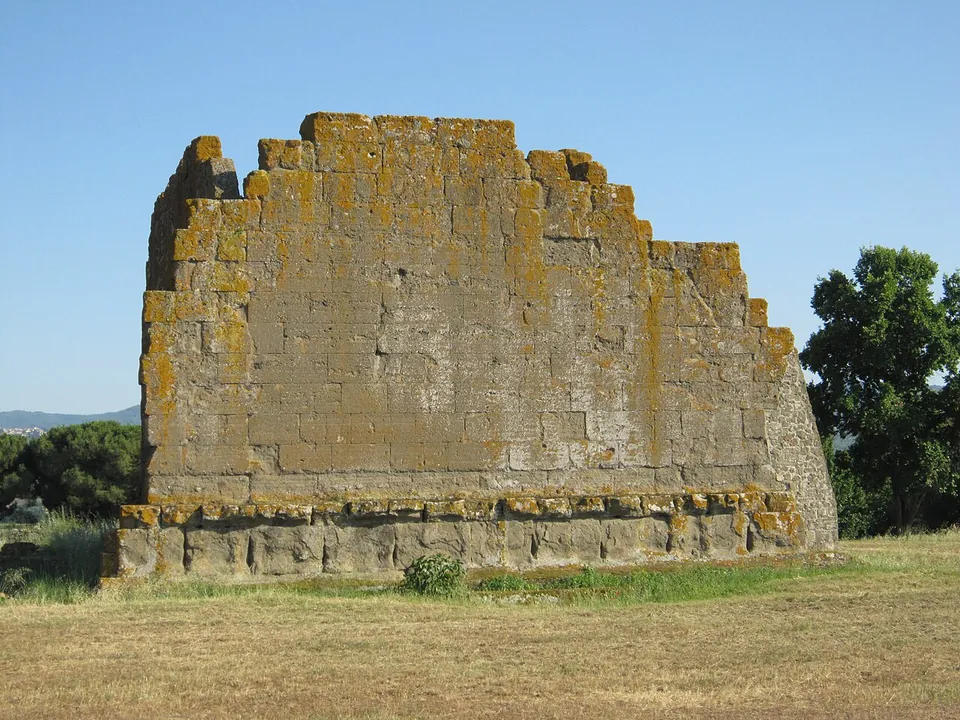
Photo: Carlomorino · CC BY-SA 3.0 · Commons
14 km · city · Lazio
Gabii
The park the state holds covers about 70 hectares on the southern rim of a volcanic crater whose lake was drained in the 19th century (the operator; en.wikipedia).
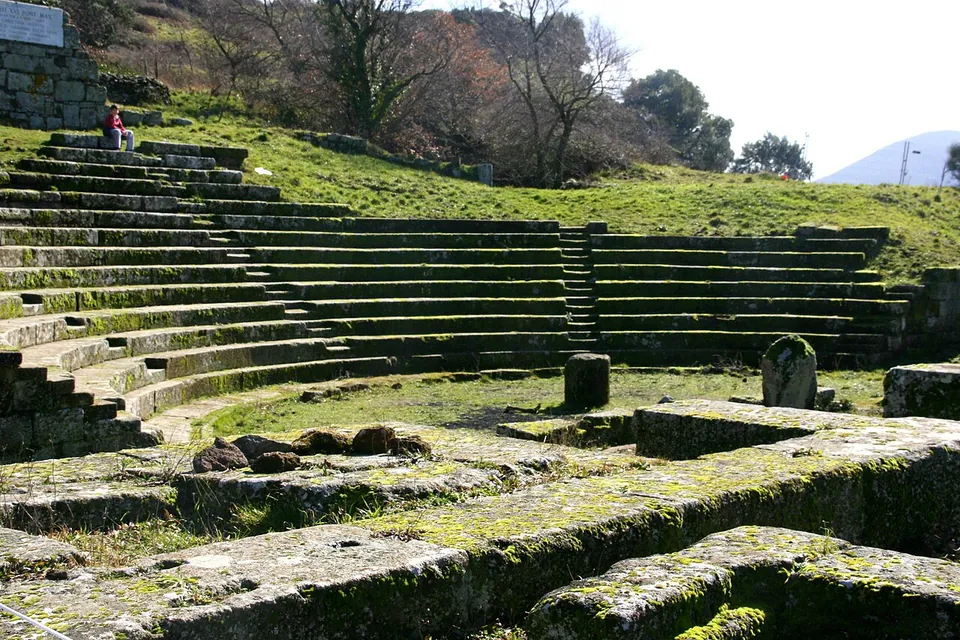
Photo: Luiza Serpa Lopes · Public domain · Commons
17 km · city · Lazio
Tusculum
The visitor route runs mainly through the forum, with the theatre halfway round (the operator).


Straight-line distances.
Sources
Every fact on this page comes from the records below, each used under the licence noted.