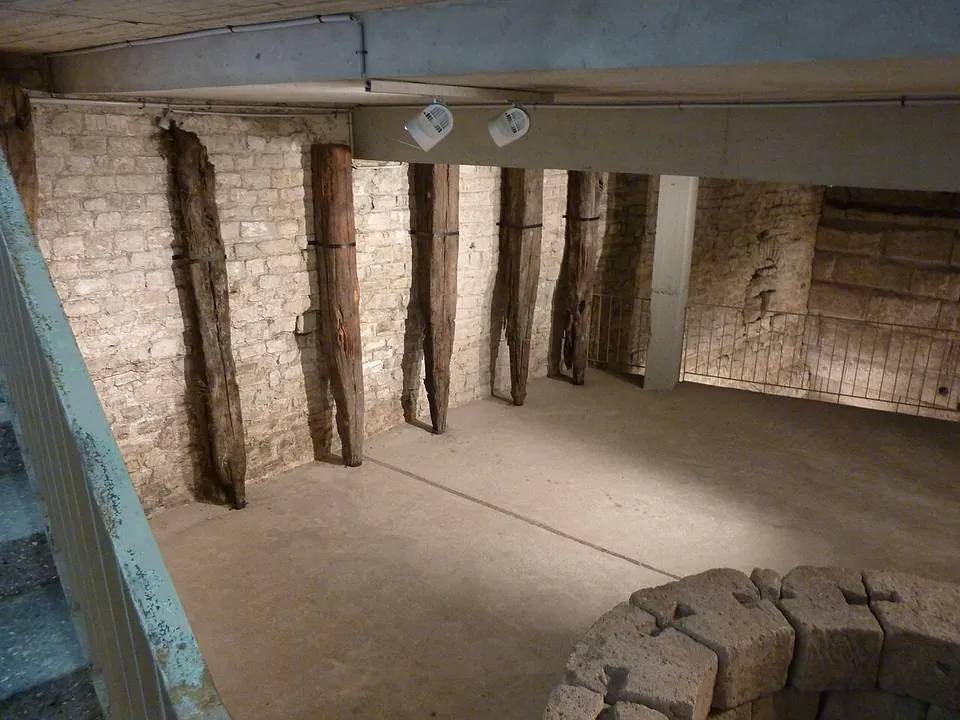
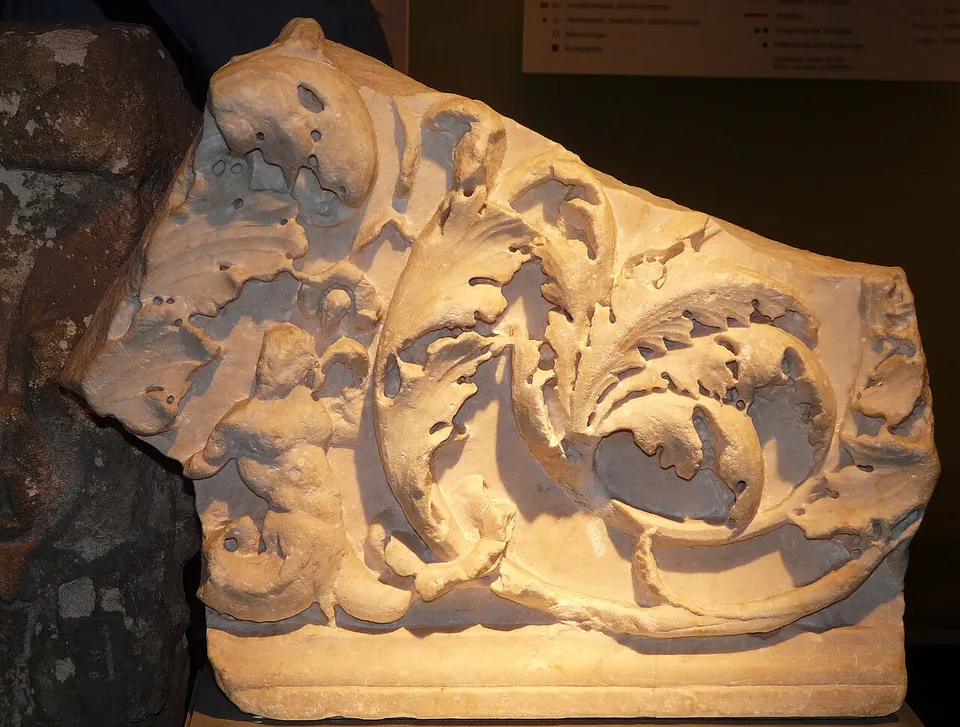
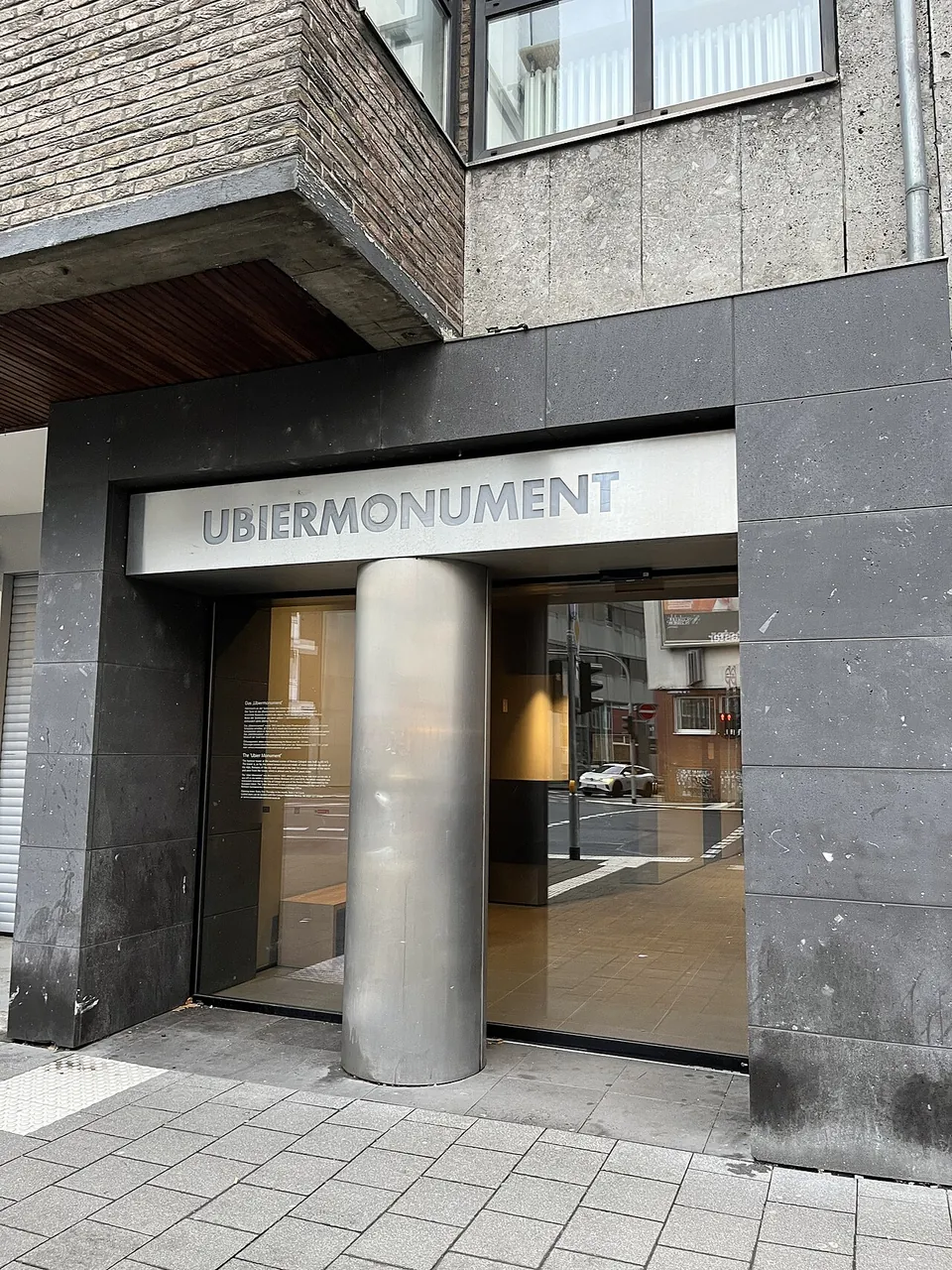
The Ubiermonument is a near-square stone tower built in AD 4/5 in the Rhine floodplain, older than the Roman colony of Cologne itself, and de.wikipedia calls it the oldest dated Roman stone building in Germany. It stands below street level in a protective structure under a modern building at the corner of Mühlenbach and An der Malzmühle, and it opens for three hours on the first Thursday of each month.
What is there today
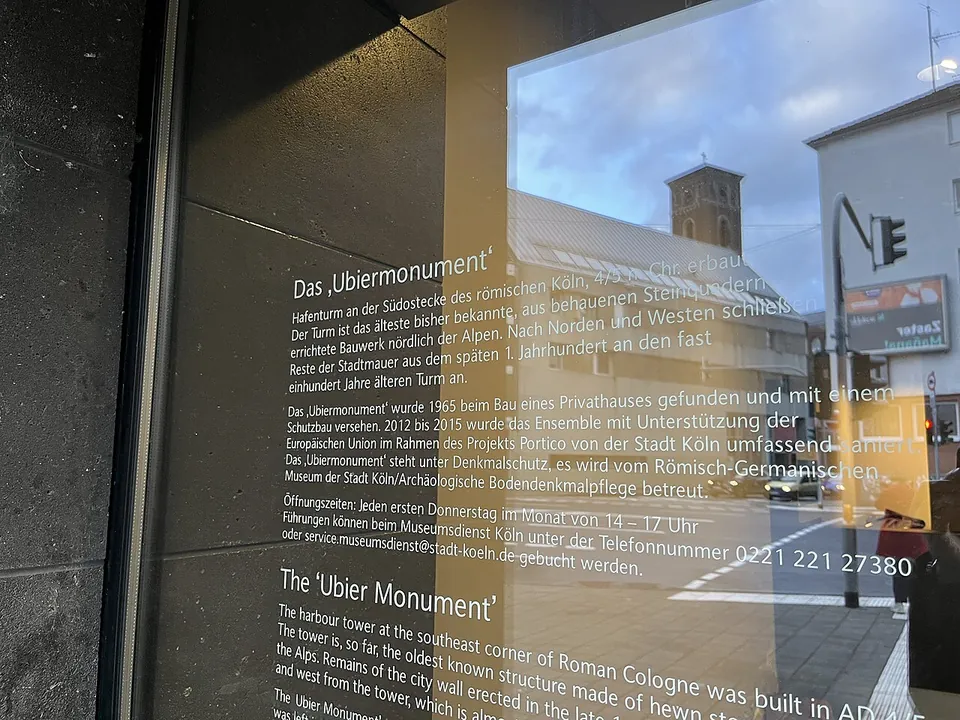
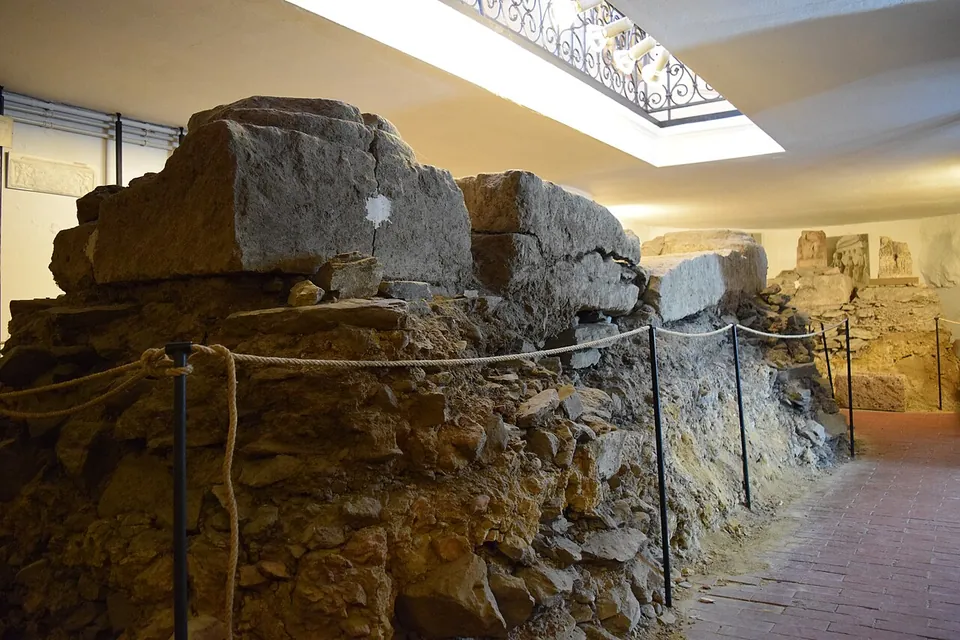
The tower is built of large blocks of tuff on a foundation of mortared rubble, and it still stands to a height of about 6.50 m, up to nine courses of dressed blocks; when it was built it was at least 12 m high (de.wikipedia; the operator). Its foundations reach about 6 m below the ground level of the Roman city: the tower stood in the old floodplain of the Rhine, where oak piles were driven into the gravel to carry its weight (de.wikipedia). It was found in 1965 during the building of a private house and given a protective structure, and the city restored it with EU funding between 2012 and 2015 (the information panel at the entrance). It has been open to the public again since March 2016 (de.wikipedia).
The tower marks the south-east corner of the later Roman colony, and remains of the city wall of the late 1st century adjoin it to the north and west (the operator; the panel). OpenStreetMap records remains of the next section of wall, about 50 m away, as visible from outside, and further fragments of the wall survive along the Mühlenbach, less well preserved (de.wikipedia).
Is it worth the trip?
If you can be in Cologne on the first Thursday of a month, yes. The tower still stands over 6 m high and is older than the Roman city around it, and the panel at the entrance goes further than de.wikipedia, calling it the oldest known building of dressed stone blocks north of the Alps. It is a single tower, so the visit is short; it fits easily into a day spent on the city’s other Roman remains.
On any other day you see only the entrance, the panel and the wall fragments outside, unless you have booked a guided tour in advance. It is not worth a special journey outside the opening hours.
Getting there
The entrance is at An der Malzmühle 1, in Cologne’s Altstadt-Süd, about half a kilometre south of the town hall square (the operator; Wikidata; OpenStreetMap). The Heumarkt stop is about 110 m away, and there is street parking about 20 m away (OpenStreetMap). OpenStreetMap marks the site as wheelchair-accessible.
It opens on the first Thursday of every month from 14.00 to 17.00; at other times it can be visited only on a guided tour booked through the museum service, for adults or school classes (roemisch-germanisches-museum.de, read 30 October 2026). The operator’s pages give no price. The city’s museum fee ordinance of 2020 set entry at €1, and its 2022 revision still lists the Ubiermonument as charging entry, so expect a small fee.
Visiting details
- Opening hours
- The first Thursday of every month (KölnTag), 14.00–17.00. At other times only on a guided tour booked in advance, for adults or school classes.
- Tickets
- The operator's pages give no price. The City of Cologne's museum fee ordinance of 1 January 2020 set entry at €1; the ordinance was revised in April 2022, and the revised schedule still lists the Ubiermonument among the places that charge entry.
- Parking
- Street-side parking is mapped about 20 m away; the Heumarkt stop is about 110 m away.
Before you go
- The Ubiermonument opens for three hours a month, on the afternoon of the first Thursday; on any other day you see only the entrance and the outside of the building.
Hours and prices checked 30 October 2026 on the operator's own site. Confirm before travelling.
History
The tower was built when the town here was still the oppidum Ubiorum, the chief town of the Ubii, decades before Claudius made it a Roman colony in AD 50 (de.wikipedia; see the Cologne page). The oak piles under its foundation were felled in AD 4, which dendrochronology has established, and the operator dates the building to AD 4/5 (de.wikipedia; the operator).
What it was for is disputed. It may have been part of the oppidum’s defences, a watchtower over the Roman harbour, or both (de.wikipedia). The operator thinks it most likely belonged to an earlier town wall and marked the entrance to the Rhine harbour; in the literature it is also called the harbour tower (de.wikipedia).
When the colony’s wall was built at the end of the 1st century, the tower was partly pulled down and what remained was built into the new wall (the operator); de.wikipedia says it was already destroyed by then.
More photographs
Nearby
Photo: Konrad Förstner · CC0 · Commons
9 km · tomb · North Rhine-Westphalia
Römergrab Köln-Weiden
A flight of stairs takes you down to a doorway about six metres below ground and into a single vaulted room built of tuff stone, roughly 3.6 by 4.4 metres and 4 metres high under the vault.
44 km · fort · Rhineland-Palatinate
Rigomagus
The Römisches Museum occupies a 15th-century chapel on Kirchstraße.
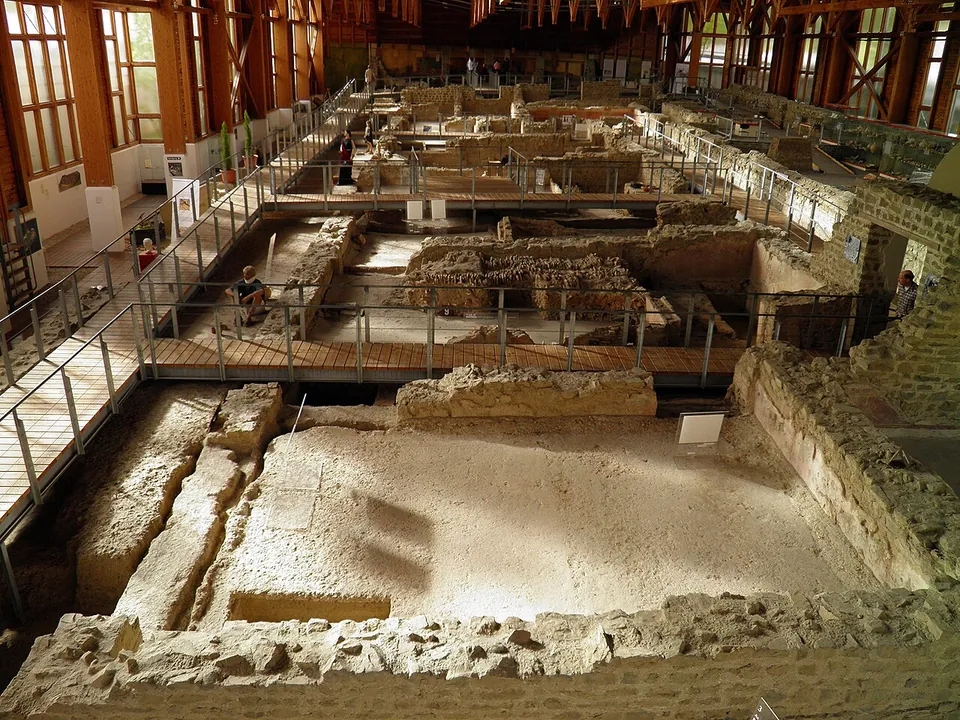
Photo: Carole Raddato from FRANKFURT, Germany · CC BY-SA 2.0 · Commons
45 km · villa · Rhineland-Palatinate
Römervilla von Bad Neuenahr-Ahrweiler
The house is 72 m long and 18 to 20 m deep (de.wikipedia), and walkways take you through and over its rooms.


Straight-line distances.
Sources
Every fact on this page comes from the records below, each used under the licence noted.