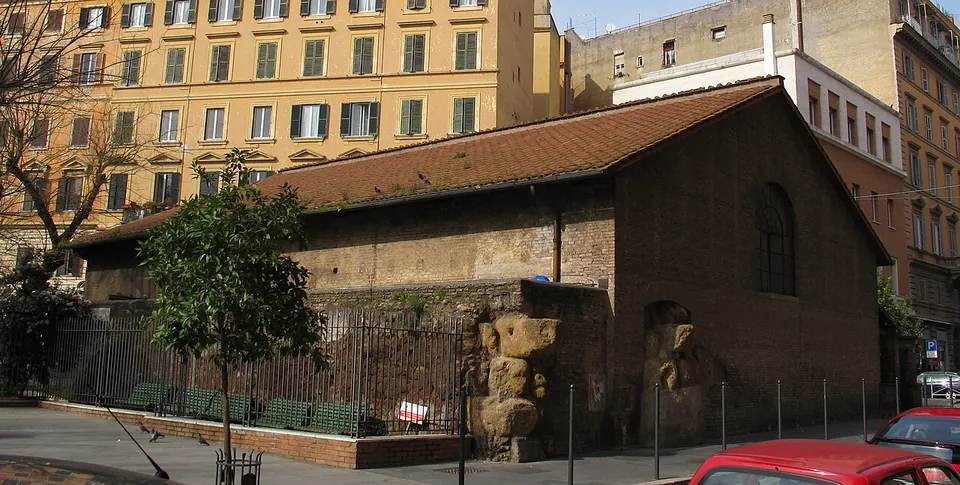
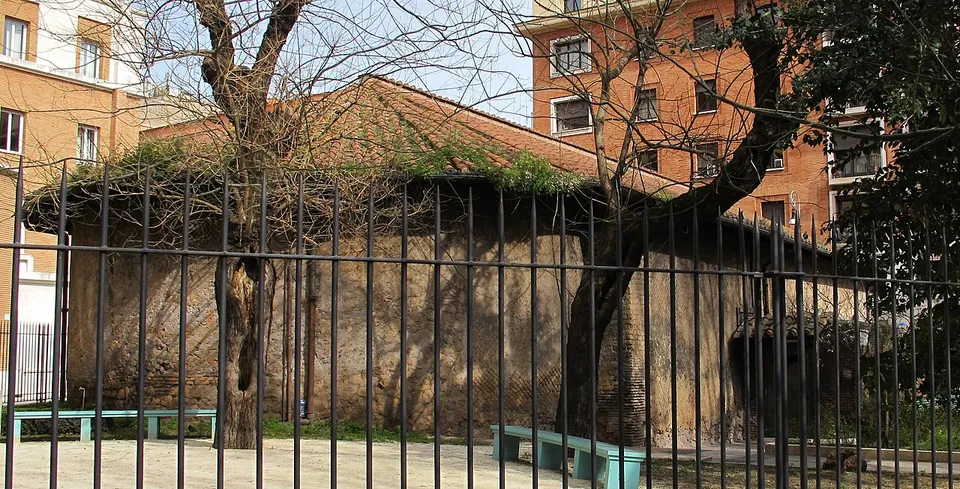


The so-called Auditorium of Maecenas is a half-sunken hall with a stepped apse and painted niches, the only part of Maecenas’s villa on the Esquiline still standing, in a small garden on Largo Leopardi along Via Merulana. It is closed for restoration, so for now it is something to look at through the railings rather than to go into.
What is there today
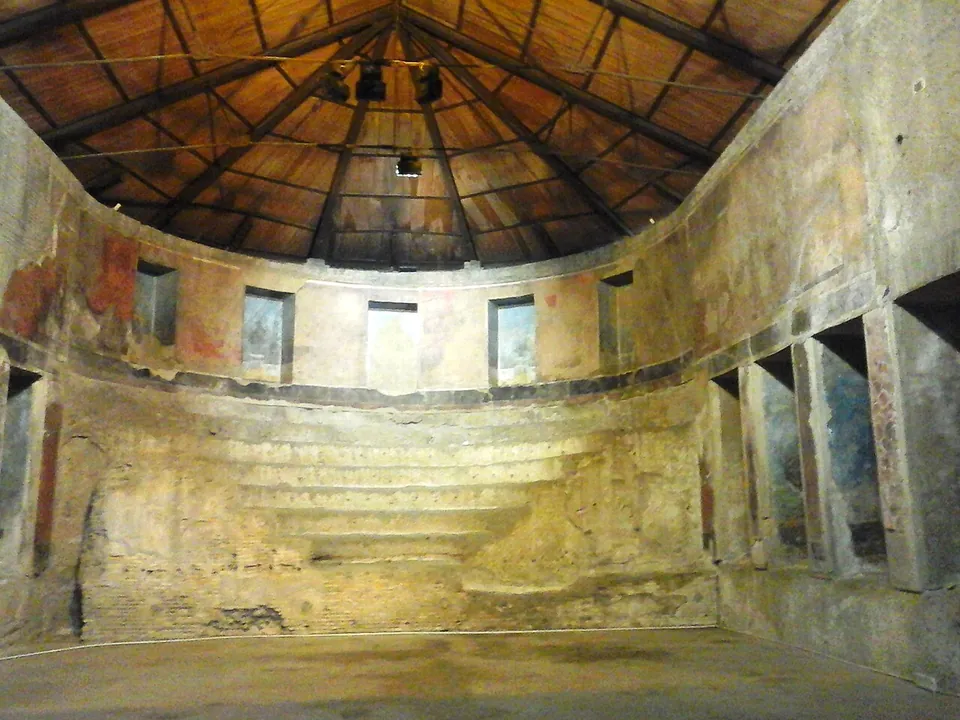
One rectangular room survives, about 24 m long and between 10.6 and 13 m wide (published figures differ), sunk partly below ground and now covered by a modern roof. At its far end a semicircular apse holds seven narrow curved steps, and the walls are lined with niches (it.wikipedia; the operator). The paintings, made at the beginning of the 1st century AD, show gardens: the niches were painted as windows onto greenery with fountains and small birds, and a frieze on a black ground carries Dionysian scenes and miniature gardens (the operator). They survive only in fragments (it.wikipedia).
The hall is closed to visitors while restoration works run, so what you see is its exterior behind railings in the public garden.
Is it worth the trip?
Not for itself, not at the moment. The interior is the point of the place and it is shut: the site has been closed since 1 August 2024, and the operator’s latest list of visits, for October to December 2026, does not include it. Looking at the outside takes a minute.
It is worth a short detour if you are walking the Esquiline anyway, because several other Roman remains stand within about 400 m: the Arch of Gallienus, the brick ruin of an imperial fountain in Piazza Vittorio Emanuele II, and, at weekends, a museum showing excavated structures of the Horti Lamiani. They are described below. When the hall reopens, the visit will be by booking only.
Getting there
The hall stands in the garden on Largo Leopardi, along Via Merulana (it.wikipedia). The bus stop “Merulana/Brancaccio” is about 35 m away (OpenStreetMap).
When visits resume, they are booked on 060608 (daily 09.00–19.00): groups of up to 30 with their own guide, or individual visitors on the dates the operator publishes for each quarter. A ticket is €9.50, reduced €5.00, paid in cash on site; residents of Rome and its metropolitan area and holders of the MIC Card go free, and a guided tour is not included (Sovrintendenza Capitolina, read 21 October 2026).
Visiting details
- Opening hours
- Temporarily closed to the public since 1 August 2024 for restoration works, with no reopening date published. When it is open, visits are by booking only, on 060608 (daily 09.00–19.00) - groups of up to 30 with their own guide, or individual visitors on dates the operator publishes each quarter.
- Tickets
- €9.50, reduced €5.00, paid in cash on site, when visits run; free for residents of Rome and its metropolitan area and for MIC Card holders. A guided tour is not included and has to be arranged separately.
Before you go
- Closed for restoration works funded by Italy's recovery plan (PNRR). The operator's access page of 24 September 2026 still lists it among the closed sites, and the individual visiting dates for October to December 2026 do not include it. What you can see meanwhile is the outside of the hall, behind railings in the small public garden on Largo Leopardi.
Hours and prices checked 21 October 2026 on the operator's own site. Confirm before travelling.
Nearby on the Esquiline
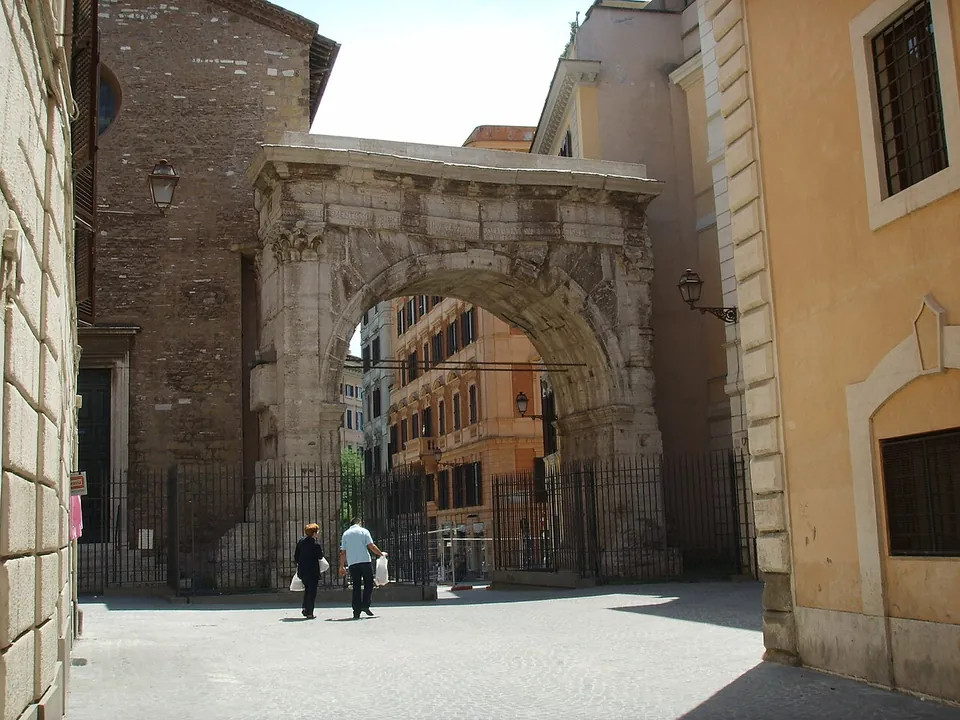
Arch of Gallienus. About 200 m away in Via San Vito stands the single travertine arch of the Porta Esquilina, a gate of the Servian Wall where the Via Labicana and the Via Tiburtina left the city (Pleiades). It was rebuilt in monumental form under Augustus and rededicated in 262 to the emperor Gallienus and his wife Salonina; the arch is 8.80 m high and 7.30 m wide, and its two smaller side arches were demolished in the 15th century. It now rests against the church of San Vito (en.wikipedia).
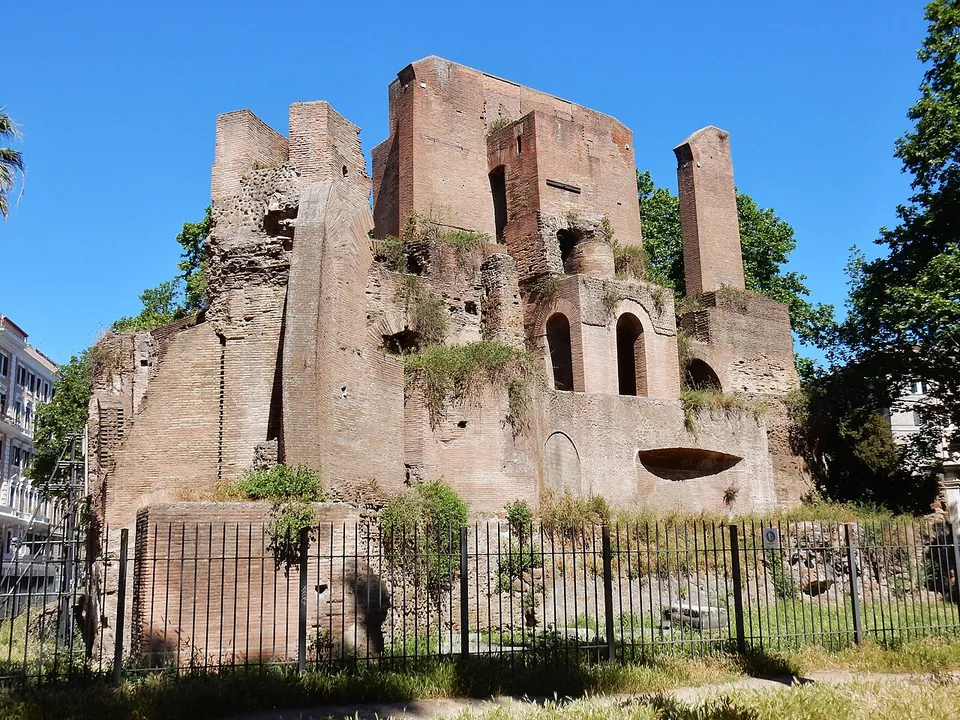
Nymphaeum of Alexander Severus. In the northern corner of Piazza Vittorio Emanuele II, about 230 m away, stand the brick ruins of a monumental fountain, known since the Middle Ages as the “Trofei di Mario” after two sculpted trophies that came from it and have stood on the Capitoline since 1590. The structure is about 25 m wide at the base, rises on three levels, and dates from the first two decades of the 3rd century; coins of Alexander Severus from 226 show it. It is the only survivor of the fifteen display fountains of ancient Rome (it.wikipedia). The ruin is in view from the square; visits to the monument are for booked groups of up to 25 (the operator).
Horti Lamiani and the Museo Ninfeo. The area around Piazza Vittorio Emanuele II was the Horti Lamiani, the gardens of the consul Lucius Aelius Lamia that became imperial property; Caligula lived there (en.wikipedia). Excavations in 2006–2009 under the ENPAM building found new parts of the estate, and the Museo Ninfeo on Piazza Vittorio Emanuele II is centred on a Roman hall attributed to Alexander Severus (en.wikipedia). The museum opens on Saturdays and Sundays, with audio-guided entries every half hour from 10.00 to 12.00 and a tour with an archaeologist in the late afternoon, booked through Vivaticket; the ticket office on site sells any places left, by card only. The museum’s booking page does not give the price (museoninfeo.it).
Sette Sale. About 220 m south-west, on the Oppian, the Sette Sale is the cistern that supplied the Baths of Trajan: it held more than 8 million litres in two levels of nine parallel compartments, and brick stamps date it to Trajan’s reign (en.wikipedia; it.wikipedia). It is almost entirely preserved (it.wikipedia) but closed to the public (Turismo Roma).
San Martino ai Monti. The church about 300 m away dates from the Carolingian era, but remains of a 3rd-century pillared hall have been found below and beside it. Some scholars identify the hall with the Titulus Equitii, the 4th-century foundation that preceded the church; Hugo Brandenburg thinks it more probably served as storage for trade (en.wikipedia).
History
The hall belonged to the gardens of Gaius Maecenas, the statesman who worked with Augustus, and dates from the creation of his villa around 30 BC (it.wikipedia). Maecenas built over a cemetery that lay just outside the Servian Wall and filled the ditch in front of the wall (the operator); on the Largo Leopardi side the hall was built over the wall itself, destroying a stretch of it (it.wikipedia). Its walls are of small-module opus reticulatum, which fits a date between the end of the Republic and the beginning of the Empire (it.wikipedia).
According to Suetonius, Augustus often slept in Maecenas’s house when he was ill. After Maecenas died in 8 BC the villa passed to the emperors and was given to Tiberius on his return from Rhodes; the garden paintings belong to his alterations (it.wikipedia). In the 2nd century the gardens belonged to Marcus Cornelius Fronto, tutor of Marcus Aurelius, and lead water pipes inscribed with his name were found beside the hall (en.wikipedia).
The building was excavated in 1874, while the new Esquiline district was being laid out after Rome became the capital of Italy (the operator). Its seven steps were then taken for the seating of a small theatre, which gave it the name “auditorium” (the operator). What it was is still debated. Pipes at the top of the steps poured water into the room, so it is read as a nymphaeum, a fountain hall (it.wikipedia); the operator calls it a summer dining room for convivial and cultural gatherings, cooled by water, and points to verses of the Greek poet Callimachus on wine and love painted on the outside plaster of the apse; Pleiades notes that it may have served as a conservatory.
More photographs



Nearby
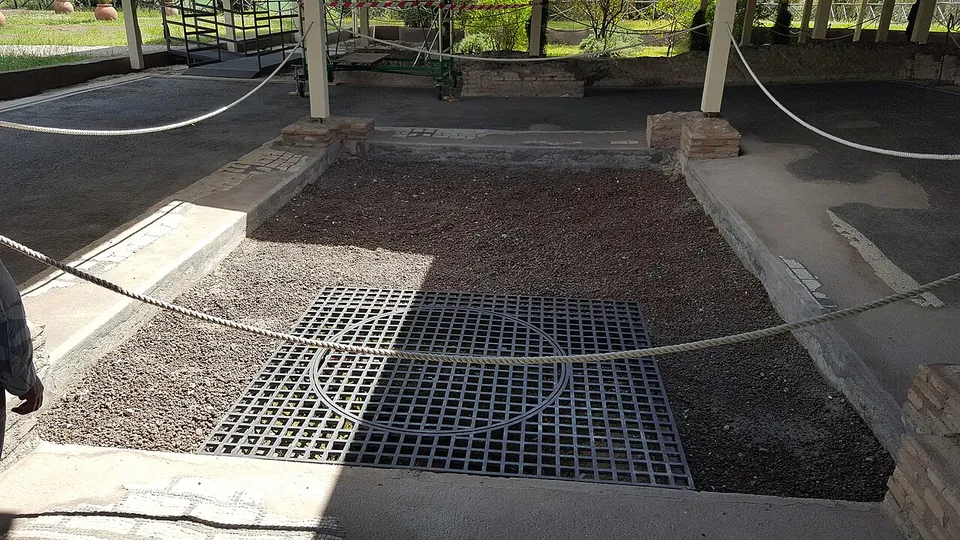
Photo: MumblerJamie · CC BY-SA 2.0 · Commons
12 km · villa · Lazio
Villa of Livia
The operator describes the private wing with the bedrooms of Livia and the emperor, an atrium and a small inner garden, and the large reception rooms that open onto a peristyle; the rooms once had painted walls and floors of mosaic and cut marble (Soprintendenza Speciale di Roma).
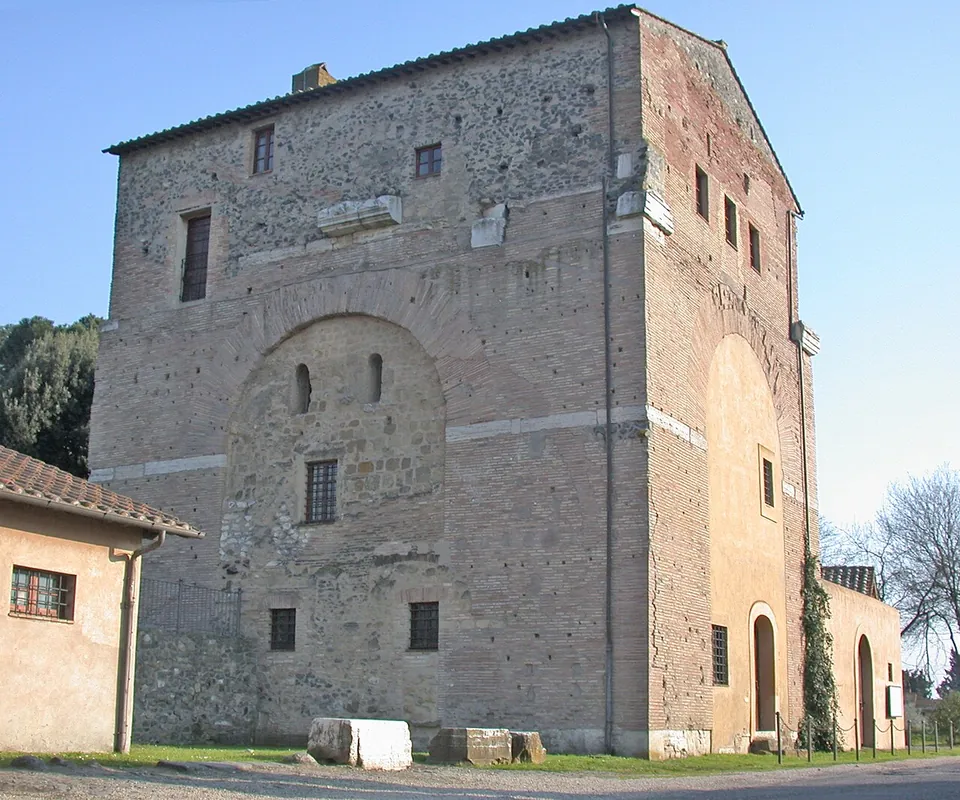
Photo: MM · Public domain · Commons
18 km · arch · Lazio
Arch of Malborghetto
At first sight you see an austere farmhouse rather than an arch (it.wikipedia).
Photo: Carlomorino · CC BY-SA 3.0 · Commons
18 km · city · Lazio
Gabii
The park the state holds covers about 70 hectares on the southern rim of a volcanic crater whose lake was drained in the 19th century (the operator; en.wikipedia).


Straight-line distances.
Sources
Every fact on this page comes from the records below, each used under the licence noted.