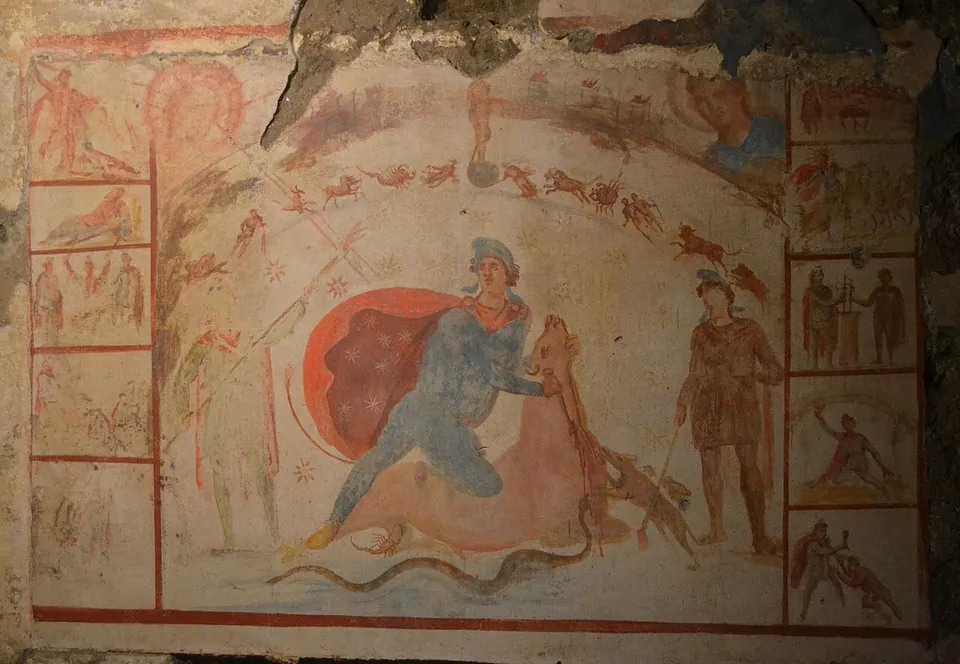


Under an officers’ club behind Palazzo Barberini, a few minutes’ walk from Barberini metro station, is a Roman shrine of Mithras whose end wall still carries its painting: Mithras killing the bull, framed by ten small scenes of his story (it.wikipedia; the operator). With the mithraeum of Santa Prisca, it is one of only two painted mithraea in Rome (it.wikipedia). It is worth a Saturday morning if you care about Roman painting or religion. It can only be seen on a 45-minute guided tour on Saturdays, booked in advance, and costs €7 (the operator).
What is there today
One room: a hall 11.85 m long and 6.25 m wide under a barrel vault, with a bench along each side where the worshippers reclined during the rites (it.wikipedia; the Soprintendenza). A project funded by the EU’s NextGenerationEU programme gave it new lighting for the room and the painting, a model of the monument that can be taken apart and a new information panel. Before that the room was usually closed, or open only to very limited visits (the Soprintendenza).
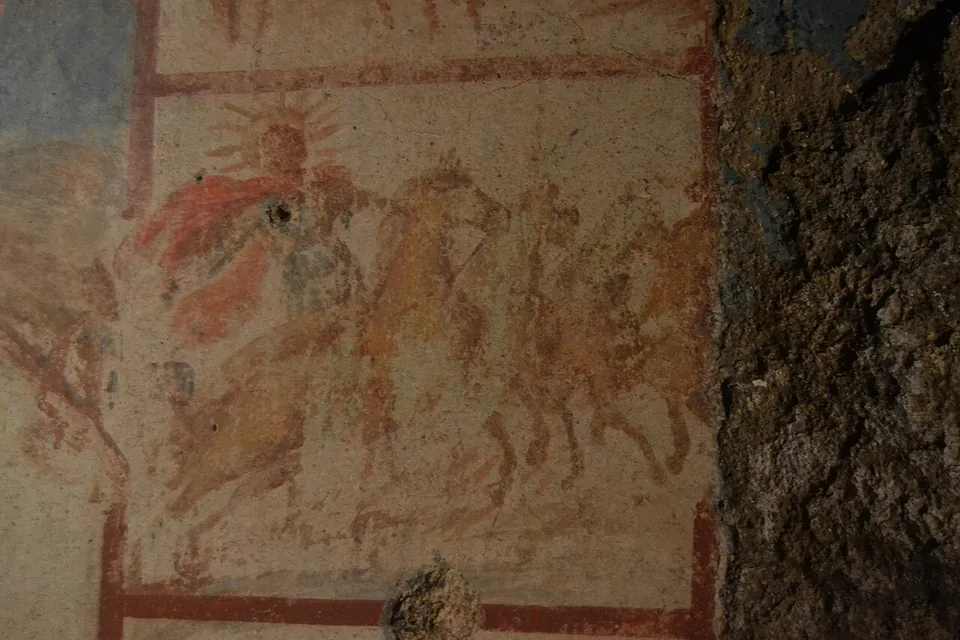
The painting on the end wall is what you come for. Few others compare with it; the sources name the paintings in the mithraea of Marino and Capua (it.wikipedia; the Soprintendenza). In the central panel Mithras kills the bull while a dog and a snake lap its blood and a scorpion stings it. The two torchbearers, Cautes and Cautopates, stand on either side. Above them two curved lines mark the vault of heaven, with the signs of the zodiac inside it and, in the middle, a lion-headed god standing on a globe, wrapped in the coils of a snake. The Sun and the Moon fill the upper corners (it.wikipedia). Down both sides run ten small panels of the god’s story, among them Mithras born from the rock, Mithras striking water from a rock with an arrow, Mithras carrying the bull, the mystic banquet, and Mithras climbing into the chariot of the Sun (it.wikipedia). To the right of the painting, a stretch of wall coated in limestone concretions imitates rock. It carried a low vault whose springing can still be seen, and the zodiac was painted again on the front of its arch, where the sign of the Fishes can be seen (it.wikipedia).
Is it worth the trip?
Yes, if you can be in Rome on a Saturday morning and you have an interest in Roman religion or painting. The draw here is the painted cult image on the end wall, with Mithras’s story told in the side panels, so it complements the carved altar at the San Clemente Mithraeum rather than repeating it. It is also central, and a combined ticket adds the collections of Palazzo Barberini and Galleria Corsini to the same visit (the operator).
It is one underground room, though, and the visit is short and closely managed. The tour lasts 45 minutes, takes at most 20 people and must be booked (the operator; CoopCulture). Visitors with limited mobility see the chamber from a viewing point but cannot go down into it (the operator). The operator’s page does not say in which language the tour is given.
Getting there and what it costs
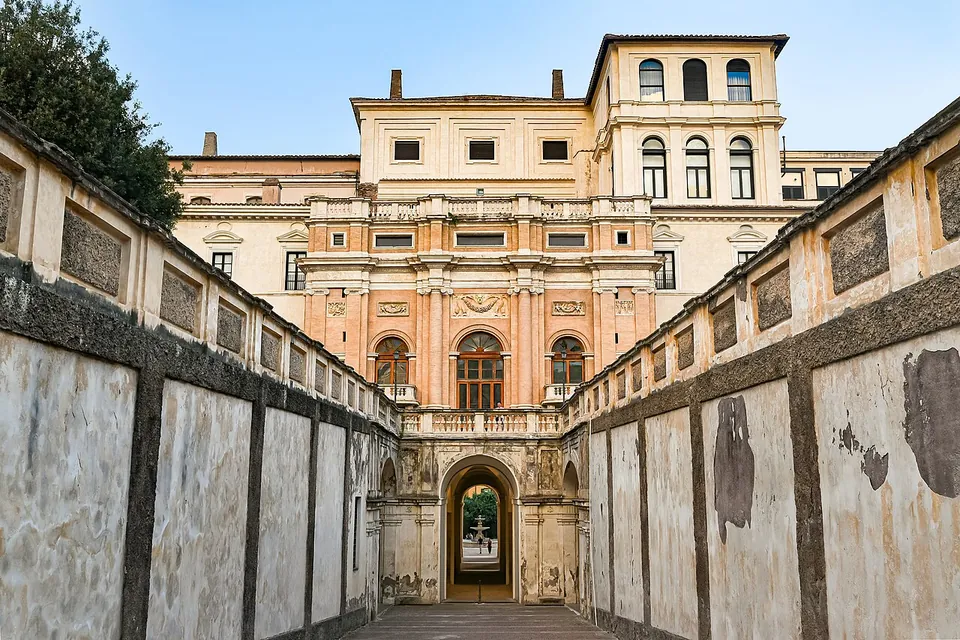
The site lies on the east side of Palazzo Barberini, between the palace and the Salita di San Nicola da Tolentino (the operator). Barberini station on metro line A is about 150 m away (OpenStreetMap), and buses 53, 61, 62, 63, 80, 81, 83, 160, 492 and 590 serve the area (the operator). The tour meets in front of the ticket office of the Palazzo Barberini museum, Via delle Quattro Fontane 13, 10 minutes before it starts; bring the booking code (CoopCulture; the operator). Garage Barberini is mapped 86 m from the site (OpenStreetMap).
Tours run every Saturday at 10.00, 11.00 and 12.00 (the operator), and the ticket office lists them from 3 October 2026 to 31 December 2027 (CoopCulture). The ticket is €7, or €5 up to 25 years, and does not include the museum. The combined ticket with the collections of Palazzo Barberini and Galleria Corsini costs €17, €7 for 18 to 25 year olds, and €5 for under-18s and others entitled to free entry to the museum (barberinicorsini.org, read 20 October 2026). Book through CoopCulture, the operator’s ticket office; places are limited.
Visiting details
- Opening hours
- Guided tours only, every Saturday at 10.00, 11.00 and 12.00; each lasts 45 minutes and takes at most 20 people. The ticket office lists these Saturdays from 3 October 2026 to 31 December 2027.
- Tickets
- €7 for the Mithraeum and its guided tour; €5 up to 25 years. With the collections of Palazzo Barberini and Galleria Corsini, €17; €7 for 18–25 year olds; €5 for under-18s and others entitled to free museum entry. Booking is compulsory, through CoopCulture, while places last.
- Parking
- Garage Barberini is mapped 86 m from the site (OSM node/10116760682); its rates are not mapped.
Before you go
- Open only on Saturday mornings, and only with a guided tour booked in advance.
- The tour meets in front of the Palazzo Barberini museum ticket office, Via delle Quattro Fontane 13, 10 minutes before the start, with the booking code.
- Visitors with limited mobility can see the chamber from a viewing point, but cannot go down into it.
- The operator does not say in which language the tour is given.
Hours and prices checked 20 October 2026 on the operator's own site. Confirm before travelling.
Nearby
The Baths of Diocletian, which have a page of their own, are about 600 m away. Palazzo Barberini, next door, houses the Gallerie Nazionali di Arte Antica, which run the tours and sell the combined ticket (the operator).
History
The shrine lay in the southern part of the Horti Sallustiani, the Gardens of Sallust (the operator). It was fitted into an existing building of the 2nd century AD: the western end of that building was turned into a mithraeum in the 3rd century (it.wikipedia; Pleiades). In the operator’s reading, a large cistern, several nymphaea and the Baths of Diocletian farther off gave the shrine a reliable supply of the water its rites needed. No source records when it went out of use.
It was found in the summer of 1936, during the building of the Palazzina Savorgnan di Brazzà, designed by Marcello Piacentini and Gustavo Giovannoni and now the Armed Forces Officers’ Club (the operator). The room lies in the semi-basement of that building, within the grounds that belong to the Galleria Nazionale di Arte Antica (the Soprintendenza).
Nearby
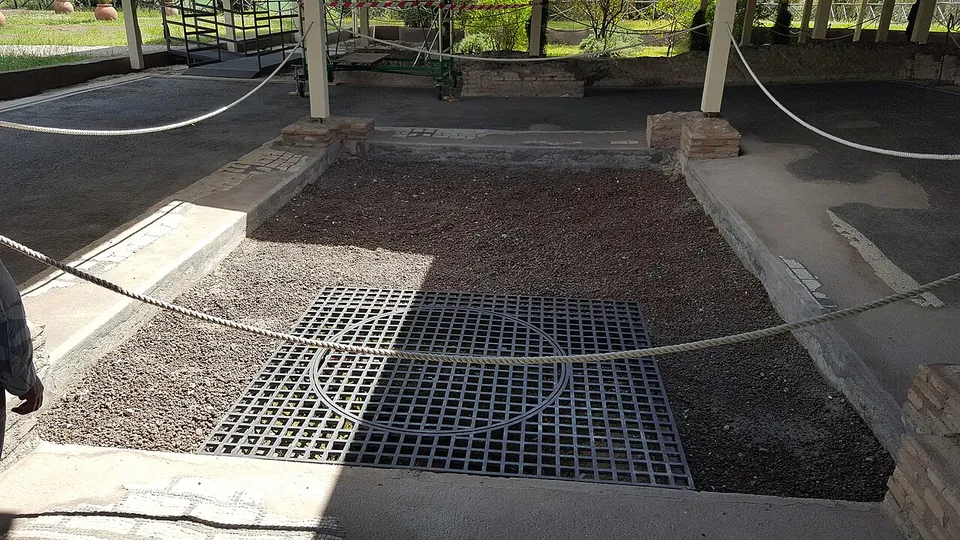
Photo: MumblerJamie · CC BY-SA 2.0 · Commons
11 km · villa · Lazio
Villa of Livia
The operator describes the private wing with the bedrooms of Livia and the emperor, an atrium and a small inner garden, and the large reception rooms that open onto a peristyle; the rooms once had painted walls and floors of mosaic and cut marble (Soprintendenza Speciale di Roma).
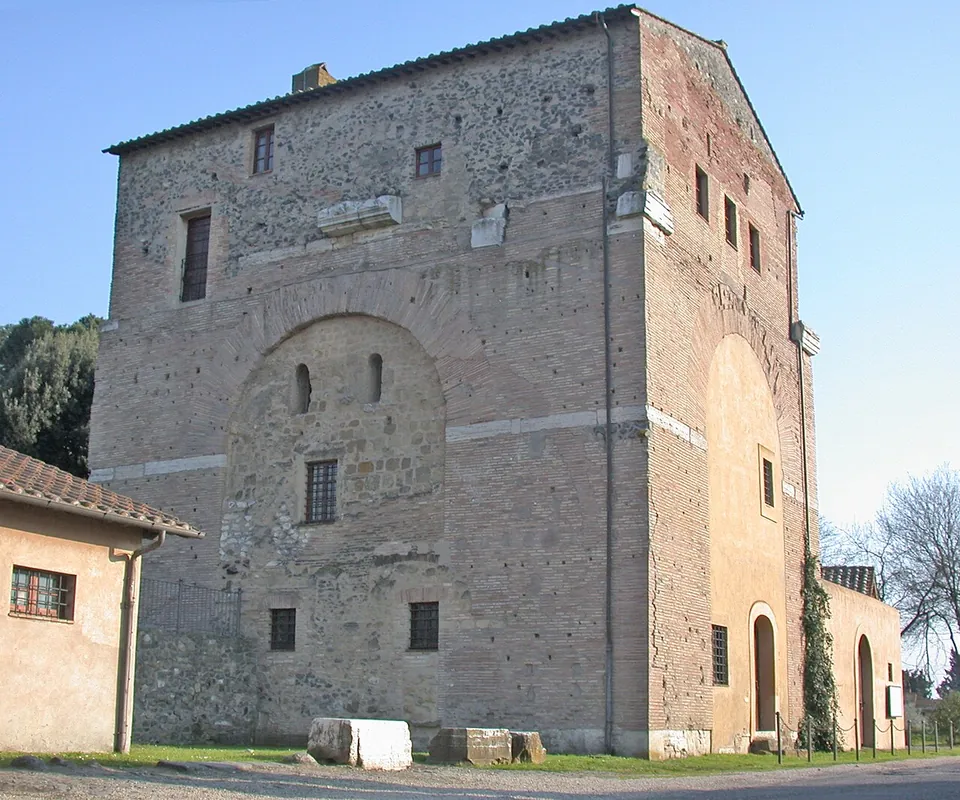
Photo: MM · Public domain · Commons
17 km · arch · Lazio
Arch of Malborghetto
At first sight you see an austere farmhouse rather than an arch (it.wikipedia).
Photo: Carlomorino · CC BY-SA 3.0 · Commons
19 km · city · Lazio
Gabii
The park the state holds covers about 70 hectares on the southern rim of a volcanic crater whose lake was drained in the 19th century (the operator; en.wikipedia).


Straight-line distances.
Sources
Every fact on this page comes from the records below, each used under the licence noted.
| Source | Licence |
|---|---|
| Pleiades 462454014 | CC BY |
| Wikidata Q3859475 | CC0 |
| OpenStreetMap node/9244137967 | ODbL |
| Wikipedia (it) — Mitreo Barberini | CC BY-SA 4.0 |
| Wikipedia (fr) — Mithraeum Barberini | CC BY-SA 4.0 |
| Gallerie Nazionali di Arte Antica — Mitreo Barberini (the operator) | licence not recorded |
| CoopCulture — Visita al Mitreo di Palazzo Barberini (the operator's ticket office) | licence not recorded |
| Soprintendenza Speciale di Roma — 242, Mitreo Barberini, valorizzazione e fruizione | licence not recorded |