

The Roman houses of the Caelian are a set of Roman houses and apartment blocks preserved underground beneath the church of Saints John and Paul, about 400 m south of the Colosseum. More than twenty rooms have been excavated, thirteen of them frescoed (it.wikipedia). The paintings, from a 3rd-century sea scene to 4th-century Christian scenes, are what you come to see.
What is there today
The visit goes underground, through rooms that belonged to at least five buildings (en.wikipedia). The two main ones are a building with a small bath on its ground floor and living quarters above, and an apartment block with shops at street level. They were later joined into a single house (it.wikipedia; fr.wikipedia). English Wikipedia counts the complex among the best-preserved Roman residential buildings still in existence, and among the best examples of a domus ecclesiae, a house used as a Christian church.
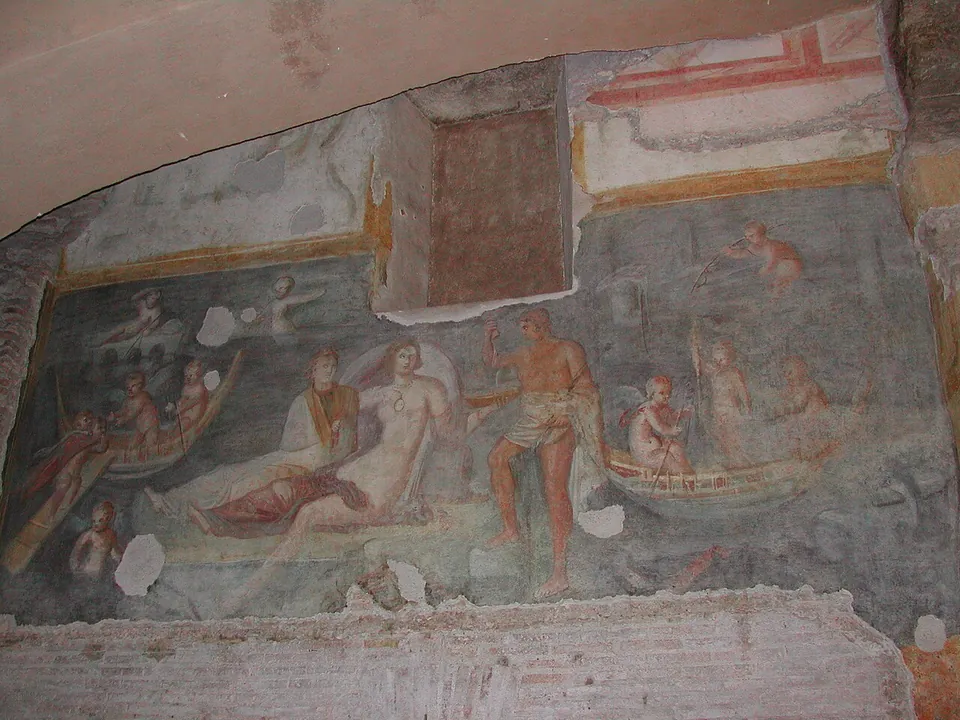
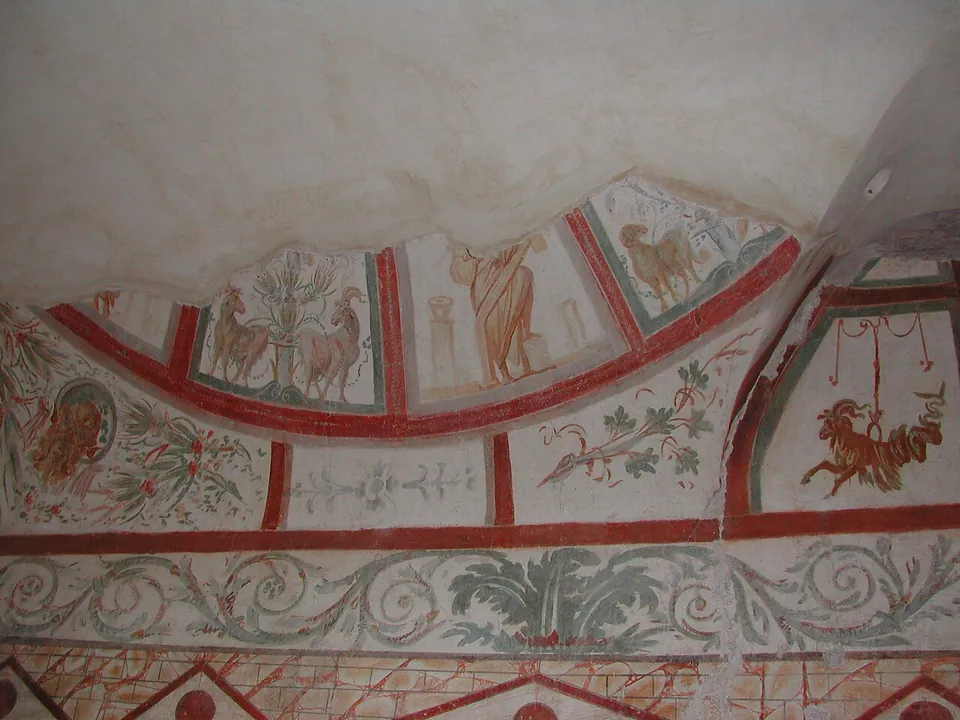
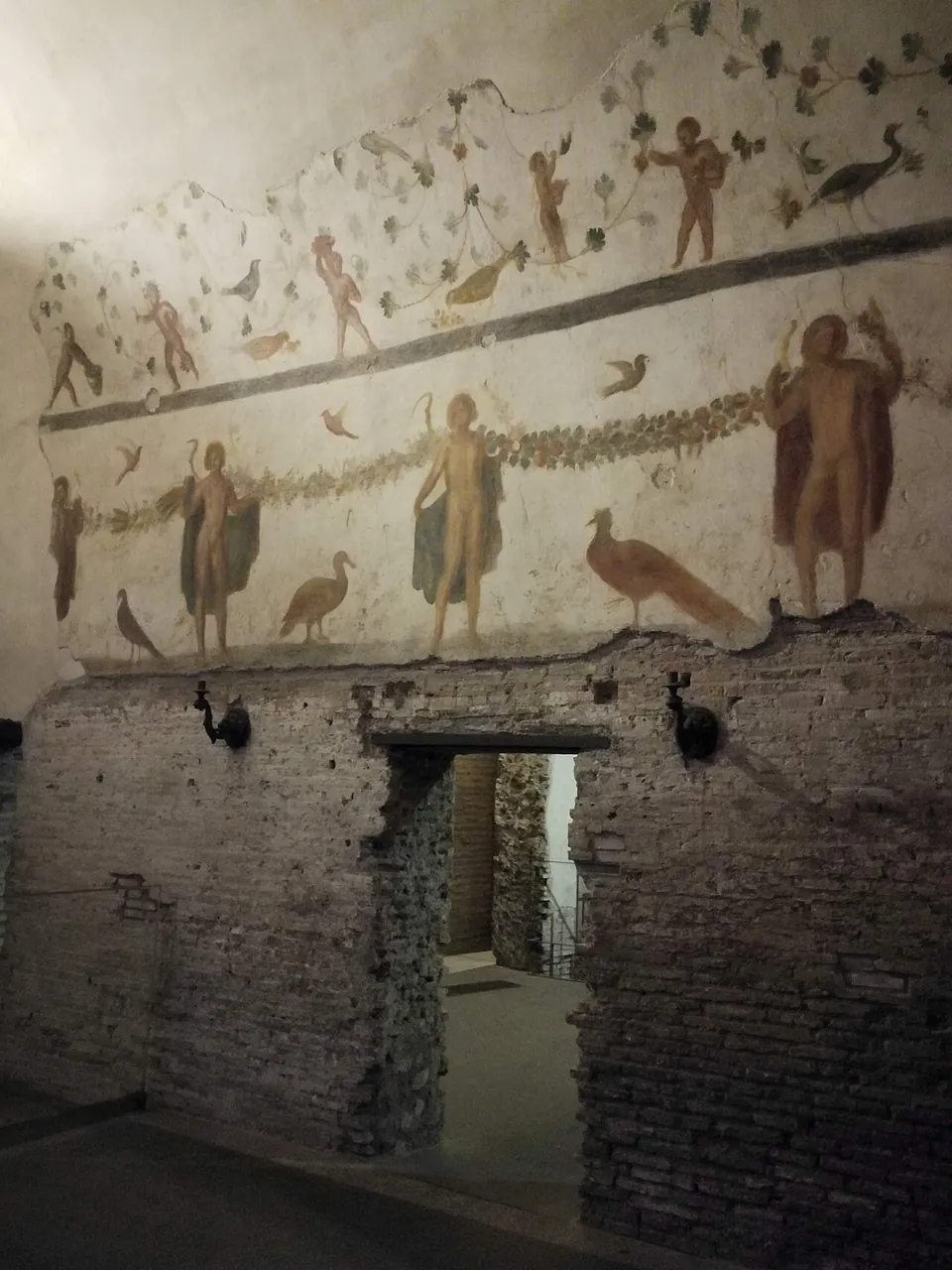
The set piece is the former courtyard, the Nymphaeum of Proserpina. A wall painting about 3 by 5 m from the 3rd century shows cupids fishing and sailing around a group of figures on a raft (en.wikipedia; fr.wikipedia). Who those figures are is disputed: the woman at the centre has been read as Venus, protector of sailors, or as Proserpina returning from the underworld (fr.wikipedia). Around it are rooms named after their paintings. In the Room of the Genii, youthful figures hold garlands of fruit and flowers among exotic birds. In the 4th-century Room of the Orans, a woman at prayer survives almost intact. Around her are goats and rams flanking male figures who may be philosophers, and masks among flowers and vines. The Confessio is a small 4th-century chapel under a stair landing, painted with Christian scenes of arrest and martyrdom (fr.wikipedia).
There is also a narrow lane that once ran between the two buildings, a 2nd-century black-and-white mosaic floor cut through by the church’s foundation wall, and a small museum, the Antiquarium. Its finds include inscriptions, amphorae from the 1st to the 7th century, and 4th-century carved glass (fr.wikipedia).
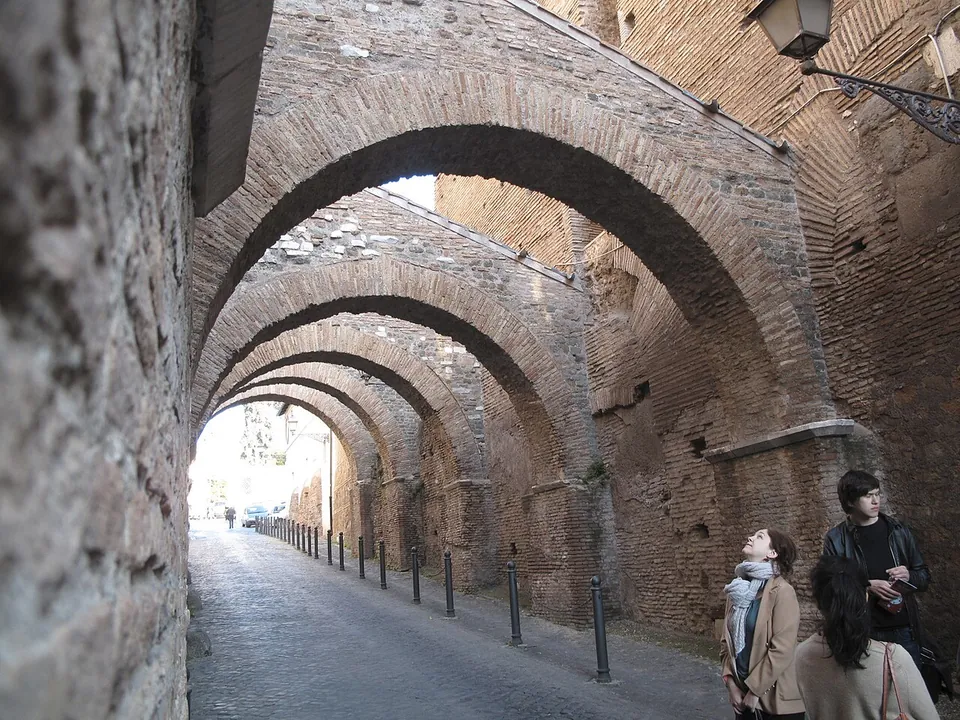
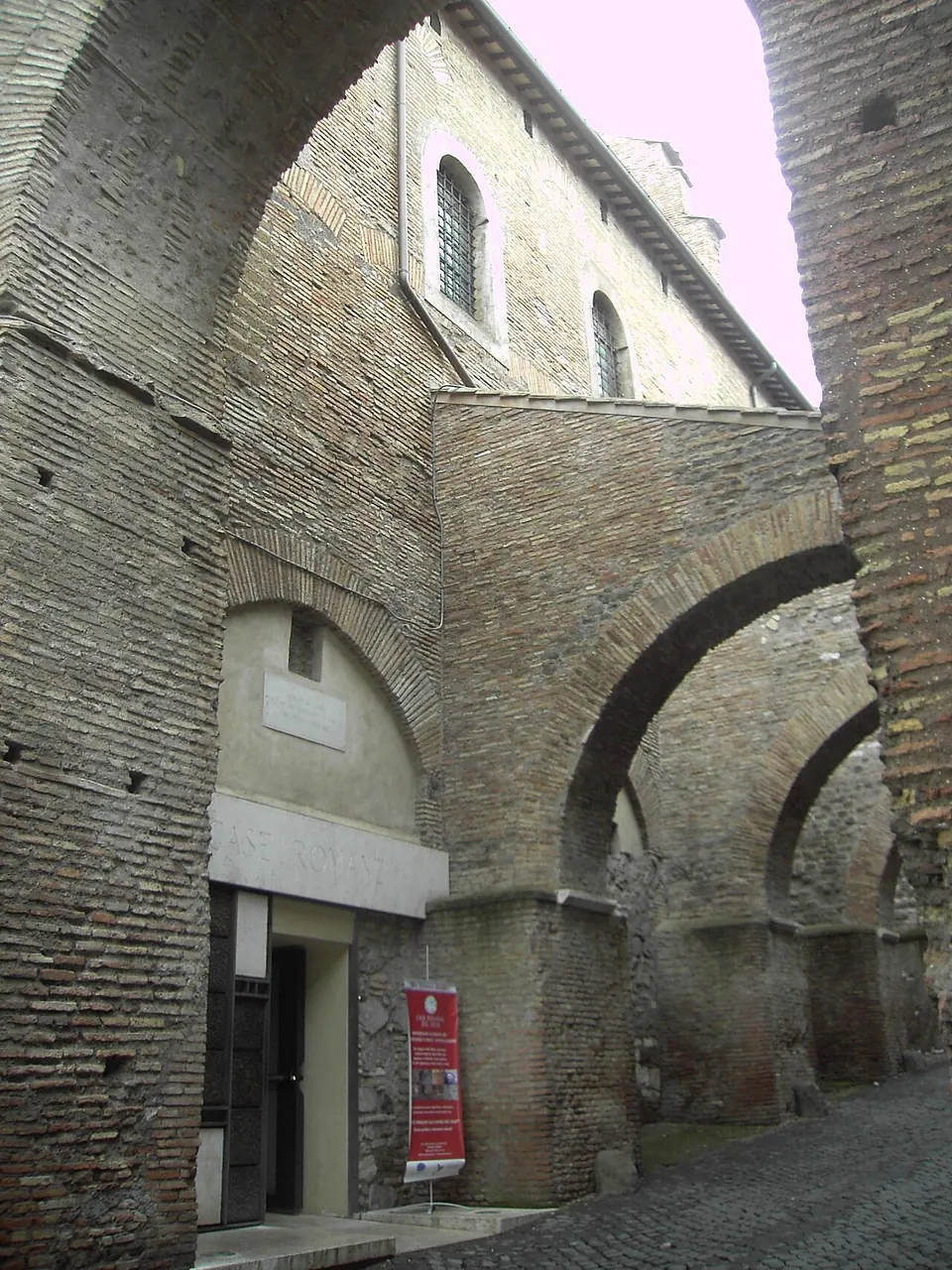
Outside, the Clivo di Scauro still follows the line of the ancient street and keeps its name. By the square in front of the church, a 3rd-century row of brick shops stands with traces of a second floor (en.wikipedia and it.wikipedia, Clivus Scauri).
Is it worth the trip?
Yes, if painted Roman rooms appeal to you more than big ruins. There is no grand architecture here. The houses are a sequence of underground rooms, and the walls of the church above still block the view across some of them (fr.wikipedia). The painted walls are the reason to come. The operator sells it on exactly that: original frescoed rooms, exceptionally well preserved, that record the passage from paganism to Christianity (caseromanedelcelio.it).
It is also easy to fit in. It opens every day, a ticket is €8 to €10, and it lies about 430 m south of the Colosseum. That makes it a natural add-on to the Colosseum, or to the Mithraeum under San Clemente, about 570 m to the north-east. It is one of the stops of Roma – Rome.
Getting there and what it costs
The entrance is on the Clivo di Scauro, next to Piazza Santi Giovanni e Paolo. The operator lists metro line B to Colosseo or Circo Massimo, or tram 3 and the buses that stop at Colosseo. A tram stop, Parco Celio, is mapped about 140 m away (OpenStreetMap).
It is open every day, public holidays included, from 10.00 to 16.00. The ticket office closes an hour earlier, at 15.00, and the site is closed on 1 January and 25 December. A ticket is €8, or €6 for children aged 6 to 14, groups of more than 12, and individuals who book a guided visit. Under-sixes go free, as do disabled visitors with certification and a companion, and students of archaeology, art history, cultural heritage and architecture. Booking adds €2. A guided tour in Italian runs on Saturdays, Sundays and public holidays at 11.30 for €15, including the ticket. An audio guide in Italian or English costs €5. Groups must book an entry slot. The whole site is accessible to visitors with reduced mobility except the Confessio (caseromanedelcelio.it, read 18 October 2026).
One discrepancy: the online ticket page the site links to, run by CoopCulture, shows €10 (€8 reduced) under a tariff it dates 20 December 2025 to 22 March 2026. Expect to pay €8 to €10.
Visiting details
- Opening hours
- Daily, public holidays included, 10.00–16.00; the ticket office closes an hour earlier. Closed 1 January and 25 December.
- Tickets
- €8; €6 reduced for ages 6 to 14, groups of more than 12, schools without a guided visit and individuals who buy a guided visit; free under 6, and for disabled visitors with certification and a companion, journalists, tour guides and students of archaeology, art history, cultural heritage and architecture. Booking fee €2. CoopCulture's online ticket page shows €10 (€8 reduced), a tariff it dates 20 December 2025 to 22 March 2026. Guided tour in Italian on Saturdays, Sundays and public holidays at 11.30, €15 including ticket and booking fee; audio guide €5.
Before you go
- The Confessio, the small 4th-century chapel, is not accessible to visitors with reduced mobility; the rest of the site is.
- Groups of 12 to 25 must book an entry slot in advance.
Hours and prices checked 18 October 2026 on the operator's own site. Confirm before travelling.
On the same hill
The basilica of Saints John and Paul stands directly over the houses. The senator Pammachius built it in 398 over the home of two Roman soldiers, John and Paul, martyred under the emperor Julian in 362 (en.wikipedia; Pleiades). That is the tradition. Italian Wikipedia notes that the better sources think the house more probably belonged to Pammachius’s own family. Damaged in the sack of 410 and by an earthquake in 442, the church was restored under Pope Paschal II (1099–1118), who added the bell tower and the portico (en.wikipedia; it.wikipedia). The present façade, restored to its early Christian form, dates from 1951 (it.wikipedia). It is a working church, home to the Passionists (en.wikipedia).
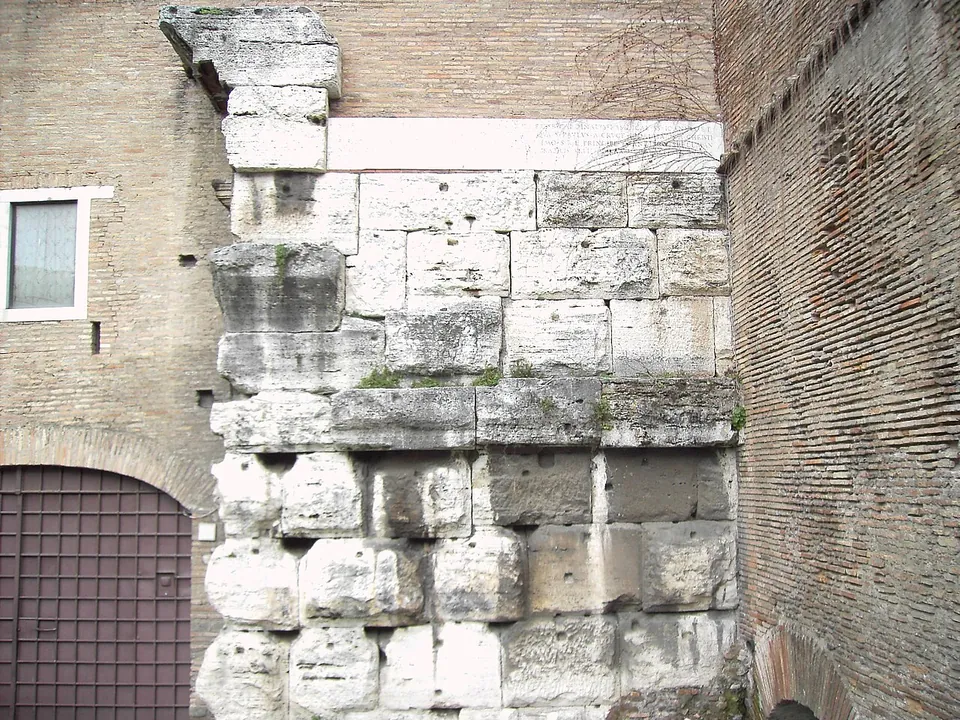
The Temple of Claudius covered much of the hilltop next to the basilica. Agrippina began it after Claudius died in 54, and Nero turned its eastern wall into a great fountain facing his Golden House. Vespasian then rebuilt the temple (en.wikipedia). Nothing of the temple itself survives, but the platform it stood on, 180 by 200 m, does, held up by retaining walls 15 m or more high that are still partly visible. Some of its travertine western side is built into the base of the basilica’s bell tower, on the square in front of the church. The eastern side, where Nero’s fountain was, is the best preserved; the area came to light when Via Claudia was built in 1880 (en.wikipedia).
The Arch of Dolabella, about 280 m further up the same street, now Via di San Paolo della Croce, still spans the road. It is a plain travertine arch built by senatorial decree in AD 10 by the consuls Dolabella and Silanus. It probably replaced an older city gate, and Nero later carried his branch of the Aqua Claudia over it (en.wikipedia).
What you cannot see. Several other Roman places on the hill are in the gazetteers, but none of them makes a visit. Under Santo Stefano Rotondo, the remains of the soldiers’ barracks of the Castra Peregrina and their 2nd-century mithraeum are closed to the public (en.wikipedia). Nero’s Macellum Magnum, a food market, is placed at that church in one account and beside it in another (it.wikipedia), and no visible remains of it are recorded. The Basilica Hilariana, a building of the cult of Cybele, was found in 1889 while Rome’s military hospital was being built. It lies under what is now the hospital’s inner courtyard (en.wikipedia; it.wikipedia), and no source describes it as open to visitors. At the foot of the hill, nothing is visible of the Porta Capena, the gate where the Appian Way began, or of the Temple of Honour and Virtue just outside it (en.wikipedia).
History
The street outside, the Clivus Scauri, probably takes its name from a member of the Aemilii Scauri family, perhaps Marcus Aemilius Scaurus, censor in 109 BC (en.wikipedia; fr.wikipedia). Published dates for the houses differ. Italian Wikipedia dates the first building on the site to 111 and the apartment block to the following century. French Wikipedia puts the first house at the start of the 2nd century and the block in the early 3rd, and English Wikipedia speaks more broadly of buildings from the 1st to the 4th century. The two were joined into one house in the 3rd century (it.wikipedia), or at the turn of the 3rd and 4th (fr.wikipedia).
In the 4th century the property became a Christian titulus, a house church, first named after the senator Byzas and then after his son Pammachius (it.wikipedia). When the basilica was built over it from 398, most of the Roman rooms were filled in or used as its foundations (it.wikipedia). Some stayed in use: one was a wine or food store until the 7th century, and another was turned into an oratory in the 8th century (fr.wikipedia).
The houses were rediscovered in 1887. Father Germano di San Stanislao, the basilica’s rector, was searching for the martyrs’ tombs. Going down into a burial chamber, he found large rooms below the church whose walls kept traces of paintings under a thin coat of lime (en.wikipedia; fr.wikipedia). Further excavations followed in 1913–14 and in 1951. The Antiquarium was set up in 2001, and the rooms opened to the public in 2002 after restoration (fr.wikipedia).
More photographs



Nearby
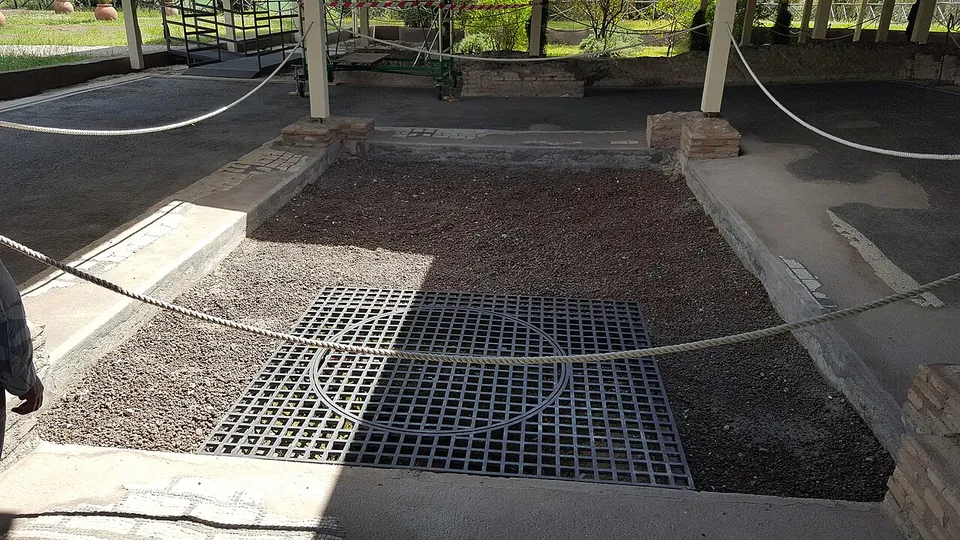
Photo: MumblerJamie · CC BY-SA 2.0 · Commons
13 km · villa · Lazio
Villa of Livia
The operator describes the private wing with the bedrooms of Livia and the emperor, an atrium and a small inner garden, and the large reception rooms that open onto a peristyle; the rooms once had painted walls and floors of mosaic and cut marble (Soprintendenza Speciale di Roma).
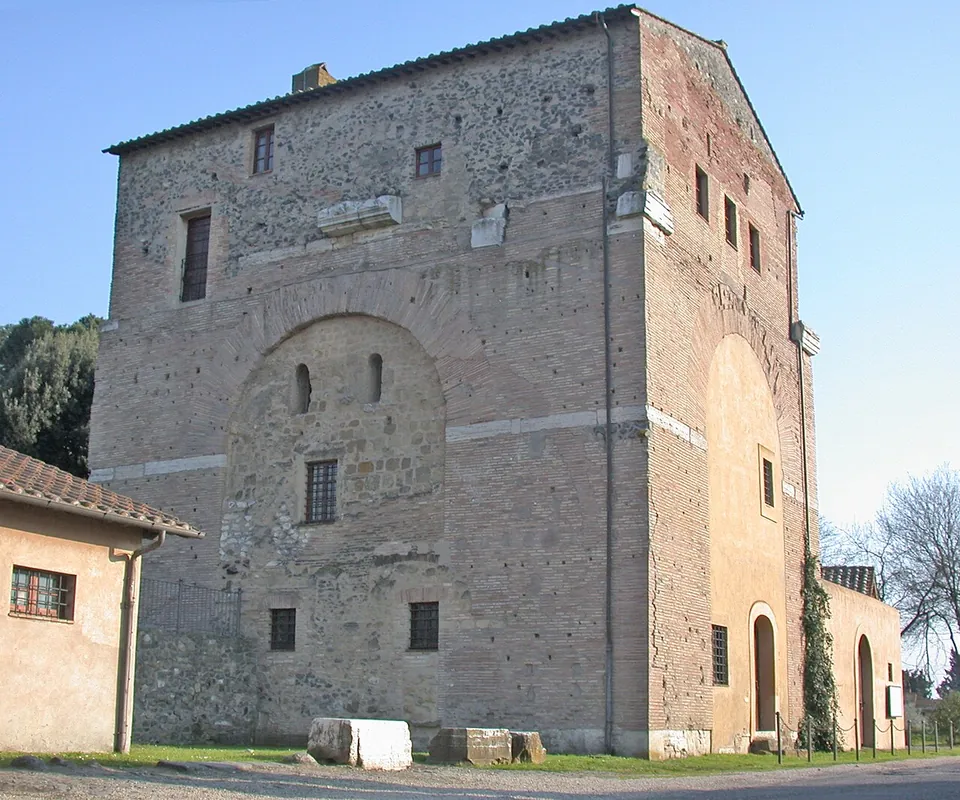
Photo: MM · Public domain · Commons
18 km · arch · Lazio
Arch of Malborghetto
At first sight you see an austere farmhouse rather than an arch (it.wikipedia).
Photo: Carlomorino · CC BY-SA 3.0 · Commons
19 km · city · Lazio
Gabii
The park the state holds covers about 70 hectares on the southern rim of a volcanic crater whose lake was drained in the 19th century (the operator; en.wikipedia).


Straight-line distances.
Sources
Every fact on this page comes from the records below, each used under the licence noted.