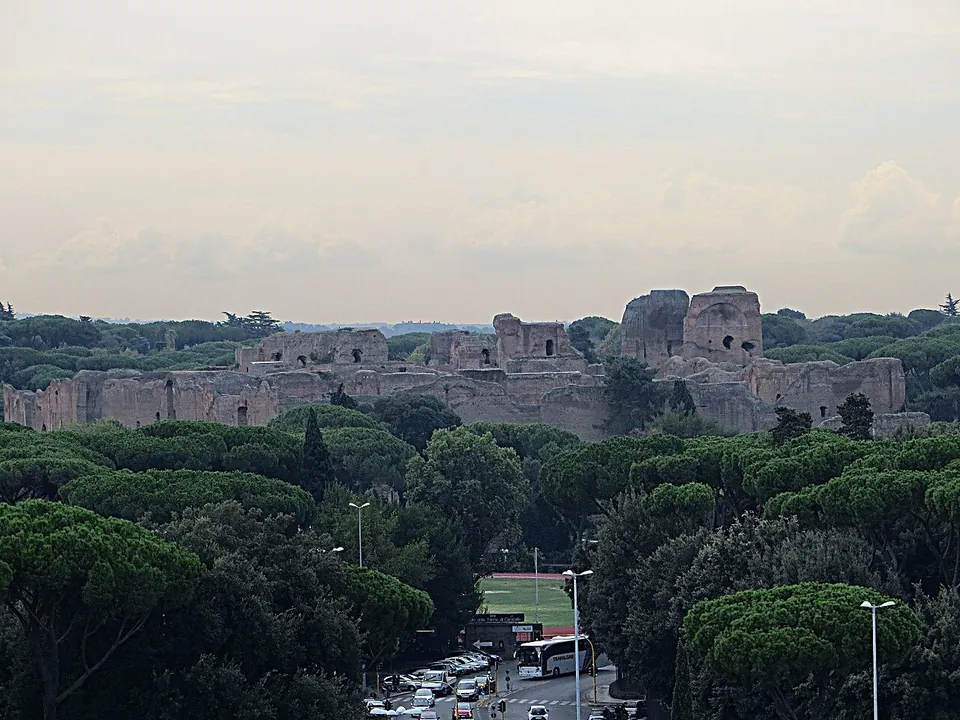
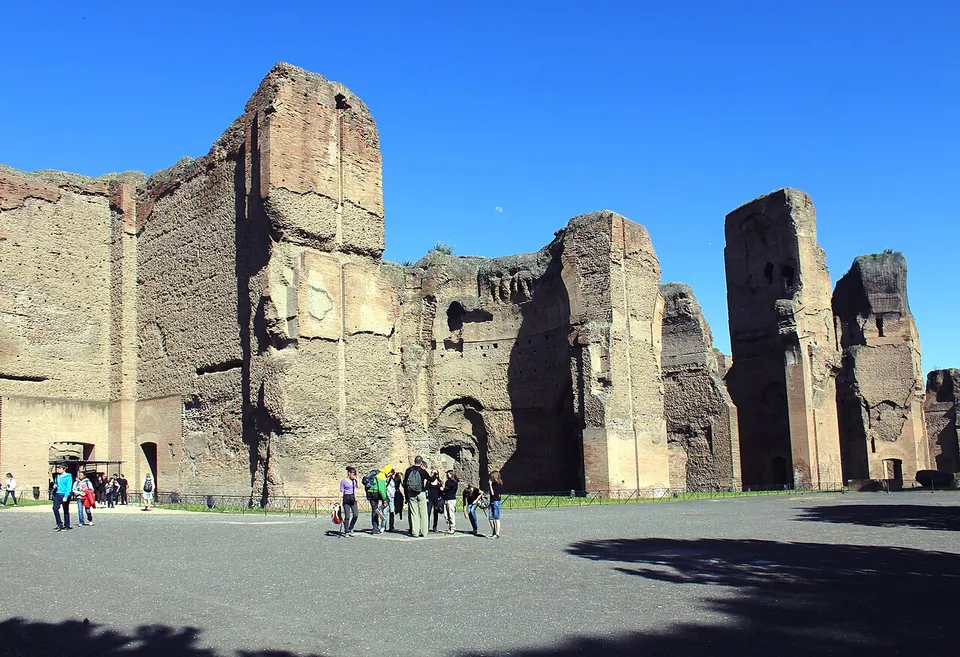


The Baths of Caracalla are the ruins of one of ancient Rome’s great public bathing and leisure complexes, built between 212 and 216 and in use until 537, and the second largest in the city after the Baths of Diocletian (en.wikipedia). The brick walls of the central block still stand several storeys high, and no later building stands on them: the operator calls them one of the best-preserved imperial buildings of antiquity for that reason.
What is there today
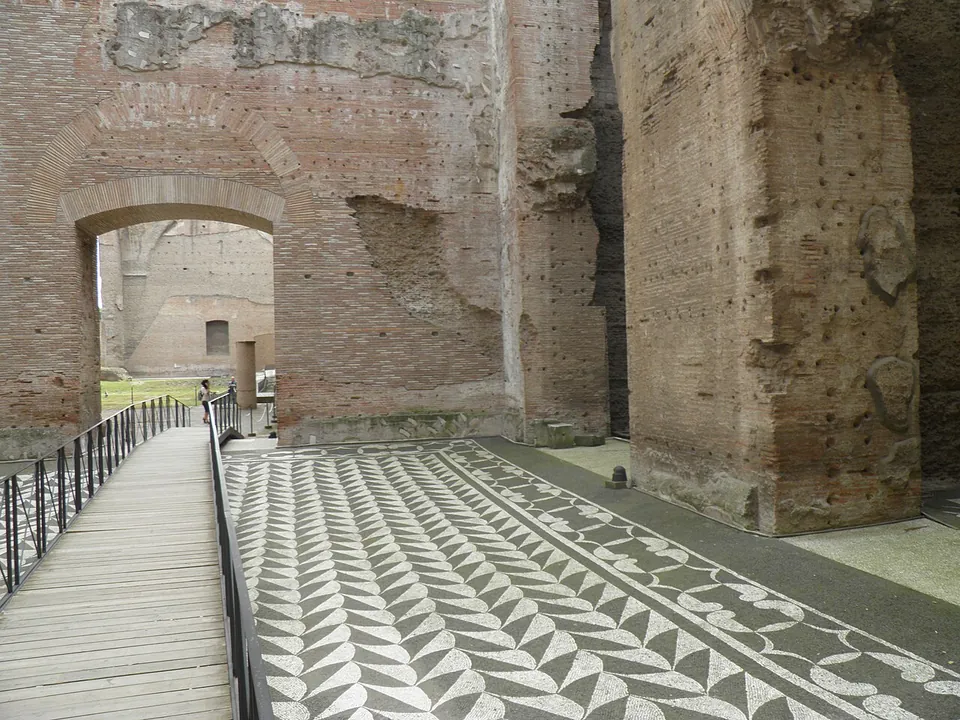
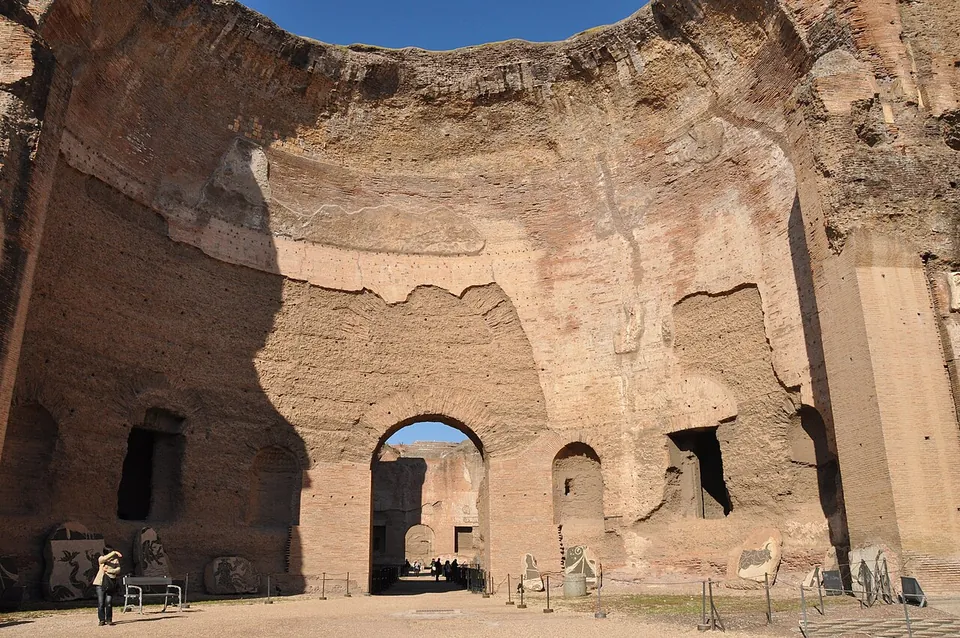
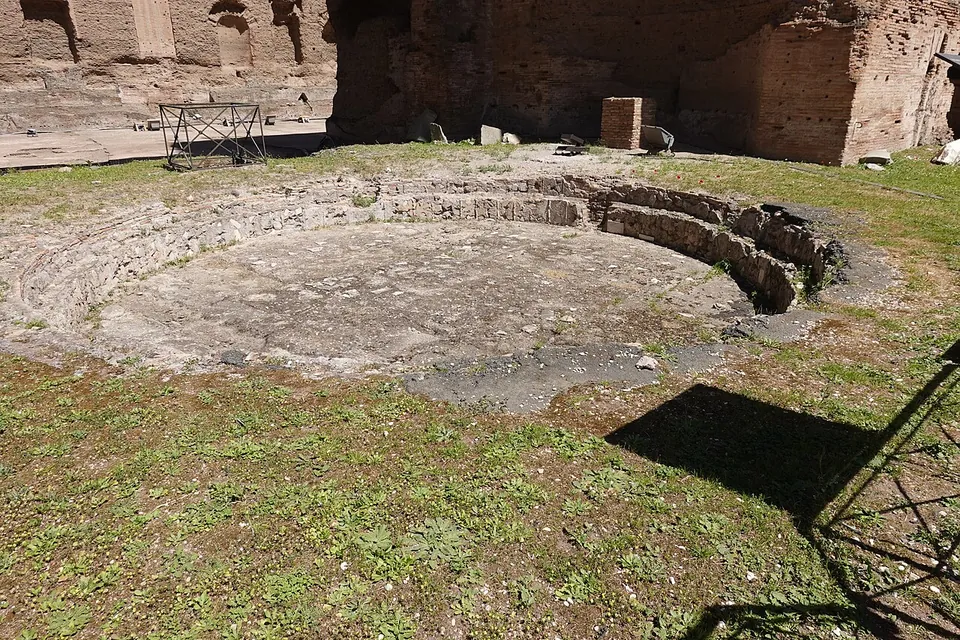
The plan is that of the “great imperial baths”: a vast rectangular precinct, 337 by 328 m, enclosing a central bath block (en.wikipedia; it.wikipedia). Inside the block the bathing rooms run along one axis - the circular caldarium (hot room), the tepidarium, the frigidarium (cold hall) and the natatio, the open-air swimming pool - with a large palaestra (exercise court) and changing rooms repeated on each side (the operator). The scale is the point. The frigidarium measured 58 by 24 m under three vaults, the caldarium about 35 m across beneath a dome close to the size of the Pantheon’s, and the pool 50 to 54 m long, as published figures differ (en.wikipedia). The caldarium is partly preserved, and mosaics survive in the changing rooms (it.wikipedia); visitors keep to set paths and walkways so as not to damage them (en.wikipedia). Around the block, the precinct held cisterns, two libraries, of which one survives, and two large exedras (en.wikipedia; it.wikipedia).
Two newer additions are part of the visit. Since 2022 the restored frescoes of the Domus di Vigna Guidi, a house that stood here before the baths, have been on the route, including a shrine where the Egyptian gods Anubis, Isis and perhaps Osiris face Jupiter, Juno and Minerva (the operator). Since 2024 a rectangular mirror pool at the entrance, meant to recall the natatio, has brought water back to the site, with jets and lights (the operator; it.wikipedia).
Below ground, about two kilometres of service galleries survive, wide enough for carts, which held the wood stores, the furnaces and boilers, the water system, a mill and a Mithraeum (the operator). They are normally closed (see below). The surface, by contrast, is level and easy to walk, with tactile panels along the route (the operator).
Is it worth the trip?
Yes. The walls of the central block still rise high enough to show how vast the bathing halls were, and no later building stands in the way.
Two honest caveats. What stands is mostly the brick shell: from at least the 12th century the ruins served as a quarry, and the famous statues found here, the Farnese Bull and the Farnese Hercules, are in the Museo Archeologico Nazionale in Naples (en.wikipedia). And the underground, where the Mithraeum is, opens only for special events. On an ordinary day you see the surface, the mosaics and the Domus di Vigna Guidi.
Getting there and what it costs
The entrance is at Viale delle Terme di Caracalla 52, about 1.3 km from the Colosseum in a straight line. The operator gives the Circo Massimo metro stop, and buses 75, 628 and 760 and tram 3 to Circo Massimo; a bus stop named Terme Caracalla is mapped about 230 m from the site (OpenStreetMap). Drivers with a disability may use the car park facing the entrance (the operator).
The site is open Tuesday to Sunday and closed on Mondays. From 1 to 24 October it opens 09.00 to 18.30, with last entry at 17.30, and from 25 October to 28 February 09.00 to 16.30, with last entry at 15.30. From 1 to 28 March the hours are 09.00 to 17.30, from 29 March to 31 August 09.00 to 19.15, and in September 09.00 to 19.00. It opens on the public holidays the operator lists, Easter Monday among them, on the ordinary hours.
A ticket is €8, €2 for ages 18 to 25, and free under 18. A €2 supplement applies during exhibitions, so while the Frank Horvat photography exhibition runs, until 10 January 2027, it is €10 and €4. Entry is free on the first Sunday of the month under the ministry’s #DomenicalMuseo scheme, though the Domus di Vigna Guidi stays shut on those crowded days. Tickets carry your name and are sold only on the Musei Italiani website and app or at the desks and card-only machines at the entrance; the operator offers no guided tours or skip-the-line tickets and takes no responsibility for tickets bought anywhere else (soprintendenzaspecialeroma.it and cultura.gov.it, read 17 October 2026).
In summer the baths are also a stage: the Rome Opera’s open-air season is one of the fixed events of the Roman summer (it.wikipedia), now on a movable stage outside the main structure (en.wikipedia).
Visiting details
- Opening hours
- Tuesday to Sunday, closed on Mondays. 09.00–18.30 from 1 to 24 October (last entry 17.30); 09.00–16.30 from 25 October to 28 February (last entry 15.30); 09.00–17.30 from 1 to 28 March (last entry 16.30); 09.00–19.15 from 29 March to 31 August and 09.00–19.00 in September (last entry 18.00). Open on the public holidays the operator lists, Easter Monday among them, on the ordinary hours.
- Tickets
- €8; €2 for ages 18 to 25; free under 18. A €2 supplement applies during exhibitions, so €10 and €4 while the Frank Horvat photography exhibition runs, until 10 January 2027. Free on the first Sunday of the month (the ministry's
- Parking
- Drivers with a disability may use the car park facing the entrance (the operator). Other car parks are mapped about 190 m from the site (OpenStreetMap way/359870862 and way/27383401).
Before you go
- The underground galleries and the Mithraeum are normally closed and open only for special events, such as the operator's evening openings (six evenings in 2026, the last on 15 October).
- The frescoed Domus di Vigna Guidi closes at 18.00 and stays shut on crowded days such as the first Sunday of the month.
- Buy only from Musei Italiani or at the site; the operator disclaims tickets sold through any other channel.
Hours and prices checked 17 October 2026 on the operator's own site. Confirm before travelling.
The Mithraeum
In one of the underground galleries near the north-west exedra, entered from outside the precinct, is a Mithraeum, a hall for the cult of the god Mithras, and the largest found in Rome (it.wikipedia; the operator’s 2026 press release). It is about 23 m long and 10 m wide under cross vaults, with a black-and-white mosaic floor, benches along the walls and a fresco of Mithras or a torchbearer (en.wikipedia). A pit in the floor, linked by a small tunnel to a side room, is unique among mithraea: most scholars read it as a fossa sanguinis, over which a bull was sacrificed so that its blood fell on the initiates below, while others think it worked as a kind of stage trapdoor (en.wikipedia); the operator says the pit can still be made out. Published dates for its discovery differ, 1912 (en.wikipedia) or 1938 (it.wikipedia).
It is normally closed and opens only on special occasions (it.wikipedia). In 2026 the operator opened the underground and the Mithraeum on six evenings between July and 15 October, with tickets at €8 (€2 reduced) sold online only.
Santa Balbina
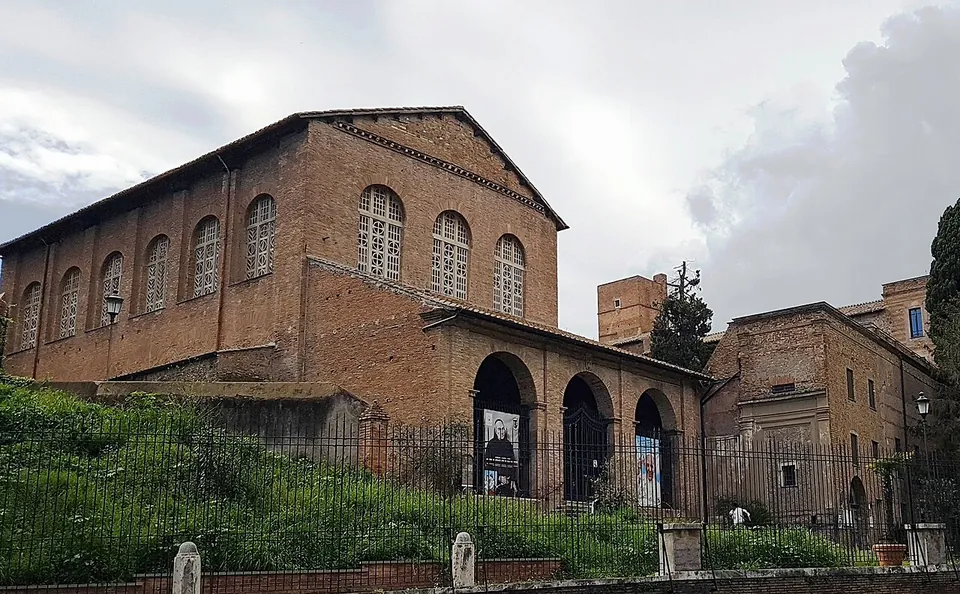
On the “little Aventine” beside the baths, entered from Viale Guido Baccelli, stands Santa Balbina, an early Christian basilica (it.wikipedia). The site was the house of Lucius Fabius Cilo, which Septimius Severus had given him at the start of the 3rd century (en.wikipedia; it.wikipedia), and around 370 Christian owners rebuilt it along the lines of today’s church (en.wikipedia); its walls of brick and banded masonry point to the 4th century, and it is first recorded at the synod of 595 (it.wikipedia). The interior is a single hall with side chapels, a 13th-century Cosmatesque bishop’s chair in the apse, an ancient sarcophagus used as a font (en.wikipedia) and Roman mosaics laid into the floor in the 1930s, brought from the excavations on Via dei Fori Imperiali (it.wikipedia). After roof repairs that began in 2024, it reopened for worship and visitors at the end of the 2025 Jubilee year (St Peter’s Basilica, whose chapter the church belongs to). No opening hours are published.
History
Septimius Severus probably began the baths and his son Caracalla inaugurated them in 216 (en.wikipedia); the operator says the work took only five years. Building went on after Caracalla’s death in 217 and was finished under the last emperors of the dynasty, Elagabalus and Severus Alexander (the operator). A new branch of the Aqua Marcia, the Aqua Antoniniana, was built to feed them (en.wikipedia; it.wikipedia). They were restored several times, above all by Constantine (the operator), who altered the caldarium (en.wikipedia). In the 5th century they were counted among the seven wonders of Rome, and Olympiodorus of Thebes gave their capacity as 1,600, read as the number of bathers at any one time (en.wikipedia).
In 537, during the Gothic War, the Ostrogothic king Vitiges cut Rome’s aqueducts during his siege, and the baths stopped working (the operator; en.wikipedia). In the 6th and 7th centuries pilgrims who died in a nearby hostel were apparently buried inside, and an earthquake in 847 destroyed much of the building (en.wikipedia). From at least the 12th century the ruins were quarried for building stone and decoration, which went into Pisa Cathedral and Santa Maria in Trastevere, among others (en.wikipedia). Excavations under Pope Paul III Farnese in 1545–1547 uncovered so many statues and fragments that a museum, the Museo Farnese, was created to hold them (en.wikipedia). The last whole granite column was taken from the natatio in 1563 and stands in Piazza Santa Trinita in Florence as the Column of Justice (it.wikipedia), and two granite basins from the frigidarium serve as the fountains of Piazza Farnese (en.wikipedia; it.wikipedia).
The Rome Opera made the caldarium its summer home from 1937 (en.wikipedia), and the 1960 Olympic gymnastics events were held here (en.wikipedia; it.wikipedia). The baths have also shaped other buildings: the Baths of Diocletian and the Basilica of Maxentius in antiquity, and New York’s original Pennsylvania Station and Chicago Union Station in modern times (en.wikipedia).
More photographs



Nearby
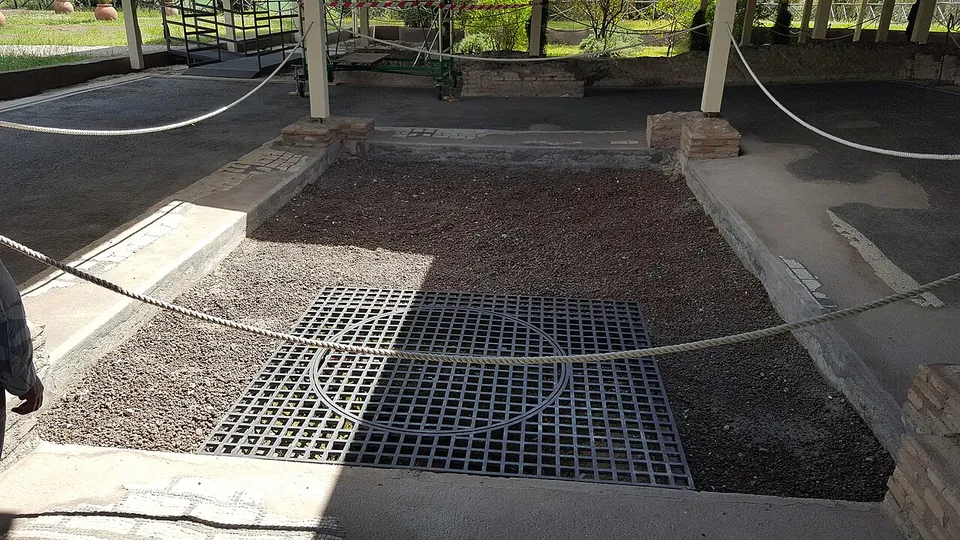
Photo: MumblerJamie · CC BY-SA 2.0 · Commons
14 km · villa · Lazio
Villa of Livia
The operator describes the private wing with the bedrooms of Livia and the emperor, an atrium and a small inner garden, and the large reception rooms that open onto a peristyle; the rooms once had painted walls and floors of mosaic and cut marble (Soprintendenza Speciale di Roma).
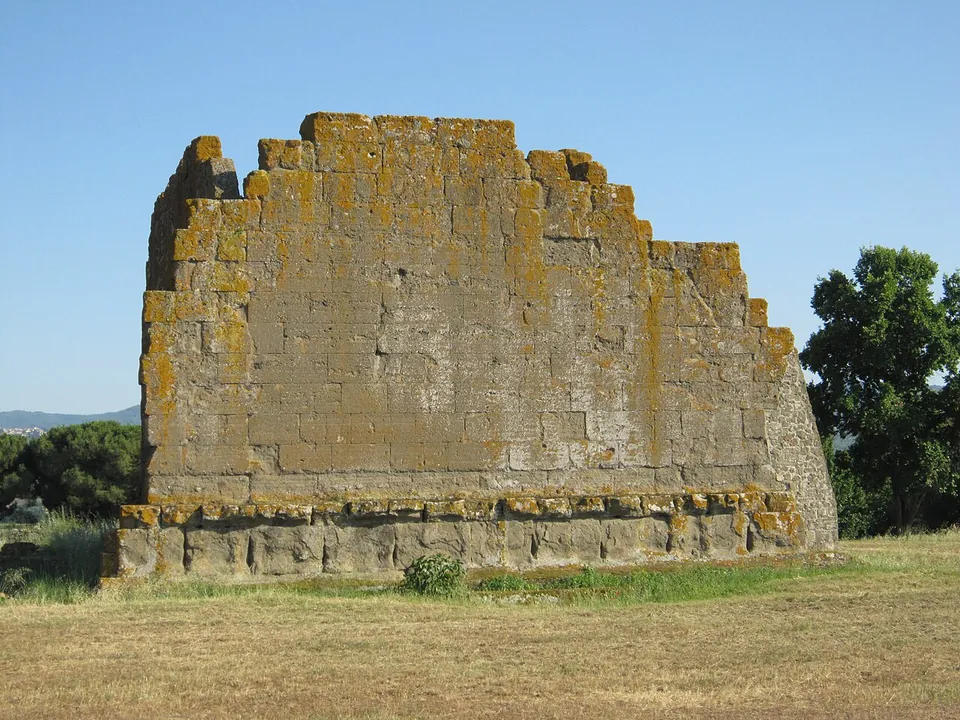
Photo: Carlomorino · CC BY-SA 3.0 · Commons
19 km · city · Lazio
Gabii
The park the state holds covers about 70 hectares on the southern rim of a volcanic crater whose lake was drained in the 19th century (the operator; en.wikipedia).
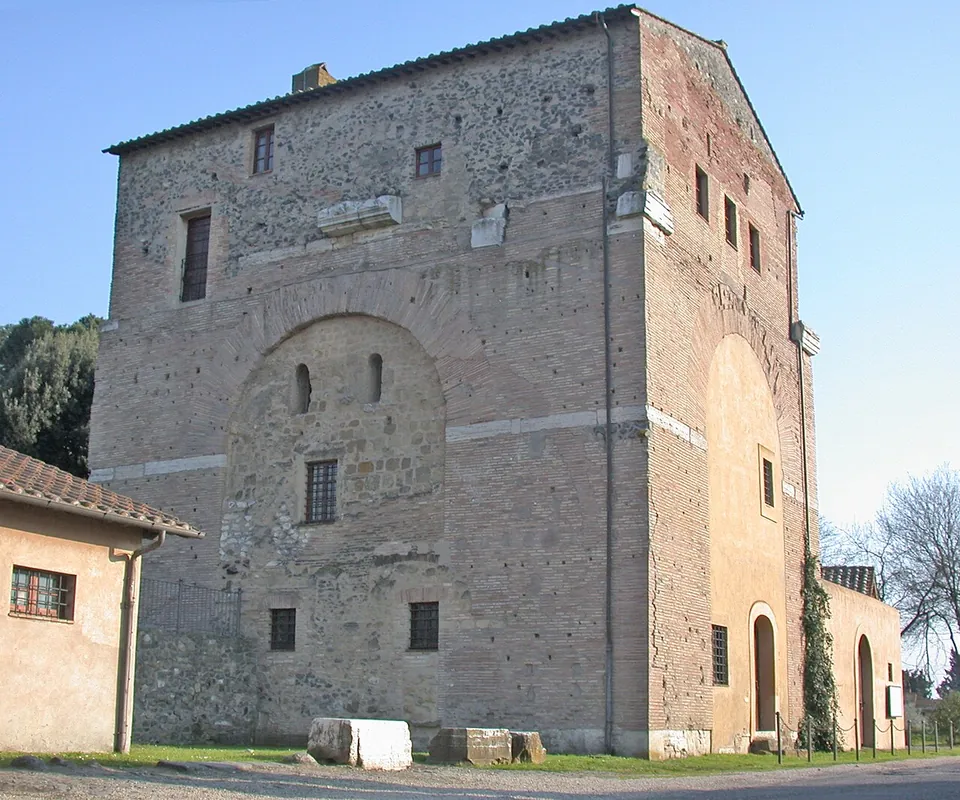
Photo: MM · Public domain · Commons
19 km · arch · Lazio
Arch of Malborghetto
At first sight you see an austere farmhouse rather than an arch (it.wikipedia).


Straight-line distances.
Sources
Every fact on this page comes from the records below, each used under the licence noted.
| Source | Licence |
|---|---|
| Pleiades 322942899 | CC BY |
| Wikidata Q502098 | CC0 |
| OpenStreetMap relation/13476232 | ODbL |
| Wikipedia (en) — Baths of Caracalla | CC BY-SA 4.0 |
| Wikipedia (it) — Terme di Caracalla | CC BY-SA 4.0 |
| Wikipedia (fr) — Thermes de Caracalla | CC BY-SA 4.0 |
| Wikipedia (it) — Mitreo delle Terme di Caracalla | CC BY-SA 4.0 |
| Wikipedia (en) — Santa Balbina | CC BY-SA 4.0 |
| Wikipedia (it) — Basilica di Santa Balbina all'Aventino | CC BY-SA 4.0 |
| Pleiades — Basilica di Santa Balbina all'Aventino | licence not recorded |
| Soprintendenza Speciale di Roma — Terme di Caracalla, hours and tickets (the operator) | licence not recorded |
| Ministero della Cultura — Terme di Caracalla (hours and tickets) | licence not recorded |
| Soprintendenza Speciale di Roma — Notturno Imperiale 2026 press release (underground and Mithraeum evenings) | licence not recorded |
| Ministero della Cultura — | licence not recorded |
| Basilica Papale di San Pietro — Santa Balbina reopened for worship | licence not recorded |