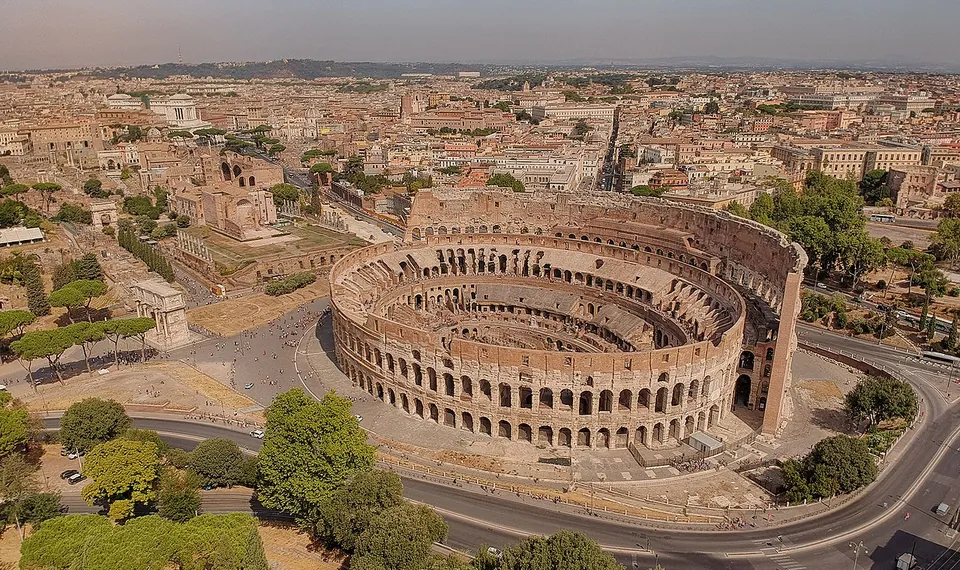
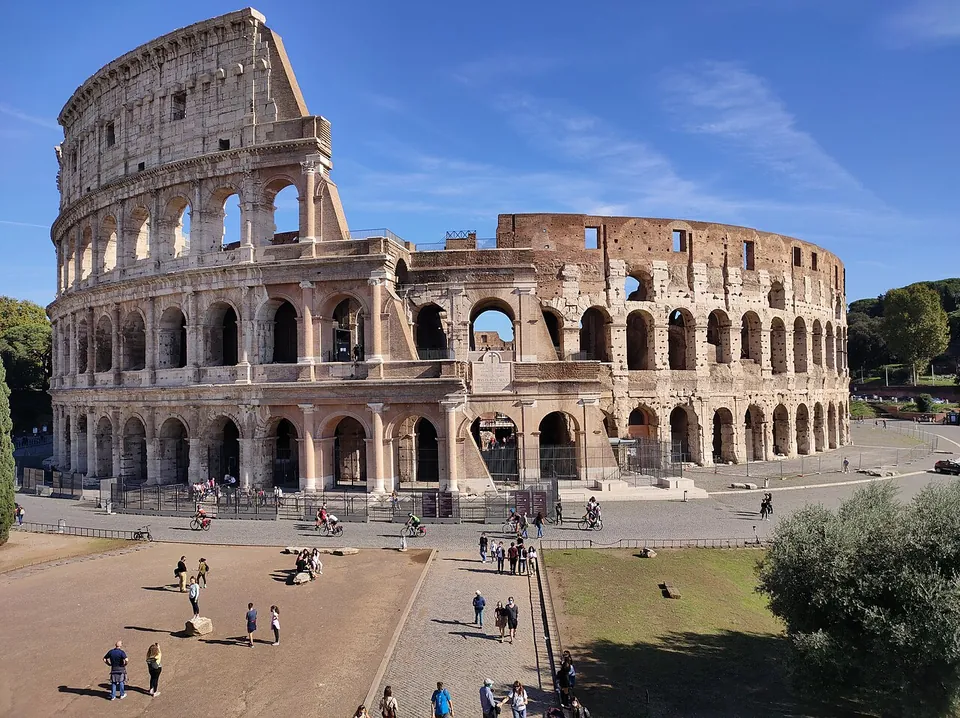


The Colosseum is the great oval arena of ancient Rome, where crowds watched gladiators and wild-animal hunts, and it still stands in the middle of the city, just east of the Roman Forum. It is the largest amphitheatre ever built in the ancient world (en.wikipedia), and the building still reaches 48 m at its highest point, against 52 m originally (it.wikipedia). It is worth the trip and the crowds; the catch is that you go in only at a time you have booked, and on the standard ticket you have 75 minutes inside. That ticket costs €18 and also covers the Roman Forum and the Palatine for 24 hours (colosseo.it).
What is there today
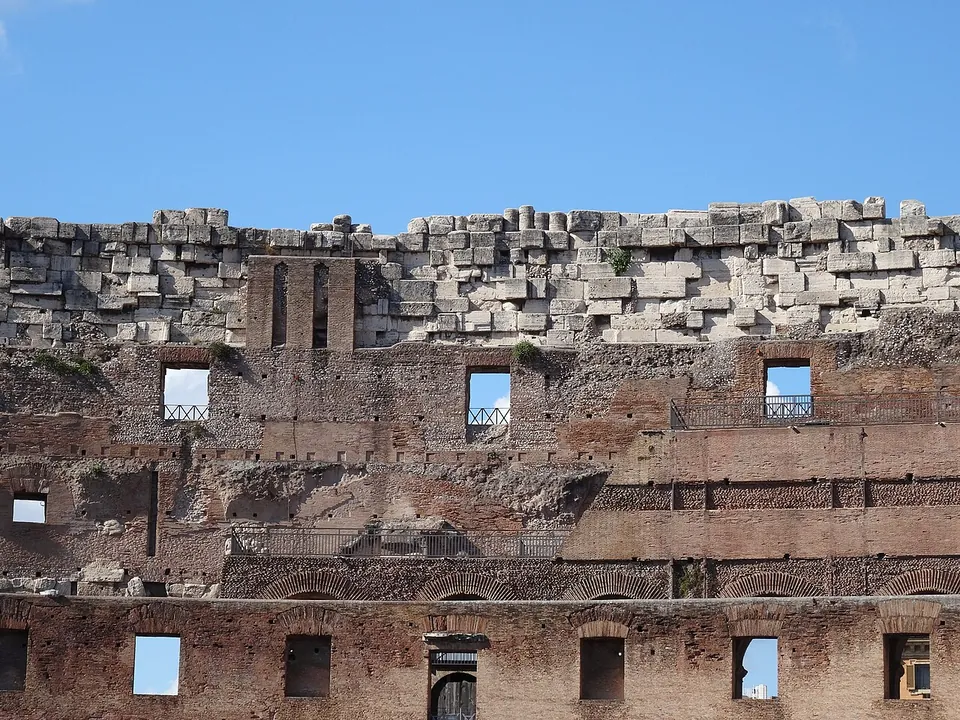
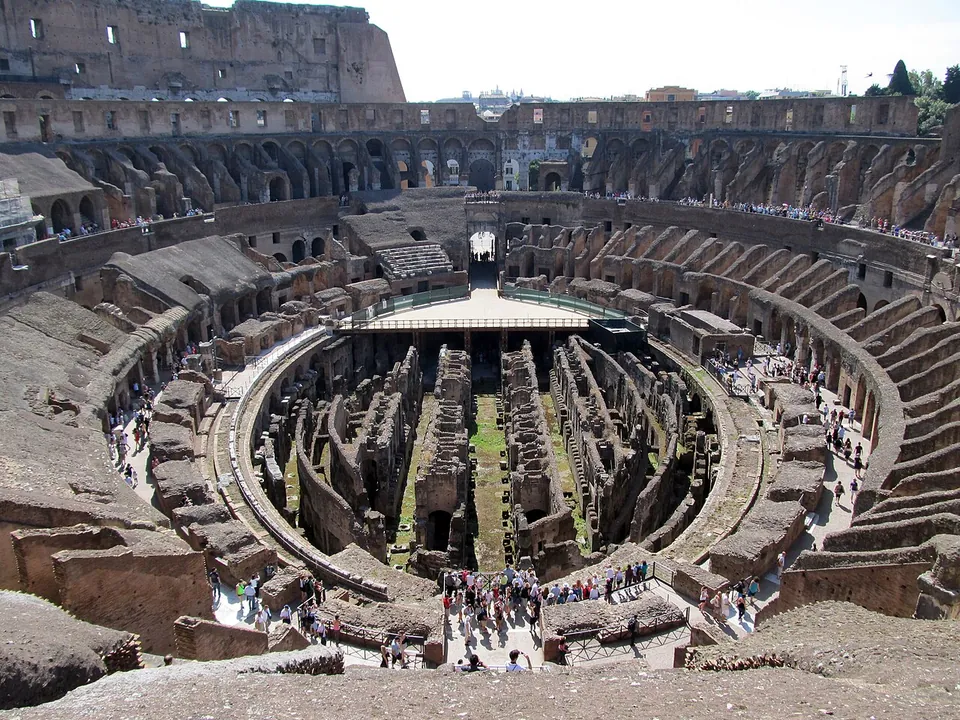
The whole oval still stands, as a ruin: on one side the outer wall still stands up to its top storey, three tiers of arches with a solid storey above them, while on the other it has broken away, leaving a lower ring of arches (the photographs here). The building is an oval 527 m round and 187.5 by 156.5 m across, around an arena of 86 by 54 m (it.wikipedia). It is built of travertine, tuff and Roman concrete (en.wikipedia), and earthquakes and stone-robbers have ruined much of it: fr.wikipedia lists earthquakes in 443, 508, 801, 847 and 1349.
The standard ticket takes you round the first and second levels, with panoramic terraces on the second, and into the Colosseum’s own museum; temporary exhibitions are included (colosseo.it). Inside, the basement under the arena lies open to view, its brick walls and passages exposed, with part of the arena floor over it (the photographs here). The arena floor, the underground and the third level with the attic are each reached only on other tickets (colosseo.it).
Around the Colosseum
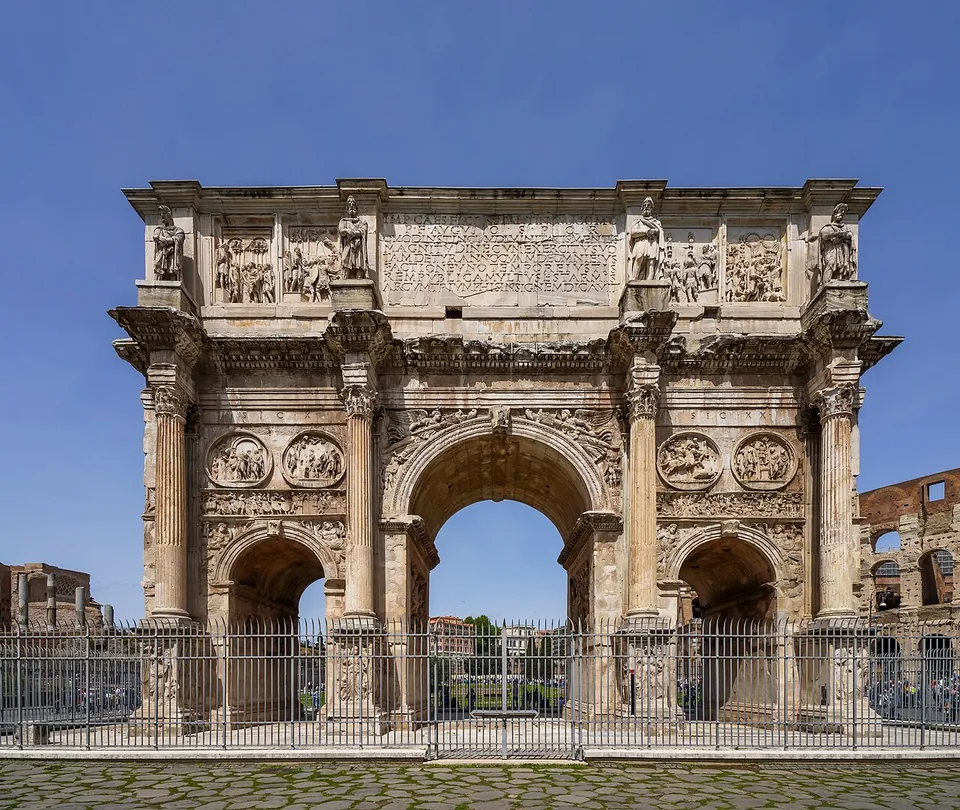
The Arch of Constantine stands between the Colosseum and the Palatine Hill. The Senate commissioned it to mark Constantine’s victory over Maxentius at the Milvian Bridge in 312, and it was dedicated in 315. At 21 m high and 25.9 m wide it is the largest Roman triumphal arch, and much of its sculpture was taken from earlier monuments to Trajan, Hadrian and Marcus Aurelius, with the portrait heads replaced by Constantine’s (en.wikipedia). The Colosseum’s entrance is next to it (colosseo.it).
The Ludus Magnus, directly east of the Colosseum, was the largest of the four gladiator schools known in ancient Rome, built under Domitian (de.wikipedia). What is visible belongs to a rebuilding under Trajan (en.wikipedia), and it is the only one of the four that can still be partly seen (it.wikipedia), uncovered in 1937 when a building was going up (fr.wikipedia). An information board about it is mapped nearby (OpenStreetMap).
The Meta Sudans was a monumental cone-shaped fountain, the cone 17 m high, south-west of the amphitheatre, at the point where four, perhaps five, of the city’s regions met (Pleiades; de.wikipedia). What was left of it was removed in 1933–36 when Mussolini’s new avenue, today’s Via dei Fori Imperiali, was laid out, and its remains were dug out again in the 1990s (de.wikipedia). Only traces survive (Pleiades).
The Colossus of Nero was a bronze statue of the emperor; published heights run from 30 to 35 m. It stood first in the entrance hall of Nero’s palace, the Domus Aurea. His successors turned it into the sun god Sol, and Hadrian had it moved nearer the amphitheatre (en.wikipedia; fr.wikipedia). One popular theory holds that the Colosseum is named after it (en.wikipedia). The statue is lost: a few concrete blocks from the foundation of its pedestal are all that remains (en.wikipedia), about 130 m from the amphitheatre (OpenStreetMap).
Three more places are on the map, but they have little to show. The so-called Baths of Elagabalus, on the north-east slope of the Palatine beside the Via Sacra, were in fact a warehouse of the early 3rd century; the bath that gave them their name was added in the 4th (it.wikipedia). The Nymphaeum of Nero was a large ornamental fountain built against the north-east side of the platform of the Temple of the Deified Claudius on the Caelian Hill while the Domus Aurea was going up (it.wikipedia). The Compitum Acili, a small Augustan shrine of the Lares, the guardian gods of a crossroads, was found in 1932 and destroyed in the works for Via dei Fori Imperiali (de.wikipedia; it.wikipedia).
Is it worth the trip?
Yes. This is the largest standing amphitheatre in the world (en.wikipedia), and nothing else from Rome gives the same sense of the size of the city’s crowds: estimates of its capacity run from 50,000 to 87,000 spectators (en.wikipedia; it.wikipedia).
The honest caveats are about the visit, not the building. It draws about 7.6 million visitors a year (fr.wikipedia), so expect crowds. You go in only at the time you booked, and the standard ticket allows 75 minutes inside, the Full Experience tickets 90 (colosseo.it). If you want to stand on the arena floor or climb to the attic, book early: places on those tickets are limited (colosseo.it). The same ticket covers the Roman Forum and the Palatine, so plan the two together.
Getting there and what it costs
Colosseo metro station is about 90 m from the amphitheatre (OpenStreetMap), on line B, and buses 51, 75, 81, 85, 87 and 118 and tram 3 stop here too (colosseo.it). The entrance is near the Arch of Constantine, at the point the operator calls the Sperone Valadier; arena-only visitors go in and out on the Sperone Stern side (colosseo.it). Free public toilets are mapped about 60 m from the building (OpenStreetMap). For visitors with limited mobility the operator lists a lift; the attic is reached only by steep steps, and its panoramic lift is reserved for visitors with documented mobility difficulties (colosseo.it).
The Colosseum opens every day at 08.30. Until 24 October 2026 it closes at 18.30, with last entry at 17.30; from 25 October 2026 to 28 February 2027 it closes at 16.30, with last entry at 15.30. It is closed on 25 December and 1 January. Prices, from the operator’s pages, read on 13 October 2026:
- Colosseum, Roman Forum and Palatine: €18, valid 24 hours. It covers the Colosseum’s first and second levels and its museum, but not the arena. You enter the Colosseum at the booked time and can stay up to 75 minutes. The ticket is €2 for EU citizens aged 18 to 24. Under-18s go free but must still book a ticket.
- Only Arena: €18, a 20-minute visit to the arena floor, with the Forum and Palatine.
- Full Experience: €24 each, valid two days, with up to 90 minutes in the Colosseum. There are three: the arena; the underground and the arena; or the third level and the attic. The Passage of Commodus visit costs €32 and runs only on Mondays and Wednesdays.
- Free days: the first Sunday of every month, and 25 April, 2 June and 4 November. On free Sundays the tickets cannot be booked. They are handed out on the day at the box office in Piazza del Colosseo, first come, first served.
Most tickets go on sale 30 days ahead (some only seven days ahead) and are issued in your name, so carry an identity document to show with them, and arrive about 15 minutes before your slot (colosseo.it).
Visiting details
- Opening hours
- Open every day; the Colosseum opens at 08.30. It closes at 18.30 (last entry 17.30) until 24 October 2026, and at 16.30 (last entry 15.30) from 25 October 2026 to 28 February 2027. Closed 25 December and 1 January. Hours from March 2027 were not yet published when checked.
- Tickets
- €18 for the Colosseum (first and second levels and its museum, not the arena) with the Roman Forum and Palatine, valid 24 hours, the Colosseum entered at the booked slot and for at most 75 minutes; €2 for EU citizens aged 18–24; free under 18, but the ticket must still be booked. Only Arena (a 20-minute visit to the arena floor, with the Forum and Palatine) €18. Full Experience tickets, valid two days with up to 90 minutes inside, €24 each for the arena, for the underground and arena, or for the third level and attic; the Passage of Commodus €32, Mondays and Wednesdays only. Free for everyone on the first Sunday of the month and on 25 April, 2 June and 4 November.
Before you go
- Entry only at the time slot booked online; arrive about 15 minutes early. Most tickets go on sale 30 days ahead, some only seven days ahead.
- Tickets are issued in the visitor's name; carry an identity document to show with the ticket.
- First-Sunday free tickets cannot be booked; they are handed out on the day at the box office in Piazza del Colosseo, first come, first served.
Hours and prices checked 13 October 2026 on the operator's own site. Confirm before travelling.
History
Building began under Vespasian, in 72 according to en.wikipedia and in 70 according to it.wikipedia, and his successor Titus completed it in 80; it.wikipedia dates the inauguration to 21 April of that year. Domitian made further changes (en.wikipedia). Because those three emperors were the Flavian dynasty, the building is also called the Flavian Amphitheatre (en.wikipedia). The shows were staged by members of the imperial house, with free entry, for the free inhabitants of Rome and the empire (de.wikipedia). They included gladiatorial contests, animal hunts, executions, re-enactments of famous battles, dramas based on Roman mythology and, briefly, mock sea battles (en.wikipedia). According to fr.wikipedia, Titus opened the building with one of those sea battles, staged in the flooded arena.
The name Colosseo spread only in the Middle Ages, probably from the colossal statue of Nero that stood nearby (it.wikipedia). The operator dates the building’s decline from 438, when Valentinian III abolished gladiatorial games (colosseo.it), and the last games were held in the 6th century (fr.wikipedia). Afterwards the building served as housing, workshops, quarters for a religious order, a fortress, a quarry and a Christian shrine (en.wikipedia). Some of its stone went to St Peter’s Basilica, and after the Romantic period systematic excavation and restoration began (colosseo.it). With the historic centre of Rome it has been on UNESCO’s World Heritage List since 1980 (it.wikipedia), and each Good Friday the Pope leads a torchlit Way of the Cross that begins in the area around it (en.wikipedia).
More photographs
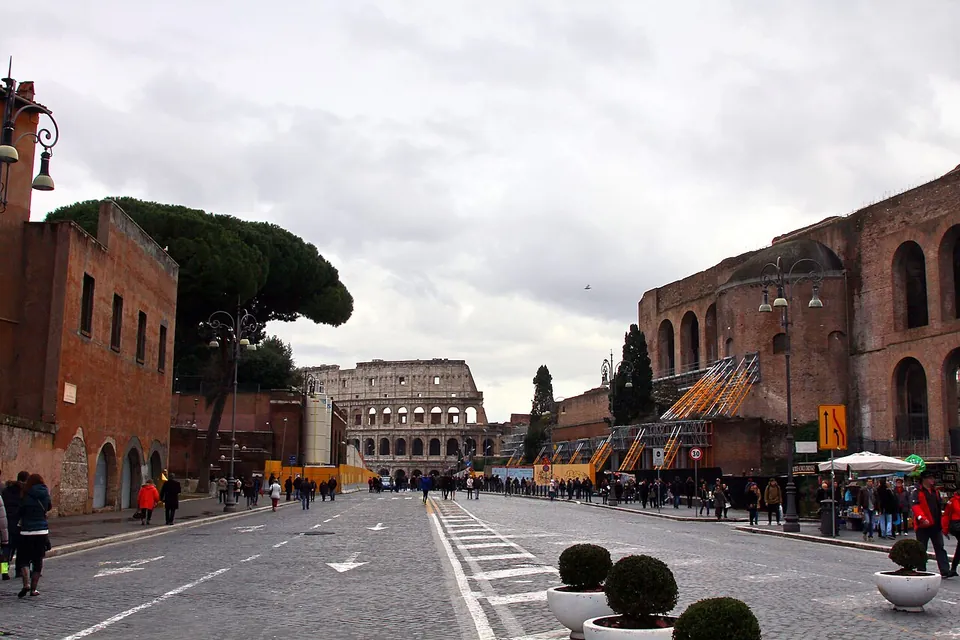



Nearby
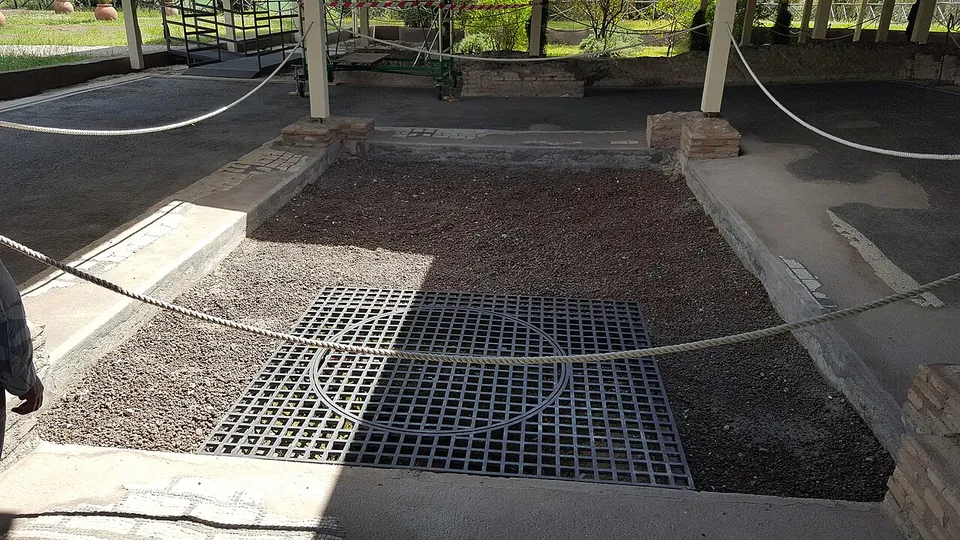
Photo: MumblerJamie · CC BY-SA 2.0 · Commons
12 km · villa · Lazio
Villa of Livia
The operator describes the private wing with the bedrooms of Livia and the emperor, an atrium and a small inner garden, and the large reception rooms that open onto a peristyle; the rooms once had painted walls and floors of mosaic and cut marble (Soprintendenza Speciale di Roma).
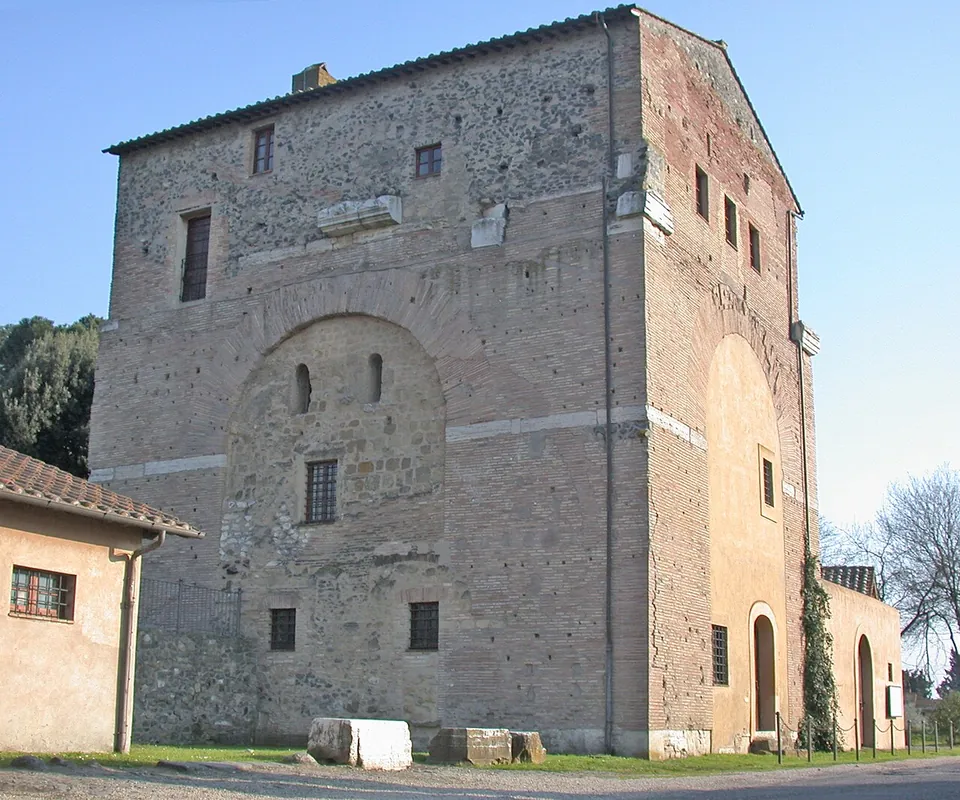
Photo: MM · Public domain · Commons
18 km · arch · Lazio
Arch of Malborghetto
At first sight you see an austere farmhouse rather than an arch (it.wikipedia).
Photo: Carlomorino · CC BY-SA 3.0 · Commons
19 km · city · Lazio
Gabii
The park the state holds covers about 70 hectares on the southern rim of a volcanic crater whose lake was drained in the 19th century (the operator; en.wikipedia).


Straight-line distances.
Sources
Every fact on this page comes from the records below, each used under the licence noted.