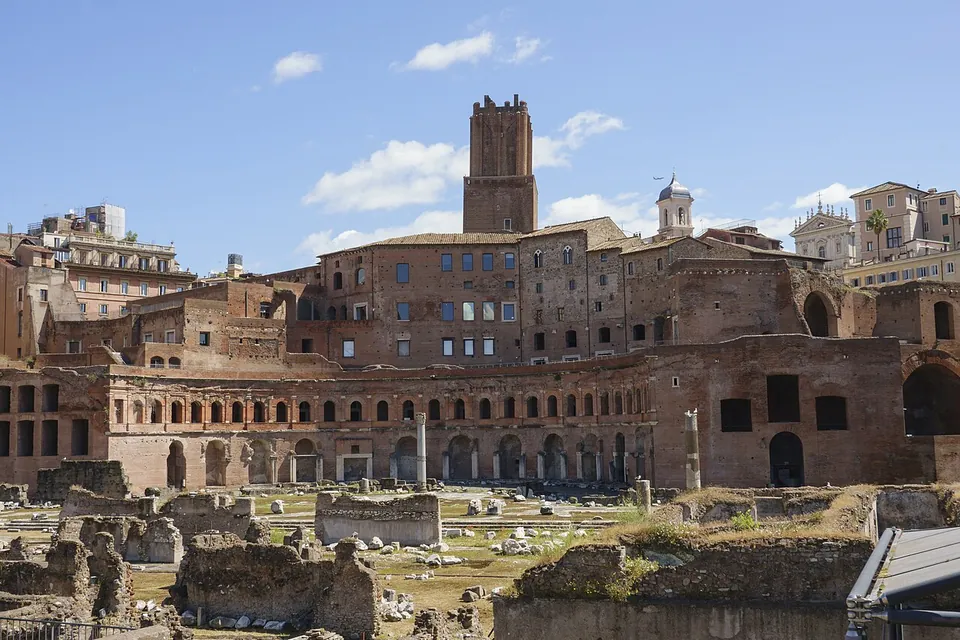
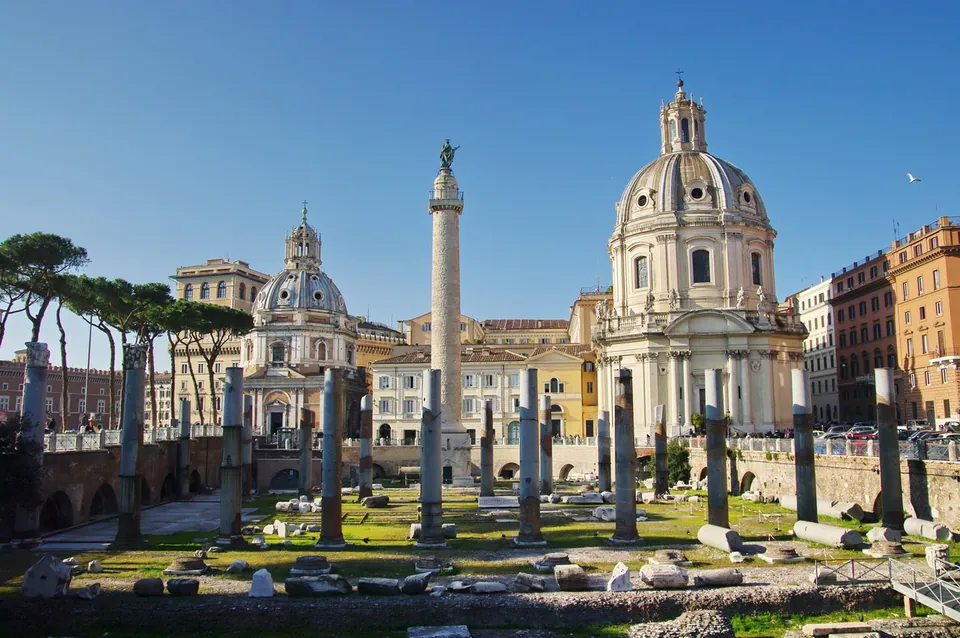


The Imperial Fora are the five monumental squares that Julius Caesar and the emperors Augustus, Vespasian, Nerva and Trajan built beside the Roman Forum between 46 BC and AD 113 (it.wikipedia), and they lie today along Via dei Fori Imperiali, between Piazza Venezia and the Colosseum (Sovrintendenza Capitolina). What still stands is Trajan’s Column with its spiral of carved reliefs, the brick tiers of Trajan’s Markets, a towering firewall and a few temple columns; the rest is foundations and paving. Parts of it can be seen from the street, and the walkway through it is on the €18 Forum Pass SUPER, which also covers the Roman Forum and the Palatine.
What is there today
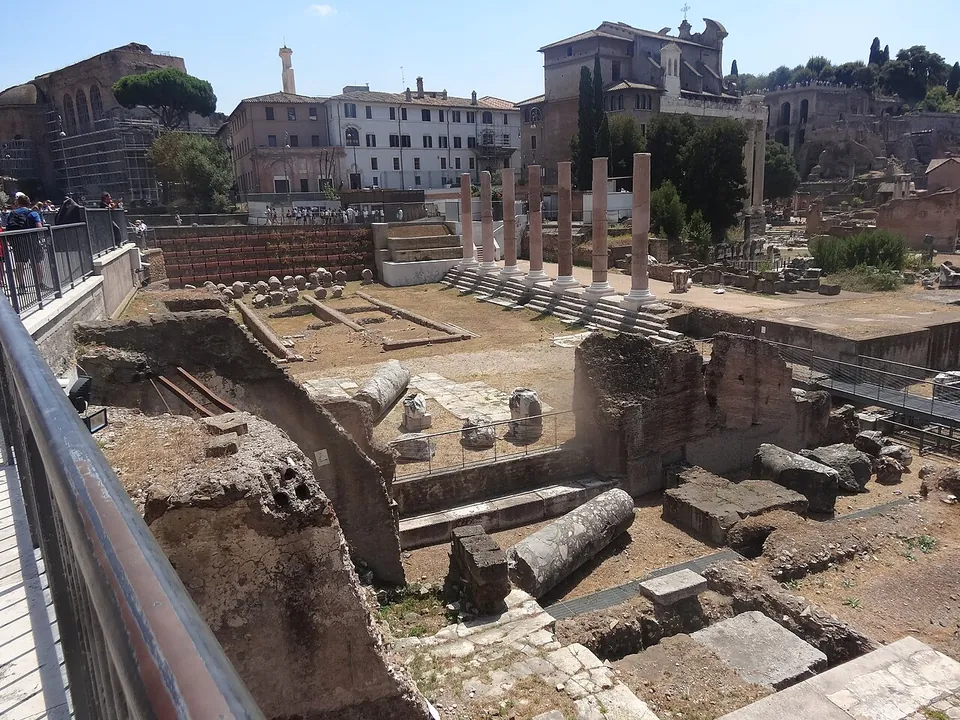
The fora were laid out side by side, and since 1924–1932 Via dei Fori Imperiali has run across them (de.wikipedia). The operator’s walkway starts at Trajan’s Column, crosses part of Trajan’s Forum, passes under the road through the cellars of the Alessandrino quarter, a neighbourhood built over part of the fora at the end of the 16th century, runs the whole length of the Forum of Caesar and reaches the Forum of Nerva, from where it continues past the Curia Julia into the Roman Forum. It is step-free (Sovrintendenza).
Trajan’s Forum and Trajan’s Column. The last of the fora and the largest, it was inaugurated in 112 and its design is attributed to Apollodorus of Damascus; the complex measured 300 by 185 m (it.wikipedia). To make room, the slope of the Quirinal was cut back, and about 300,000 m³ of rock was removed (Sovrintendenza). Today only the central section of the Basilica Ulpia is visible, its two ends lying under Via dei Fori Imperiali and the buildings by the Magnanapoli steps (it.wikipedia); at 117 by 55 m it was the largest basilica in Rome (en.wikipedia). Beyond it, Trajan’s Column still stands where it was put up (de.wikipedia). Dedicated on 12 May 113, it is about 30 m tall, 35 m with its pedestal, and a frieze 190 m long winds 23 times round the shaft with scenes of Trajan’s wars against the Dacians; the bronze Saint Peter on top was placed there in 1587 (en.wikipedia). The urn with Trajan’s ashes was laid in its base (de.wikipedia).
Trajan’s Markets. Built at the same time as the forum, on the cut slope of the Quirinal, the Markets rise on six levels (Sovrintendenza; it.wikipedia). Despite the name, they are now thought to have housed mainly administrative offices, with trade only in a limited part (it.wikipedia). Since 2007 they have held the Museo dei Fori Imperiali (it.wikipedia), where carved fragments from the fora are shown, among them a piece of the frieze from the Temple of Venus Genetrix and statues of Dacian prisoners from the Basilica Ulpia (Sovrintendenza).
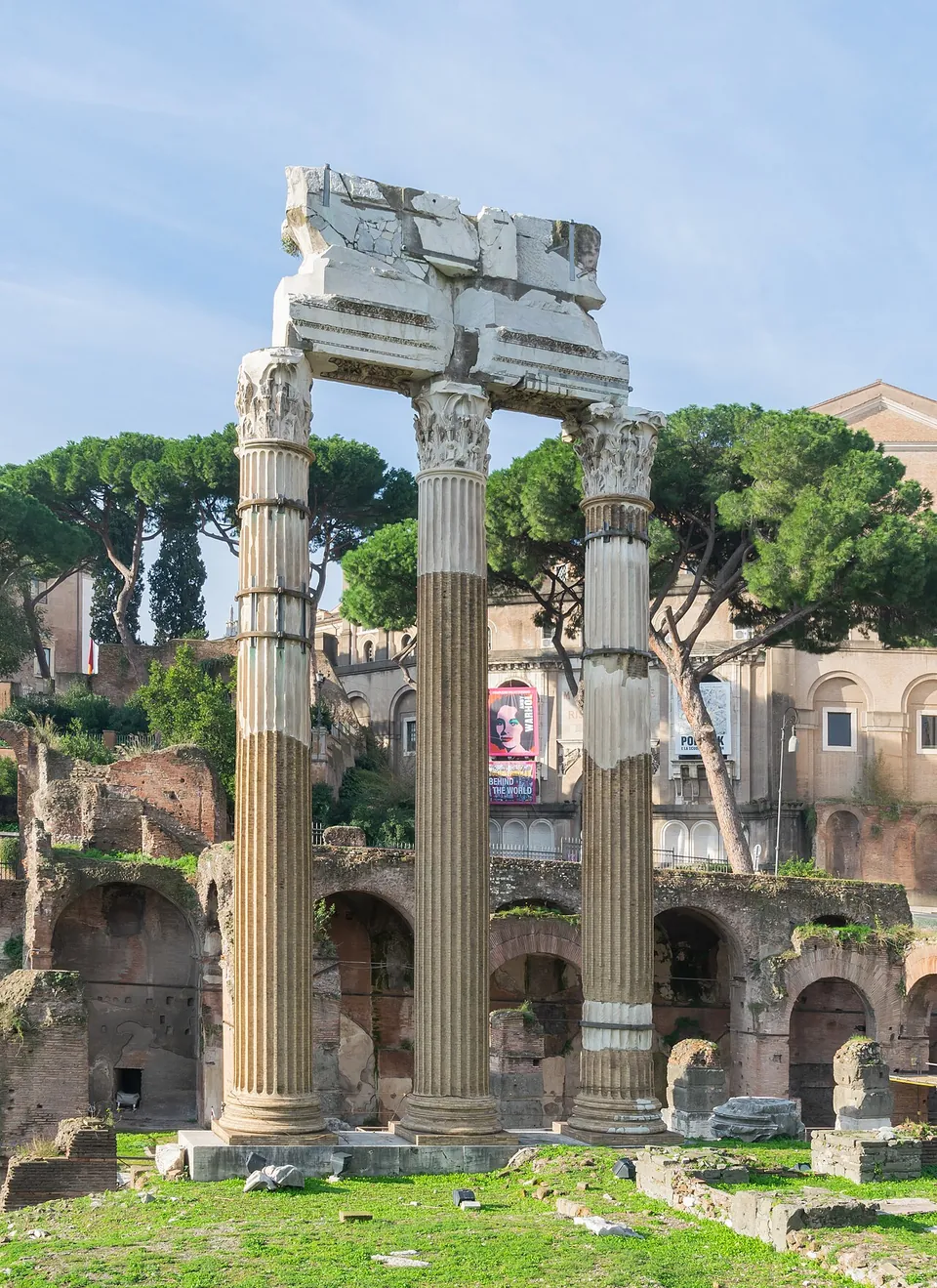
The Forum of Caesar. Caesar began it in 54 BC (Sovrintendenza; de.wikipedia) and inaugurated it, still unfinished, on 26 September 46 BC, the last day of his four triumphs; Augustus completed it (it.wikipedia). Of the Temple of Venus Genetrix, the goddess the Julian family claimed as its ancestor, three columns stand, put back up with part of their entablature in 1933 (Sovrintendenza). Beside it is the so-called Basilica Argentaria, a portico of pillars whose walls still carry many graffiti (Sovrintendenza; en.wikipedia); behind it the Clivus Argentarius, an ancient street, runs along the slope of the Capitoline (it.wikipedia).
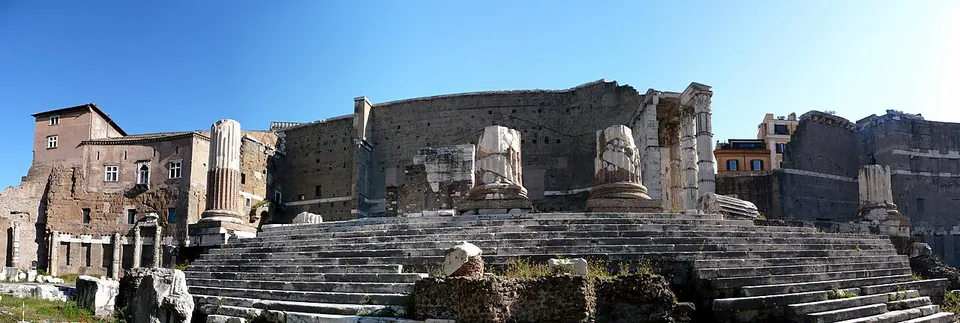
The Forum of Augustus and the Temple of Mars Ultor. Octavian vowed a temple to Mars the Avenger before the battle of Philippi in 42 BC, and the forum and temple were inaugurated, still incomplete, in 2 BC (en.wikipedia). Of the temple, the podium and three of its outer columns survive (Sovrintendenza). Behind it rises the forum’s back wall, of peperino, Gabine stone and travertine, up to 33 m high, built to protect the forum from the fires of the Subura quarter behind; restored in 2025, it can be seen from Via dei Fori Imperiali, Via Alessandrina and Via Tor de’ Conti (Sovrintendenza).
The Temple of Peace. Vespasian built it between 71 and 75, after putting down the Jewish revolt (it.wikipedia; Sovrintendenza), and it held the menorah and the Table of Shewbread taken from the Temple in Jerusalem (en.wikipedia). Only the part south-east of Via dei Fori Imperiali has been excavated (de.wikipedia), and its remains can be seen in part from the road (it.wikipedia). Seven columns of pink Aswan granite from its western portico, about 7 m high, were re-erected in 2015 from fragments found where they had fallen; about 70 per cent of the whole is modern infill, matched in colour, and the work is designed to be recognisable and reversible (Sovrintendenza).
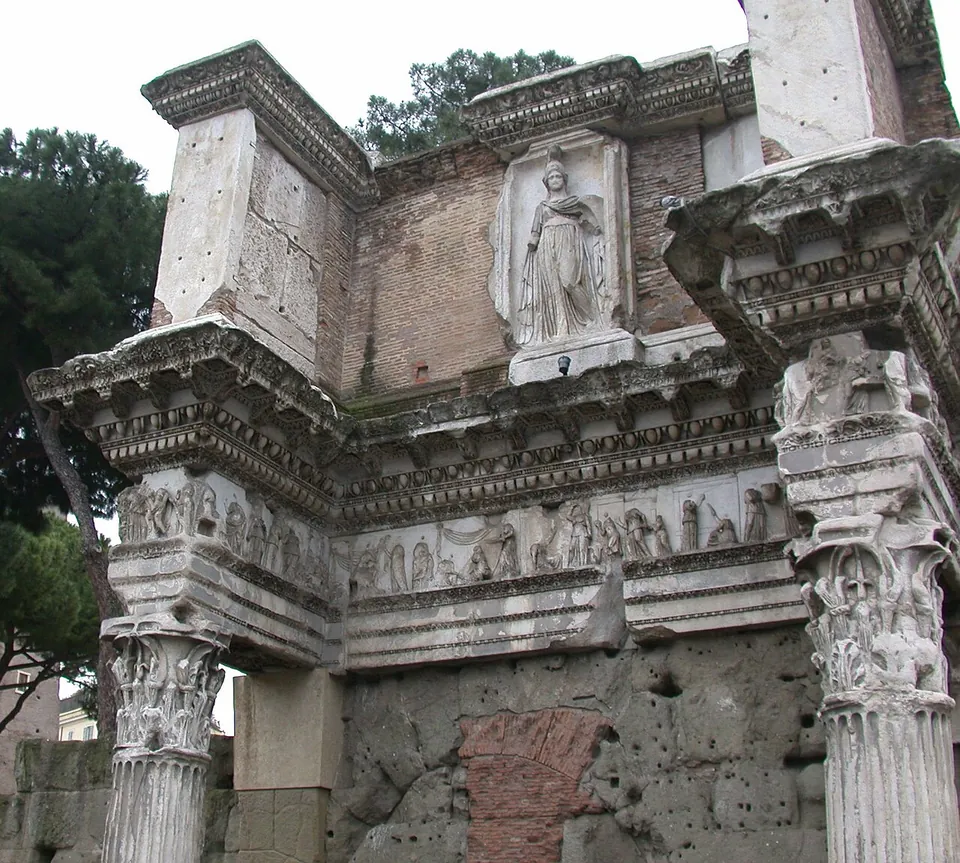
The Forum of Nerva. Domitian built it, but he was murdered in 96, and Nerva inaugurated it in 97 (Sovrintendenza). Its Temple of Minerva stood until 1606, when Pope Paul V took its stone for the Acqua Paola fountain (en.wikipedia; it.wikipedia); scant remains of the podium are left (it.wikipedia). The standing piece is the only surviving stretch of the enclosure wall, with two of its columns, the Colonnacce. Their frieze, about 25 m of it left, shows 61 figures in eight scenes from the myths of Minerva, Arachne among them; the helmeted woman in the relief above was long read as Minerva and has recently been identified as the personification of the Pirustae, a Balkan people conquered by Rome (Sovrintendenza). In front of the Colonnacce, wheel ruts mark the paving where carts used the forum as a street in the early Middle Ages (Sovrintendenza).
Around the edges. Under Palazzo Valentini, beside Trajan’s Column, are the remains of Roman houses, the Domus Romane, shown on timed visits that must be booked, with their own ticket (€15; closed on Tuesdays) (Wikidata; palazzovalentini.it); the temple Hadrian added to Trajan’s Forum is thought to lie beneath the same palazzo (it.wikipedia). In Piazza Venezia, excavation for Metro Line C found in 2009 the site of Hadrian’s Athenaeum, a school for literary and scientific studies (en.wikipedia); Rome’s tourism office lists it as closed to the public (Turismo Roma).
Is it worth the trip?
Yes, and it costs little effort: the fora lie on the walk between Piazza Venezia and the Colosseum, and the walkway comes with the Forum Pass SUPER for the Roman Forum. Trajan’s Column alone is worth the stop: the first column ever raised with a spiral of reliefs (it.wikipedia), its carved story still winding round the shaft.
The honest caveat is that, apart from the column, the Markets, the Augustan wall and a few groups of columns, this is a field of foundations, cut through by a busy road whose traffic has damaged the buildings through vibration and pollution (en.wikipedia). To make sense of what you see, the Museo dei Fori Imperiali in Trajan’s Markets holds fragments of the decoration that once covered these squares; it is a separate ticket.
Getting there and what it costs
The fora are in the centre of Rome, along Via dei Fori Imperiali, with the Roman Forum adjoining to the south and the Colosseum at the far end of the road (Sovrintendenza; en.wikipedia). Bus stops named Fori Imperiali/Campidoglio and Fori Imperiali are mapped about 50 and 90 m from the point (OpenStreetMap). The ticket office and entrance are at Trajan’s Column, in Piazza della Madonna di Loreto; the walkway leaves by Via Bonella, at the Forum of Caesar. Coming from the Roman Forum on the same ticket, the route ends at the Trajan’s Column office instead (Sovrintendenza).
The fora open every day at 09.00. Until 24 October 2026 they close at 18.30; from 25 October to 28 February at 16.30; from 1 to 27 March at 17.30; and from 28 March to 30 September at 19.15, with last entry an hour before closing. Entry is controlled in numbers (Sovrintendenza, read 16 October 2026).
- Forum Pass SUPER: €18, valid one day for one entry to the Imperial Fora, the Roman Forum and the Palatine, without the Colosseum; €2 for EU citizens aged 18 to 25, free for EU citizens under 18, and a €2 fee online. It is sold online and at the Trajan’s Column office until 1 hour 45 minutes before closing (Sovrintendenza).
- The Imperial Fora alone: a ticket for the fora only is sold at the same office until an hour before closing. The operator’s page lists €7 (€4 reduced) for the Fora area, but ties that rate to the visits it organises itself, so the price for an independent visitor is not clear from it.
- Free days: on the first Sunday of the month the city’s museums and archaeological sites are free, the Imperial Fora included, entered at Trajan’s Column (Sovrintendenza).
- Trajan’s Markets (Museo dei Fori Imperiali): Via IV Novembre 94, daily 09.30 to 19.30, last admission an hour before closing, closed 1 May and 25 December; €15, €9.50 reduced, free for residents of Rome and its metropolitan area (mercatiditraiano.it).
Visiting details
- Opening hours
- The Imperial Fora walkway, entered at Trajan's Column, is open every day, 09.00–18.30 until 24 October 2026 and 09.00–16.30 from 25 October to 28 February; 09.00–17.30 from 1 to 27 March and 09.00–19.15 from 28 March to 30 September. Last entry one hour before closing; 24 and 31 December 09.00–14.00. Trajan's Markets (Museo dei Fori Imperiali) daily 09.30–19.30, last admission an hour before closing; closed 1 May and 25 December.
- Tickets
- Forum Pass SUPER €18 (one day, one entry, covering the Imperial Fora, the Roman Forum and the Palatine but not the Colosseum); €2 for EU citizens aged 18–25; free for EU citizens under 18; €2 pre-sale fee online. Sold online and at the Trajan's Column ticket office until 1 hour 45 minutes before closing. A ticket for the Imperial Fora alone is sold there until an hour before closing; the operator's €7 (€4 reduced) Fora tariff is stated to apply only to the visits it organises itself. Free for everyone on the first Sunday of the month. Trajan's Markets have their own ticket, €15 (€9.50 reduced, free for residents of Rome and its metropolitan area).
- Parking
- A surface car park is mapped about 90 m from the point (OSM way/134605478), with no fee recorded; in the centre, buses and walking are the simpler way in.
Before you go
- The walkway covers part of Trajan's Forum and the whole Forum of Caesar and reaches the Forum of Nerva. The Forum of Augustus and the Temple of Peace are not on it; they are seen from the street above.
- Via dei Fori Imperiali is being repaved (2026) to widen the space for pedestrians and cyclists, as part of the city's Carme works.
Hours and prices checked 16 October 2026 on the operator's own site. Confirm before travelling.
History
By the end of the Republic the old Forum was too cramped for the city’s business (fr.wikipedia). Caesar, in open rivalry with Pompey, whose theatre had opened in 55 BC, presented his new square as a necessary extension of the Roman Forum (Sovrintendenza). About fifty years later Augustus added a second forum on the same plan, walled off from the Subura (de.wikipedia). Vespasian’s Temple of Peace followed after the Jewish War, and when Domitian filled the space left between it and the Forum of Augustus, the group became one complex; Nerva gave his name to the new square, also called Transitorium for its role as a passage (de.wikipedia). Trajan added the last and grandest between 107 and 112, clearing buildings and the ridge that joined the Capitoline to the Quirinal (de.wikipedia); the inscription on his column says it is as tall as the hill that was removed (de.wikipedia). Together the fora were the centre of politics, religion and the economy (en.wikipedia).
They kept their form and their purpose through antiquity; the first changes came in the 4th century, and the Forum of Peace was still visited as a public museum in the early 6th (Sovrintendenza). Stone-robbing then took them apart. The Temple of Mars Ultor was demolished for its marble, all but three columns and the podium, as early as the reign of the Ostrogothic king Theodoric (493–526), and by the 10th century a monastery stood on its podium, later the first Roman seat of the Knights of St John, while the Forum of Caesar had become fields, vineyards and one-storey houses (Sovrintendenza). The French administration cleared the Basilica Ulpia in 1812–1813, and the work was finished under Pope Pius VII in 1820 (Sovrintendenza).
Between 1911 and 1934 the later buildings were almost all demolished to free the ancient remains and lay out Via dei Fori Imperiali (Sovrintendenza). Mussolini, who restored the fora to evoke the glories of ancient Rome, also drove the road across the middle of the site, and proposals to remove it have come to nothing (en.wikipedia). Excavations in 1998–2000 uncovered much of Trajan’s Forum (Sovrintendenza), and the city’s Carme programme, under way in 2026, is restoring the monuments and redesigning the road for pedestrians (Sovrintendenza).
More photographs



Nearby
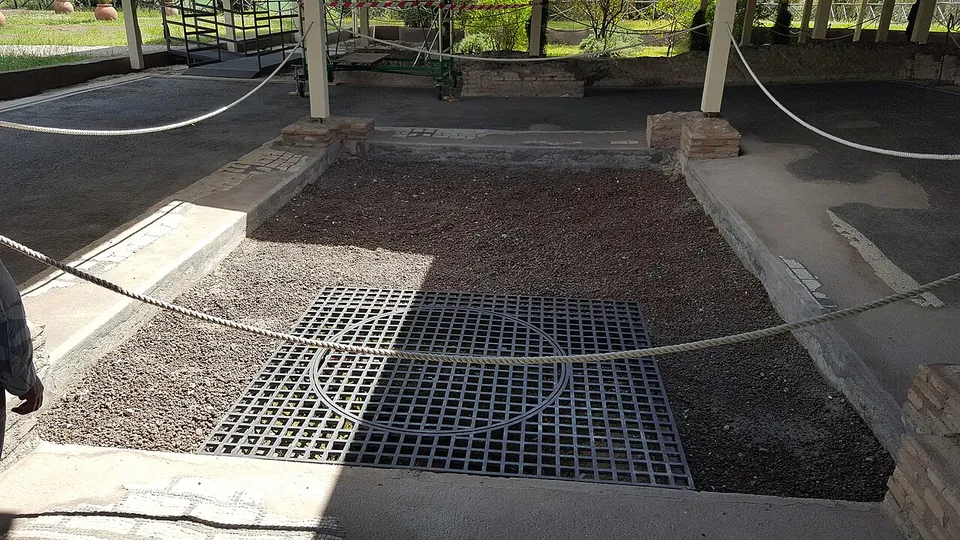
Photo: MumblerJamie · CC BY-SA 2.0 · Commons
12 km · villa · Lazio
Villa of Livia
The operator describes the private wing with the bedrooms of Livia and the emperor, an atrium and a small inner garden, and the large reception rooms that open onto a peristyle; the rooms once had painted walls and floors of mosaic and cut marble (Soprintendenza Speciale di Roma).
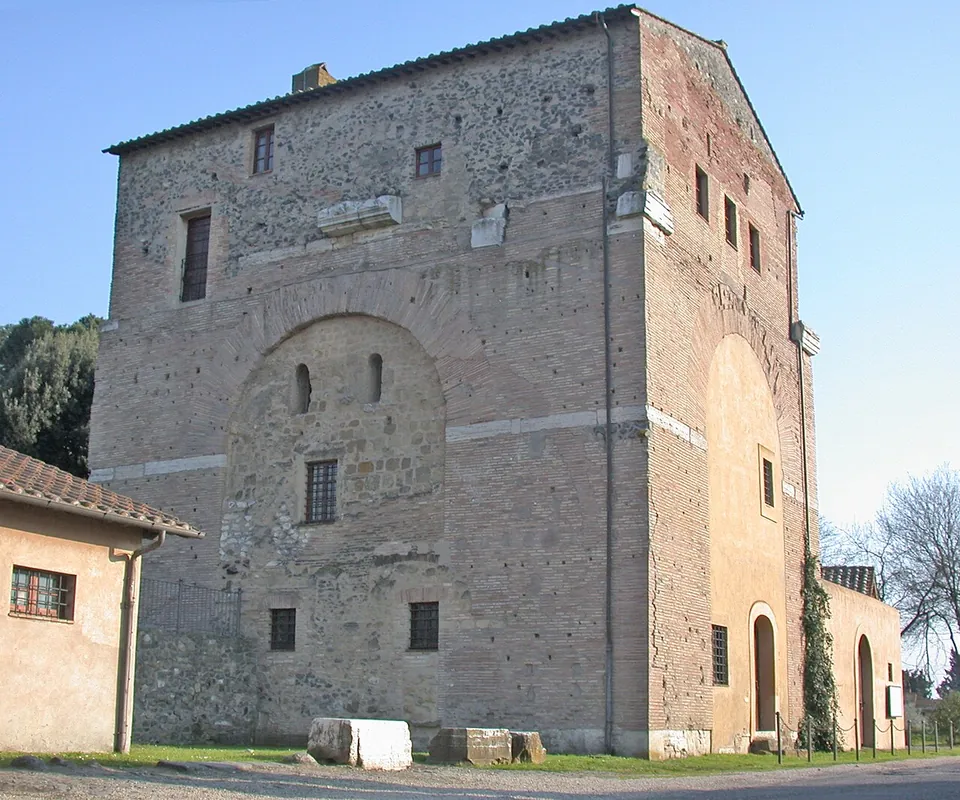
Photo: MM · Public domain · Commons
18 km · arch · Lazio
Arch of Malborghetto
At first sight you see an austere farmhouse rather than an arch (it.wikipedia).
Photo: Carlomorino · CC BY-SA 3.0 · Commons
19 km · city · Lazio
Gabii
The park the state holds covers about 70 hectares on the southern rim of a volcanic crater whose lake was drained in the 19th century (the operator; en.wikipedia).


Straight-line distances.
Sources
Every fact on this page comes from the records below, each used under the licence noted.