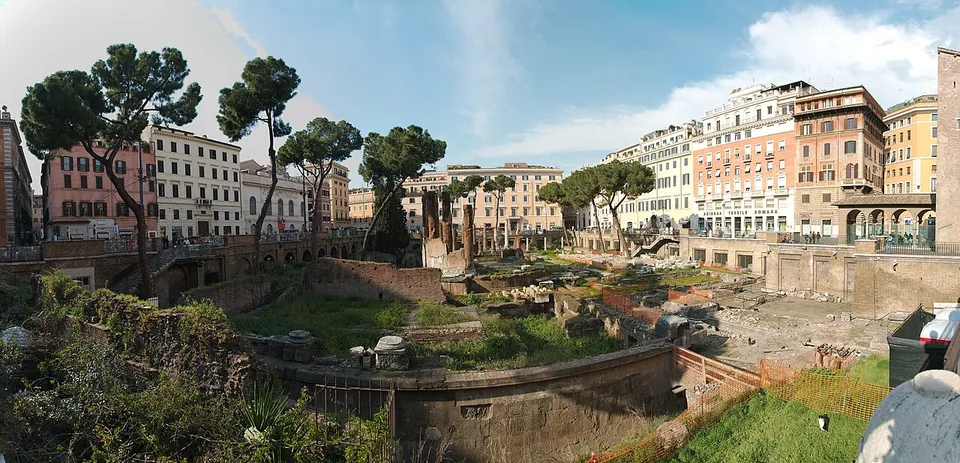
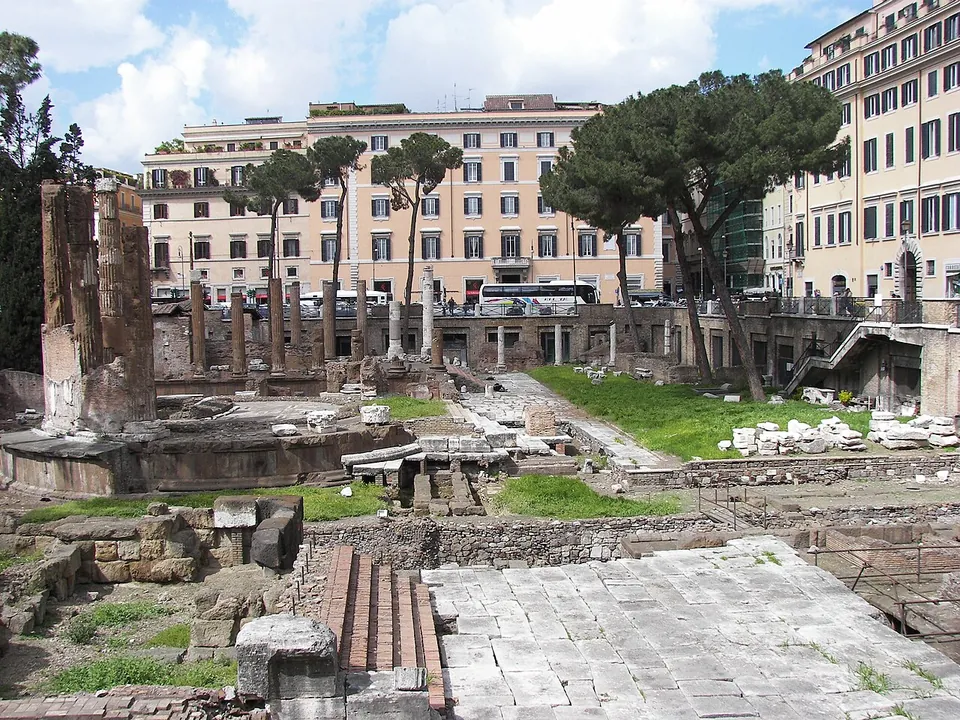
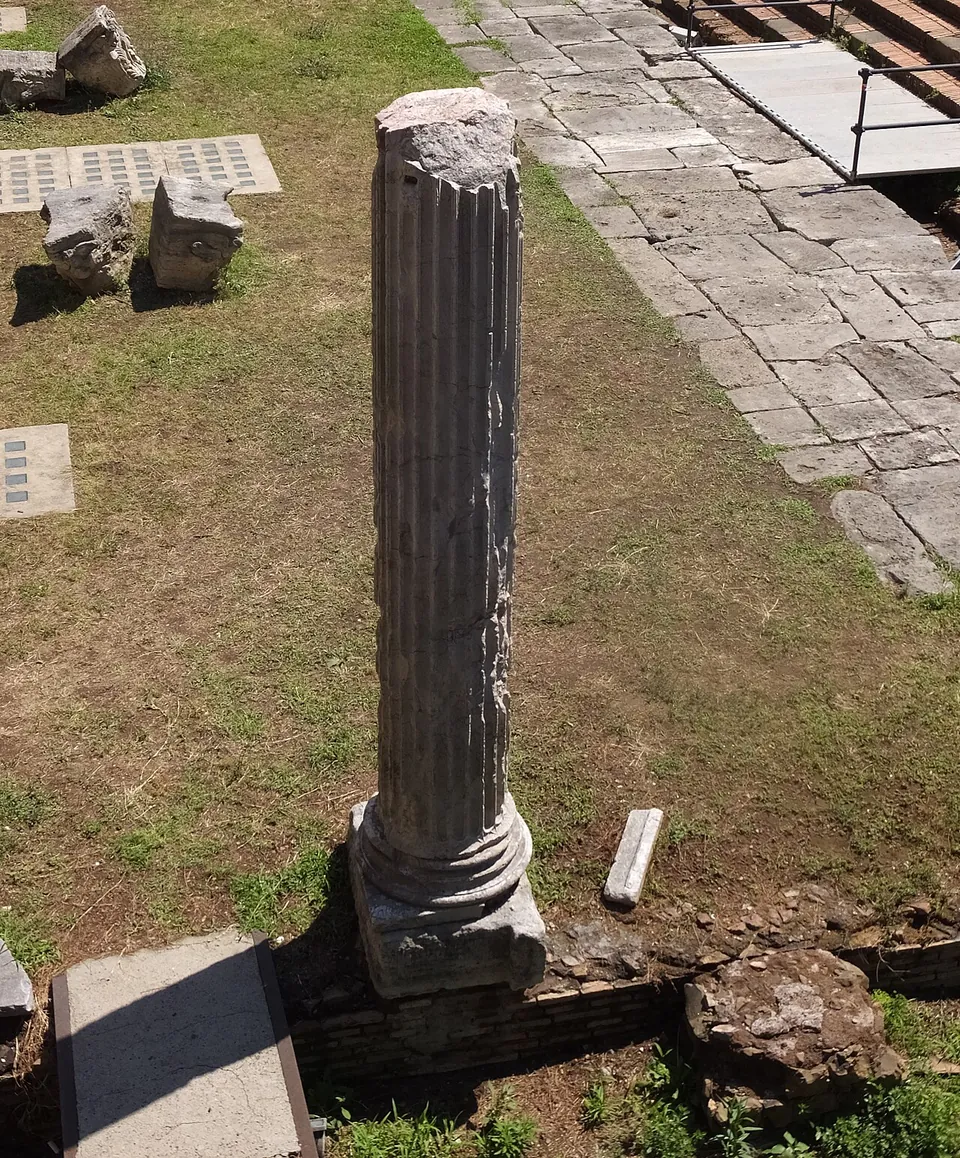


Largo di Torre Argentina is a city square in the centre of Rome whose middle is an open excavation: the remains of four temples from the Roman Republic and the foundation of the hall where Julius Caesar was killed (Pleiades; the operator). It lies under 400 m south of the Pantheon and can be seen from the pavements around it; a booked ticket takes you down among the temples.
What is there today
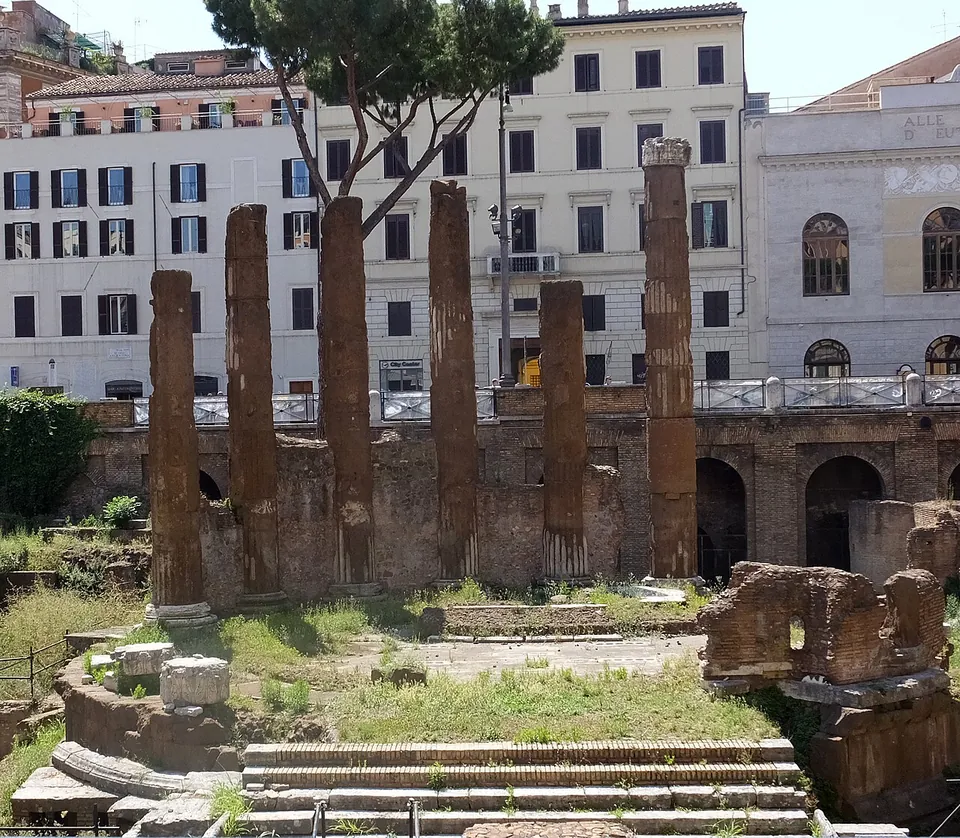
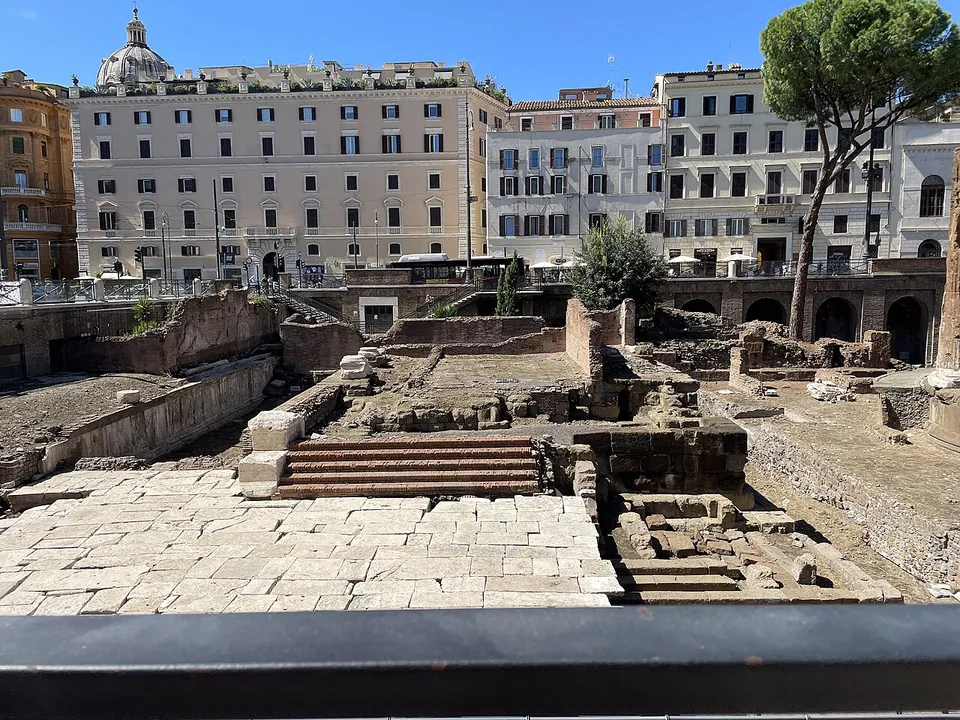
The excavated area sits below the level of the surrounding streets, a rectangle of podiums, column shafts, steps and paving with city traffic all round it (as the photographs on this page show). The four temples are known by letters, A to D, because none of them can be identified with certainty (it.wikipedia; the operator):
- Temple B, the round one, is the most recognisable: a circular temple of the late 2nd century BC with six of its columns still standing. It is thought to be the temple of Fortuna Huiusce Diei, “the Fortune of This Day”, vowed by Quintus Lutatius Catulus at the battle of Vercellae in 101 BC (en.wikipedia; Pleiades).
- Temple C is the oldest, from the 4th or early 3rd century BC, and probably belonged to the Italic goddess Feronia. It was built on a tufa podium about 3.8 m high, and the black-and-white mosaic in its cella dates from the restoration after a fire in AD 80 (it.wikipedia; en.wikipedia).
- Temple A, of the mid-3rd century BC, is probably the temple of Juturna. A church was later built into it, and part of its apse, decorated in the 12th century, survives (the operator; Pleiades).
- Temple D is the largest, of the early 2nd century BC and probably dedicated to the Lares Permarini, the guardians of seafarers. Most of it still lies under via Florida; what shows is its travertine podium, about 3 m high (it.wikipedia; Pleiades).
Behind Temples B and C is a massive base of tufa blocks: the foundation of the Curia of Pompey, the hall in Pompey’s theatre complex where the Senate was meeting on the Ides of March, 44 BC, when Caesar was assassinated (the operator; en.wikipedia).
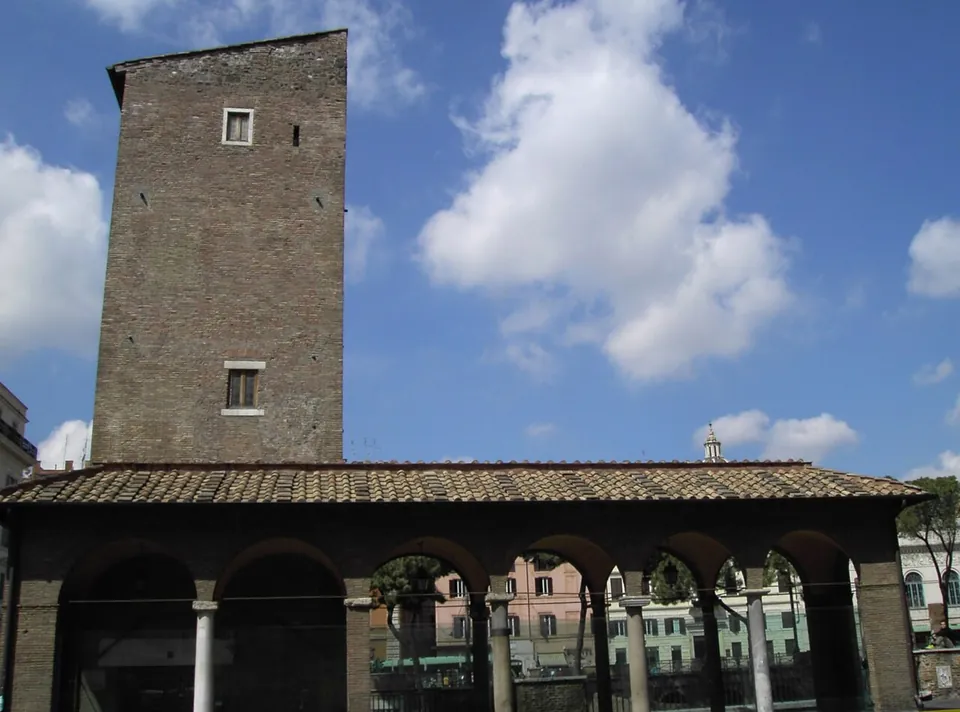
Since June 2023 a walkway has taken visitors among the structures, and two exhibition areas, one at the eastern edge of the site and one in the portico of the medieval Torre del Papito, show finds from the demolitions and excavations of the Fascist era (the operator). The square is also home to a cat sanctuary, founded in 1993 (en.wikipedia).
Is it worth the trip?
Yes, if you are in central Rome. It is not a set piece like the Forum: what you see is podiums and column stumps in a sunken square, with buses passing on the street above. But it.wikipedia calls the four temples the most important group of sacred buildings from the middle and late Republic, and the Caesar connection gives the place a pull of its own.
Looking in from the railings costs nothing. The ticket is for readers who want to walk among the temples and see the finds: about 45 minutes, booked ahead (the operator).
Getting there and what it costs
The square is in the historic centre, on Corso Vittorio Emanuele (fr.wikipedia), under 400 m from the Pantheon and about 1.4 km west of the Colosseum. ATAC bus stops lie within 80 m of the site (OpenStreetMap). The entrance is on via di San Nicola de’ Cesarini, opposite no. 10, and the ticket office and bookshop are in the Torre del Papito on piazza dei Calcarari (the operator).
It is open Tuesday to Sunday, 09.30 to 19.00 under summer time (last entry 18.45) and 09.30 to 16.00 under winter time (last entry 15.45); on 24 and 31 December until 14.00. It is closed on Mondays, 25 December and 1 May. A ticket is €7, or €4 reduced (among others for ages 6 to 25), plus a €1 booking fee. Booking in advance is compulsory, at most five tickets at a time, and entry is timed every 20 minutes. Residents of Rome and its metropolitan area, children under six and MIC Card holders enter free, and so does everyone on the first Sunday of the month, as far as capacity allows (Sovrintendenza Capitolina and Musei in Comune, read 16 October 2026). A lift platform makes the route accessible to wheelchair users; there are no toilets on site (the operator).
Visiting details
- Opening hours
- Tuesday to Sunday, 09.30–19.00 under summer time (last entry 18.45) and 09.30–16.00 under winter time (last entry 15.45); 24 and 31 December 09.30–14.00. Closed Mondays, 25 December and 1 May.
- Tickets
- €7 for non-residents, €4 reduced (among others for non-residents aged 6–25), plus a €1 booking fee; tickets must be bought in advance, at most five at a time, for an entry slot every 20 minutes. Free for residents of Rome and its metropolitan area, for under-sixes and for MIC Card holders, and for everyone on the first Sunday of the month, capacity permitting.
Before you go
- Advance booking is compulsory; the visit takes about 45 minutes.
- No toilets on site.
Hours and prices checked 16 October 2026 on the operator's own site. Confirm before travelling.
History
The area lay in the ancient Campus Martius (en.wikipedia). Its history begins with Temple C early in the 3rd century BC; Temples A, D and B followed, and with the last of them came the first common paving, in tufa slabs, probably after a fire of 111 BC (the operator). Published dates for the temples differ, Temple C’s by up to a century, so the dates above are approximate. The north and east sides were lined by the colonnades of the Porticus Minucia, and the ground level was raised by about 1.4 m, burying the older podiums to half their height (it.wikipedia). To the west, Pompey’s theatre complex, completed in 55 BC and the first permanent theatre in Rome, ran from the Curia through long porticoes and gardens to a theatre crowned by a temple of Venus Victrix (en.wikipedia; the operator).
A fire in AD 80 brought a thorough rebuilding under Domitian, with new travertine paving and the temples’ upper parts rebuilt (the operator). In the 3rd century a wall was built joining the temple fronts, making service rooms between them, probably for the offices that ran the aqueducts and the grain distribution (it.wikipedia). In the course of the 5th century the area was abandoned and transformed; aristocratic houses followed in the 8th and 9th centuries, and a church inside Temple A was dedicated to St Nicholas in 1132 (the operator).
The site came to light in 1926, when the medieval quarter on the square was demolished for new buildings. The colossal marble head and arms of an acrolithic statue found during the demolitions, the head alone 1.46 m tall, are now in the Centrale Montemartini of the Capitoline Museums and are usually attributed to Temple B (it.wikipedia; en.wikipedia). The area was inaugurated in 1929, and reopened with its walkway on 20 June 2023, after work directed by the Sovrintendenza Capitolina and paid for by Bulgari (the operator).
More photographs



Nearby
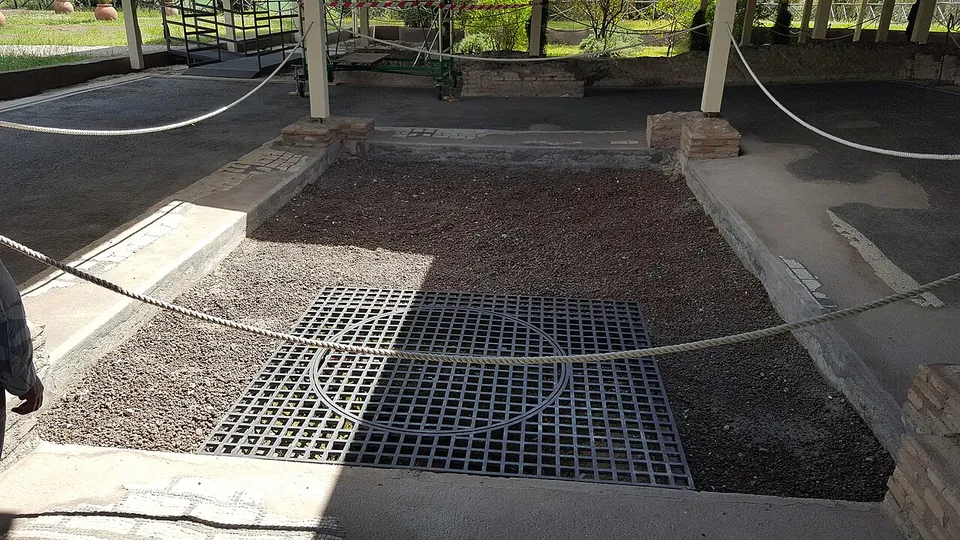
Photo: MumblerJamie · CC BY-SA 2.0 · Commons
12 km · villa · Lazio
Villa of Livia
The operator describes the private wing with the bedrooms of Livia and the emperor, an atrium and a small inner garden, and the large reception rooms that open onto a peristyle; the rooms once had painted walls and floors of mosaic and cut marble (Soprintendenza Speciale di Roma).
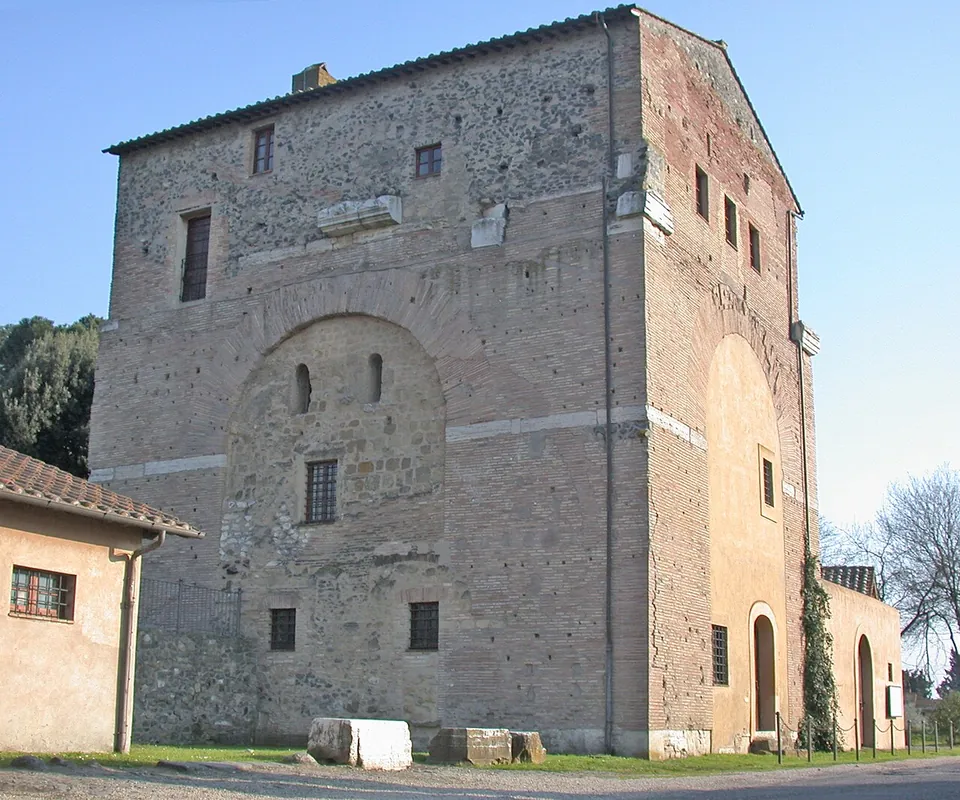
Photo: MM · Public domain · Commons
17 km · arch · Lazio
Arch of Malborghetto
At first sight you see an austere farmhouse rather than an arch (it.wikipedia).
Photo: Carlomorino · CC BY-SA 3.0 · Commons
20 km · city · Lazio
Gabii
The park the state holds covers about 70 hectares on the southern rim of a volcanic crater whose lake was drained in the 19th century (the operator; en.wikipedia).


Straight-line distances.
Sources
Every fact on this page comes from the records below, each used under the licence noted.