

The Mausoleum of Augustus is the round tomb the first emperor began for himself and his family in 28 BC on the Campus Martius, near the Tiber (it.wikipedia; en.wikipedia; fr.wikipedia). The operator calls it the largest circular tomb known (Sovrintendenza Capitolina). It has been closed since June 2022 while its restoration is finished, so for now you see it from the outside, from Piazza Augusto Imperatore, across the square from the Ara Pacis.
What is there today
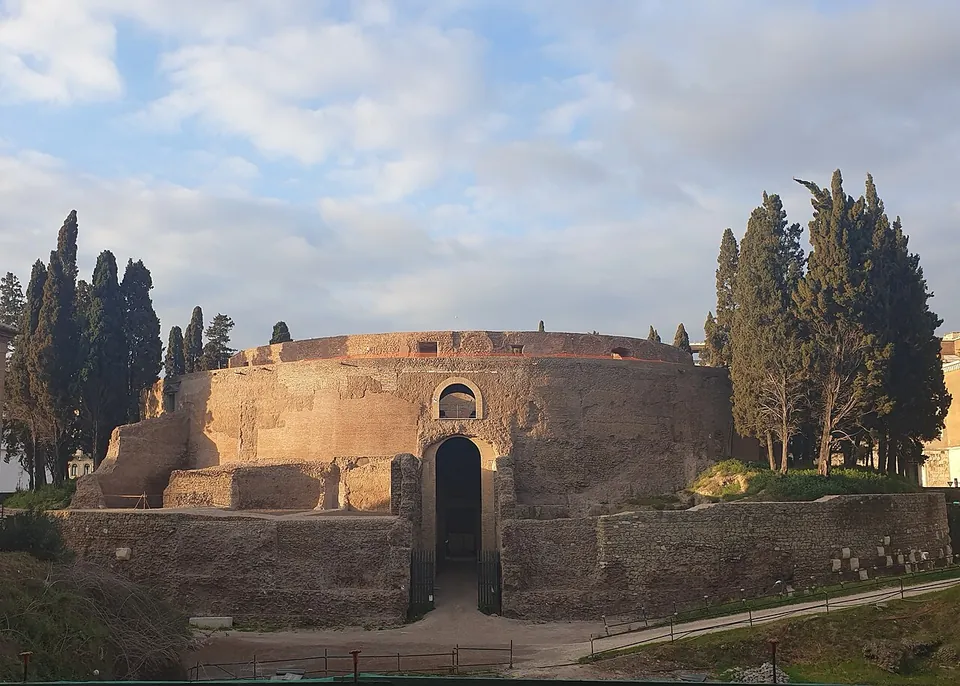
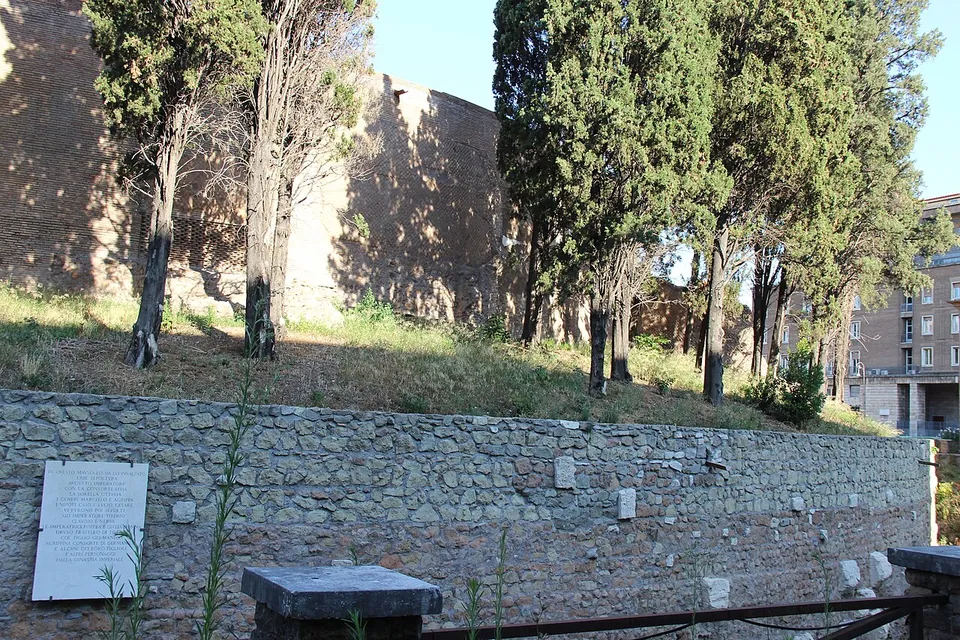
A great drum of bare brick and stone, with cypresses growing on top and an arched doorway on the south side (Sovrintendenza Capitolina; the photographs). That drum is the core of the building. Most of its facing and decoration has gone (fr.wikipedia), and so have the bronze statue of Augustus and the bronze tablets at the door; what survives is the lower part of the core and remains of the concentric ring walls (de.wikipedia). The arched window above the entrance dates from the restoration of the 1930s, and some archaeologists think that work took too many liberties (fr.wikipedia). Inside, much of the brickwork and the marble plaques naming members of the Julio-Claudian family are also 1930s reconstruction (it.wikipedia).
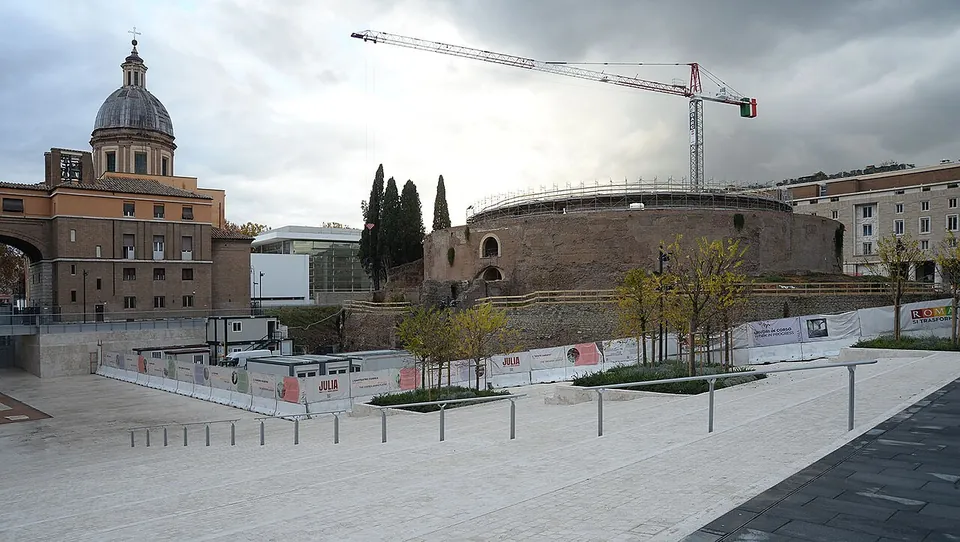
The square round it reopened on 6 June 2025 as a pedestrian area. It was rebuilt to connect today’s street level with the mausoleum’s original ground level, and part of the original 1st-century travertine paving is to be left on view (Sovrintendenza Capitolina). Late-antique structures, mosaic fragments, a boundary stone of the pomerium (the city’s sacred boundary) and a marble head of a goddess were found during the works and are to be displayed in the mausoleum (the operator). During the works the mausoleum stands inside a fenced building site; photographs from December 2025 show hoarding round it and a crane above.
Is it worth the trip?
Not on its own while it is closed. You cannot go in, and from the square you see a large ruined drum behind site hoarding. Still, it is the tomb of Augustus, it stands in central Rome, and it is about 80 m from the Ara Pacis museum, across the square (OpenStreetMap), so if you are visiting the altar, walk across the square and look.
Once the mausoleum reopens, the answer is likely to change. The restoration finishes the rooms inside and the burial chamber, and adds a new route through the green ring round the drum (Sovrintendenza Capitolina). But no opening date has been published, so check before you plan around it.
Getting there and what it costs
The mausoleum stands in Piazza Augusto Imperatore, between Via di Ripetta and the Via del Corso (en.wikipedia; de.wikipedia), about 800 m from the Pantheon in a straight line. The bus stop “Ripetta/Ara Pacis” is about 70 m away (OpenStreetMap).
There is nothing to pay because there is nothing to enter. The Sovrintendenza Capitolina, which runs the monument, has suspended entry and visits since 6 June 2022. The final phase of the works began when the square reopened on 6 June 2025, was planned to take 18 months, and is expected to end in late 2026, but no reopening date or tariff has been published (the operator; Turismo Roma, read 20 October 2026). The square itself is open to everyone. At its southern end there is a café with a ticket office and a bookshop (Turismo Roma); the bookshop, which also sells tickets for the city’s civic museums, is open every day from 10.00 to 19.00 (the operator).
Visiting details
- Opening hours
- Closed. Entry and visits have been suspended since 6 June 2022, and the operator publishes no reopening date; the final phase of restoration began in June 2025 and is expected to end in late 2026. The outside can be seen from Piazza Augusto Imperatore, a pedestrian square.
- Tickets
- No tariff is published while the mausoleum is closed.
Before you go
- The mausoleum is closed and cannot be entered. Its restoration works surround it, and photographs from December 2025 show the outside behind site hoarding.
Hours and prices checked 20 October 2026 on the operator's own site. Confirm before travelling.
History
Augustus began the mausoleum in 28 BC, on his return from Egypt after his victory at Actium in 31 BC (it.wikipedia). Whether it was modelled on the tomb of Alexander the Great, which he had seen in Alexandria, on the great round tombs of the Hellenistic world, or on Etruscan burial mounds is still debated (fr.wikipedia). The Greek geographer Strabo describes a great mound near the river on a high base of white stone, covered to the top with evergreen trees, with a bronze statue of Augustus on the summit and a large grove with fine walks behind it (quoted by the Sovrintendenza Capitolina).
Published figures put the diameter at 87 to 90 m: the operator gives 300 Roman feet, about 87 m, and en.wikipedia 90 m. A travertine-faced base about 12 m high carried a second, higher storey, and the gilded bronze statue of Augustus stood about 30 m up (Sovrintendenza Capitolina). A long corridor led to a round burial chamber with three niches for urns, and Augustus was perhaps buried in a room inside the central core. Two granite obelisks stood in front of the entrance; they were set up again in the Piazza dell’Esquilino behind Santa Maria Maggiore in 1587 and in the Fountain of the Dioscuri on the Piazza del Quirinale in 1783. Bronze tablets near the door carried Augustus’s own account of his achievements, the Res Gestae, whose text is now written out on the wall of the Ara Pacis museum facing the mausoleum (Sovrintendenza Capitolina; fr.wikipedia).
The first to be buried there was Augustus’s nephew Marcellus, his designated heir, who died in 23 BC; Augustus himself followed in AD 14 (it.wikipedia). The emperor Nerva, in AD 98, was the last emperor buried in it (it.wikipedia), and the tomb was opened once more, early in the 3rd century, for the ashes of Julia Domna, wife of Septimius Severus (fr.wikipedia; Sovrintendenza Capitolina). By tradition the Visigoths plundered it when they sacked Rome in 410, stealing the urns and scattering the ashes (it.wikipedia; fr.wikipedia), though the topographers Platner and Ashby held that the story has no historical foundation (en.wikipedia). One urn survived: Agrippina the Elder’s, used as a grain measure in the Middle Ages, is in the Capitoline Museums (it.wikipedia).
In the 12th century the Colonna family turned the ruin into a fortress. Later it served as a garden and a vineyard, from 1780 as a wooden amphitheatre for animal fights, bullfights and fireworks, and from 1907, when the city bought it, as the Augusteo, a concert hall of 3,500 seats and home of the Santa Cecilia academy (fr.wikipedia), where Toscanini, Mahler, Stravinsky and Mascagni all conducted (it.wikipedia). It closed in 1936. Between 1936 and 1940 the buildings round it were demolished and the monument was cleared, and the architect Vittorio Ballio Morpurgo laid out Piazza Augusto Imperatore around it (it.wikipedia). The archaeologist Filippo Coarelli called the square one of the most sinister achievements of Fascist architecture (fr.wikipedia).
For decades afterwards the mausoleum was closed and neglected. With a grant from Telecom Italia announced in 2017 (en.wikipedia) it reopened on 1 March 2021, by booking only and free until 21 April (it.wikipedia), and closed again in June 2022 for the last phase of works (it.wikipedia). The new museum layout is by the Dutch architect Rem Koolhaas, funded by the Bulgari group (Turismo Roma; Sovrintendenza Capitolina).
Nearby
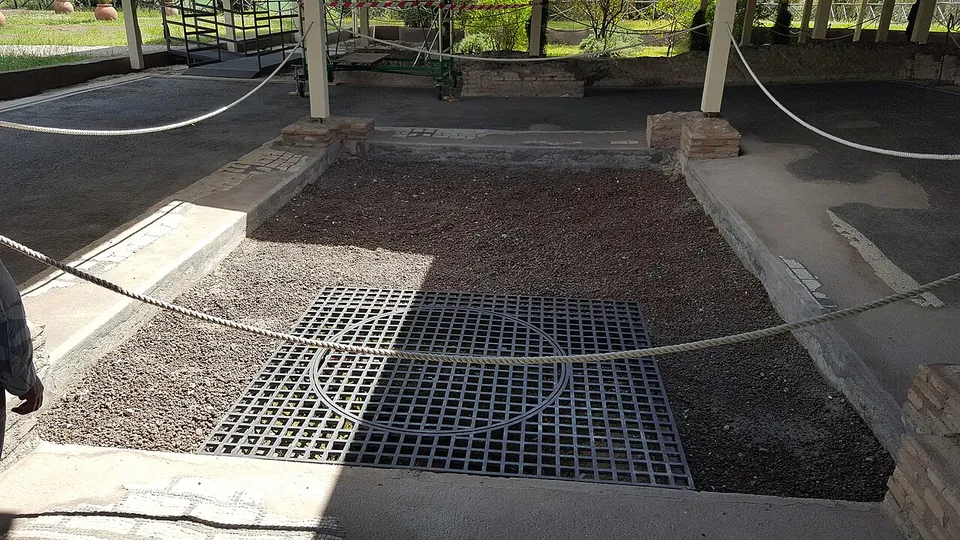
Photo: MumblerJamie · CC BY-SA 2.0 · Commons
11 km · villa · Lazio
Villa of Livia
The operator describes the private wing with the bedrooms of Livia and the emperor, an atrium and a small inner garden, and the large reception rooms that open onto a peristyle; the rooms once had painted walls and floors of mosaic and cut marble (Soprintendenza Speciale di Roma).
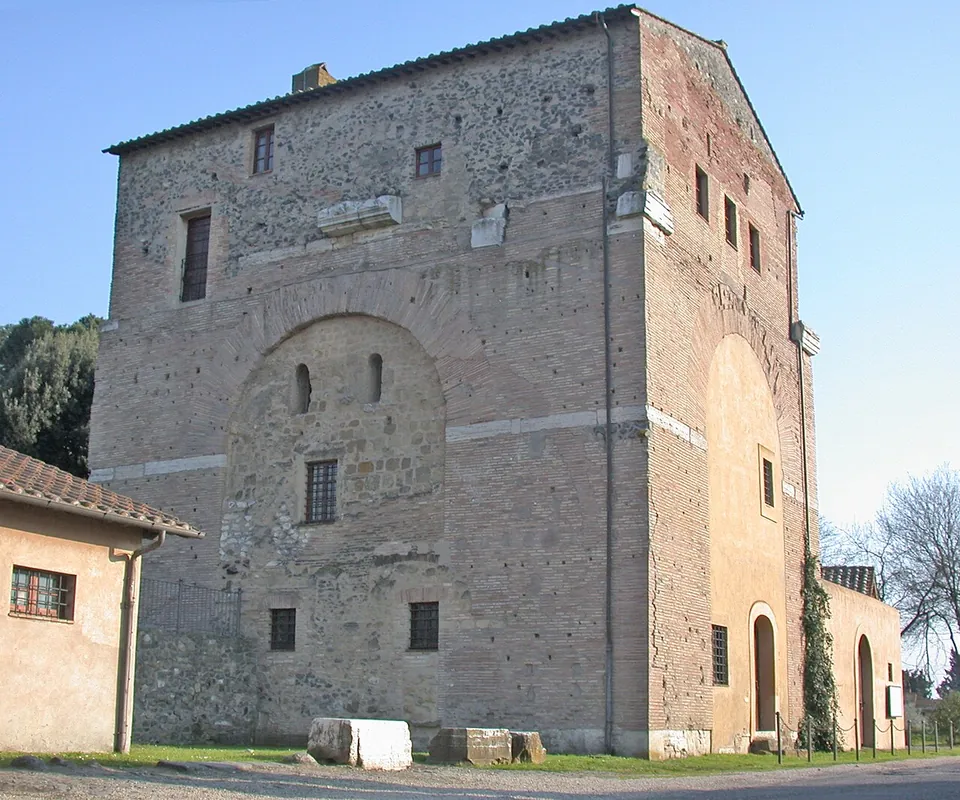
Photo: MM · Public domain · Commons
16 km · arch · Lazio
Arch of Malborghetto
At first sight you see an austere farmhouse rather than an arch (it.wikipedia).
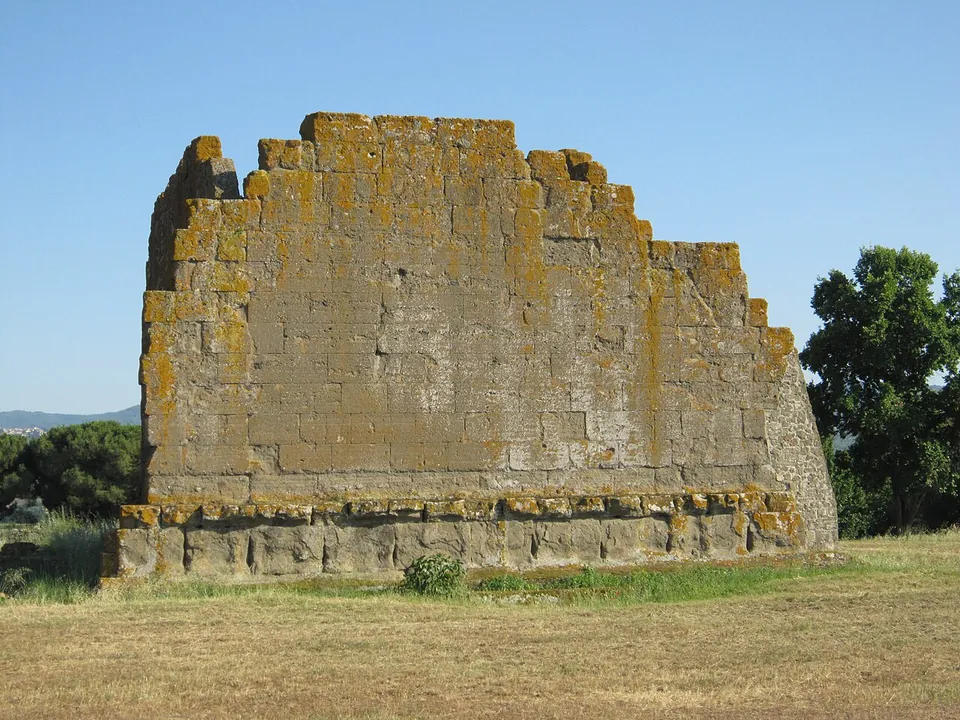
Photo: Carlomorino · CC BY-SA 3.0 · Commons
20 km · city · Lazio
Gabii
The park the state holds covers about 70 hectares on the southern rim of a volcanic crater whose lake was drained in the 19th century (the operator; en.wikipedia).


Straight-line distances.
Sources
Every fact on this page comes from the records below, each used under the licence noted.
| Source | Licence |
|---|---|
| Pleiades 281368358 | CC BY |
| Wikidata Q770847 | CC0 |
| OpenStreetMap relation/2709954 | ODbL |
| Wikipedia (en) — Mausoleum of Augustus | CC BY-SA 4.0 |
| Wikipedia (it) — Mausoleo di Augusto | CC BY-SA 4.0 |
| Wikipedia (fr) — Mausolée d'Auguste | CC BY-SA 4.0 |
| Wikipedia (de) — Augustusmausoleum | CC BY-SA 4.0 |
| Sovrintendenza Capitolina — Mausoleo di Augusto (the operator) | licence not recorded |
| Sovrintendenza Capitolina — press release on the new Piazza Augusto Imperatore, 6 June 2025 (the operator) | licence not recorded |
| Turismo Roma — Mausoleo di Augusto | licence not recorded |
| Turismo Roma — Inaugurata la nuova piazza Augusto Imperatore | licence not recorded |