

What is there today
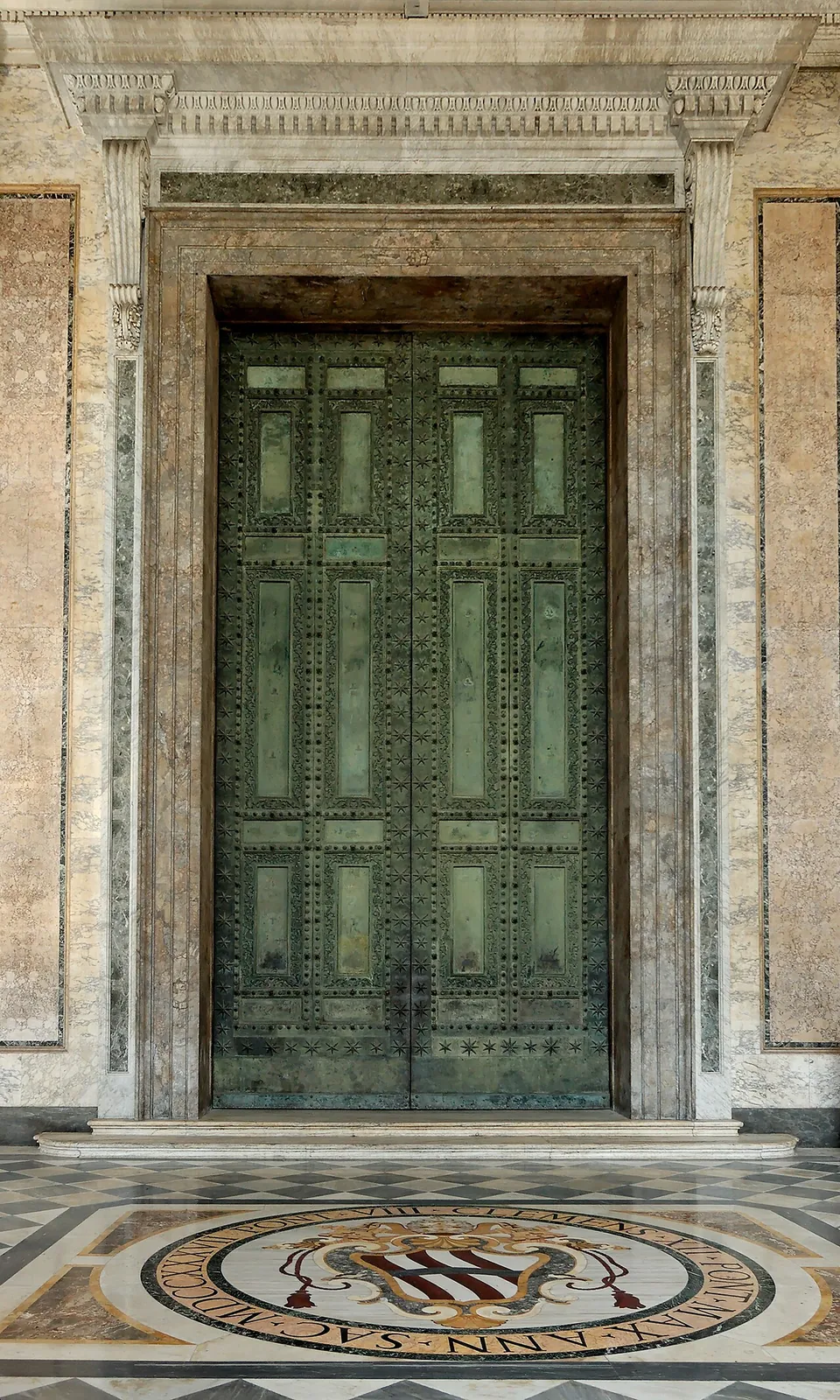
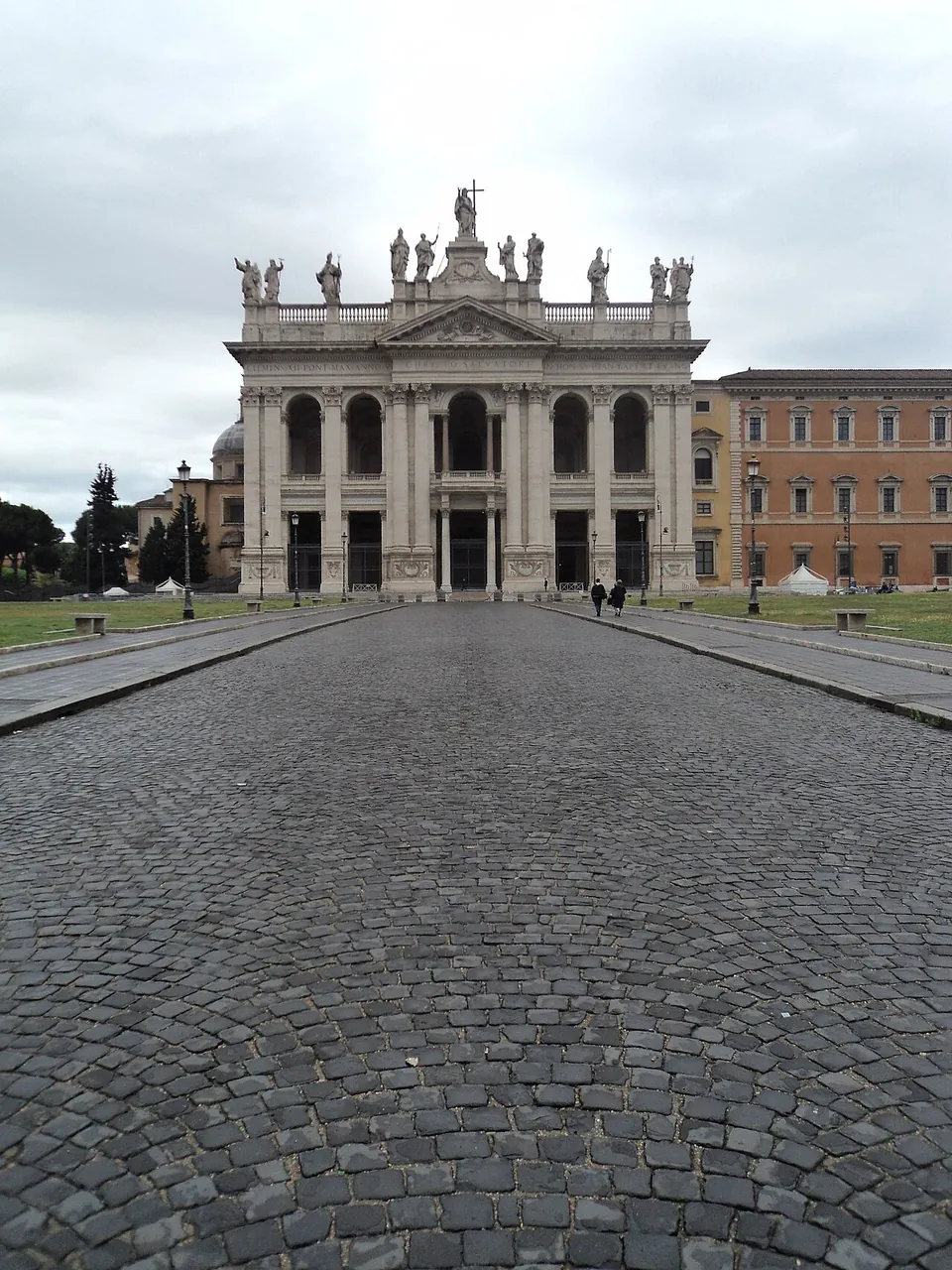
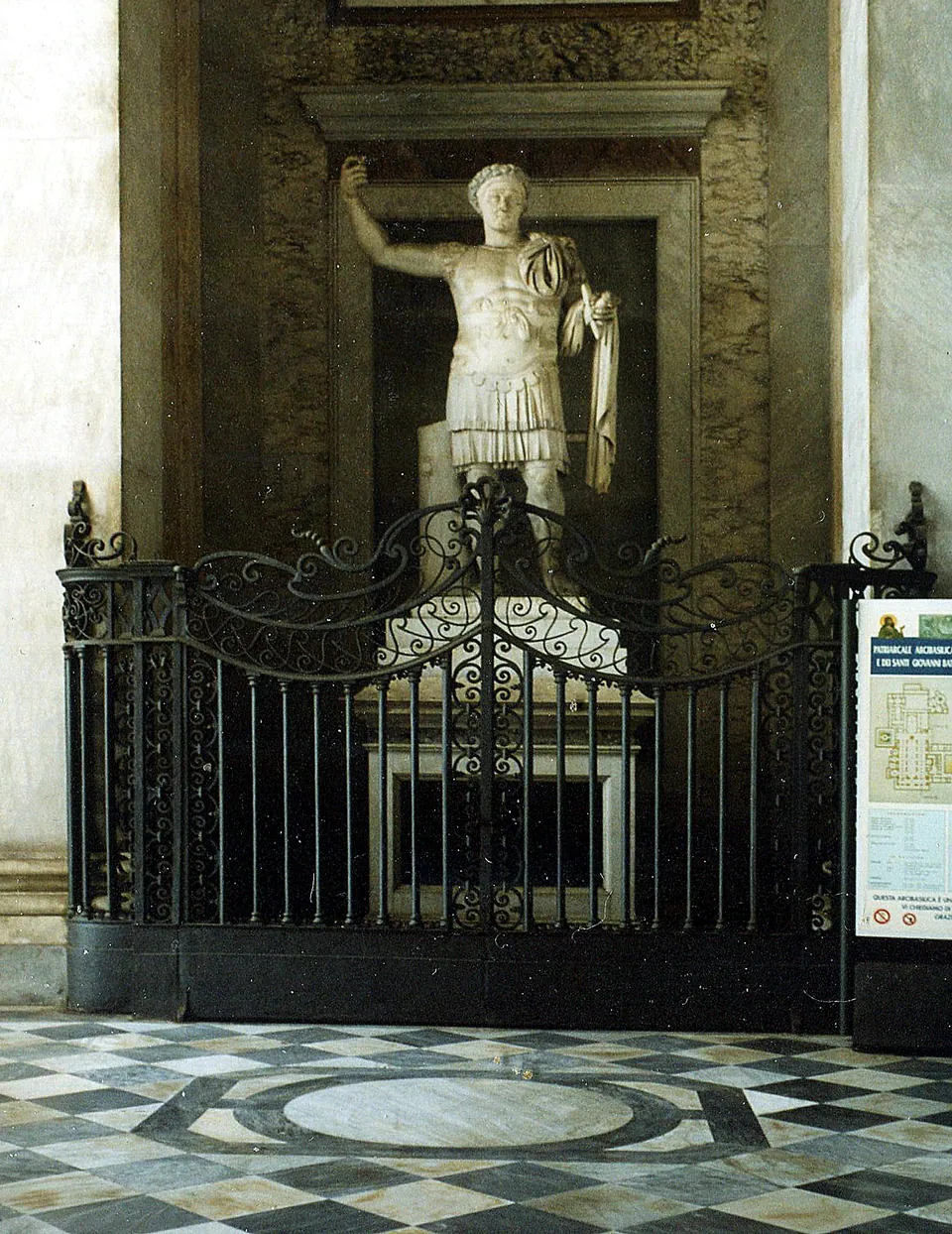
The basilica. The building you walk into is not Constantine’s. An earthquake almost destroyed the first church late in the 9th century, two fires followed in the 14th, and the present church dates from Sixtus V’s rebuilding in the late 16th century, Borromini’s interior of the 17th and a façade finished in 1735 (en.wikipedia). The Roman pieces are at the door. The central doorway holds the bronze doors of the Curia Iulia, the Senate house in the Forum, made in the 4th century after the fire of 283 and refitted here by Borromini, and a niche at the left end of the portico holds a statue of Constantine from the Roman period (it.wikipedia).
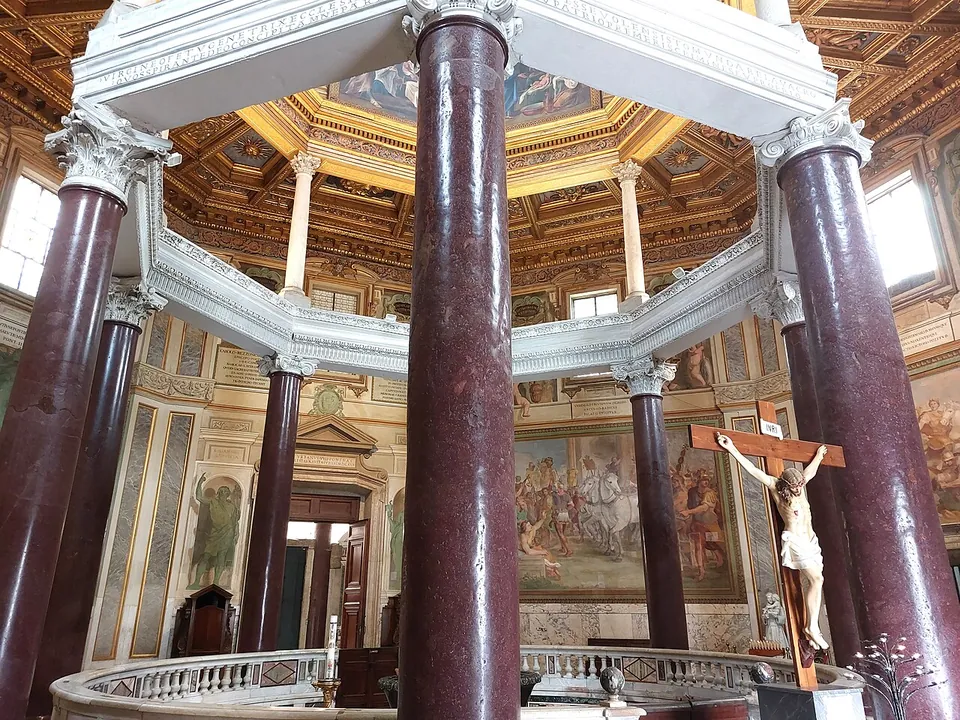
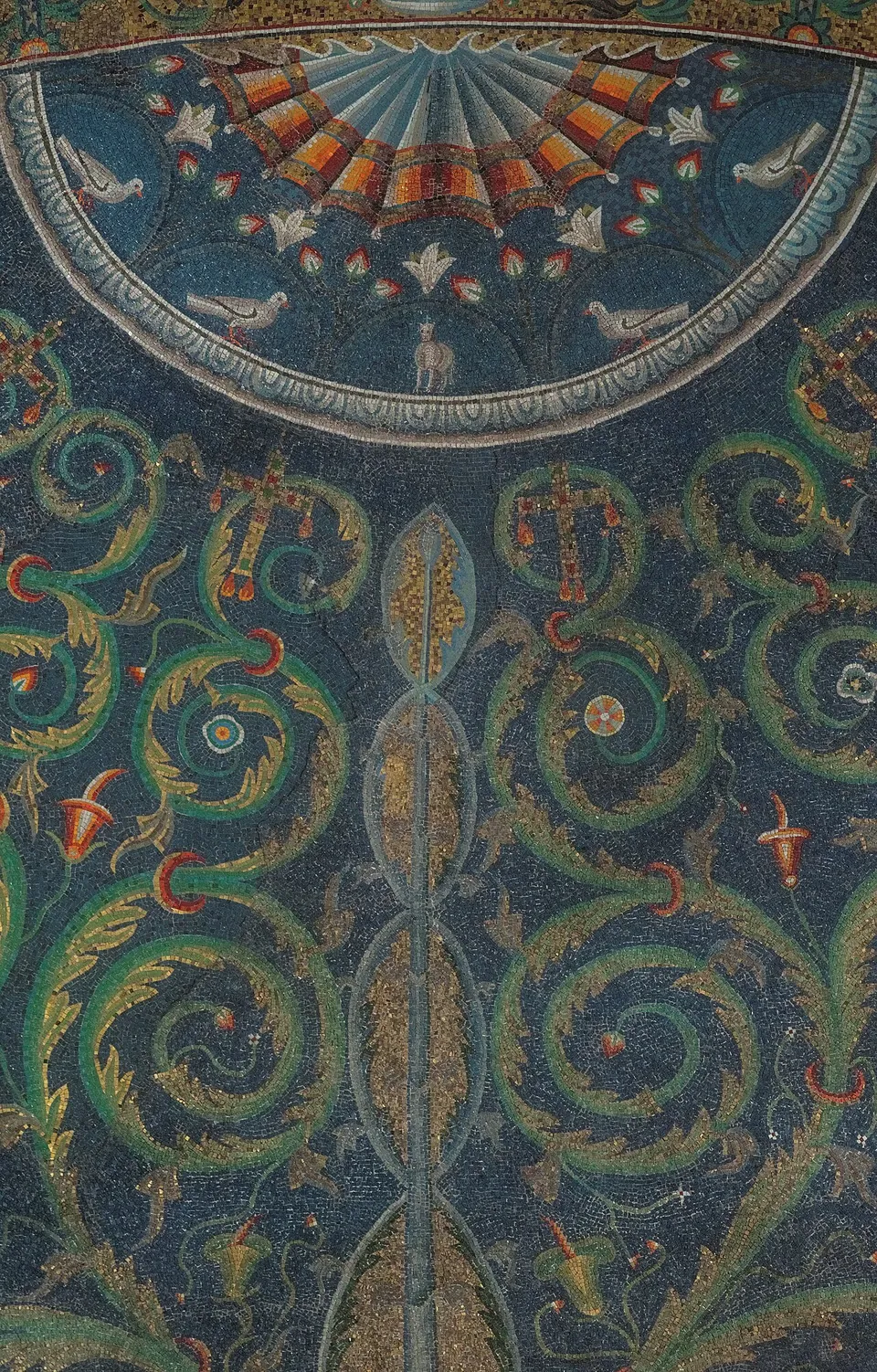
The baptistery. The octagonal baptistery next to the basilica is the Roman-era building you can actually walk into. A first baptistery, probably Constantine’s, was built over a bath suite in the 4th century; Pope Sixtus III rebuilt it from about 432 to 440, and the building today is substantially that rebuilding (it.wikipedia). For generations it was Rome’s only baptistery, and its octagon became the model for baptisteries across Italy (en.wikipedia). Two 5th-century mosaics survive: in the porch, an apse of gold scrolls on a green ground under the Lamb of God, from the time of Pope Hilarius (461–468), and in the chapel of St John the Evangelist, a gold-ground vault with the Lamb at its centre (it.wikipedia). The chapel of San Venanzio was added in the 7th century, with gold-ground mosaics of the same date. Much is later: the eight porphyry columns round the font were set up in the early 10th century, and the upper columns, dome and wall paintings date from the 17th (it.wikipedia).
The fort beneath the nave. In 193 Septimius Severus built the Castra Nova, the “new fort” of the emperor’s mounted bodyguard, here, enlarging the guard from 1,500 to 2,000 men. Constantine disbanded the guard after it fought for Maxentius in 312, demolished the fort and built the basilica over it. Excavations in 1934–1938 found it in good condition just below the floor: the headquarters building with its two strongrooms, a two-storey storehouse and two barracks, preserved under the basilica together with remains of Constantine’s church and a domus of Nero’s time (en.wikipedia). They are shown only on booked group visits (see below).
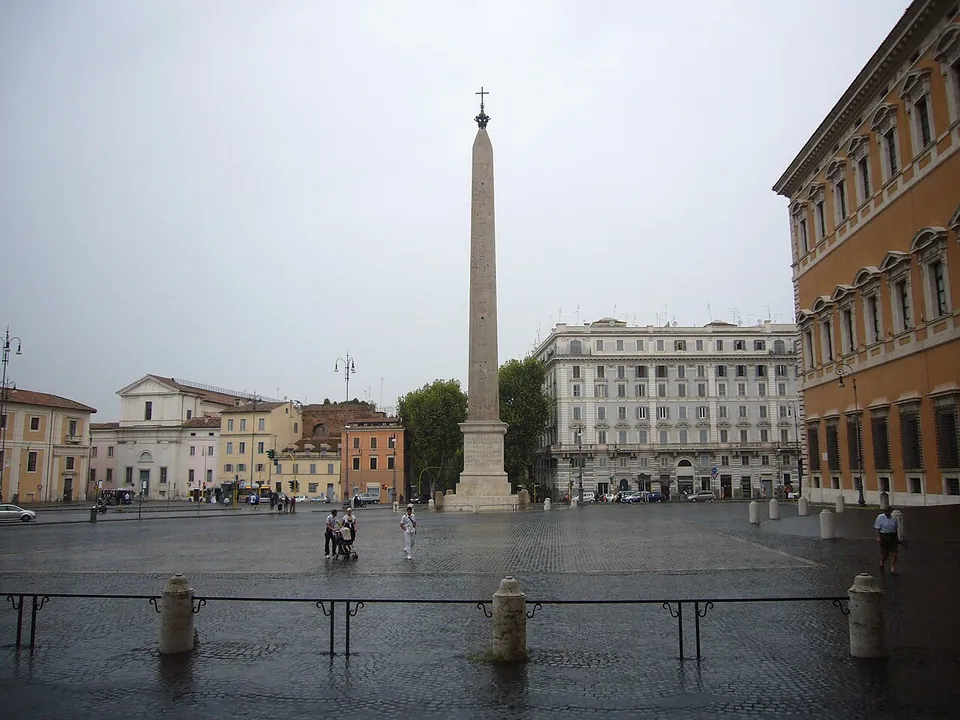
The obelisk. The obelisk on the square is the largest standing ancient Egyptian obelisk, made at Karnak around 1400 BC under Thutmose III and Thutmose IV. Constantius II shipped it to Rome in 357 and set it up in the Circus Maximus; it later fell and broke, and Sixtus V had it re-erected here, about 4 m shorter, in 1588 (en.wikipedia).
Is it worth the trip?
Yes, if you are in Rome: it is free, open from early morning, and about 1.1 km in a straight line from the Colosseum. Go knowing what you will see. The great church is a building of the 16th to 18th centuries, and the Roman story is told by pieces of it: the Senate house doors, the baptistery and its mosaics, the obelisk on the square and, a few minutes away, the towers of Porta Asinaria. The remains that make this a Roman site in the full sense, the guard fort under the nave, need a booked group visit arranged at least three days ahead. Without one, the basilica, baptistery and square combine easily with the Caelian or the Colosseum.
Getting there
The square is Piazza di San Giovanni in Laterano. Public transport stops named after it lie on the square, and a paid car park is about 140 m from the obelisk (OpenStreetMap).
The basilica is open every day from 07.00 to 18.30 and entry is free; the baptistery opens daily from 09.00 to 19.00, needs no booking and offers an audio guide by QR code at its entrance. The excavations under the basilica are seen on one-hour guided visits from Monday to Saturday, following the Vatican calendar, for groups of up to 20 in Italian, English, French, German or Spanish, booked by e-mail to [email protected] at least 72 hours ahead (the operator, basilicasangiovanni.va, read 20 October 2026). The basilica’s page does not give the price of an excavation visit. The basilica warns that times can change and posts closures in its news section.
Visiting details
- Opening hours
- Basilica daily 07.00–18.30; baptistery daily 09.00–19.00. The excavations under the basilica are shown only on booked one-hour group visits, Monday to Saturday (following the Vatican calendar).
- Tickets
- The basilica is free. The baptistery needs no booking, and the operator's page gives no charge for it. Excavation visits are for groups of up to 20 (Italian, English, French, German or Spanish), booked by e-mail to [email protected] at least 72 hours ahead; the basilica's page does not publish their price.
- Parking
- A paid surface car park about 140 m from the square (OSM relation/2578872).
Before you go
- The basilica's page warns that times may change and lists closures in its news section.
Hours and prices checked 20 October 2026 on the operator's own site. Confirm before travelling.
Around the square
These places are part of this visit and appear on its map.
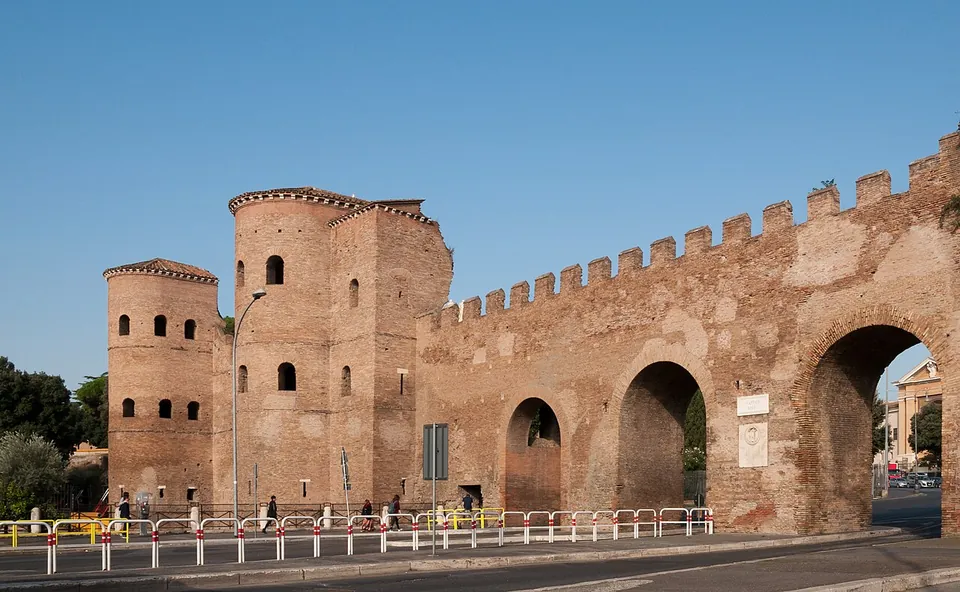
Porta Asinaria. About 300 m from the obelisk, this gate in the Aurelian Walls dates from the building of the walls in the 270s. Its two round towers, about 20 m high, are still perfectly preserved, with a travertine facing on the outer side. Totila’s Goths came in through it to sack the city in 546. It was closed in 1574, when Porta San Giovanni was opened beside it, and reopened in 1956 for pedestrians only (it.wikipedia). East Roman troops under Belisarius had entered Rome through it in 536 (en.wikipedia).
Domus Valeriorum. The house of the Valerii lay where the San Giovanni Addolorata hospital stands; frescoes, mosaic floors and a corridor overlooking a garden have been excavated there, but it cannot be visited (it.wikipedia; en.wikipedia).
Vicus Drusianus. An ancient street of Rome’s first region, known from an inscription; part of its course may follow the present Via della Ferratella in Laterano (Pleiades).
Domus of Lucius Licinius Sura. OpenStreetMap marks the site of this house about 230 m from the obelisk; no source describes what can be seen.
Columbarium of Tiberius Claudius Vitalis. A 1st-century AD columbarium tomb in the grounds of the Villa Wolkonsky (Pleiades; Wikidata). The sources do not record whether it can be visited.
History
The Laterani, one of Rome’s leading families, had their estate here; Plautius Lateranus was put to death for his part in the Pisonian conspiracy of AD 65 and his property confiscated (de.wikipedia). Excavations under the basilica found a large building of Julio-Claudian date, rebuilt in the 2nd century, beneath the fort (de.wikipedia).
The palace came to Constantine through his marriage to Fausta, and as the Domus Faustae it hosted a synod of bishops in 313 or 314, as published dates differ (de.wikipedia; en.wikipedia). Constantine gave the site to the bishop of Rome, and Pope Sylvester I dedicated the basilica to Christ the Saviour in 324 (en.wikipedia). The early church had five aisles and was known as the Basilica Aurea, the “golden basilica”, for the gifts lavished on it. Alaric’s Goths sacked Rome in 410 and the Vandals stripped the church in 455; Pope Leo I restored it around 460 (it.wikipedia). The popes lived in the Lateran palace until the move to Avignon in 1309 (en.wikipedia).
Works on the square for the 2025 Jubilee turned up more of the ancient site, including Severan foundations linked to the fort, a wall of the 1st century BC or AD and late antique walling (de.wikipedia).
More photographs




Nearby
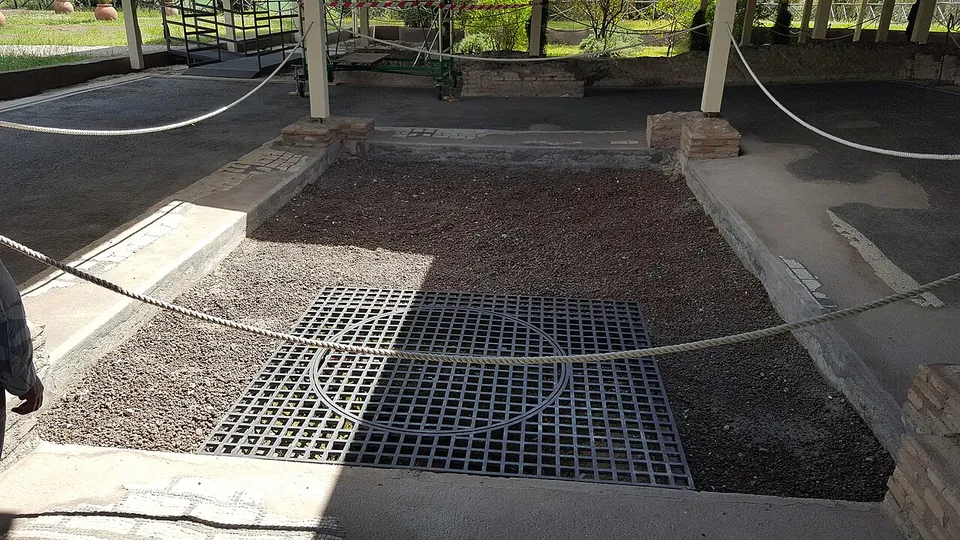
Photo: MumblerJamie · CC BY-SA 2.0 · Commons
13 km · villa · Lazio
Villa of Livia
The operator describes the private wing with the bedrooms of Livia and the emperor, an atrium and a small inner garden, and the large reception rooms that open onto a peristyle; the rooms once had painted walls and floors of mosaic and cut marble (Soprintendenza Speciale di Roma).
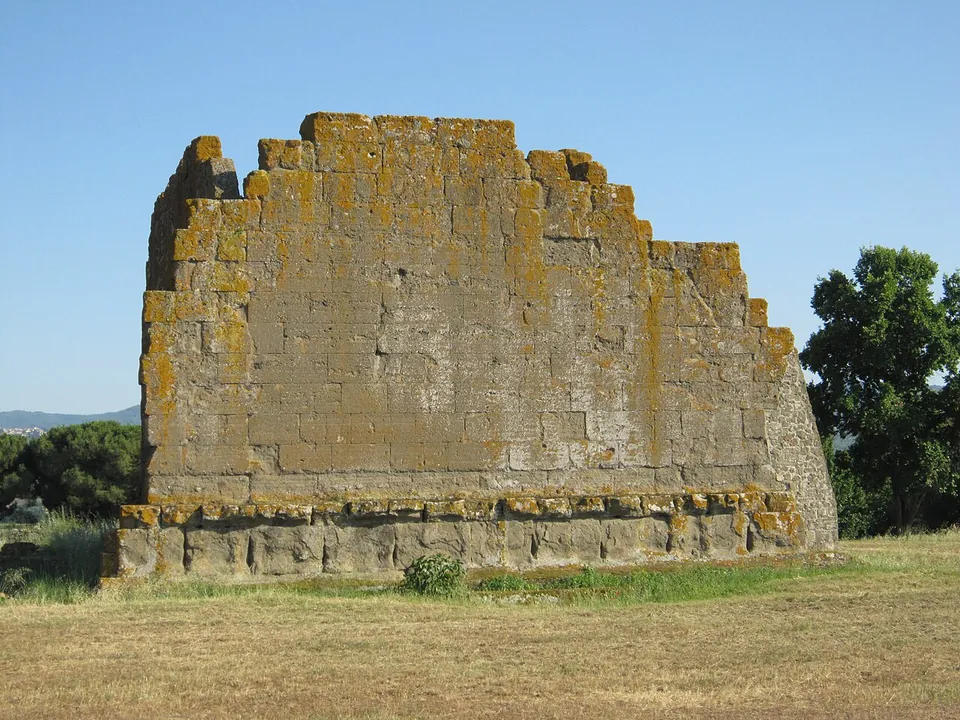
Photo: Carlomorino · CC BY-SA 3.0 · Commons
18 km · city · Lazio
Gabii
The park the state holds covers about 70 hectares on the southern rim of a volcanic crater whose lake was drained in the 19th century (the operator; en.wikipedia).
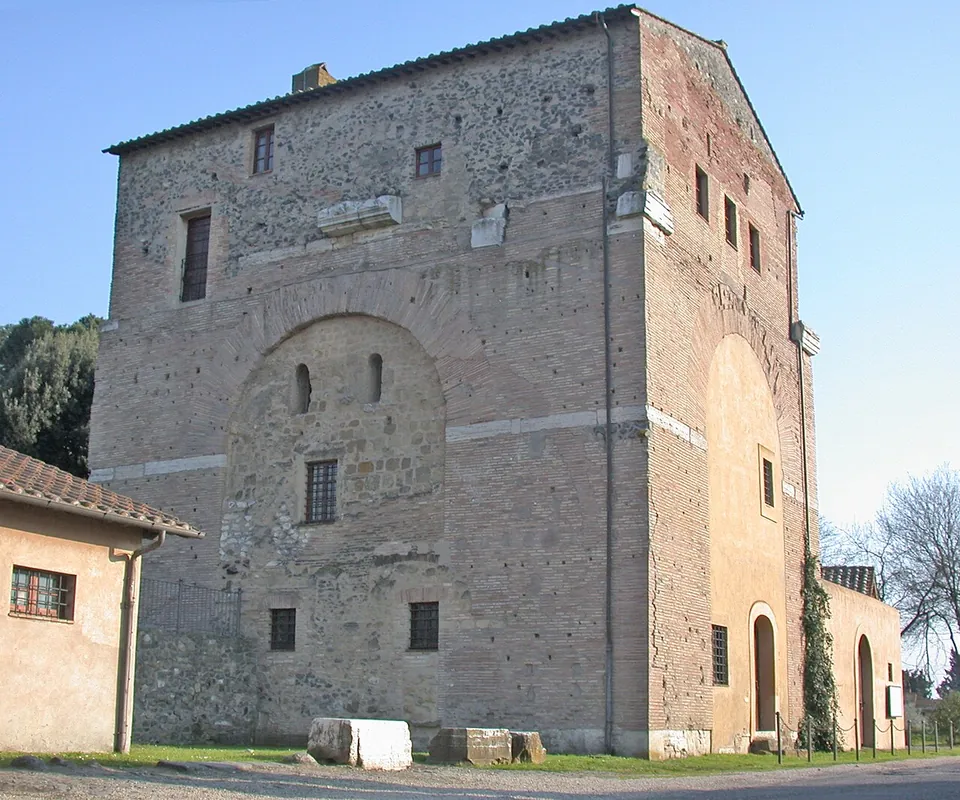
Photo: MM · Public domain · Commons
18 km · arch · Lazio
Arch of Malborghetto
At first sight you see an austere farmhouse rather than an arch (it.wikipedia).


Straight-line distances.
Sources
Every fact on this page comes from the records below, each used under the licence noted.
| Source | Licence |
|---|---|
| Pleiades 825912337 | CC BY |
| Wikidata Q125121589 | CC0 |
| Wikipedia (en) — Archbasilica of Saint John Lateran | CC BY-SA 4.0 |
| Wikipedia (it) — Basilica di San Giovanni in Laterano | CC BY-SA 4.0 |
| Wikipedia (de) — Piazza di San Giovanni in Laterano | CC BY-SA 4.0 |
| Wikipedia (it) — Battistero lateranense | CC BY-SA 4.0 |
| Wikipedia (en) — Lateran Baptistery | CC BY-SA 4.0 |
| Wikipedia (en) — Castra Nova equitum singularium | CC BY-SA 4.0 |
| Wikipedia (en) — Lateran Obelisk | CC BY-SA 4.0 |
| Wikipedia (it) — Obelisco Lateranense | CC BY-SA 4.0 |
| Wikipedia (en) — Porta Asinaria | CC BY-SA 4.0 |
| Wikipedia (it) — Porta Asinaria | CC BY-SA 4.0 |
| Wikipedia (it) — Domus Valeriorum | CC BY-SA 4.0 |
| Pleiades — Lateran Obelisk | licence not recorded |
| Pleiades — Columbarium of Tiberius Claudius Vitalis | licence not recorded |
| Pleiades — Vicus Drusianus | licence not recorded |
| Archbasilica of St John Lateran — information and timetables (the operator) | licence not recorded |
| Lateran Baptistery parish site — opening hours (the operator) | licence not recorded |