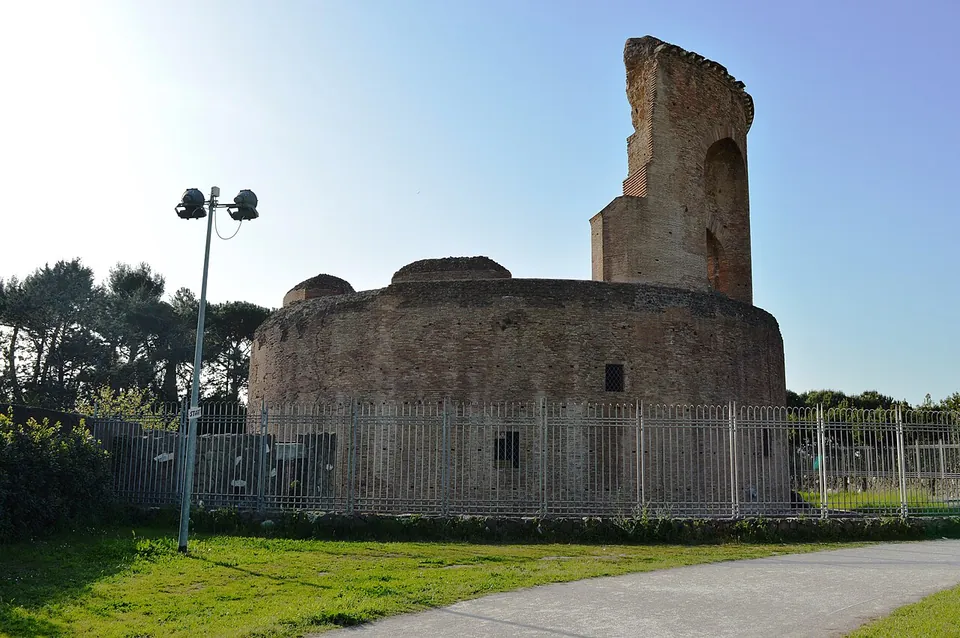
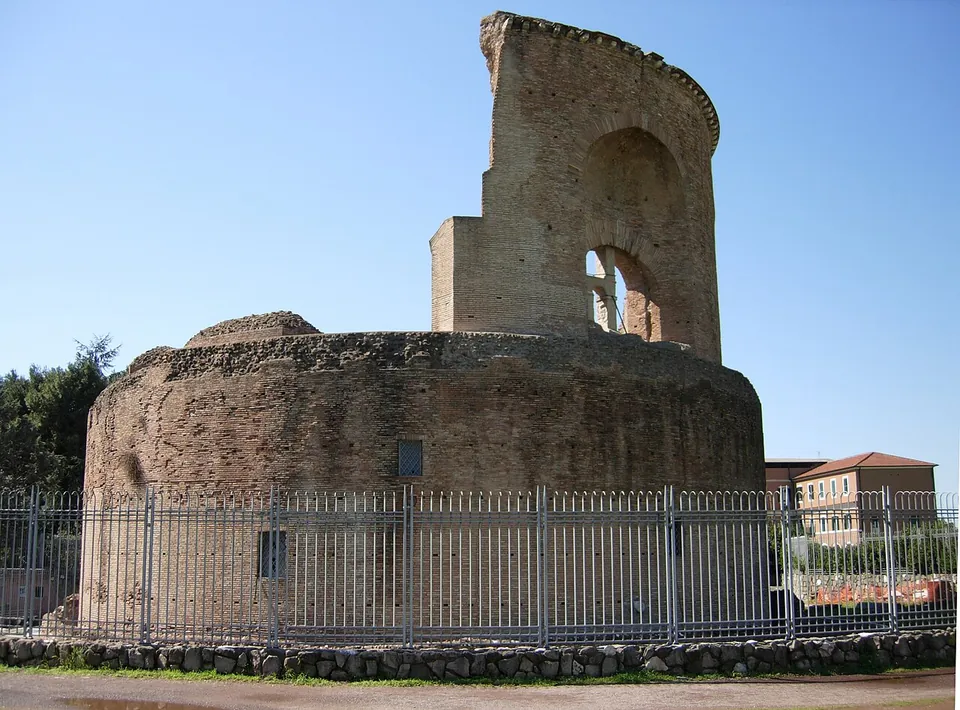


The Mausoleum of Helena is the great round tomb that the emperor Constantine built on the Via Labicana outside Rome, apparently for himself, and in which his mother Helena was buried. Its brick drum still stands to about 18 m, and beneath and beside it lie the Catacombs of Marcellinus and Peter, whose paintings, most of them from the 4th century, are the other reason to come (it.wikipedia; Soprintendenza Speciale di Roma).
What is there today
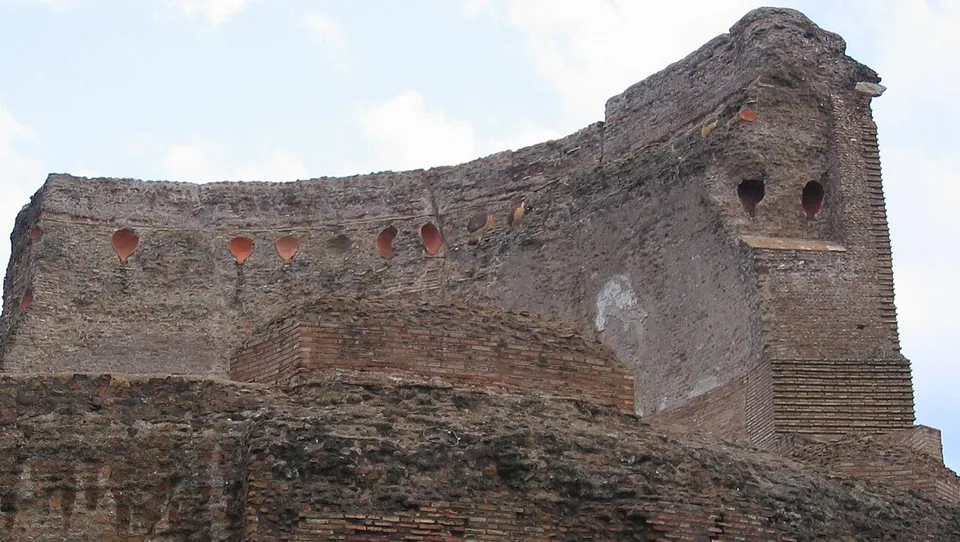
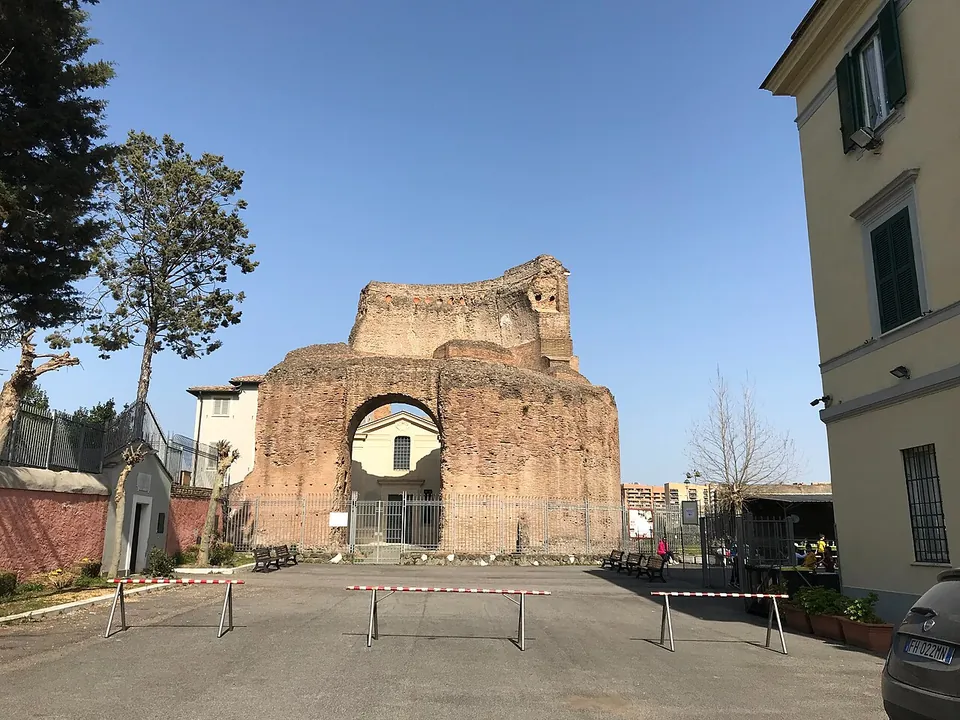
The mausoleum is a ruin without its roof: a circular building of two stacked drums, the lower one 27.7 m across on the outside and 20.2 m inside, originally 25.4 m high and now about 18 m, since the dome has collapsed (it.wikipedia). In the broken springing of the dome you can still see the empty amphorae built into the concrete to lighten it. The vessels are called pignatte, pots, and gave the building its medieval name, Torre delle pignatte, which as Tor Pignattara is now the name of the whole district around it (it.wikipedia; en.wikipedia; de.wikipedia). The marble facing of the walls was stripped when the building served as a quarry, and of the mosaic that decorated the dome only the impressions of its tesserae remain, its subject unknown (de.wikipedia; Soprintendenza Speciale di Roma).
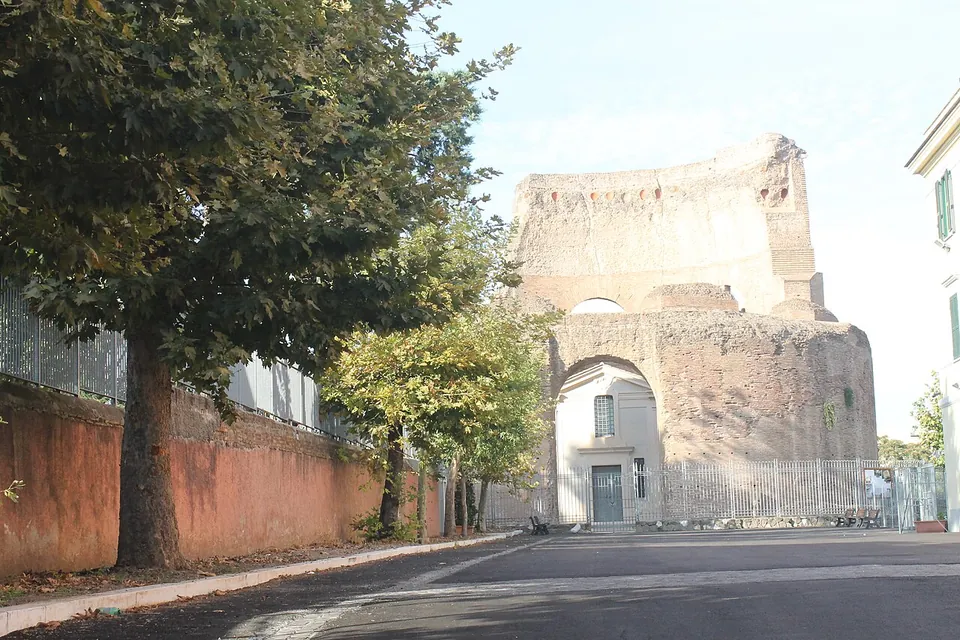
A restoration between 1993 and 2000 removed later additions, restoring the building’s original volume, and added two walkways at first- and second-floor level from which the interior can be seen from above (it.wikipedia). Inside the drum stands the small church and priest’s house built there in the 17th century and enlarged in the 18th (Soprintendenza Speciale di Roma; it.wikipedia dates the church to the 18th). It now holds the antiquarium: finds from the cemetery of the imperial horse guard that lay here and from the catacomb below, among them a woman’s head thought to be a possible portrait of Helena (Soprintendenza Speciale di Roma). Of Constantine’s basilica, which the mausoleum adjoined, only the foundations survive (Soprintendenza Speciale di Roma). Helena’s red porphyry sarcophagus, carved with battle scenes, is not here: it is in the Vatican Museums (it.wikipedia; en.wikipedia).
Is it worth the trip?
For anyone interested in Constantine and how Rome became Christian, yes, and best on the same visit as the catacombs: the mausoleum on its own is a single building and its antiquarium, while the combined ticket adds a guided walk through what the catacombs’ own site calls one of the richest bodies of early Christian painting to have come down to us, and the Soprintendenza “a true picture gallery of the age”. It is a different Rome from the centre: a ruin in a park in the Torpignattara district, about 5.5 km east of the Forum.
If you have one or two days in Rome, the Colosseum, the Forum and the Pantheon come first. And plan around the closures: the whole complex shuts on Thursdays, the catacombs need a booked tour, and the catacombs are not suitable for visitors with reduced mobility.
Getting there and what it costs
The entrance is at Via Casilina 641. Bus 105 runs from Termini station towards Centocelle; get off at Casilina/Berardi (the stop is called Berardi on the site’s own directions); the catacombs are on the opposite side of the road from the stop. From Parco di Centocelle station on Metro line C, the same bus 105 leaves from the terminus opposite the station (the site’s own directions). A bus stop is mapped about 140 m from the mausoleum (OpenStreetMap). For drivers, the site recommends parking near the Villa de Sanctis park on Via dei Gordiani.
The mausoleum and antiquarium cost €3 and need no booking. The catacombs can be seen only on a guided tour of about 40 to 45 minutes, which must be booked; with the mausoleum, the ticket is €13, or €10 reduced for ages 7 to 16, school groups, students of archaeology, architecture, art history and heritage up to 25, and priests and members of religious orders, and it is free under 7. A €3 mausoleum ticket also gets you the catacomb tour for €10 at another time or on another day within a week. Booking is free and you pay on the day, in cash or by card. English tours run at 10.00 and 16.00 from April to October and at 10.00 and 15.00 from November to March.
The mausoleum is open 10.00 to 13.00 and 16.00 to 19.00 from 1 April to 31 October, and 10.00 to 13.00 and 15.00 to 18.00 from 1 November to 31 March. It is closed on Thursdays and from 1 to 15 August and 1 to 15 September (Soprintendenza Speciale di Roma; the catacombs’ own ticket page, both read 17 October 2026; check before travelling, since prices move).
Visiting details
- Opening hours
- Mausoleum and antiquarium: 10.00–13.00 and 16.00–19.00 from 1 April to 31 October, 10.00–13.00 and 15.00–18.00 from 1 November to 31 March, no booking needed. Catacombs by booked guided tour only, about 40–45 minutes: in English at 10.00 and 16.00 (summer) or 10.00 and 15.00 (winter); in Italian at 11.00, 12.00, 17.00 and 18.00 (summer) or 11.00, 12.00, 16.00 and 17.00 (winter). The whole complex is closed on Thursdays, and from 1 to 15 August and 1 to 15 September for maintenance.
- Tickets
- Mausoleum and antiquarium €3. Catacombs and mausoleum together €13, or €10 reduced (ages 7–16, school groups, students of archaeology, architecture, art history and heritage up to 25, priests and members of religious orders); free under 7 and for disabled visitors and a companion. With a €3 mausoleum ticket the catacomb tour costs €10 on another day within 7 days. Booking is free and you pay on the day, in cash or by card.
- Parking
- The site's own directions point to parking for cars and coaches near the Villa de Sanctis park on Via dei Gordiani; the car parks mapped closest to the mausoleum are private (OpenStreetMap).
Before you go
- Closed every Thursday, and from 1 to 15 August and 1 to 15 September.
- The catacombs can be seen only on a booked guided tour, and the catacombs' own site says it cannot guarantee access for visitors with reduced mobility. The mausoleum and its antiquarium are listed as accessible.
Hours and prices checked 17 October 2026 on the operator's own site. Confirm before travelling.
The Catacombs of Marcellinus and Peter
The catacombs are named after two martyrs, Marcellinus and Peter, who died in the persecution under Diocletian (de.wikipedia; Soprintendenza Speciale di Roma). The oldest parts of the Christian catacomb date from the second half of the 3rd century (it.wikipedia; de.wikipedia), and the cemetery grew into a network of galleries on three levels (en.wikipedia). Published figures for its extent differ, from 1.8 to 3 hectares (it.wikipedia; de.wikipedia; en.wikipedia). Among the scenes are Jonah, Daniel among the lions, the raising of Lazarus and Moses striking water from the rock, and, in the cubicle of the two saints, Christ enthroned among martyrs (en.wikipedia; it.wikipedia).
Excavations between 2004 and 2010 found chambers of mass burials older than the Christian ones, holding from tens to hundreds of bodies each, some covered in plaster or amber and wrapped in textiles. Published dates for them run from the 1st to the early 3rd century, and one explanation is an epidemic (en.wikipedia; it.wikipedia). After a restoration financed by the Republic of Azerbaijan, the catacombs have been open on regular visiting hours since April 2014 (it.wikipedia).
History
The land here, at the third mile of the Via Labicana (today’s Via Casilina), was an imperial estate known as ad duas lauros, “at the two laurels” (de.wikipedia; it.wikipedia). According to the Liber Pontificalis it stretched from the gate now called Porta Maggiore out to the third mile (it.wikipedia). Necropolises lined the road from the late Republic, and in the 2nd and 3rd centuries AD the cemetery of the equites singulares, the emperor’s horse guard, lay here (Soprintendenza Speciale di Roma). The guard had fought for Maxentius against Constantine at the Milvian Bridge, and Constantine disbanded it and built over its cemetery: deliberately, says the Soprintendenza, while the Wikipedia articles call revenge a plausible motive (Soprintendenza Speciale di Roma; en.wikipedia; it.wikipedia; de.wikipedia).
Constantine built a basilica here in honour of Marcellinus and Peter, and the mausoleum against it. Published dates differ: the Soprintendenza and it.wikipedia give 315 to 326 for the mausoleum, while en.wikipedia and de.wikipedia give 326 to 330, de.wikipedia placing the basilica around 315 and the mausoleum about a decade later as a second phase. The battle scenes on the porphyry sarcophagus suggest that tomb and sarcophagus were first meant for Constantine himself and were no longer needed once he moved his residence to Constantinople; it was his mother Helena who was buried here, after her death, which published dates place between 328 and 330 (de.wikipedia; it.wikipedia; en.wikipedia). The pairing of a martyrs’ basilica with an imperial mausoleum had no precedent, and was repeated for Constantine’s daughter Constantina at Sant’Agnese, the mausoleum known today as Santa Costanza (de.wikipedia).
After Helena’s death the estate passed to the Church (de.wikipedia; it.wikipedia). Pleiades records a villa called Ad Duas Lauros at Centocelle, nearby; no source describes remains of it that a visitor can see. In the 8th century the mausoleum was turned into a fortress, and it was quarried for its stone and marble over the following centuries (it.wikipedia; de.wikipedia). The relics of Marcellinus and Peter were taken to Germany in 827 (de.wikipedia). Helena’s sarcophagus stayed in the mausoleum until it was moved to the Lateran, in the 11th century according to the Wikipedia articles and in the 12th according to the Soprintendenza, and from there to the Vatican Museums (it.wikipedia; Soprintendenza Speciale di Roma). After its restoration the mausoleum was opened to the public, together with the catacombs, on 12 October 2019 (it.wikipedia).
More photographs


Nearby
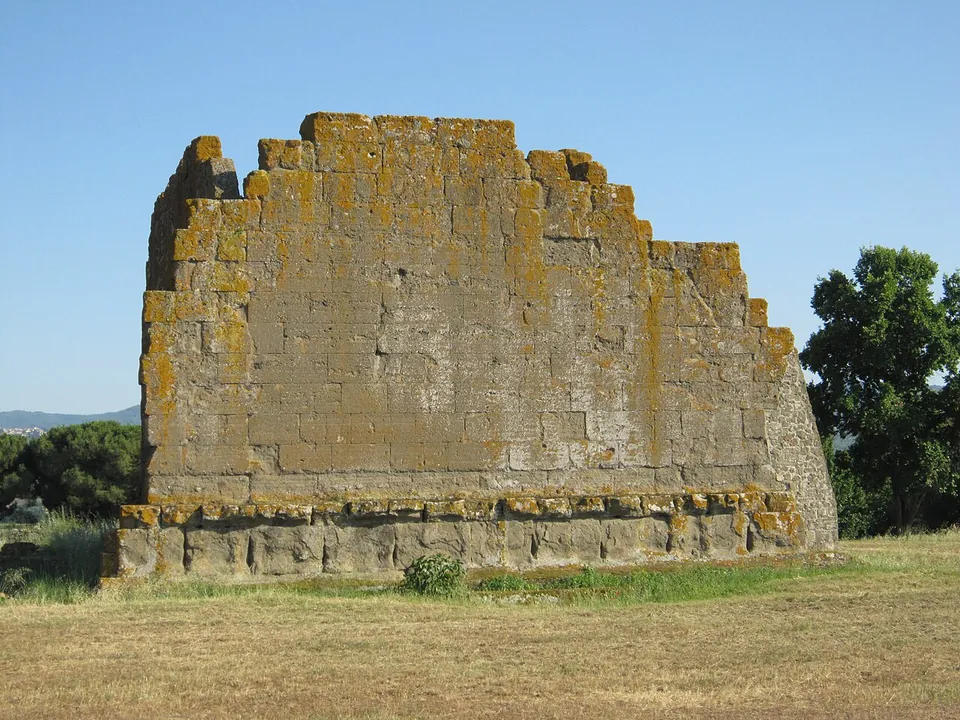
Photo: Carlomorino · CC BY-SA 3.0 · Commons
14 km · city · Lazio
Gabii
The park the state holds covers about 70 hectares on the southern rim of a volcanic crater whose lake was drained in the 19th century (the operator; en.wikipedia).
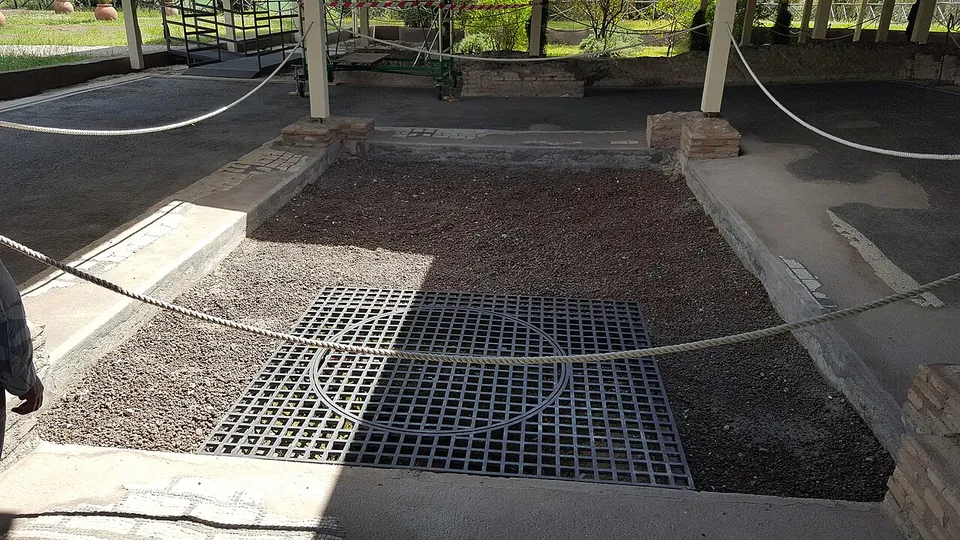
Photo: MumblerJamie · CC BY-SA 2.0 · Commons
14 km · villa · Lazio
Villa of Livia
The operator describes the private wing with the bedrooms of Livia and the emperor, an atrium and a small inner garden, and the large reception rooms that open onto a peristyle; the rooms once had painted walls and floors of mosaic and cut marble (Soprintendenza Speciale di Roma).
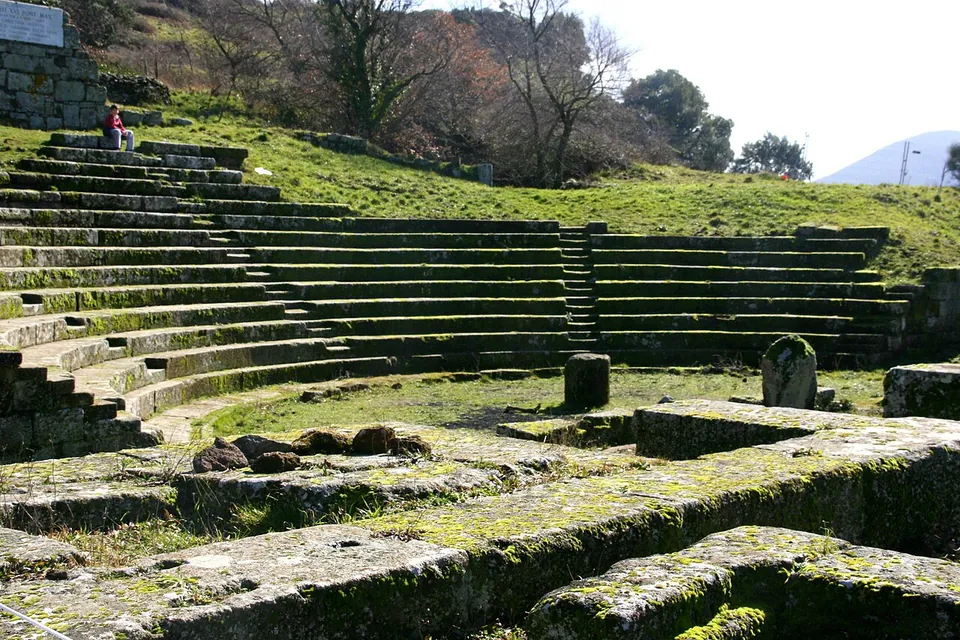
Photo: Luiza Serpa Lopes · Public domain · Commons
16 km · city · Lazio
Tusculum
The visitor route runs mainly through the forum, with the theatre halfway round (the operator).


Straight-line distances.
Sources
Every fact on this page comes from the records below, each used under the licence noted.
| Source | Licence |
|---|---|
| Pleiades 987039111 | CC BY |
| Wikidata Q1548855 | CC0 |
| OpenStreetMap way/112655535 | ODbL |
| Pleiades — Ad Duas Lauros | licence not recorded |
| Pleiades — Catacombe San Marcellino e Pietro | licence not recorded |
| Wikipedia (en) — Mausoleum of Helena | CC BY-SA 4.0 |
| Wikipedia (it) — Mausoleo di Elena | CC BY-SA 4.0 |
| Wikipedia (de) — Helenamausoleum | CC BY-SA 4.0 |
| Wikipedia (en) — Catacombs of Marcellinus and Peter | CC BY-SA 4.0 |
| Wikipedia (it) — Catacombe dei Santi Marcellino e Pietro | CC BY-SA 4.0 |
| Wikipedia (de) — Katakombe der Heiligen Marcellinus und Petrus | CC BY-SA 4.0 |
| Soprintendenza Speciale di Roma — Mausoleo di Sant'Elena (the operator) | licence not recorded |
| Catacombe dei Santi Marcellino e Pietro – Mausoleo di Sant'Elena — info and tickets (the ticket office the operator links to) | licence not recorded |
| Catacombe dei Santi Marcellino e Pietro – Mausoleo di Sant'Elena — how to get there | licence not recorded |