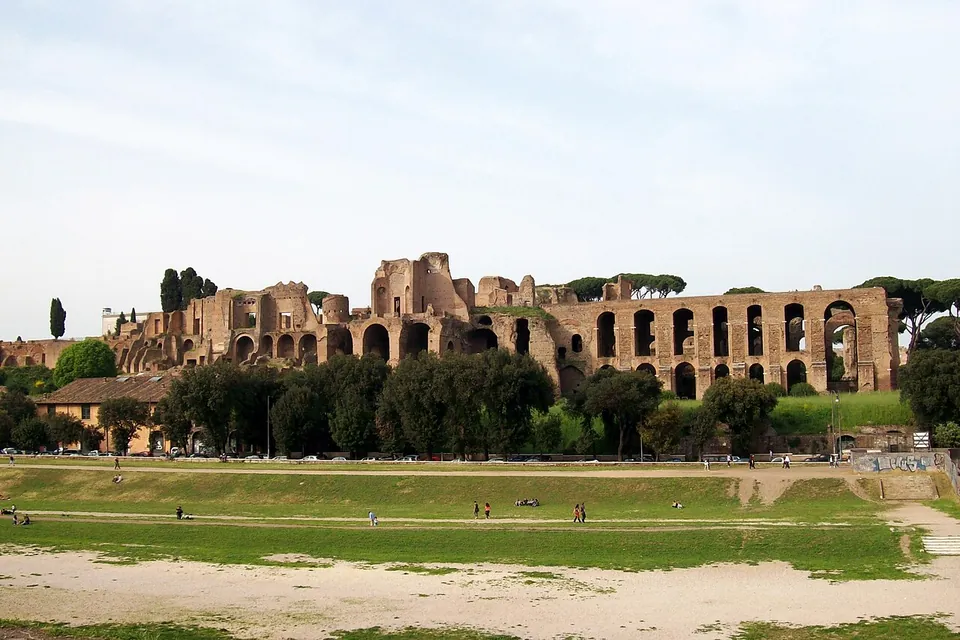


The Palatine is the hill above the Roman Forum where the emperors lived, from Augustus onwards, and the word “palace” comes from its name (en.wikipedia). Today it is a large open-air museum (en.wikipedia): the brick ruins of Domitian’s palace dominate the top of the hill, with painted houses, temple sites and gardens around it, and views down over the Forum on one side and the Circus Maximus on the other. It is on the same €18 ticket as the Colosseum and the Forum.
What is there today
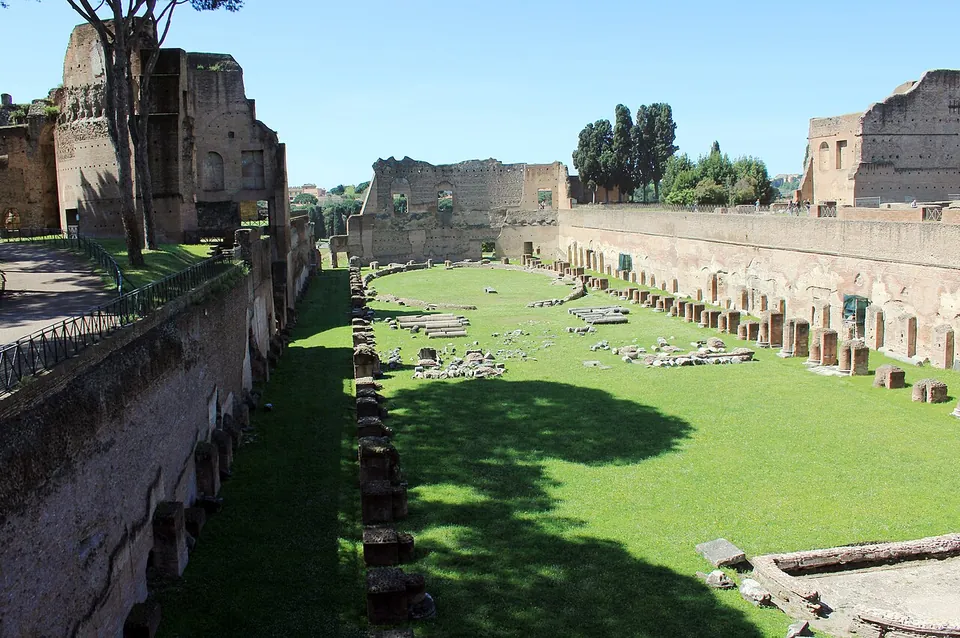
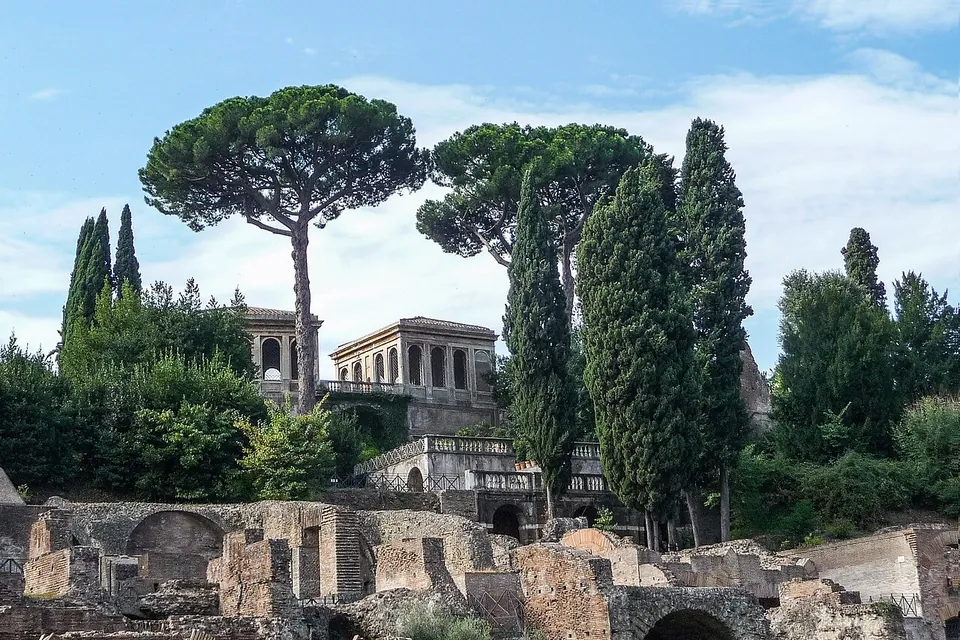
Domitian’s palace. The ruins that dominate the hill are the Palace of Domitian, built as the emperor’s official residence in 81–87 and used by the emperors after him; not all of it can be seen, as parts lie under later buildings (en.wikipedia). Its modern names divide it into three. The Domus Flavia, completed in 92 and attributed to the architect Rabirius, held the great public rooms for official business and ceremony (en.wikipedia), among them the Aula Regia, the audience hall (en.wikipedia). The Domus Augustana beside it was the private, residential part (en.wikipedia; it.wikipedia), and large stretches of the palace’s brick walls still stand (de.wikipedia); its tall arcades face the Circus Maximus below. The third part is the so-called stadium, a long sunken enclosure on the hill’s south-east side. Pleiades calls the name probably a misnomer: it may have been an elaborate porticoed garden, and it was restored under Hadrian and Septimius Severus. Below the stadium’s exedra are the remains of baths, and at the corner of the hill stand the brick substructures with which Septimius Severus extended the palace when the emperors had run out of space (en.wikipedia, Domus Severiana). Beneath the Domus Flavia lie houses of the Republic that the palace buried: the Casa dei Grifi, named after a stucco lunette with griffins, is one of the best-preserved Republican houses in Rome (it.wikipedia; fr.wikipedia), and the frescoes of the underground Aula Isiaca, which cannot be visited, have been moved to a room next to the Loggia Mattei, where they can be seen from the loggia (it.wikipedia).
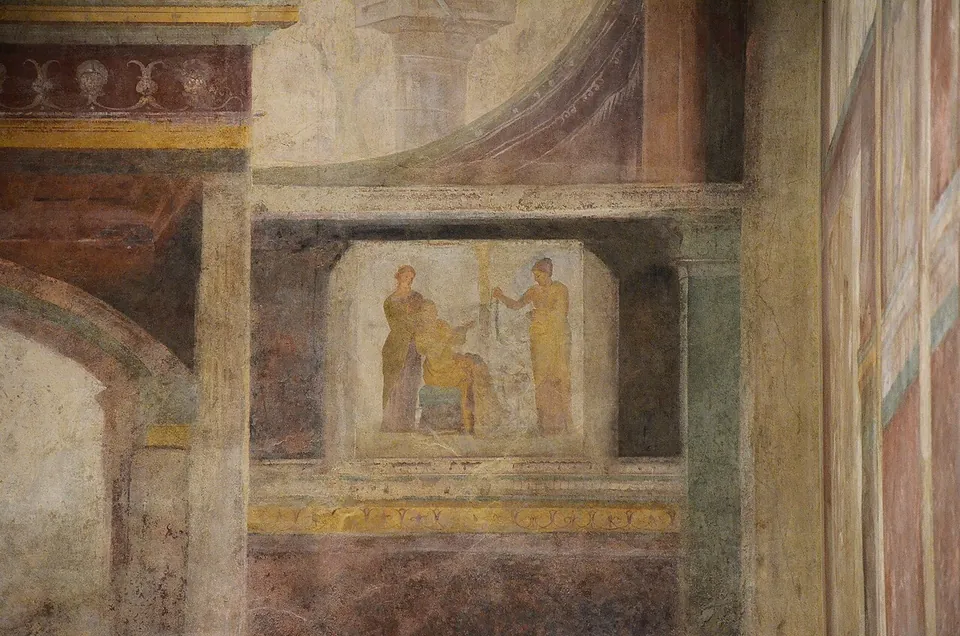
The Augustan houses and temples, on the south-west corner. A house here has long been identified as Augustus’s own, though the identification is disputed and more recent scholarship has tended to doubt it (en.wikipedia). Two of its rooms keep wall paintings from 30 BC, among them the Room of the Masks, with painted architecture and theatrical masks, and a restoration completed in 2008 opened the house to the public (en.wikipedia). The neighbouring House of Livia owes its name to a lead pipe bearing the name Iulia Aug(usta) and to its closeness to Augustus’s house; its oldest parts date to 75–50 BC, and it may have been an apartment for Livia within her husband’s house (it.wikipedia; en.wikipedia). It is known for its frescoes (en.wikipedia). Next to Augustus’s house stood the Temple of Apollo Palatinus, dedicated in 28 BC (de.wikipedia; en.wikipedia); it has been excavated and partly restored since the 1860s, but only partial remains survive (en.wikipedia). At the western edge is the site of the Temple of Magna Mater, dedicated in 191 BC and restored by Augustus (Pleiades), with a small shrine beside it, possibly the Temple of Juno Sospita, whose remains are mostly a Hadrianic restoration (en.wikipedia).
Rome’s beginnings. The same corner holds the traces of the city’s legend. In 1872 excavators found the postholes of an archaic hut at the spot ancient writers gave for the Casa Romuli, the hut of Romulus, and historians generally identify them with it (de.wikipedia). In 2007 a cavity 16 m underground, decorated with shells and marble, was found and claimed as the Lupercal, the cave of the she-wolf; others think it is a Neronian nymphaeum, and it was measured with endoscopes and lasers for fear that digging would damage it further (de.wikipedia; en.wikipedia). Whether the Murus Romuli, the wall said to have ringed the hill in the 8th century BC, existed at all remains hotly debated (Pleiades).
The north side: Farnese Gardens and the Domus Tiberiana. From the 16th century the Farnese family owned the hill and laid out gardens, designed by Vignola, which are partly preserved (it.wikipedia). They sit on top of the Domus Tiberiana, the palace that takes its name from Tiberius, of which mainly retaining walls and lower storeys can be seen; most of it has never been excavated (de.wikipedia; it.wikipedia; en.wikipedia).
The Palatine Museum. In the surviving part of the Villa Mills on the summit, later a convent, the museum shows only finds from the hill (en.wikipedia; it.wikipedia): the ground floor runs from the first huts to the Republic, the first floor covers the imperial age, with paintings from Nero’s first palace, the Domus Transitoria, portraits of emperors, and the Alexamenos graffito, a 3rd-century drawing mocking a Christian, found in the Paedagogium below the palace in 1857 (en.wikipedia).
Is it worth the trip?
Yes, and with the Forum ticket already in hand there is no reason to skip it. This is where the emperors actually lived, and the scale of their palace is felt best walking through it. It is also the green half of the area, with pines and gardens among the ruins, and high enough to see the Forum laid out below. The honest caveat: the palaces stand as brick shells and floor plans rather than rooms, so the painted houses and the museum are what bring them to life, and the houses are worth checking before you go.
Getting there and what it costs
The Palatine rises directly above the Roman Forum, about 370 m from the Forum’s centre and 490 m from the Colosseum. The Forum and Palatine share one fenced area, so you can walk up from the Forum, or come in from the Via di San Gregorio side, where a public-transport stop named S. Gregorio is mapped about 270 m from the hilltop (OpenStreetMap). The operator lists the entrances as the Arch of Titus, Largo della Salara Vecchia, Via del Tulliano, Via del Foro Romano and Via di San Gregorio; the old entrance by Trajan’s Column is no longer in use (colosseo.it). Free toilets are mapped by the museum (OpenStreetMap).
The Forum and Palatine open at 09.00 every day. Until 24 October 2026 the park closes at 18.30, with last entry at 17.30; from 25 October 2026 to 28 February 2027 it closes at 16.30, last entry 15.30. It is closed on 25 December and 1 January (colosseo.it, read 13 October 2026).
There are two ways in, both €18 (€2 for EU citizens aged 18 to 24; free under 18, with a ticket booked online):
- Colosseum, Roman Forum and Palatine: valid 24 hours, with one entry to the Forum and Palatine on the day of your booked Colosseum slot or within 24 hours of it. One entry means seeing the Forum and the Palatine in one go.
- Forum Pass SUPER: the Forum, the Palatine and the Imperial Fora for one day, without the Colosseum.
Entry is free for everyone on the first Sunday of the month and on 25 April, 2 June and 4 November (colosseo.it). The hours above are those of the Forum-Palatine area; before building a visit around the House of Augustus or the House of Livia, check colosseo.it that they are open on your day.
Visiting details
- Opening hours
- The Forum and Palatine open at 09.00 every day. The park closes at 18.30 (last entry 17.30) until 24 October 2026, and at 16.30 (last entry 15.30) from 25 October 2026 to 28 February 2027. Closed 25 December and 1 January. Hours from March 2027 were not yet published when checked.
- Tickets
- €18 for the Colosseum, Roman Forum and Palatine ticket, valid 24 hours, with one entry to the Forum and Palatine on the same day as the booked Colosseum slot or within 24 hours of it; or €18 for the Forum Pass SUPER (Forum, Palatine and Imperial Fora, no Colosseum, one day). €2 for EU citizens aged 18–24 on either ticket; free under 18 with a ticket booked online. Free for everyone on the first Sunday of the month and on 25 April, 2 June and 4 November.
Before you go
- The Palatine and the Roman Forum are one fenced area with one entry on the ticket. The entrances are at the Arch of Titus, Largo della Salara Vecchia, Via del Tulliano, Via del Foro Romano and Via di San Gregorio; the old entrance by Trajan's Column is no longer in use.
- The hours here are those of the Forum-Palatine area. Check colosseo.it that the painted houses (House of Augustus, House of Livia) are open before planning a visit around them.
Hours and prices checked 13 October 2026 on the operator's own site. Confirm before travelling.
History
Rome began here. People have lived on the Palatine since the 10th century BC (de.wikipedia; en.wikipedia), and traces of Iron Age huts have been found cut into the rock (it.wikipedia). Legend made it the hill on which Romulus founded the city (Pleiades). The hut of Romulus was rebuilt in its original simplicity whenever fire damaged it and survived into the 3rd or 4th century AD (de.wikipedia; fr.wikipedia), and the Lupercalia were celebrated at the Lupercal until at least 494 (en.wikipedia). Under the Republic it was where the rich lived (en.wikipedia), Cicero and Mark Antony among them (it.wikipedia), and its cults included Victory, whose temple of 294 BC sheltered the sacred stone of the Magna Mater until her own temple was finished in 191 BC (en.wikipedia).
Augustus, who may have been born at the north-east corner of the hill (Pleiades), bought the orator Hortensius’s house here and enlarged it; after lightning struck the property he dedicated the Temple of Apollo beside it (en.wikipedia). From then on the hill gradually became the emperors’ own: Tiberius, Nero, the Flavians and Septimius Severus built one palace after another (it.wikipedia; en.wikipedia), until the hilltop was a single complex of imperial buildings and gardens and Palatium had come to mean “palace” (it.wikipedia). Nero’s first palace, the Domus Transitoria, was damaged or destroyed in the Great Fire of 64 (en.wikipedia); Domitian’s palace, built largely over Nero’s buildings and completed in 92, remained in use until the end of the Empire (en.wikipedia). Elagabalus (218–222) added a temple to his Syrian sun god at the hill’s north-east corner (en.wikipedia; it.wikipedia). The palaces were still the seat of power under Theodoric (it.wikipedia, Palazzi imperiali di Roma) and fell into ruin from the 6th century (fr.wikipedia, Domus Flavia).
From the 16th century the Farnese owned the hill and planted their gardens over the ruins. Napoleon III bought the gardens in 1861 and entrusted the excavation of the Palatine to Pietro Rosa, and in 1870 he sold them to the Italian state (it.wikipedia). Intensive excavation began in the 18th century, peaked in the late 19th after Rome became Italy’s capital, and has continued since (en.wikipedia).
More photographs


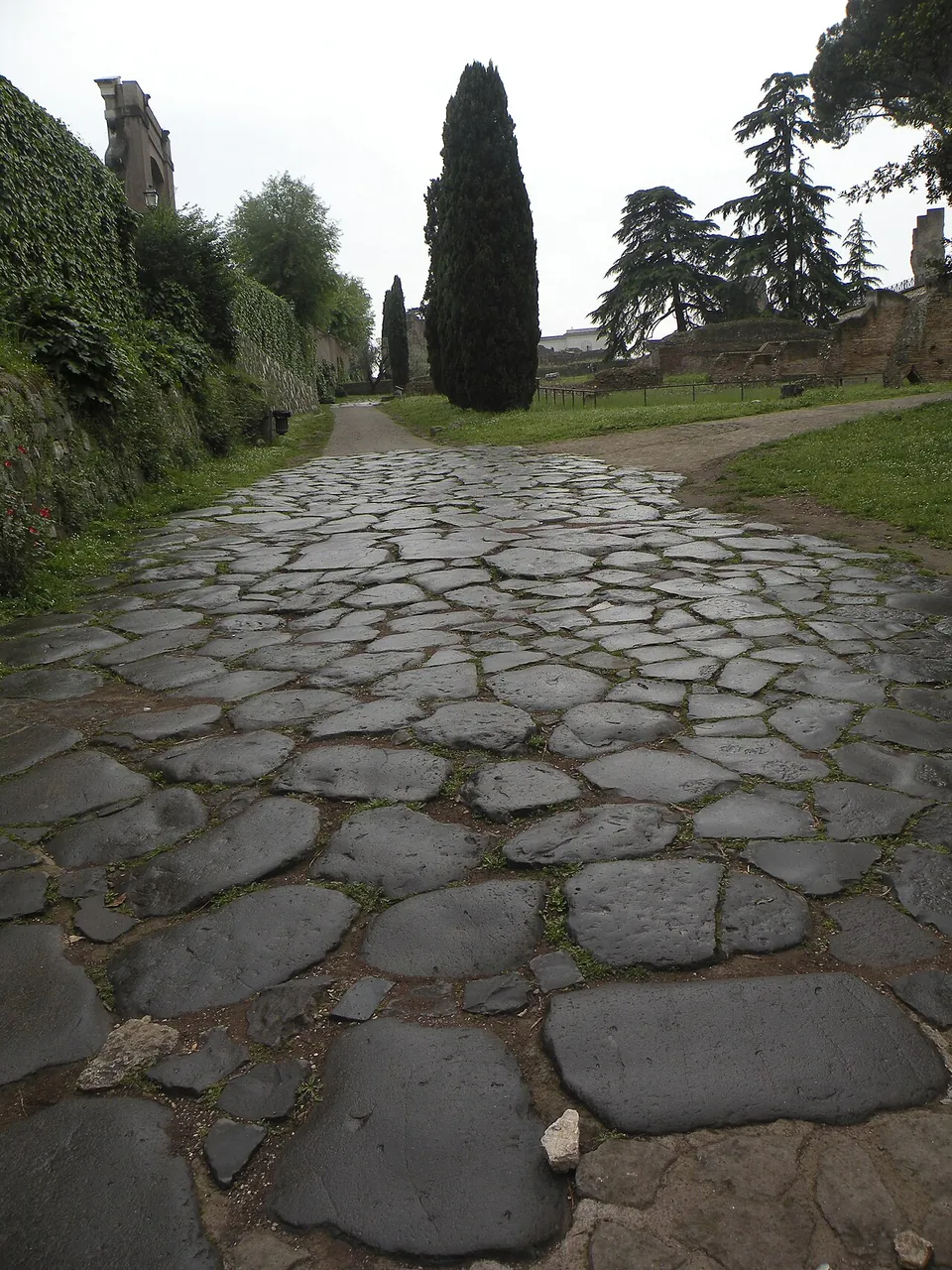

Nearby
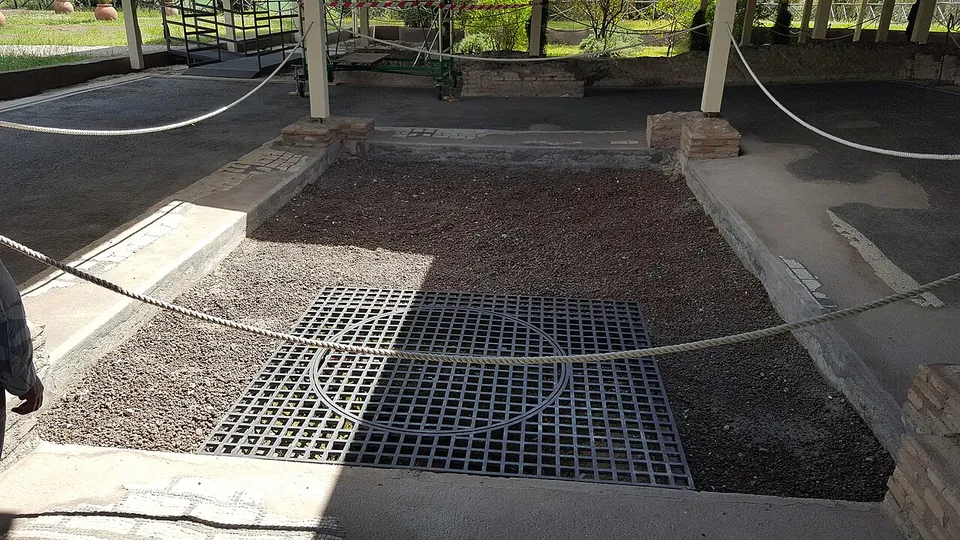
Photo: MumblerJamie · CC BY-SA 2.0 · Commons
13 km · villa · Lazio
Villa of Livia
The operator describes the private wing with the bedrooms of Livia and the emperor, an atrium and a small inner garden, and the large reception rooms that open onto a peristyle; the rooms once had painted walls and floors of mosaic and cut marble (Soprintendenza Speciale di Roma).
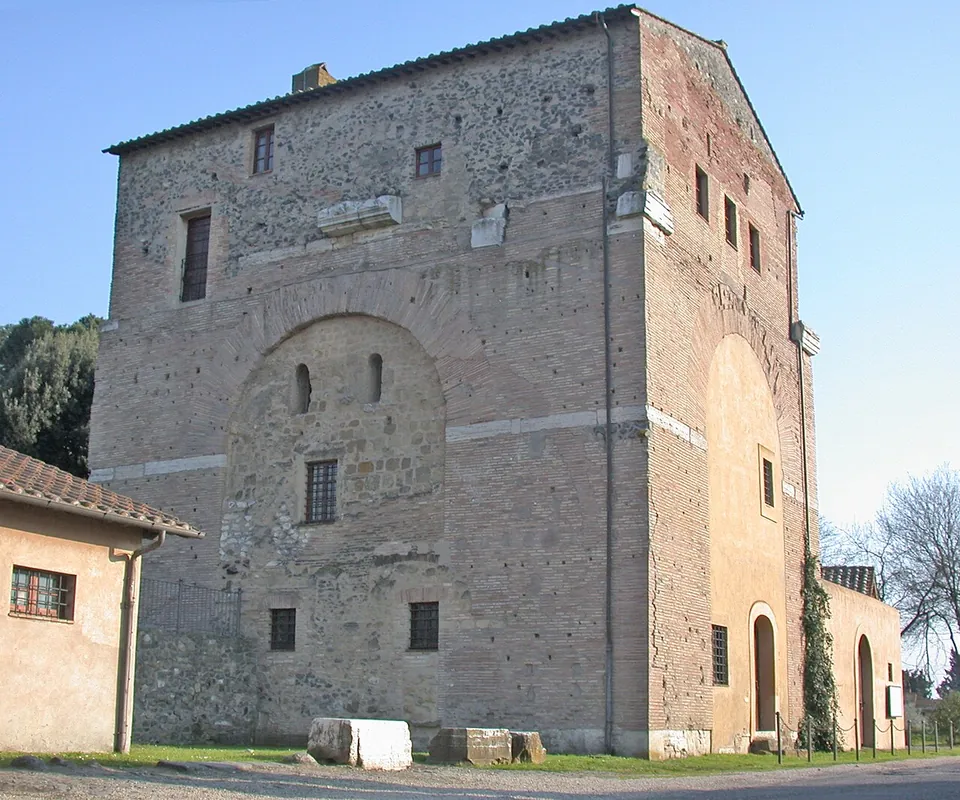
Photo: MM · Public domain · Commons
18 km · arch · Lazio
Arch of Malborghetto
At first sight you see an austere farmhouse rather than an arch (it.wikipedia).
Photo: Carlomorino · CC BY-SA 3.0 · Commons
19 km · city · Lazio
Gabii
The park the state holds covers about 70 hectares on the southern rim of a volcanic crater whose lake was drained in the 19th century (the operator; en.wikipedia).


Straight-line distances.
Sources
Every fact on this page comes from the records below, each used under the licence noted.