

The Pantheon is a Roman temple still standing in the middle of Rome’s old centre: a round hall under its ancient concrete dome, entered through a columned porch, and a Catholic church since 609 (en.wikipedia). It is one of the best-preserved of all Roman buildings, largely because it has been in use the whole time, and its dome is still the largest unreinforced concrete dome in the world (en.wikipedia). It is worth the trip without hesitation. A ticket is €7, and it is open every day from 09.00 to 19.00 (Ministero della Cultura).
What is there today
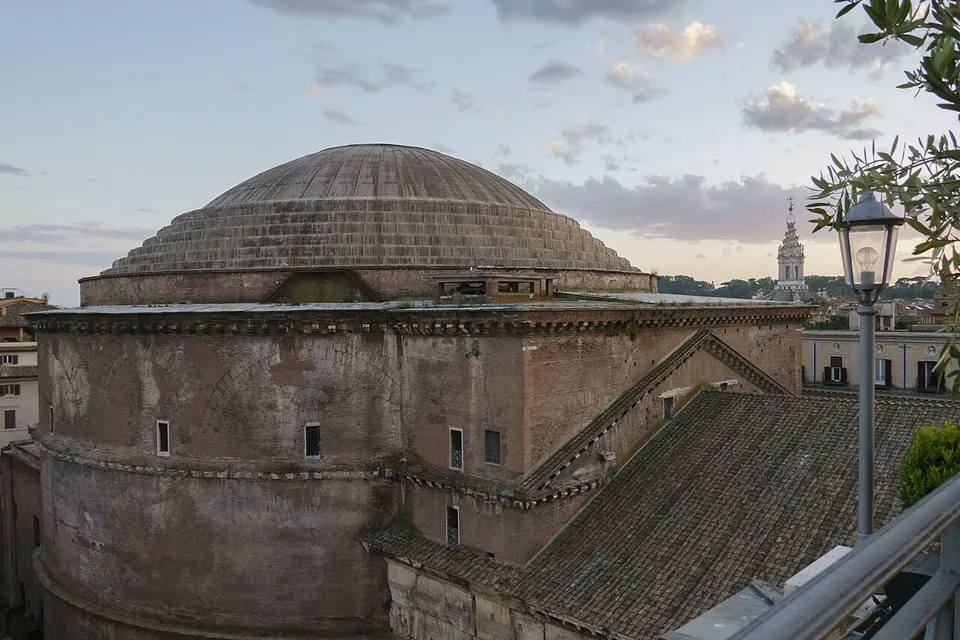
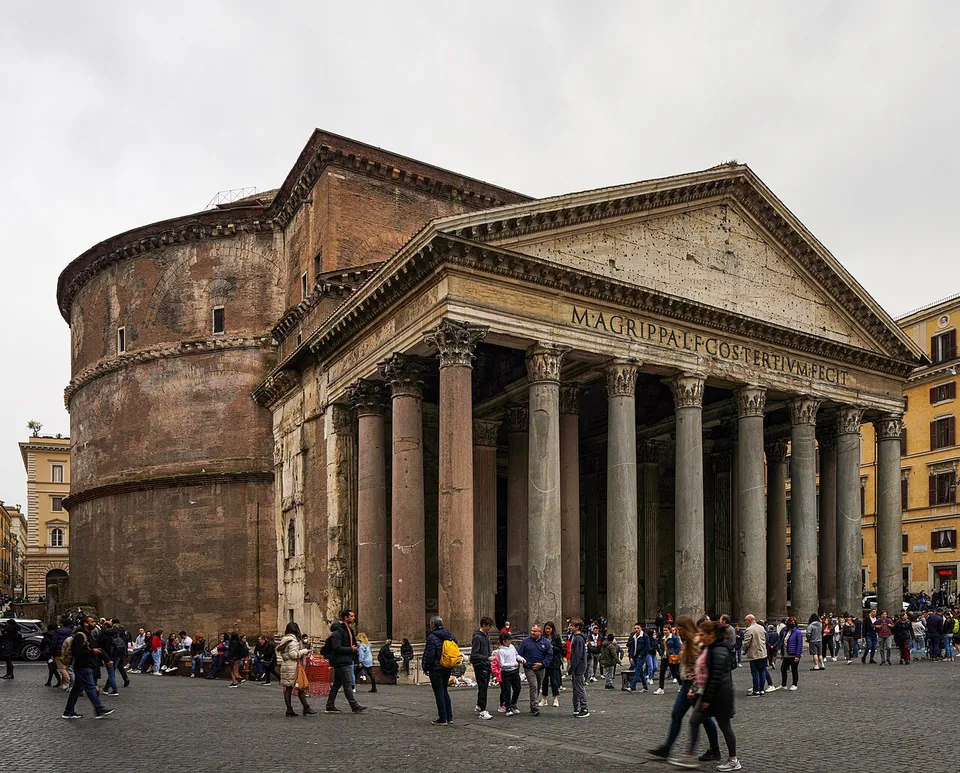
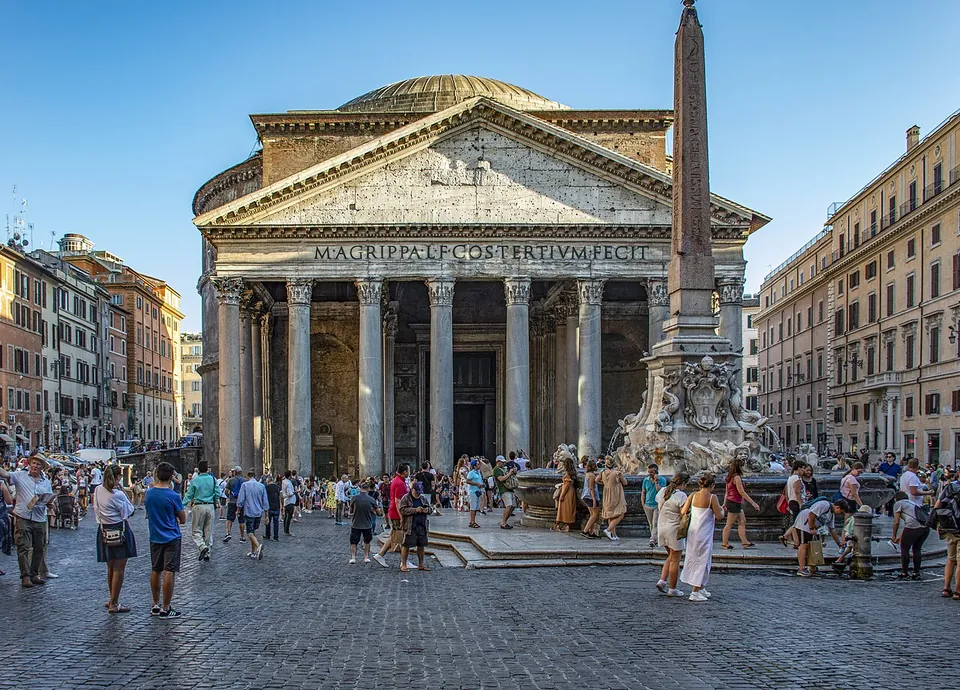
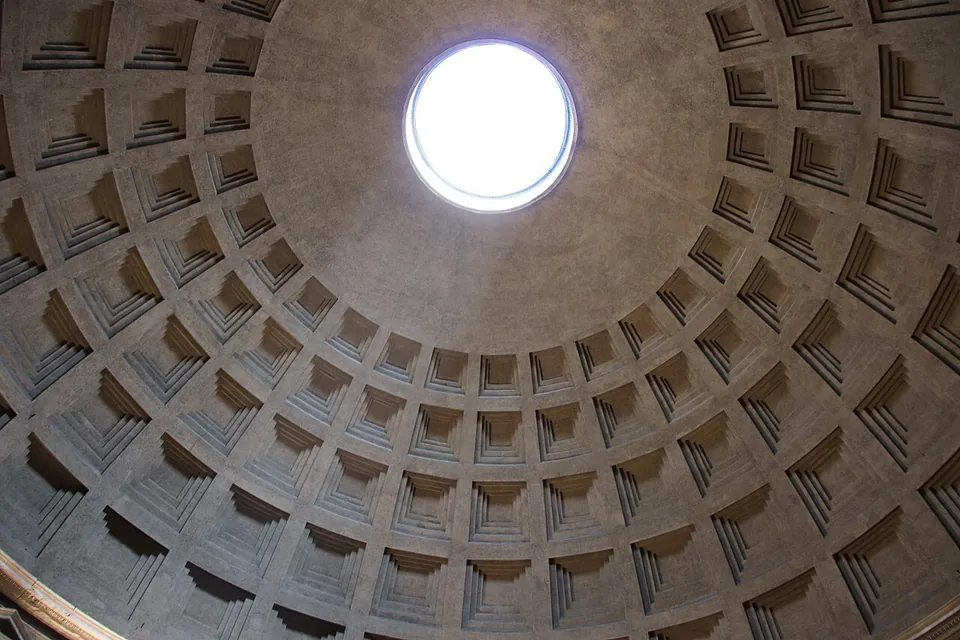
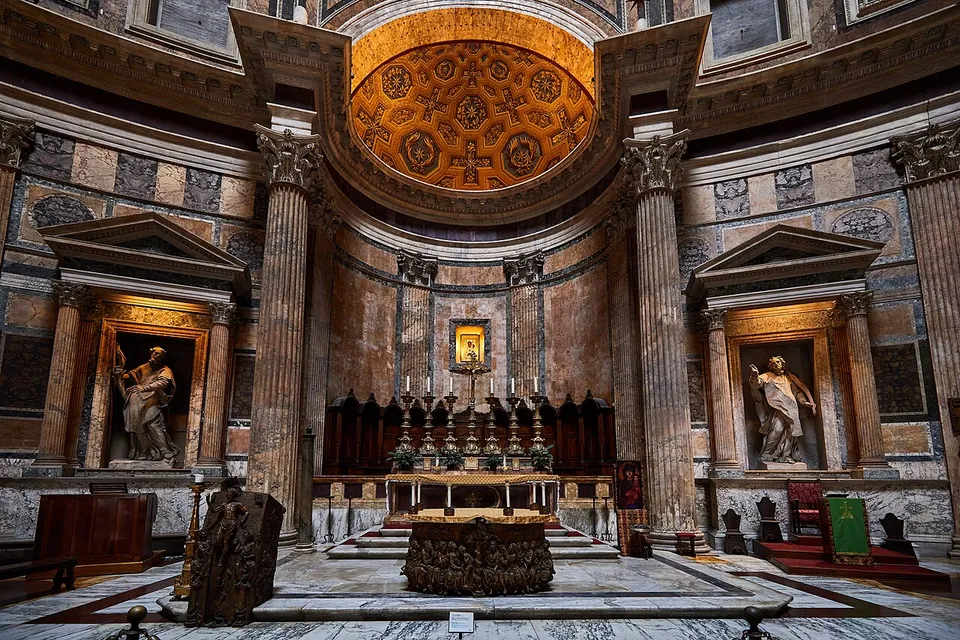
The whole building. A porch of large granite Corinthian columns, eight across the front and two groups of four behind, carries a pediment; a rectangular vestibule leads into the rotunda, under a coffered dome with a round opening, the oculus, open to the sky at its top (en.wikipedia). The dome is 43.30 m across inside, and the height to the oculus is the same; a cylindrical wall more than 6 m thick carries it (Ministero della Cultura). Measured by its inner diameter, it was the largest dome in the world for more than 1,700 years (de.wikipedia).
What you see is not Agrippa’s temple but Hadrian’s rebuilding of it. The inscription across the front still names Agrippa, because Hadrian had the new temple inscribed with Agrippa’s original one (en.wikipedia). Its marble and bronze decoration was plundered, and architects of the 17th and 18th centuries added decoration of their own (fr.wikipedia); the interior is a working church, with altars and tombs. The tombs of Raphael and of the kings Vittorio Emanuele II and Umberto I are inside (OpenStreetMap).
Around the Pantheon
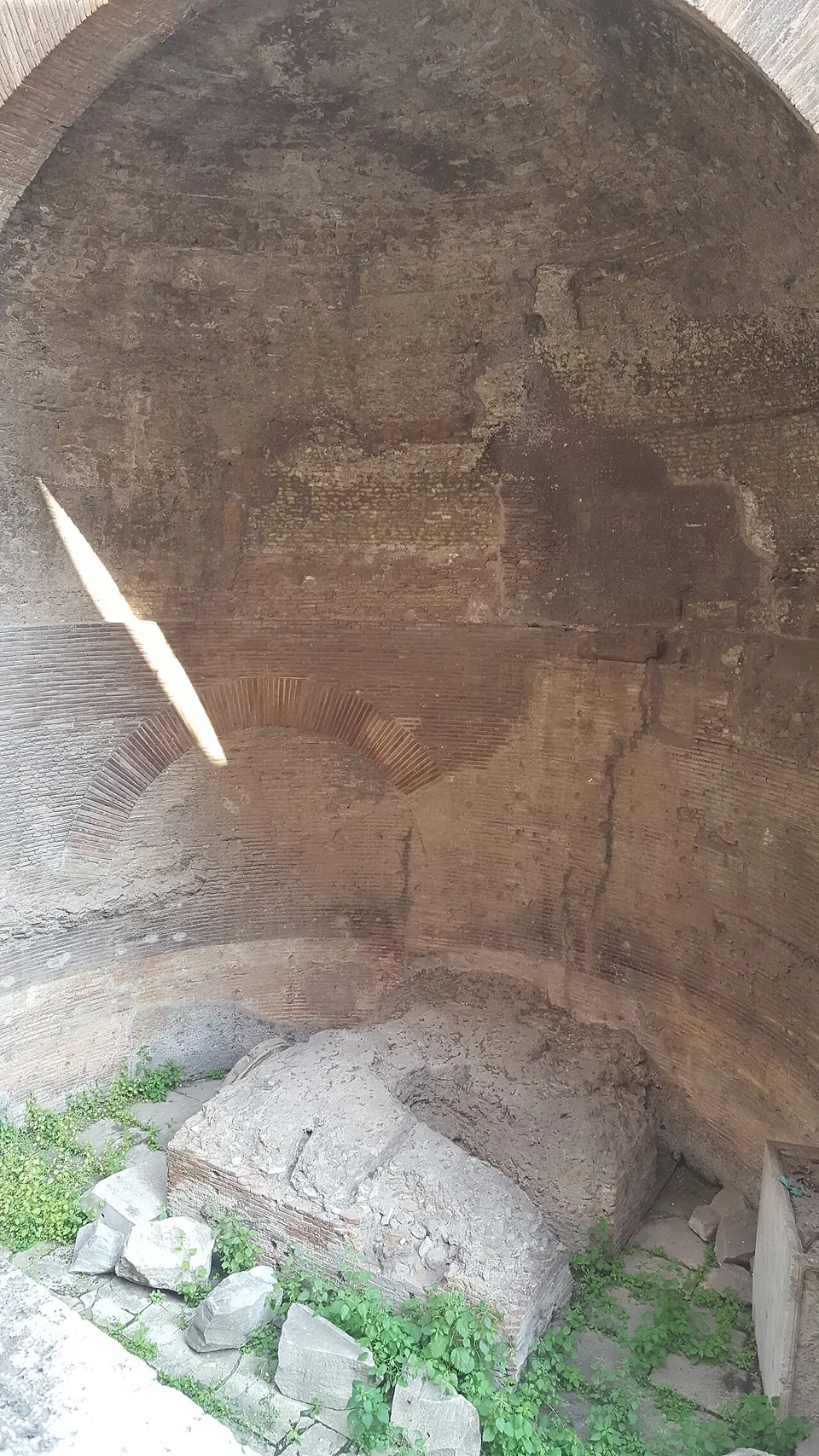
The Basilica of Neptune stands right up against the Pantheon (it.wikipedia). Agrippa built it about 25 BC in honour of Neptune, to celebrate his naval victories at Mylae, Naulochus and Actium, and surviving fragments of it are visible on the site (en.wikipedia). It was restored under Hadrian, and what it was used for is not known (it.wikipedia).
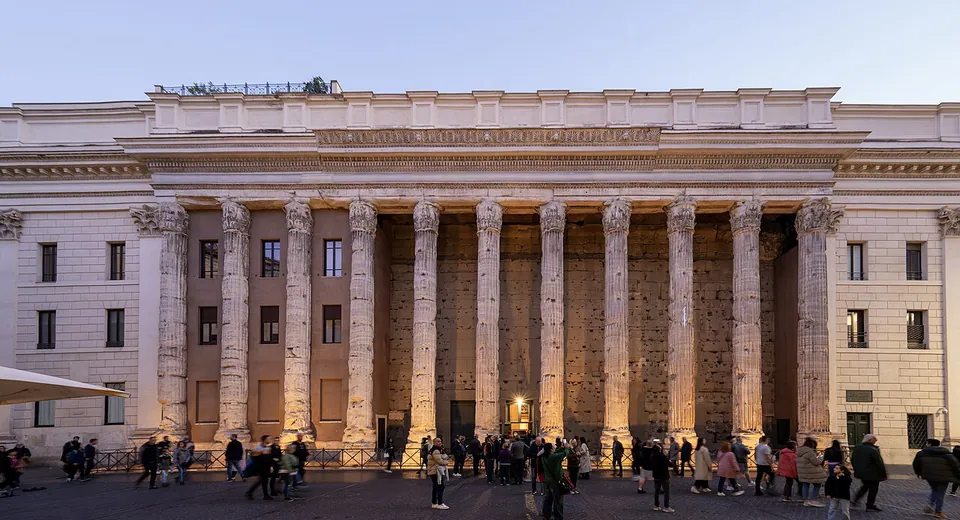
The Temple of Hadrian, about 250 m to the east on Piazza di Pietra, was dedicated to the deified Hadrian by his successor Antoninus Pius in 145 (en.wikipedia). One wall of its cella and eleven columns of the colonnade survive, built into a 17th-century papal palace by Carlo Fontana that now houses Rome’s Chamber of Commerce (en.wikipedia). The columns face onto the square.
Three more places are on the map, but there is nothing of them to see. The small Temple of Minerva Chalcidica stood nearby in the Campus Martius, and no remains of it have been found (de.wikipedia). Domitian built or rebuilt it after the fire of AD 80; en.wikipedia credits the first temple to Pompey, around 60 BC, while de.wikipedia leaves any earlier building open. Its name lives on in the church of Santa Maria sopra Minerva (en.wikipedia), about 150 m from the Pantheon (OpenStreetMap). The Temple of Marcus Aurelius, built for the deified emperor after his death in 180, has no certain site: it probably stood just west of the Column of Marcus Aurelius on Piazza Colonna (en.wikipedia), about 350 m north-east, and building fragments found near the column in the 1960s may belong to it (de.wikipedia). And the Theatrum Scauri, a theatre built in 58 BC by Marcus Aemilius Scaurus when he was curule aedile (Wikidata), is recorded in the Campus Martius, and no source describes anything left of it.
Is it worth the trip?
Yes. This is a great Roman building you can walk into with its dome still overhead, and the dome, lit from the oculus (it.wikipedia), is the point of the visit. It is also an easy one: it sits on a square in the old centre, open every day, about 400 m from Largo di Torre Argentina.
The caveats are about people, not the building. In 2019 it had 8,955,569 visitors, more than any other state museum site in Italy (it.wikipedia), so expect crowds on the square and inside. Entry is by time slot, in order of arrival, and there is no skip-the-line ticket. It is a working church: cover your shoulders, and plan round the services, when ticket sales stop (Ministero della Cultura).
Getting there and what it costs
The Pantheon is on Piazza della Rotonda, in the old centre (Ministero della Cultura). The nearest bus stops mapped are Rinascimento, about 250 m away, and Corso Vittorio Emanuele/Argentina, about 300 m (OpenStreetMap). The building is mapped as wheelchair accessible (OpenStreetMap), and the operator mentions a ramp for disabled visitors.
From the operator’s page, read on 13 October 2026 (Ministero della Cultura):
- Hours: every day, 09.00 to 19.00, last entry 18.30; the ticket desks close at 18.00. Closed on 25 December and 1 January. Hours can change for religious celebrations.
- Mass: Saturdays and the eve of holidays at 17.00, Sundays and holidays at 10.30. Ticket sales stop an hour before each service, and entry during the service is free, for worship.
- Tickets: €7 since 1 July 2026 (it was €5); €2 for ages 18 to 25; free under 18. On the first Sunday of the month entry is free, with tickets collected at the desks and machines on site, and a free ticket does not give priority entry.
- Buying: booking is optional. Tickets are sold only on the Musei Italiani portal or app, or at the desks and automatic machines on site; each time slot admits up to 1,200 people.
Visiting details
- Opening hours
- Daily 09.00–19.00, last entry 18.30; the ticket desks close at 18.00. Closed 25 December and 1 January. Mass on Saturdays and the eve of holidays at 17.00 and on Sundays and holidays at 10.30; ticket sales stop an hour before each service, and hours can change for religious celebrations.
- Tickets
- €7 (since 1 July 2026); €2 for ages 18–25; free under 18. Free for everyone on the first Sunday of the month, with tickets collected on site. Booking online is optional; entry is by time slot, in order of arrival, with no skip-the-line option.
Before you go
- It is a working church - shoulders must be covered, and very short shorts or skirts, low-cut or see-through clothing are not allowed; staff can refuse entry.
- Tickets are sold only by the operator, on the Musei Italiani portal or app or at the desks and machines on site.
Hours and prices checked 13 October 2026 on the operator's own site. Confirm before travelling.
History
Marcus Vipsanius Agrippa, Augustus’s son-in-law, built the first Pantheon on the Campus Martius in 27–25 BC (Pleiades; Ministero della Cultura). The name means “[temple] of all the gods” (en.wikipedia), but which gods were worshipped there is disputed, and so is whether it was a temple at all or an imperial hall that borrowed a temple’s forms (de.wikipedia). Fires in AD 80 and 110 destroyed Agrippa’s building (it.wikipedia), and Hadrian rebuilt it. Published dates for the rebuilding run from about 112 to 128, and it was probably dedicated around 126; the date is uncertain precisely because Hadrian put Agrippa’s inscription back on the new building (en.wikipedia; it.wikipedia; de.wikipedia). It was restored again under Septimius Severus in the early 3rd century (fr.wikipedia).
Its round, domed hall behind a conventional temple porch was unique in Roman architecture (en.wikipedia). At the beginning of the 7th century the Byzantine emperor Phocas gave the building to Pope Boniface IV, who consecrated it in 609 as a church of St Mary and the Martyrs (de.wikipedia; Pleiades). That conversion is what saved it from the stripping that the other buildings of classical Rome suffered (it.wikipedia). Restoration at the end of the 19th century and in the 20th cleared later buildings from around it and allowed the ancient structures to be studied (fr.wikipedia). It belongs to the Italian state (de.wikipedia), and since April 2026 the Ministry of Culture has managed it jointly with the Diocese of Rome (Ministero della Cultura).
More photographs




Nearby
Photo: MumblerJamie · CC BY-SA 2.0 · Commons
12 km · villa · Lazio
Villa of Livia
The operator describes the private wing with the bedrooms of Livia and the emperor, an atrium and a small inner garden, and the large reception rooms that open onto a peristyle; the rooms once had painted walls and floors of mosaic and cut marble (Soprintendenza Speciale di Roma).
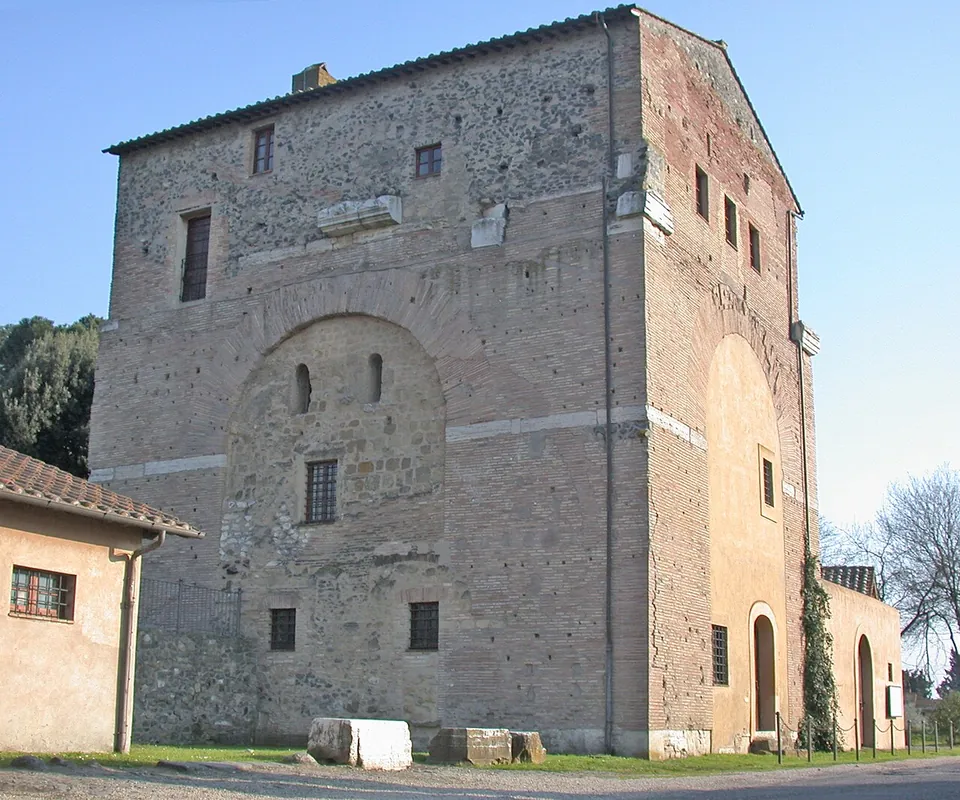
Photo: MM · Public domain · Commons
17 km · arch · Lazio
Arch of Malborghetto
At first sight you see an austere farmhouse rather than an arch (it.wikipedia).
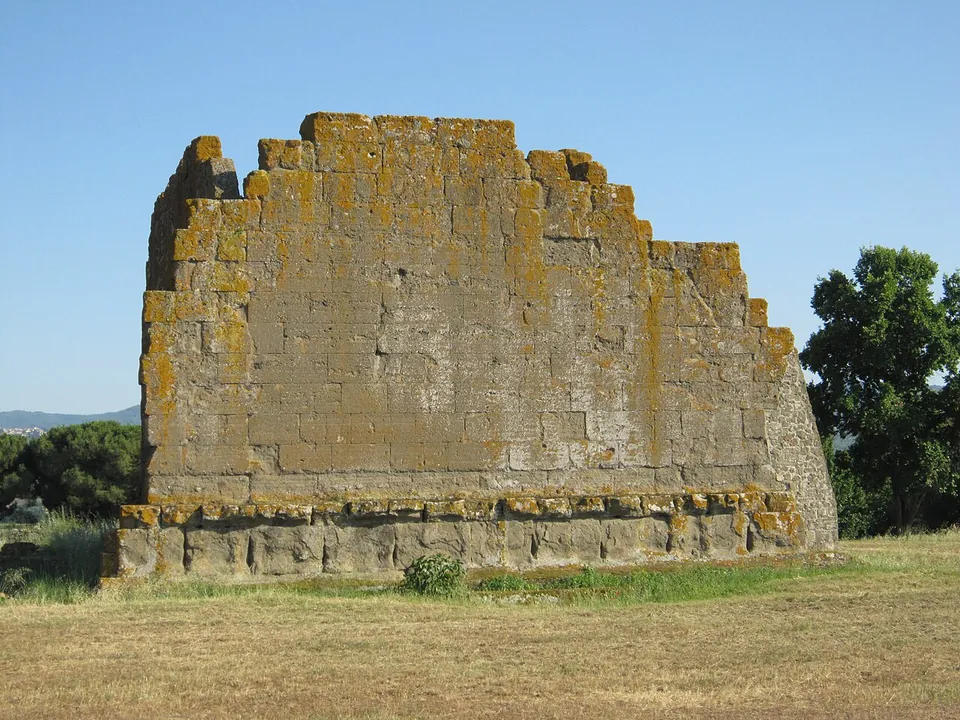
Photo: Carlomorino · CC BY-SA 3.0 · Commons
20 km · city · Lazio
Gabii
The park the state holds covers about 70 hectares on the southern rim of a volcanic crater whose lake was drained in the 19th century (the operator; en.wikipedia).


Straight-line distances.
Sources
Every fact on this page comes from the records below, each used under the licence noted.