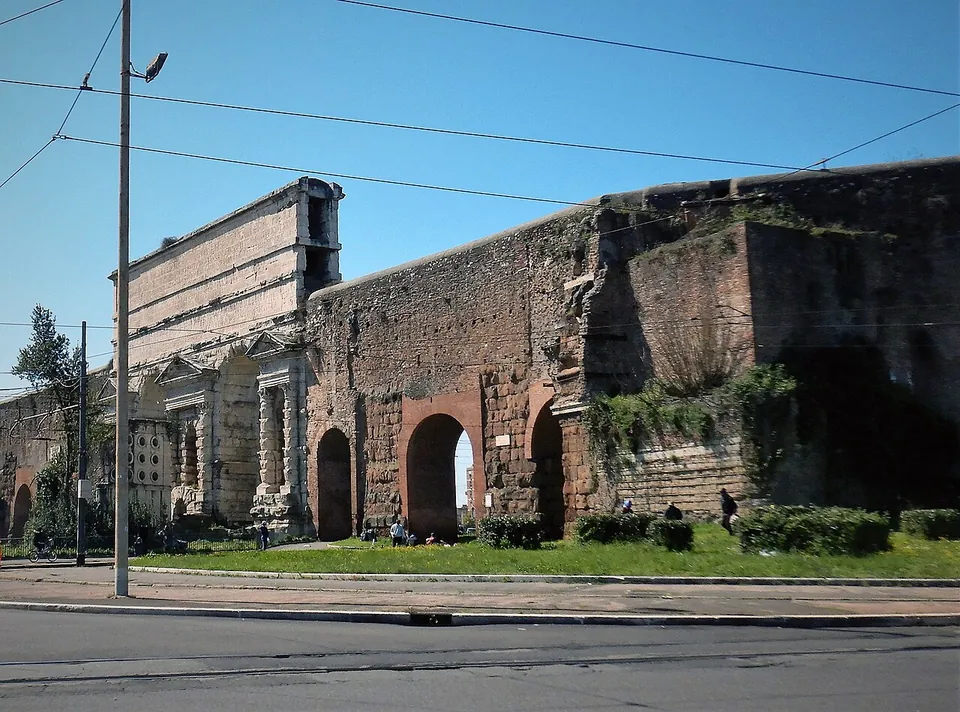
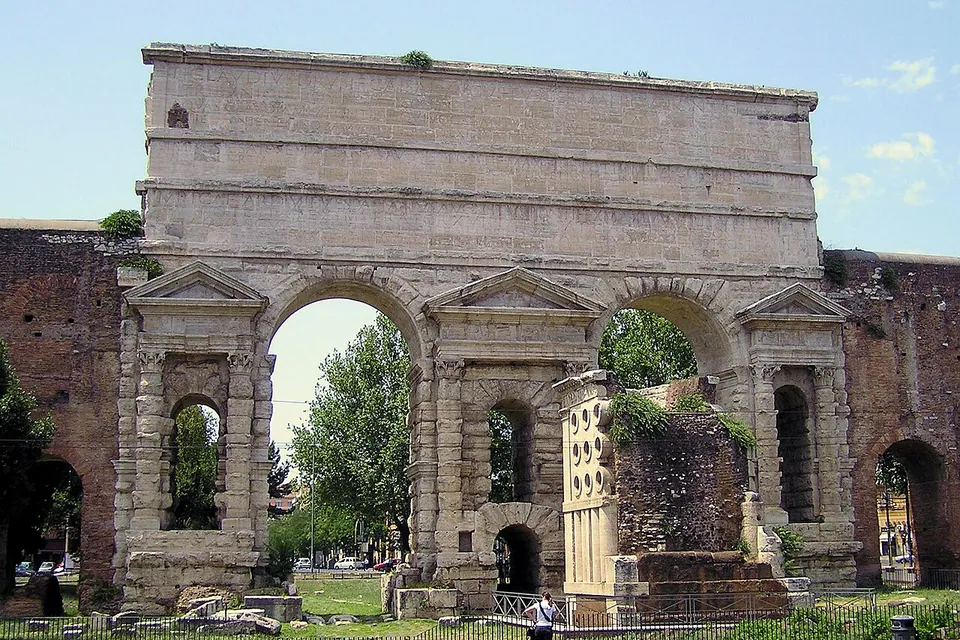


Porta Maggiore is a monumental double arch of rough-cut travertine that the emperor Claudius built in AD 52 to carry two aqueducts over two roads, and that later became a gate in Rome’s city walls. It still stands in a square crossed by tram lines, with the tomb of a rich baker at its foot.
What is there today
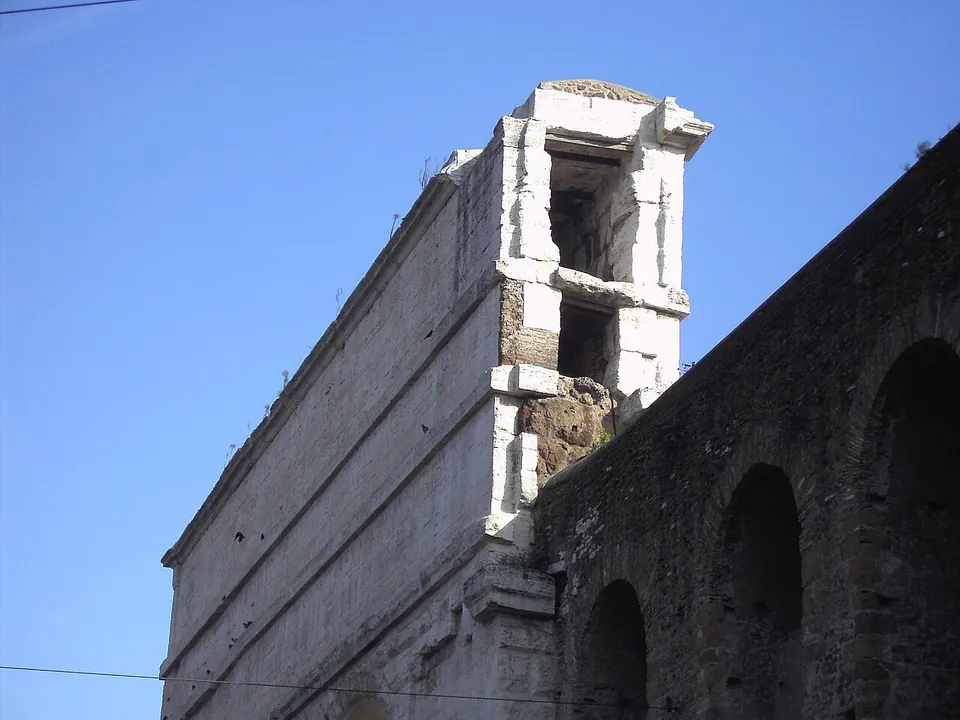
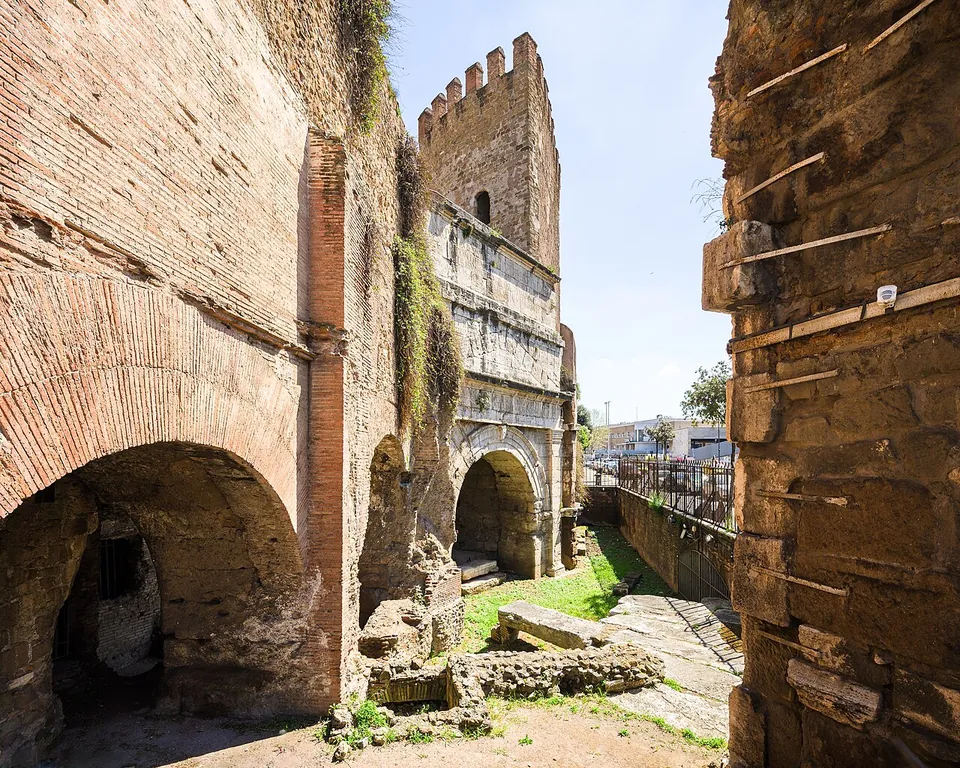
The gate itself is the sight: two great arches, each about 6 m wide and 14 m high, under a tall attic in which the channels of two aqueducts ran one above the other, the Anio Novus on top and the Aqua Claudia beneath it (it.wikipedia). At the ends of the attic the channels can be seen in cross-section, and its faces still carry three inscriptions: Claudius’s, recording that he brought both waters to Rome at his own expense, and those of Vespasian and Titus, who restored them (en.wikipedia). The piers carry windows framed by small pediments and half-columns (it.wikipedia). Under the gate the original Roman road surface can be seen (Turismo Roma), basalt paving still marked by cart ruts (it.wikipedia).
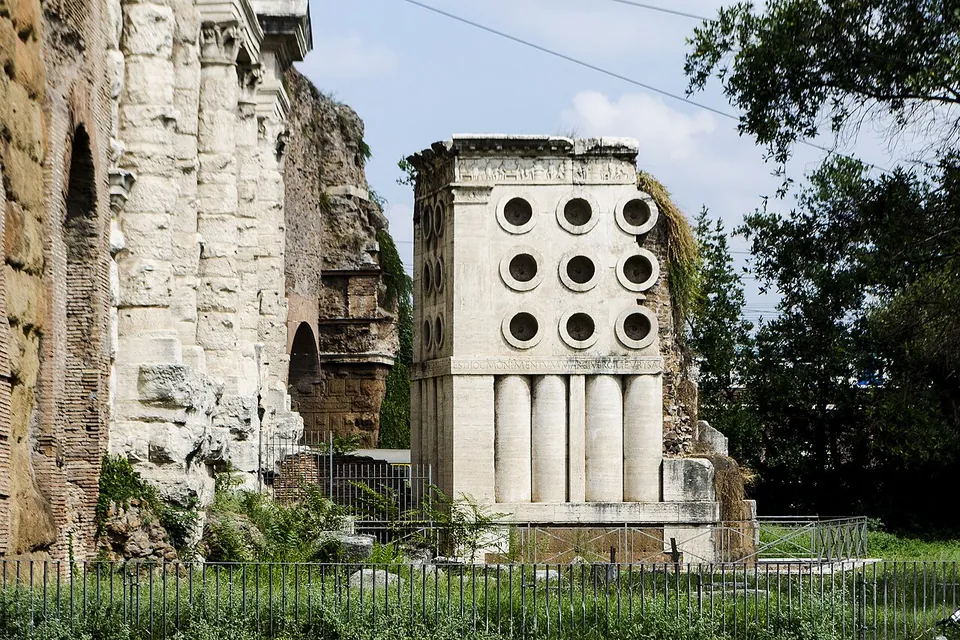
Directly in front of it, on the outer side, stands the Tomb of Eurysaces the baker, built in a style quite unlike the classical Roman tombs (en.wikipedia; see below). The brick Aurelian Walls run off from the gate on either side.
Is it worth the trip?
If you are interested in how Rome got its water, yes: en.wikipedia calls it one of the most significant places in the city for understanding and seeing the ancient aqueducts, and eight of Rome’s eleven aqueducts converged on this spot (it.wikipedia). With the Tomb of Eurysaces beside it, it is two remarkable monuments for one short stop, and nothing to pay.
Be clear about the setting, though. The gate stands in a traffic junction served by several tram lines (it.wikipedia), with tram wires strung across the view, and its foot and the tomb lie behind railings. It is a place to look at for twenty minutes or so, not a site to explore, and it is about 2.3 km east of the Roman Forum in a straight line, so it suits someone already heading this way, or anyone willing to add the so-called Temple of Minerva Medica and Porta Tiburtina nearby to make a morning of the eastern side of the walls.
Getting there and what it costs
The gate is in Piazza di Porta Maggiore, on the eastern edge of the historic centre. A public transport stop, Labicano/Porta Maggiore, is mapped 30 m away (OpenStreetMap), and it.wikipedia lists tram lines reaching the gate from Termini station, Trastevere station, the districts along the Via Prenestina, Piazza Risorgimento near St Peter’s and Villa Borghese. A free car park is mapped about 40 m from the gate (OpenStreetMap).
There is nothing to pay and no opening time: the gate stands in the open and is seen from the square and the streets around it. Turismo Roma, the city’s tourism portal, lists no timetable or ticket for it (read 17 October 2026).
Visiting details
- Opening hours
- No timetable. The gate stands in the open in Piazza di Porta Maggiore and is seen from the square and the surrounding streets.
- Tickets
- Free; no ticket is published for the gate or the Tomb of Eurysaces beside it.
- Parking
- A free surface car park about 40 m from the gate (OSM way/345610049, fee=no); the other car parks mapped nearby are private.
Before you go
- The so-called Temple of Minerva Medica, 400 m away, opens only for special events and initiatives (Soprintendenza Speciale di Roma); otherwise it is seen from the street.
- The Hypogeum of the Aurelii, 500 m away, has no opening hours; it is seen only on a special visit requested from the Pontifical Commission for Sacred Archaeology.
Hours and prices checked 17 October 2026 on the operator's own site. Confirm before travelling.
The Tomb of Eurysaces
The slightly trapezoidal monument right in front of the gate is the tomb of Marcus Vergilius Eurysaces, a baker who built it for himself, and perhaps for his wife Atistia, around the end of the Republic, about 50–20 BC (en.wikipedia; Pleiades). It is one of the largest and best-preserved tombs of a freedman in Rome, about 7 m high, and it looks like nothing else: rows of round openings in its upper storey, now thought to represent kneading basins or grain measures, and below the cornice a frieze showing the work of his bakery, from the delivery and grinding of grain to the baking and weighing of the loaves (en.wikipedia). Its inscription calls him “pistor redemptor”, baker and contractor (en.wikipedia). Three sides survive largely intact.
The tomb is older than the gate. It was built where the Via Praenestina and Via Labicana met just before entering Rome, a particularly prominent spot for a tomb (en.wikipedia). When the walls were strengthened in the early 5th century, a tower was built over it; it came to light again in 1838, when Pope Gregory XVI had that tower demolished (en.wikipedia; it.wikipedia).
The so-called Temple of Minerva Medica
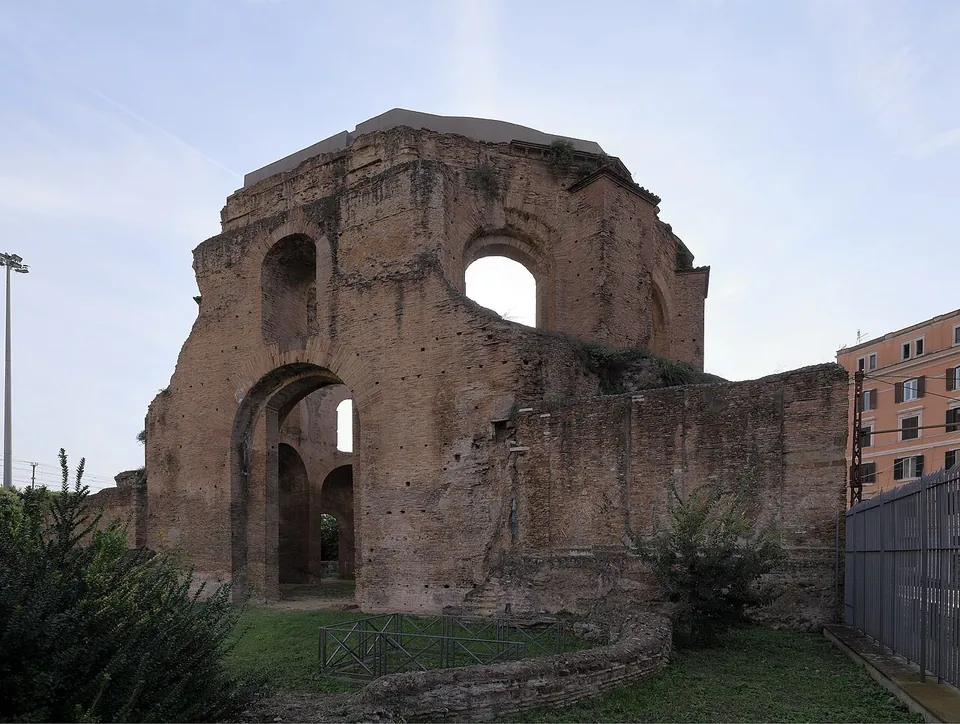
About 400 m north-west of the gate, on Via Giovanni Giolitti beside the railway into Termini, stands the brick shell of a ten-sided domed hall, the so-called Temple of Minerva Medica. It was never a temple: it was a hall of a luxurious residence of the early 4th century AD, probably imperial property, perhaps used for banquets and receptions (Soprintendenza Speciale di Roma), and probably a nymphaeum (it.wikipedia; Pleiades). Its dome, 25 m across, was the third largest in ancient Rome after the Pantheon and the Baths of Caracalla (Soprintendenza Speciale di Roma); much of it fell in 1828 (it.wikipedia; en.wikipedia). The residence it belonged to may have been the Horti Liciniani, the gardens of the Licinii, which passed to the emperor Gallienus in the 3rd century (de.wikipedia), though it.wikipedia notes that the attribution is debated.
The building is seen from the street and from trains entering Termini (it.wikipedia). Inside, it opens only for special events and initiatives (Soprintendenza Speciale di Roma).
The Hypogeum of the Aurelii
About 500 m west of the gate, at the corner of Viale Manzoni and Via Luzzatti, a small private underground tomb was found in 1919 while a garage was being built (it.wikipedia). It is on two levels, and its painted decoration of about AD 230 mixes Christian and pagan imagery; the meaning of the scenes is still unresolved (it.wikipedia; the Pontifical Commission for Sacred Archaeology). A mosaic floor names Aurelius Felicissimus, who dedicated the tomb to his siblings (it.wikipedia). It has no opening hours: it is seen only on a special visit requested from the Pontifical Commission for Sacred Archaeology (the operator).
Porta Tiburtina
About 800 m north of Porta Maggiore, Porta Tiburtina (today also Porta San Lorenzo, after the basilica of San Lorenzo fuori le mura) began the same way: as a travertine arch built in 5 BC under Augustus to carry three aqueducts, the Aqua Iulia, Marcia and Tepula, over the Via Tiburtina. When the Aurelian Walls were built from 271 the arch was taken into them, flanked by two towers and so became a gate (de.wikipedia). It too carries inscriptions about the aqueducts and the gate.
The Underground basilica
A little over 100 m along the Via Prenestina from the gate lies the Underground basilica of Porta Maggiore, a 1st-century hall found in 1917, with three naves, an apse and white stucco decoration on its vaults (en.wikipedia). It is a separate site and is not covered on this page.
History
Claudius built the double arch in AD 52, where the Aqua Claudia and the Anio Novus had to cross the Via Praenestina and the Via Labicana, and made the crossing a showpiece of the aqueduct (en.wikipedia; it.wikipedia). The aqueducts soon needed work: Vespasian restored them in 71, after nine years of disrepair, and Titus about ten years after that, as their inscriptions on the attic record (en.wikipedia; it.wikipedia). The left arch carried the Via Labicana, today’s Via Casilina, and the right one the Via Prenestina, the road to Praeneste, modern Palestrina (it.wikipedia; en.wikipedia).
When Aurelian began Rome’s new walls in 271, the aqueduct arches were built into them and became a gate, called Porta Praenestina or Labicana (it.wikipedia). Under Honorius the gate was fortified with an outer bastion and towers; an inscription on the outer side names the prefect of Rome who carried out the work in 402, and on it the name of the general Stilicho, executed in 408 and erased from inscriptions elsewhere, including Porta Tiburtina’s, survives (it.wikipedia). en.wikipedia gives 405 for Honorius’s work instead. The gate was closed during the Gothic siege of 537–538, and the Labicana arch seems to have been walled up for most of its later history (it.wikipedia).
The modern name has no clear origin: it may come from the gate’s size, from its two roads, or from the nearby basilica of Santa Maria Maggiore (it.wikipedia). In 1838 Gregory XVI removed the Honorian additions, uncovering the Tomb of Eurysaces, and only after work in 1956 did the gate return to its ancient form, with the square lowered to the old ground level and the Roman road surface exposed again (it.wikipedia).
More photographs



Nearby
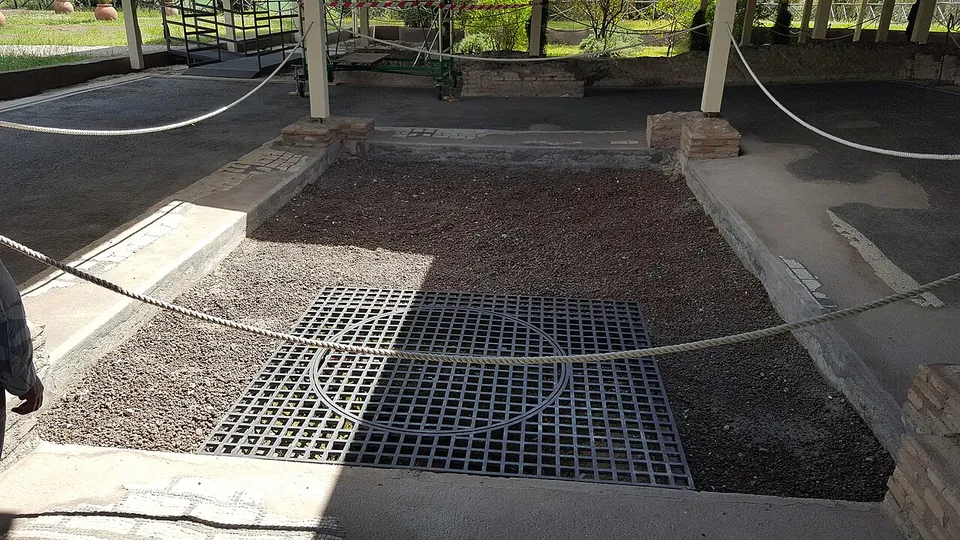
Photo: MumblerJamie · CC BY-SA 2.0 · Commons
12 km · villa · Lazio
Villa of Livia
The operator describes the private wing with the bedrooms of Livia and the emperor, an atrium and a small inner garden, and the large reception rooms that open onto a peristyle; the rooms once had painted walls and floors of mosaic and cut marble (Soprintendenza Speciale di Roma).
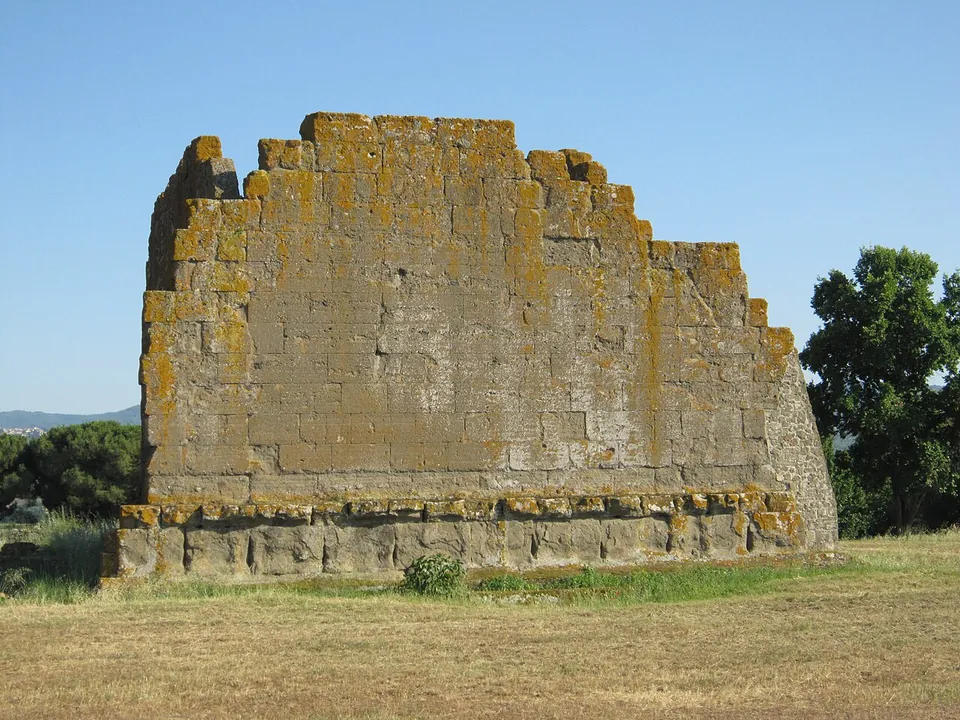
Photo: Carlomorino · CC BY-SA 3.0 · Commons
17 km · city · Lazio
Gabii
The park the state holds covers about 70 hectares on the southern rim of a volcanic crater whose lake was drained in the 19th century (the operator; en.wikipedia).
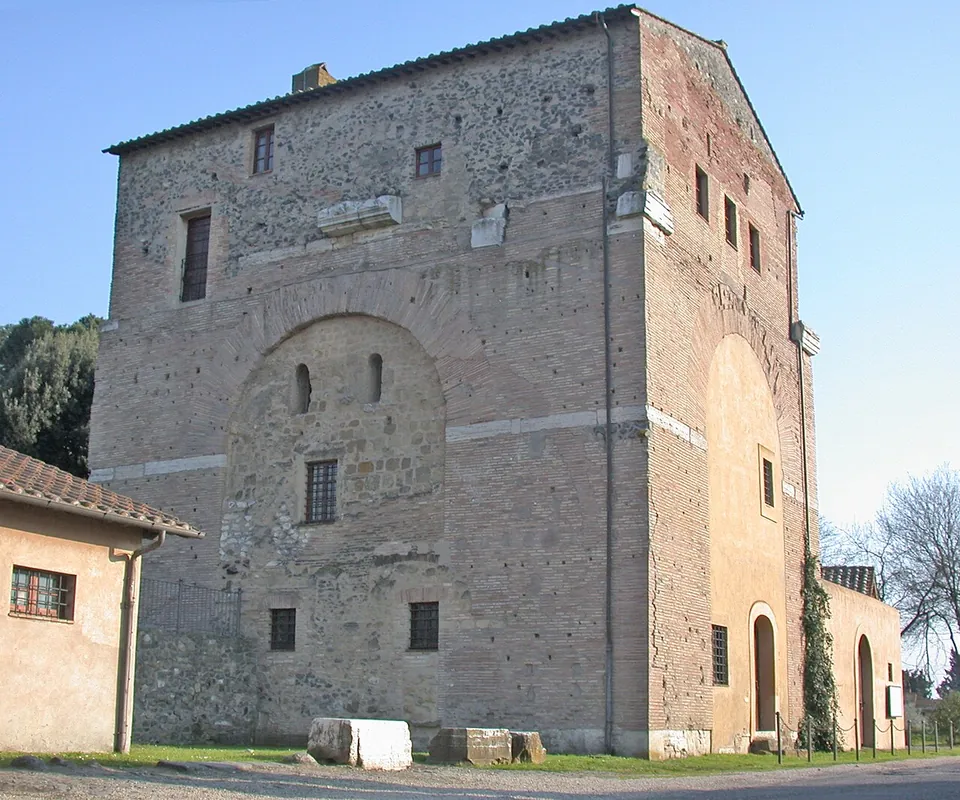
Photo: MM · Public domain · Commons
18 km · arch · Lazio
Arch of Malborghetto
At first sight you see an austere farmhouse rather than an arch (it.wikipedia).


Straight-line distances.
Sources
Every fact on this page comes from the records below, each used under the licence noted.