

What is there today
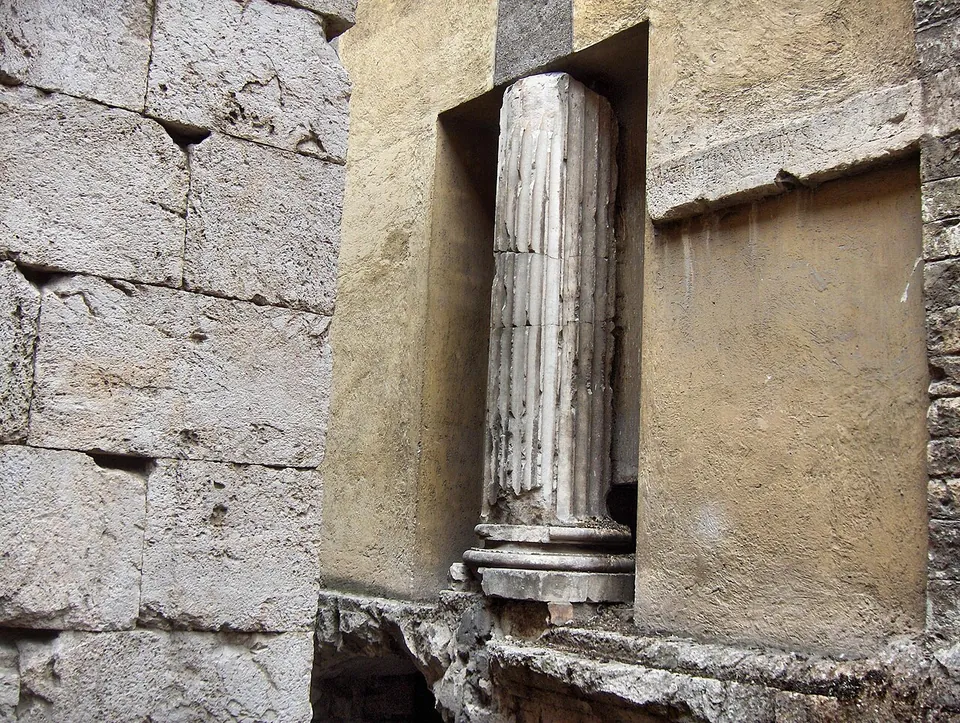
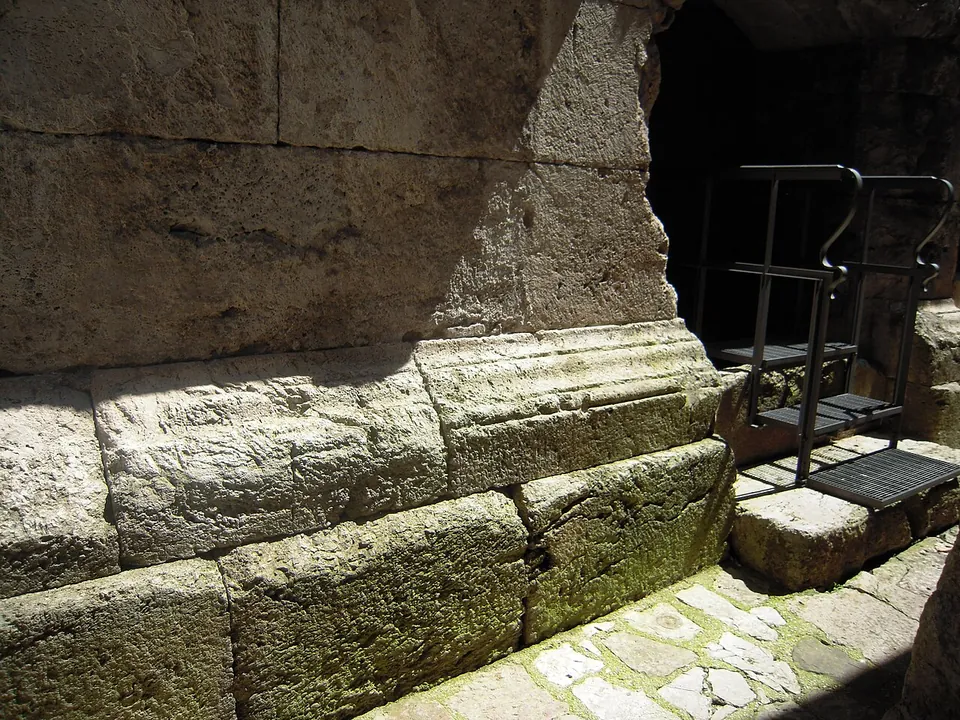
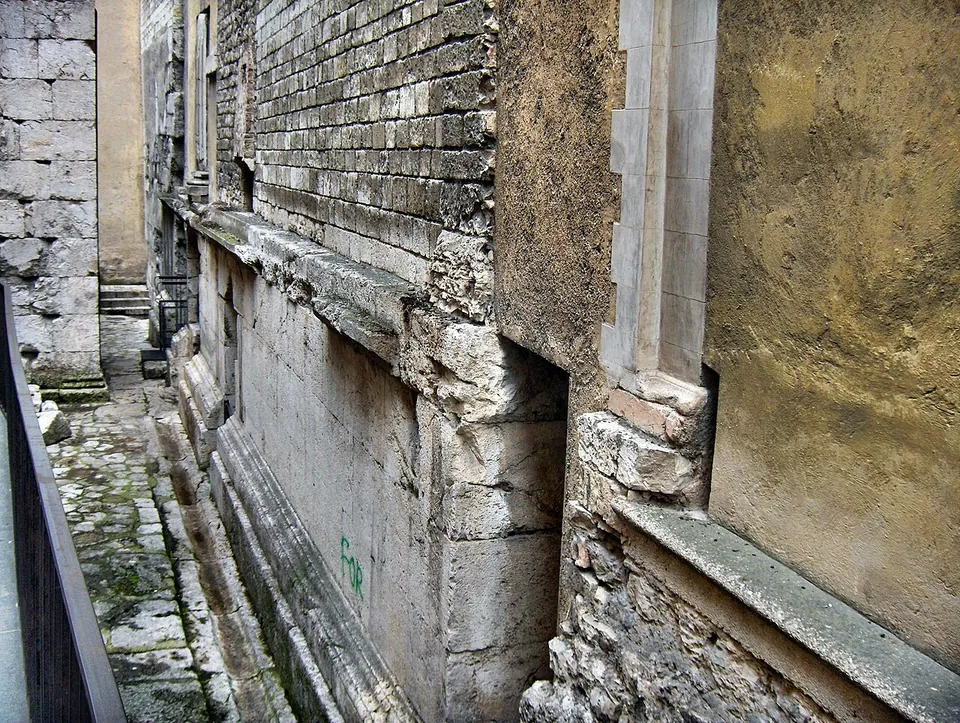
The temple faced the forum, today’s Piazza del Mercato. It was isolated almost completely in excavations of 1955–1957, and its cella wall was restored to serve as the outer wall of the church (it.wikipedia). What survives is the podium of large squared blocks, part of a fluted column found still in place, and a restored fragment of the marble entablature with its carved mouldings; to suggest the porch, the outlines of the missing columns were painted on the plaster. When complete, the temple was about 17 m long and 9 m wide, with a porch of six fluted marble columns on a podium about 3 m high, reached from the forum by a flight of steps (it.wikipedia). Its dedication is not known.
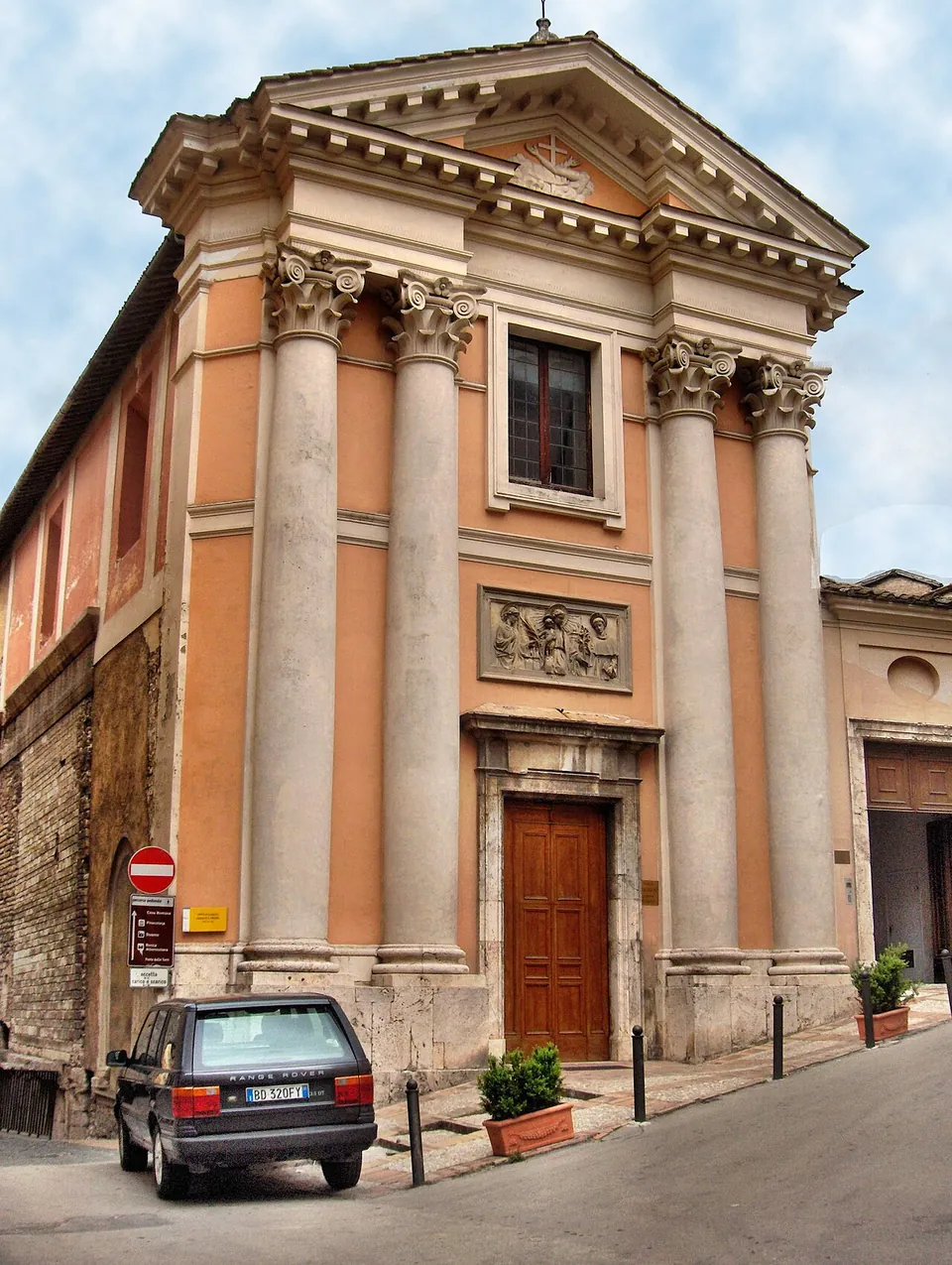
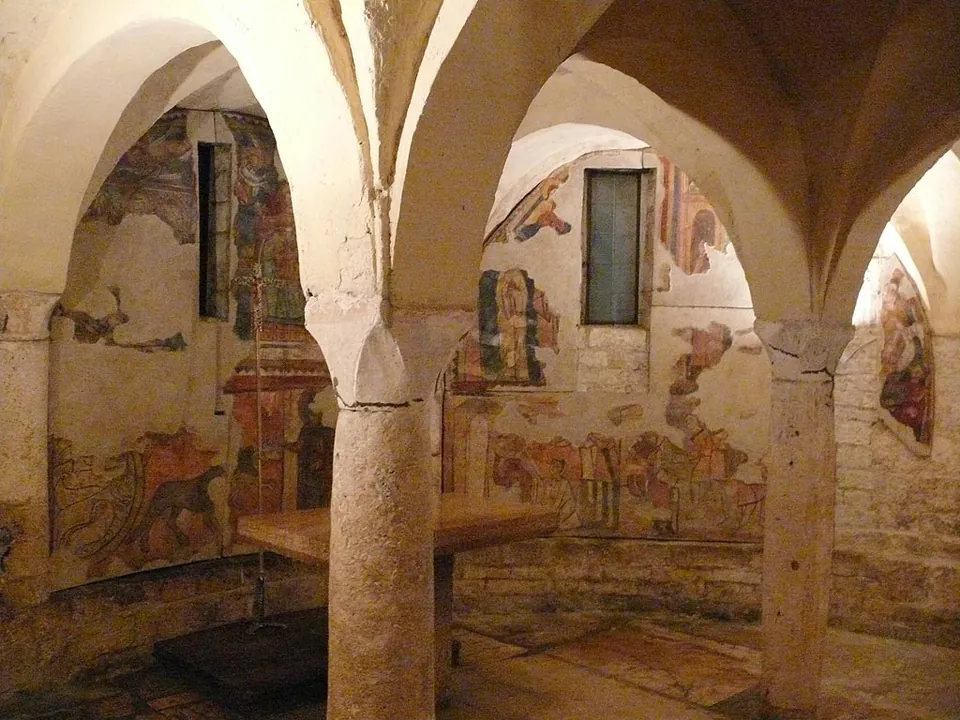
Inside, under the presbytery, an iron grating shows paving of both Roman and medieval date, and stairs lead down to the crypt of Sant’Isacco, which uses the temple’s old steps to link it to the church above (it.wikipedia). The crypt has three small aisles divided by reused columns, capitals dated to the 8th–9th century, and fragmentary frescoes of the 11th–12th century, though when the crypt was built is disputed (it.wikipedia). The church itself is neoclassical, rebuilt by Antonio Dotti in the late 18th century, with a fresco by Lo Spagna and an altarpiece by Archita Ricci (it.wikipedia; Comune di Spoleto).
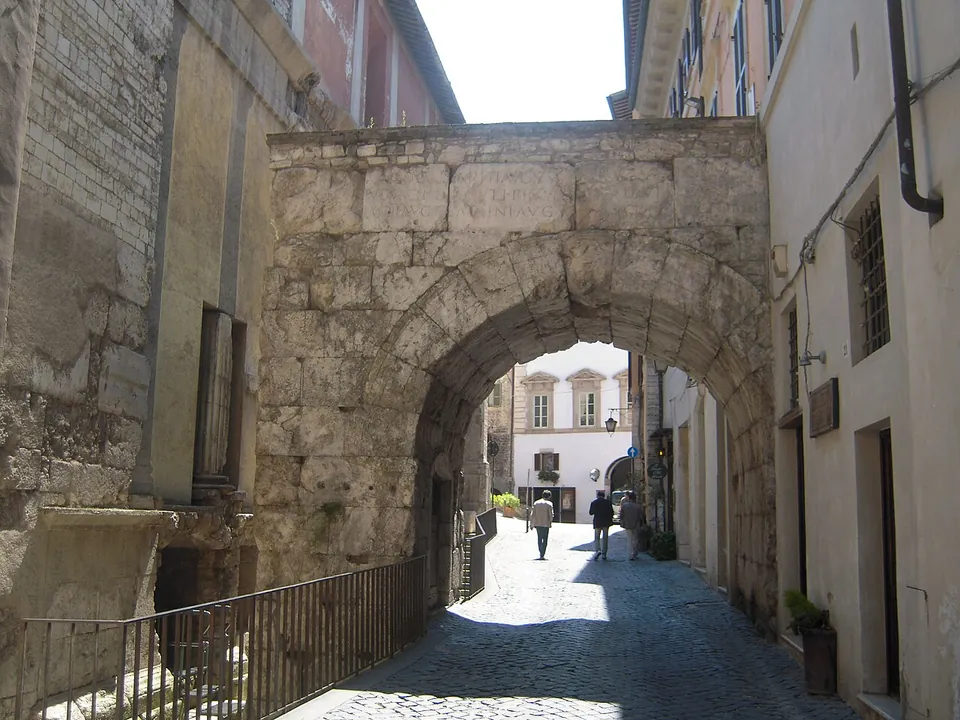
The Arch of Drusus and Germanicus spans the street immediately beside the church. It is built of squared blocks of local limestone, survives up to the entablature over its single opening, and has one pier built into later houses; Corinthian pilasters frame its outer corners, and a fragmentary dedication is cut in the masonry above the arch (it.wikipedia).
The town’s Roman theatre, about 145 m away (OpenStreetMap) inside the archaeological museum, is described, with its hours and tickets, on the Spoletium – Spoleto page.
Is it worth the trip?
As part of a visit to Spoleto, yes: the arch and the temple wall cost nothing and take a few minutes. They are fragments built into a later street and a later church, not a ruin field, so on their own they would not justify a detour to Spoleto; with the theatre and its museum and the town’s other Roman stops, all on the Spoletium – Spoleto page, they make a fuller visit. The crypt is the part to plan around: whether the church is open is not published, and seismic strengthening and restoration of the church, under the reconstruction programme for the 2016 earthquakes, was approved in December 2024 (sisma2016.gov.it), so it may be shut when you arrive.
Getting there
The church stands at the corner of Via Brignone and Via dell’Arco di Druso (Comune di Spoleto), in the upper town. One of the town’s mechanised walkways comes out at Piazza del Mercato, about 180 m away; Spoleto station is about 1.7 km away. A request bus stop is a little over 200 m away, and a paid car park about 180 m (OpenStreetMap). A history board for the complex stands about 30 m from the church.
The arch and the outside of the temple are in a public street and cost nothing to see. No hours or admission are published for the church and crypt (searched 20 October 2026).
Visiting details
- Opening hours
- Arch of Drusus and Germanicus and the outer side of the temple: in a public street. Church of Sant'Ansano and crypt of Sant'Isacco: no published hours.
- Tickets
- The arch and the temple's outer side cost nothing to see. No admission is published for the church and crypt.
- Parking
- A paid surface car park about 180 m away (OSM way/205180161); the walkway up from the lower town comes out at Piazza del Mercato, also about 180 m away (OSM node/5219333128).
Before you go
- Whether the church, and with it the crypt and the temple remains inside, is open is not published. Seismic repair and restoration works on the church were approved in December 2024.
Hours and prices checked 20 October 2026 on the operator's own site. Confirm before travelling.
History
The local senate put up the arch in AD 23 in honour of Drusus the Younger and Germanicus, the son and the adopted son of the emperor Tiberius, on the death of Drusus; Germanicus had died in 19. It was the monumental entrance to the forum from the Via Flaminia (it.wikipedia). The temple beside it is dated to the 1st century AD by its podium and by fragments of Arretine pottery found in the excavations (it.wikipedia).
After pagan worship ended, a Christian church probably took over the whole temple at some point between the Paleo-Christian period and the early Middle Ages, keeping its orientation towards the forum. It was dedicated to Isaac, a Syrian monk who came to Spoleto in the first half of the 6th century and lived as a hermit on Monteluco. Earth washing down the slope probably raised the street on the south side, and around the 12th century the new church of Sant’Ansano and Isaac was built onto the old one facing the other way, with its front to the south; the old level by the forum became the crypt. An inscription, lost and known only from a later transcription, recorded its consecration in 1164 (it.wikipedia).
The temple was found again in 1900, when the Spoleto archaeologist Giuseppe Sordini uncovered a stylobate next to the arch, and the shaft of a fluted column was found still in place. Work stopped often for lack of money and ended in 1939, when the friars who held the church refused to let it continue. Umberto Ciotti, superintendent of monuments for Umbria, resumed it in 1955–1957, demolishing two chapels, the bell tower and a small portico to expose the temple, which also gave a clearer view of the left pier of the arch; further excavations in 1969–1971 found the threshold of the cella (it.wikipedia).
More photographs



Nearby
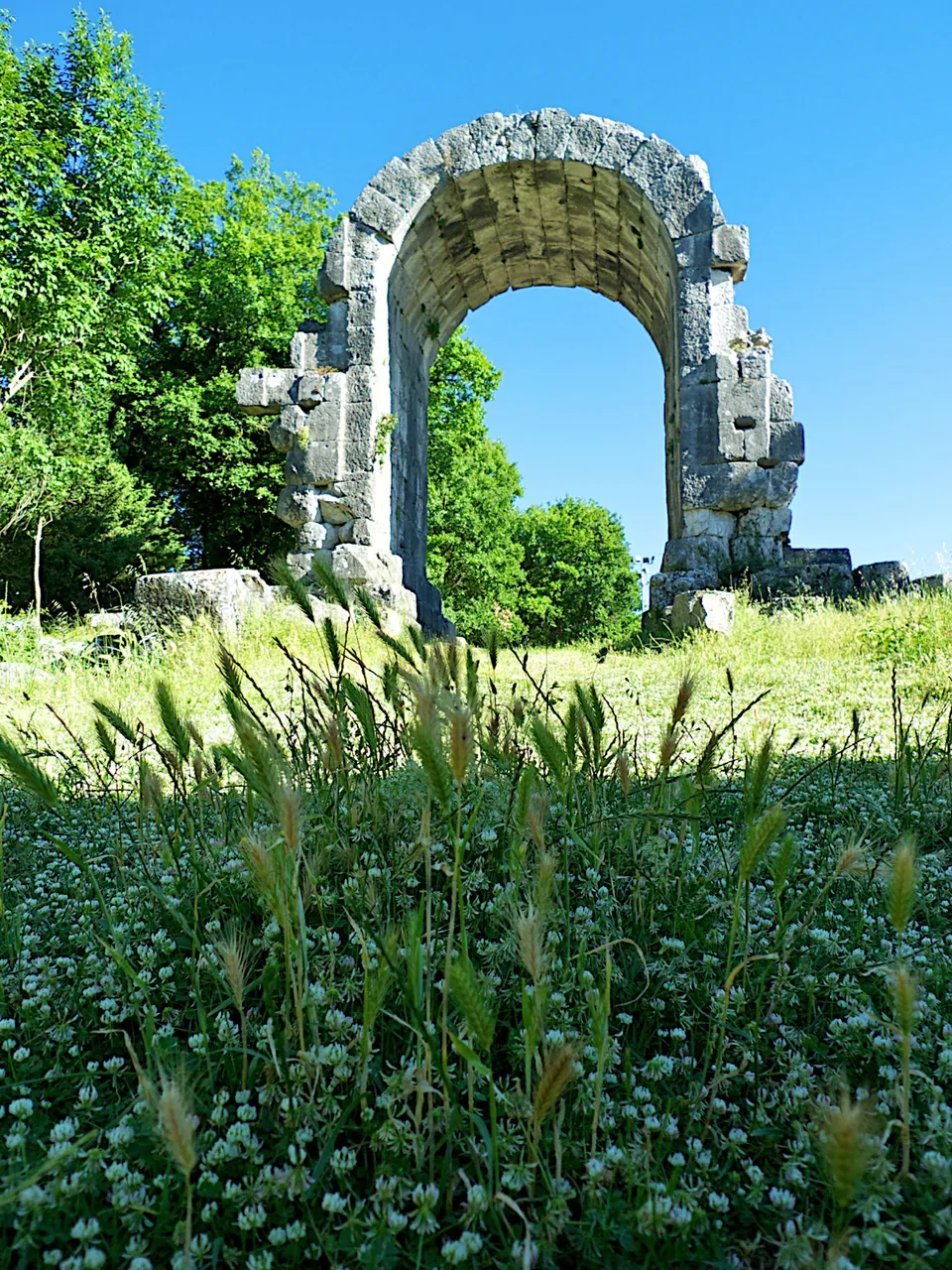
Photo: Jan Hazevoet · CC BY 3.0 · Commons
18 km · city · Umbria
Carsulae
The ticketed area is a fenced expanse of meadow and trees of 22 hectares (it.wikipedia).
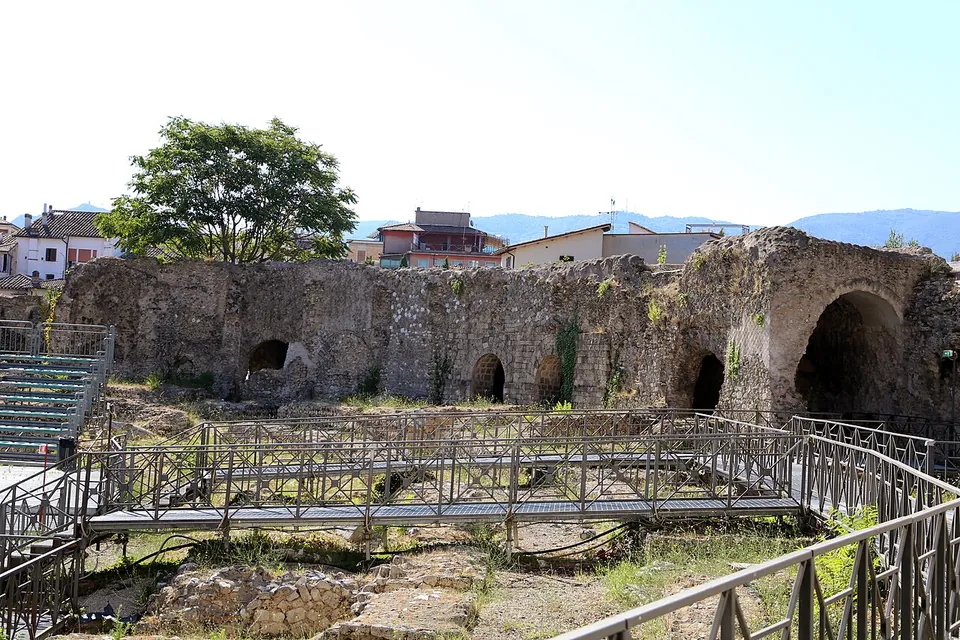
Photo: Sailko · CC BY-SA 4.0 · Commons
21 km · amphitheatre · Umbria
Anfiteatro Fausto
The oval is still easy to read on the ground, about 97.5 by 73 m overall (it.wikipedia).
Photo: ImagoAnimae · CC BY-SA 3.0 · Commons


Straight-line distances.
Sources
Every fact on this page comes from the records below, each used under the licence noted.