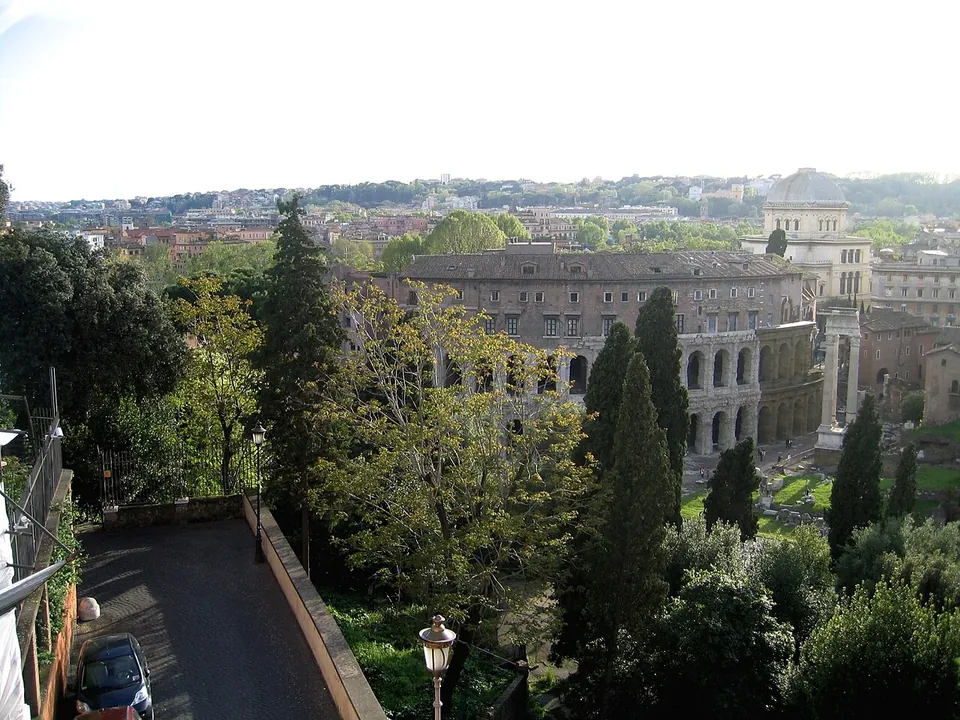
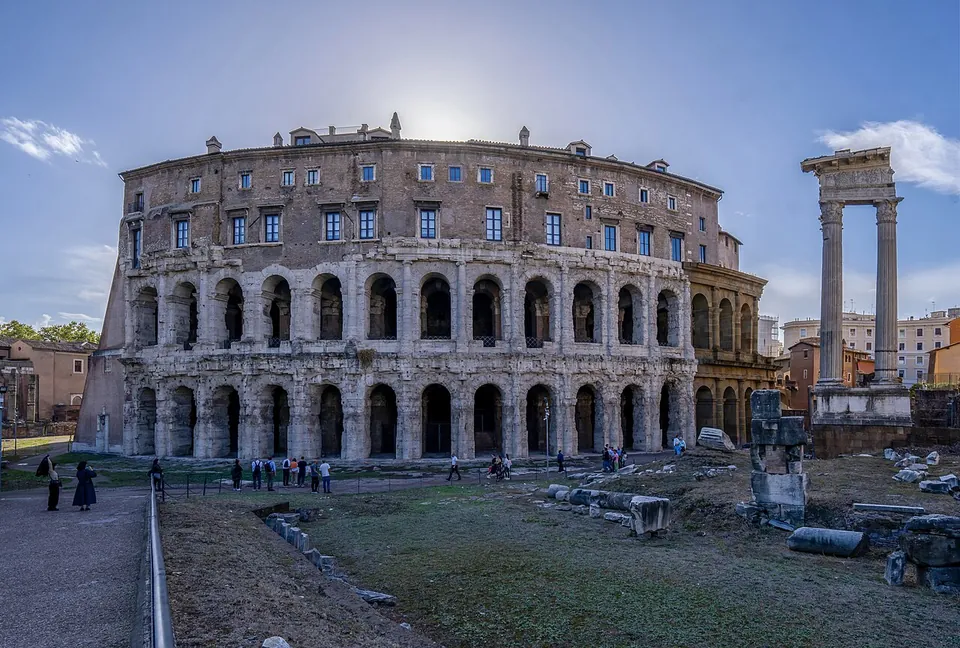


The Theatre of Marcellus is the theatre Augustus completed in about 13 BC between the Capitoline Hill and the Tiber, and the only Roman theatre in the city still standing to any height: two storeys of its curved travertine arcades carry a Renaissance palazzo on top (en.wikipedia; fr.wikipedia; it.wikipedia). It is seen from outside only, free, and around it lies a cluster of smaller Roman remains, from temple columns to the oldest bridge in Rome still in its original state.
What is there today
The theatre. What survives is the curved travertine façade, about 20 m of an original height of about 32.6 m: a ground storey of arches framed by Doric half-columns and a second storey framed by Ionic ones, with only traces left of the third (it.wikipedia). The keystones of the arches once carried colossal marble theatre masks (Turismo Roma). Above the arches stands the palazzo built on the ruin in the 16th century, which still stands and is in use (it.wikipedia; en.wikipedia). The arches were cleared of the shops and houses that filled them in 1926–1932 (it.wikipedia), and a footpath through the archaeological area, between Via Montanara and the Portico d’Ottavia, now lets you walk up to the edge of the arcades (Turismo Roma).
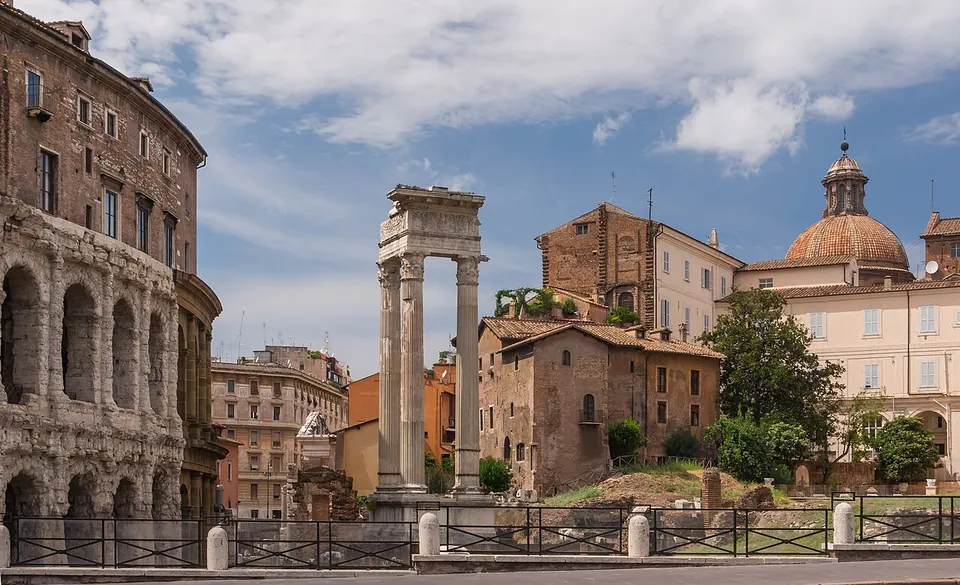
The temples beside it. Next to the theatre, three white marble Corinthian columns of the Temple of Apollo Sosianus stand on their podium; they belong to the temple’s Augustan rebuilding and were re-erected in 1940, probably not in their original positions (en.wikipedia; Turismo Roma). Of the Temple of Bellona beside it only the concrete core of the podium is left (Turismo Roma), with the church of Santa Rita, moved here in the 1930s, standing on it (it.wikipedia).
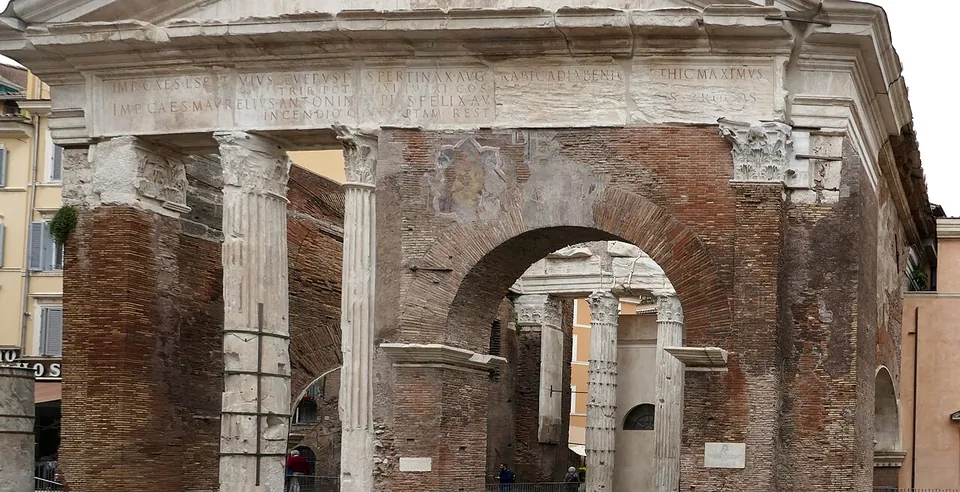
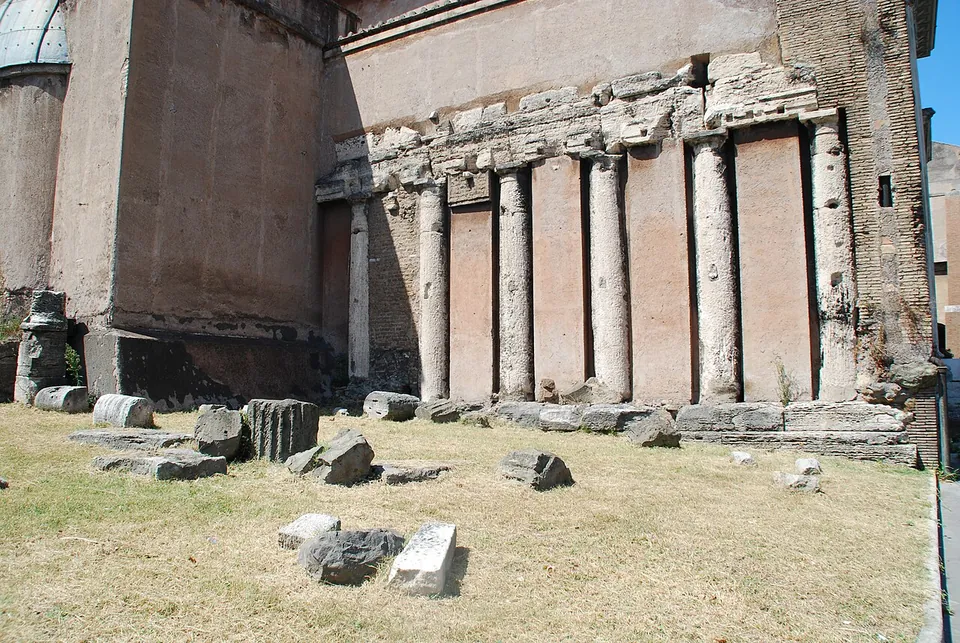
Around the corner. About 100 m north-west, the Porticus Octaviae is the gateway of the colonnaded enclosure Augustus dedicated to his sister Octavia. What stands is the central entrance as rebuilt under Septimius Severus and Caracalla, whose restoration inscription is cut into the architrave, and the arch that replaced two of its columns after an earthquake in 442 (it.wikipedia; en.wikipedia). Two columns of the Temple of Juno Regina, which stood inside the enclosure, survive in the surrounding houses (it.wikipedia). About 100 m south, the church of San Nicola in Carcere is built into three small Republican temples of the Forum Holitorium, Rome’s vegetable market: columns of one stand in its façade, columns of the others in its side walls, and the remains of the largest lie in the church’s underground rooms (it.wikipedia, Foro Olitorio; en.wikipedia, San Nicola in Carcere; Turismo Roma).
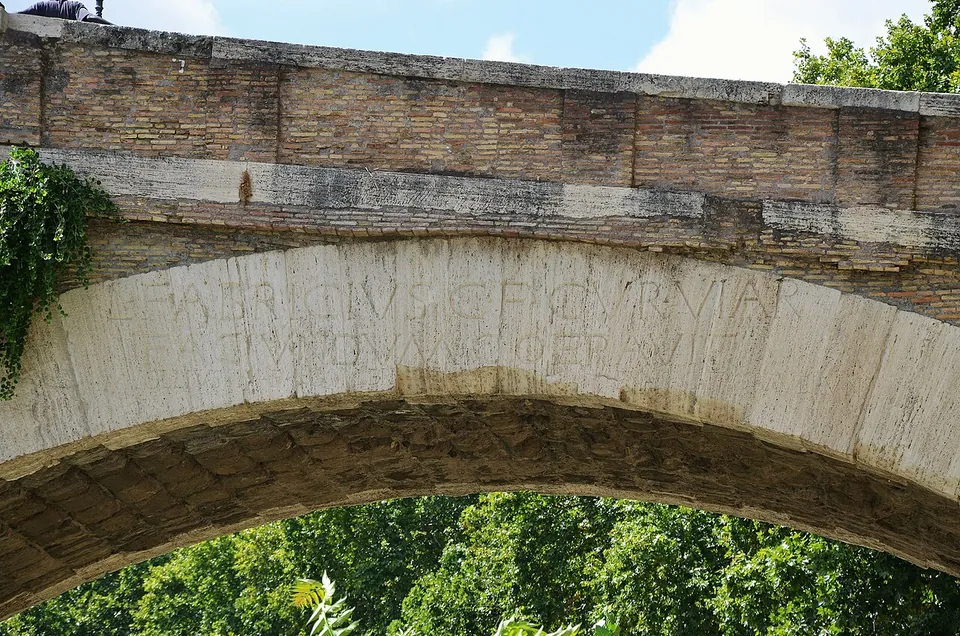
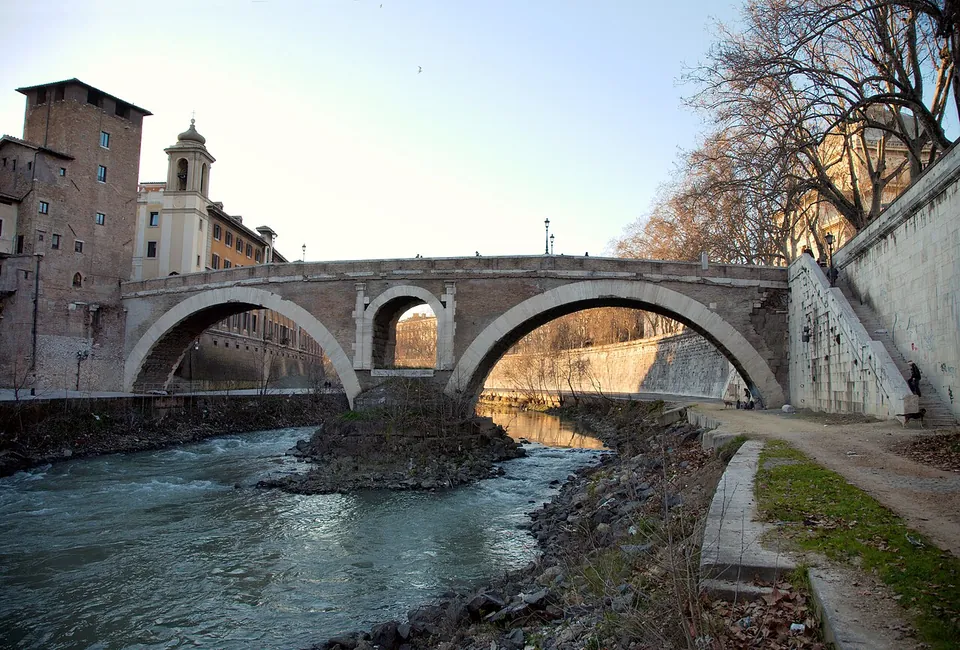
The bridges. About 150 m south-west, the Pons Fabricius crosses to the Tiber Island. Built in 62 BC, it is the oldest bridge in Rome still in its original state, in use ever since, and its builder’s name is cut into the arches (Wikidata; en.wikipedia). The Pons Cestius, which continues from the island to Trastevere, is ancient in no more than a third of its fabric, having been rebuilt when the Tiber was embanked in 1888–1892 (en.wikipedia). On the island, of the Temple of Aesculapius only some travertine blocks remain under modern buildings, among them a relief of the god’s staff (it.wikipedia). The map also marks other temples recorded around the theatre; no source describes anything to see at them.
Is it worth the trip?
Yes, as a stop on foot rather than as a destination of its own. You cannot go in, so the visit is the outside of the building, and that is enough: an ancient theatre wall with a palace grown on top of it shows at a glance how Rome lived on in its ruins. With the temple columns, the Porticus Octaviae and the walk out to the Pons Fabricius, it makes an unhurried free hour beside the old Jewish quarter. In summer the area round the theatre is used for small concerts (en.wikipedia).
Getting there and what it costs
The nearest mapped bus stops, Piazza Monte Savello, are about 110 m from the theatre, and a paid car park is about 80 m away (OpenStreetMap). OpenStreetMap marks the archaeological area as wheelchair accessible.
There is nothing to pay. Roma Capitale’s tourism site gives the building as visible only from outside and lists no charge or opening hours for the archaeological area around it (Turismo Roma, read 16 October 2026). The Pons Fabricius is still a working bridge (en.wikipedia). San Nicola in Carcere is a working church; the city’s tourism site publishes no hours for it and refers visits to the temple remains underneath to a telephone booking line (Turismo Roma).
Visiting details
- Opening hours
- The theatre is seen only from outside. Roma Capitale publishes no opening hours for the archaeological area around it, whose footpath runs between Via Montanara and the Portico d'Ottavia.
- Tickets
- No ticket is listed. The city's tourism site gives the building as visible from outside only and names no charge for the archaeological area.
- Parking
- A paid surface car park is mapped about 80 m from the theatre (OSM way/123530509).
Before you go
- The inside of the theatre is not open to visitors; the Renaissance palazzo built on top of the arcades is still in use.
Hours and prices checked 16 October 2026 on the operator's own site. Confirm before travelling.
History
Julius Caesar cleared the ground for a theatre to rival Pompey’s, demolishing temples on the site, but was killed before it was built; Augustus bought more land and built a larger theatre (en.wikipedia; it.wikipedia). It was in use by 17 BC, when part of the Secular Games was staged there (en.wikipedia; it.wikipedia), and was named after Marcus Claudius Marcellus, Augustus’s nephew and intended heir, who died young (en.wikipedia; Turismo Roma). Published dates for its inauguration run from 13 to 11 BC (en.wikipedia; it.wikipedia; Turismo Roma; Pleiades).
It was the largest theatre in ancient Rome (en.wikipedia). Published figures for its diameter run from 111 to 130 m, and estimates of its audience from 11,000 to 20,000; a catalogue of the late 4th century recorded 17,580 seats (en.wikipedia; it.wikipedia; Turismo Roma). It is built of tuff and concrete faced in travertine, and is the earliest dateable building in Rome to use fired brick (en.wikipedia). Its stage building, restored several times, is entirely lost and known from the Severan marble plan of the city (it.wikipedia).
Vespasian and Alexander Severus restored it (it.wikipedia; Turismo Roma). By the late 4th century it was being quarried, its travertine probably going into the rebuilt Pons Cestius in 370, though its statues were still restored in 421 (en.wikipedia; it.wikipedia). In the Middle Ages the Fabi and then the Pierleoni made it a fortress, which saved it from further destruction; in the 16th century Baldassarre Peruzzi built a palazzo on the arcades, for the Savelli according to it.wikipedia and the city’s tourism site, and the Orsini owned it later (en.wikipedia; it.wikipedia; Turismo Roma). By the 1920s the arches were buried about 4 m deep; the city bought the ancient part and cleared and restored it between 1926 and 1932 (it.wikipedia; Turismo Roma).
The neighbours are older. The cult of Apollo was here by the mid-5th century BC, and his temple was rebuilt by Gaius Sosius, probably from 34 BC (en.wikipedia). The Temple of Bellona was vowed in 296 BC (it.wikipedia). The Forum Holitorium temples date from the 3rd and early 2nd centuries BC (it.wikipedia; en.wikipedia, San Nicola in Carcere). The Porticus Octaviae replaced the portico Metellus built after his triumph of 146 BC; it burned in AD 80 and 203 and was restored each time (Pleiades), and from the Middle Ages until 1885 its gateway sheltered the city’s fish market (it.wikipedia).
More photographs




Nearby
Photo: MumblerJamie · CC BY-SA 2.0 · Commons
12 km · villa · Lazio
Villa of Livia
The operator describes the private wing with the bedrooms of Livia and the emperor, an atrium and a small inner garden, and the large reception rooms that open onto a peristyle; the rooms once had painted walls and floors of mosaic and cut marble (Soprintendenza Speciale di Roma).
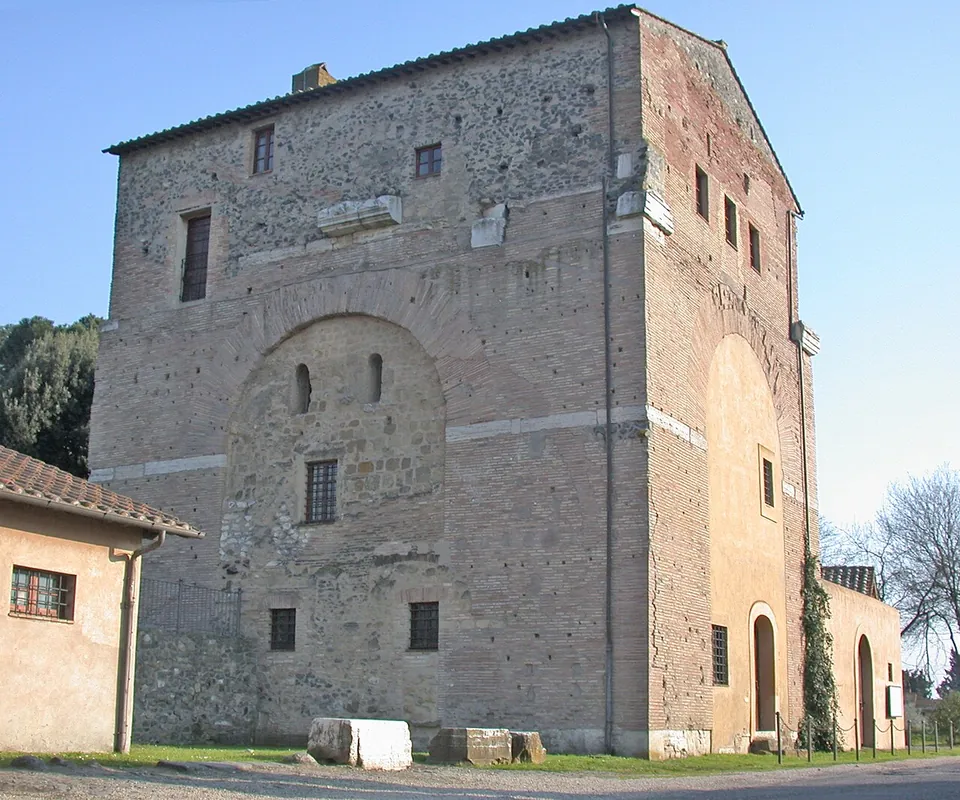
Photo: MM · Public domain · Commons
18 km · arch · Lazio
Arch of Malborghetto
At first sight you see an austere farmhouse rather than an arch (it.wikipedia).
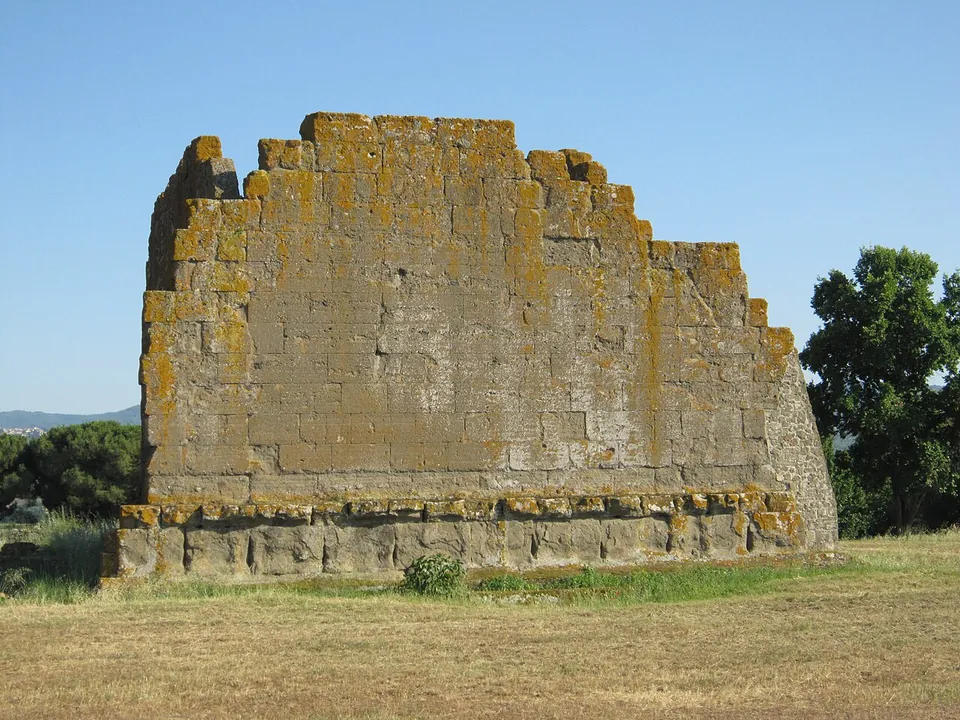
Photo: Carlomorino · CC BY-SA 3.0 · Commons
20 km · city · Lazio
Gabii
The park the state holds covers about 70 hectares on the southern rim of a volcanic crater whose lake was drained in the 19th century (the operator; en.wikipedia).


Straight-line distances.
Sources
Every fact on this page comes from the records below, each used under the licence noted.
| Source | Licence |
|---|---|
| Pleiades 300583267 | CC BY |
| Wikidata Q659138 | CC0 |
| OpenStreetMap way/86217821 | ODbL |
| Wikipedia (en) — Theatre of Marcellus | CC BY-SA 4.0 |
| Wikipedia (it) — Teatro di Marcello | CC BY-SA 4.0 |
| Wikipedia (fr) — Théâtre de Marcellus | CC BY-SA 4.0 |
| Wikipedia (en) — Temple of Apollo Sosianus | CC BY-SA 4.0 |
| Wikipedia (it) — Tempio di Bellona (Roma) | CC BY-SA 4.0 |
| Wikipedia (en) — Porticus Octaviae | CC BY-SA 4.0 |
| Wikipedia (it) — Portico di Ottavia | CC BY-SA 4.0 |
| Wikipedia (it) — Foro Olitorio | CC BY-SA 4.0 |
| Wikipedia (en) — San Nicola in Carcere | CC BY-SA 4.0 |
| Wikipedia (en) — Pons Fabricius | CC BY-SA 4.0 |
| Wikipedia (en) — Pons Cestius | CC BY-SA 4.0 |
| Wikipedia (it) — Tempio di Esculapio | CC BY-SA 4.0 |
| Pleiades — Porticus Octaviae | licence not recorded |
| Turismo Roma (Roma Capitale) — Teatro di Marcello | licence not recorded |
| Turismo Roma (Roma Capitale) — Basilica di San Nicola in Carcere | licence not recorded |
| Sovrintendenza Capitolina — access to the city's monuments (notice of 24 September 2026) | licence not recorded |