

Santa Pudenziana is a church in the Monti district of Rome, set at the end of the 4th century inside a Roman building of the 2nd, and its apse still has the mosaic made for that first church around 400: Christ enthroned as a Roman teacher among his apostles, one of the oldest Christian mosaics in the city. It is free, about 400 m from Santa Maria Maggiore, but open to visitors only from 09.00 to 11.30, Monday to Saturday, and the Roman remains under the floor are closed for restoration.
What is there today
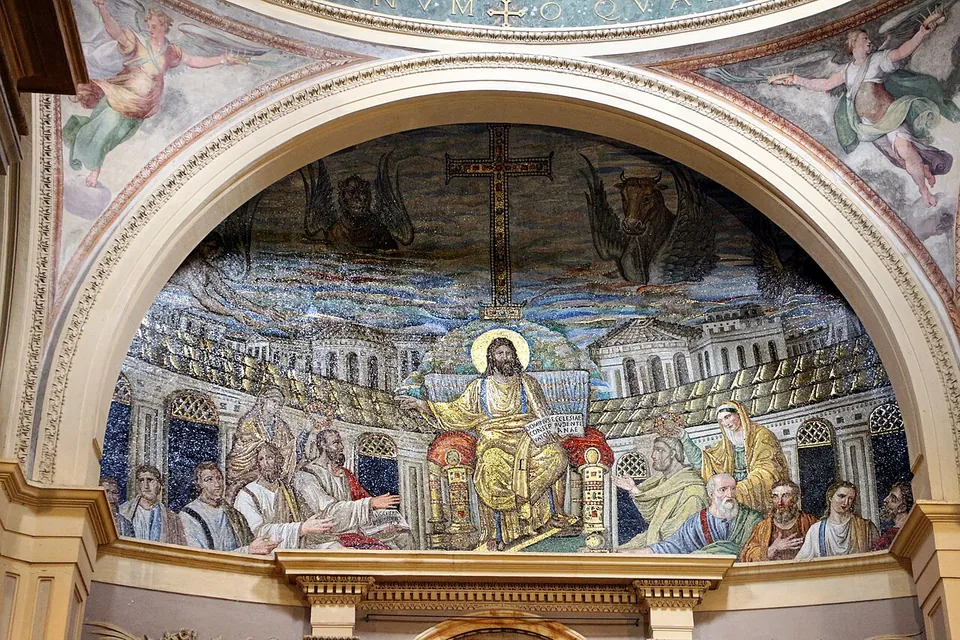
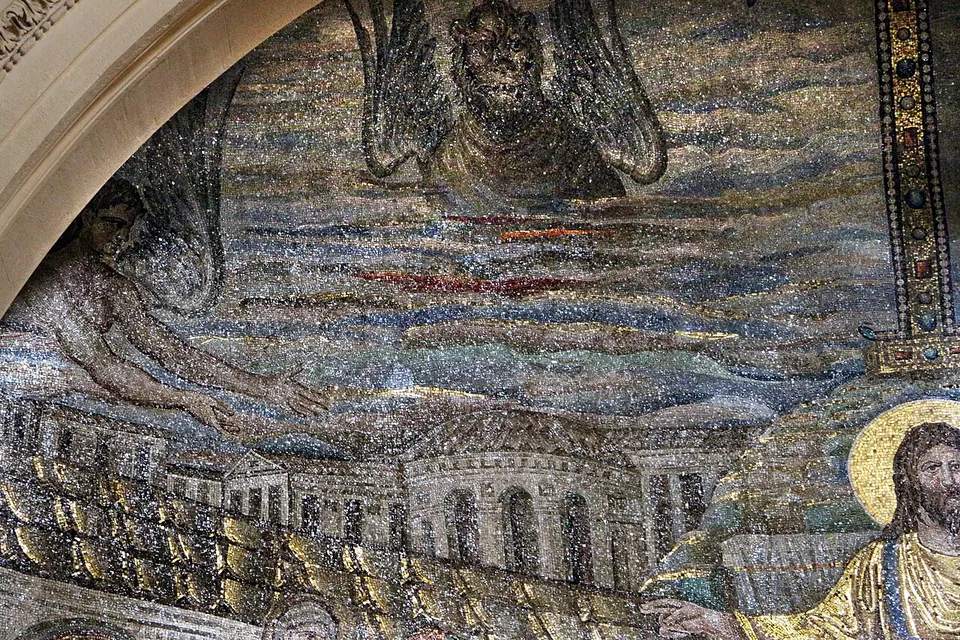
The mosaic is the reason to come. It fills the half-dome of the apse. At the centre Christ, with long hair and beard, sits on a jewelled throne, dressed like an emperor in a golden toga with a purple trim, his right hand raised to speak. The book in his left hand reads Dominus conservator ecclesiae Pudentianae, “the Lord, preserver of the church of Pudentiana”. The apostles sit on either side in senatorial togas (en.wikipedia), and two women hold wreaths over Peter and Paul. They most likely personify the Church of the converted Jews and the Church of the Gentiles (de.wikipedia; it.wikipedia), the earliest known picture of that theme (de.wikipedia). Behind them runs a curved portico roofed in gilded tiles, and over it a city, usually read as the heavenly Jerusalem, with a jewelled cross on the hill of Golgotha. Around the cross are the man, lion, ox and eagle that stand for the four evangelists (de.wikipedia), among the oldest monumental versions of them to survive (it.wikipedia).
The mosaic has not come down whole. When the dome over the sanctuary was built around 1588, and again in restorations of the 18th century, parts were lost, among them two apostles at the edges and much of the lower zone. In the 19th century gaps were filled, and the repairs are plain to see (de.wikipedia). Ten apostles remain (it.wikipedia).
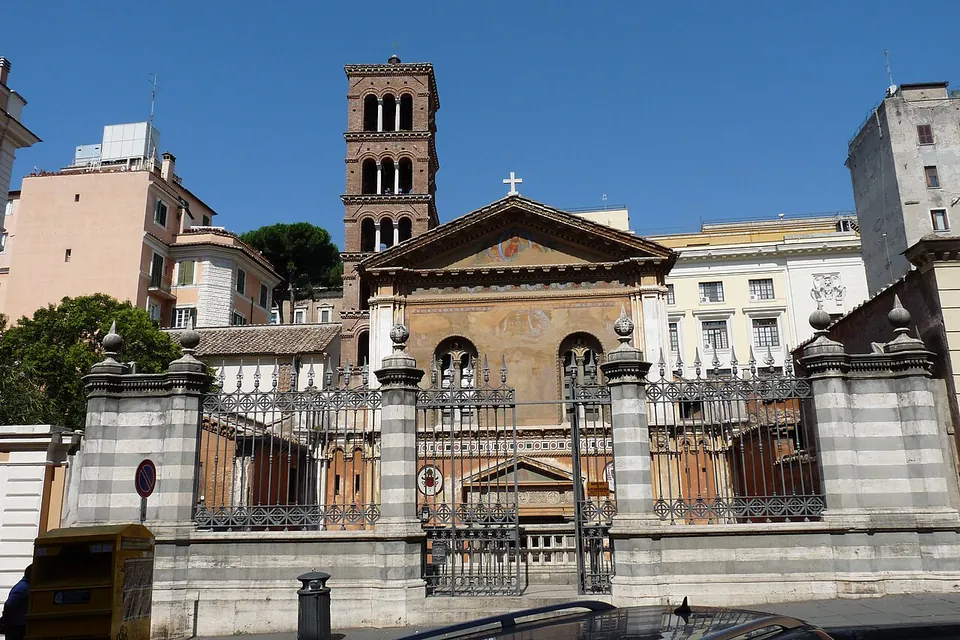
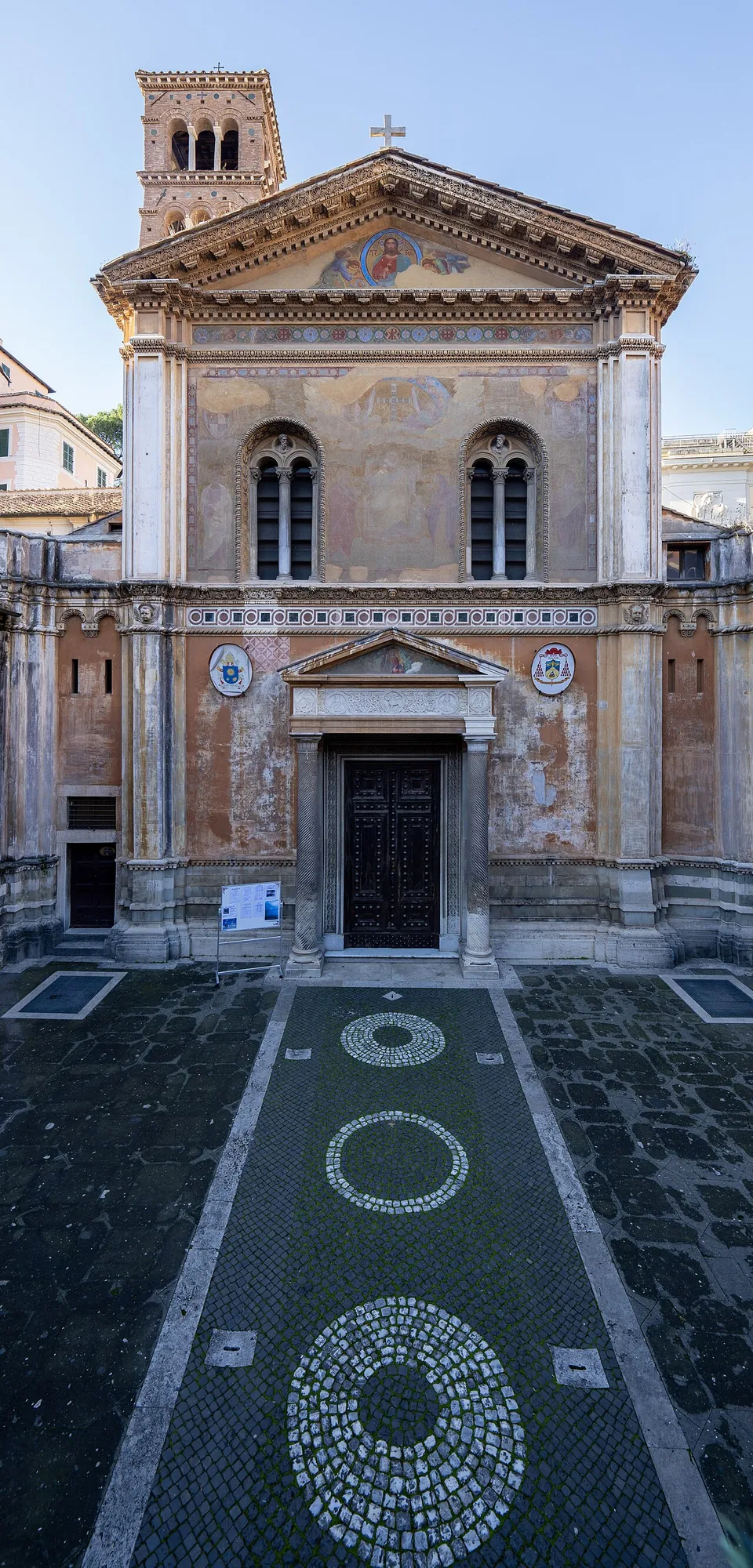
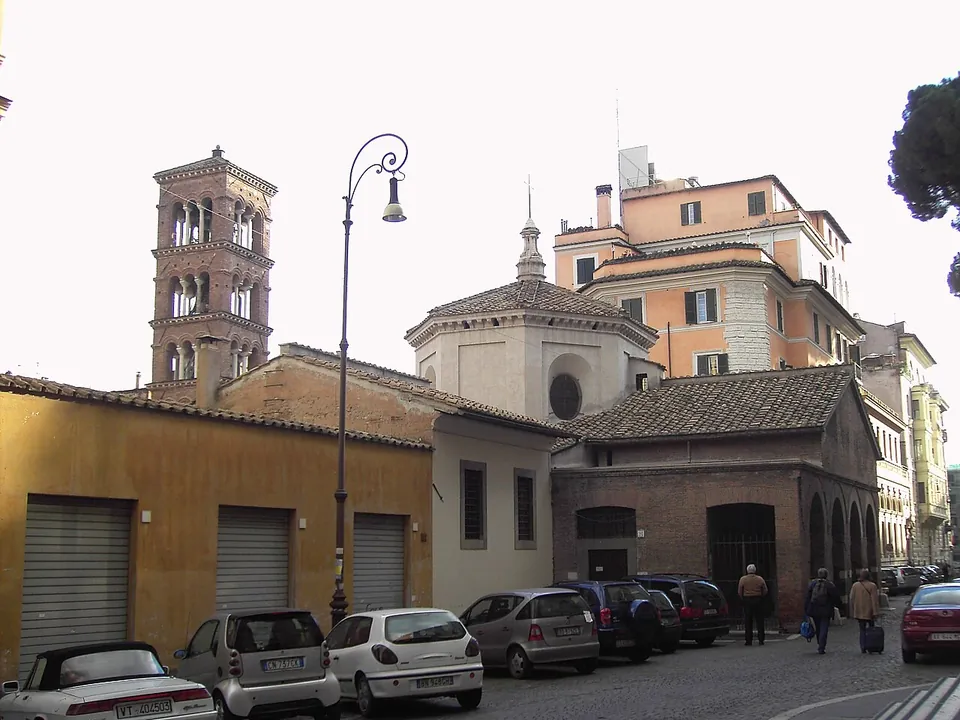
The rest of the church is mostly the work of that remodelling around 1588 (de.wikipedia; it.wikipedia), with the Caetani family chapel off the left aisle, finished in the 1590s (it.wikipedia) and one of the richest family chapels in Rome (de.wikipedia). The church lies about 3 m below Via Urbana, the ancient Vicus Patricius (de.wikipedia), reached down steps of 1870 to a courtyard. The façade was remodelled the same year, reusing a carved frieze from the 11th-century doorway (de.wikipedia; it.wikipedia). The brick bell tower is from the 12th or 13th century (de.wikipedia). Behind the apse, on Via Cesare Balbo, a chapel to the Virgin with paintings of the 9th to 11th centuries stands in the walls of the Roman building, and an entrance there with four open round arches belongs to the 2nd-century remains; it was restored to its original state in 1931 (de.wikipedia).
Under the floor lie remains of Roman buildings of the 1st and 2nd centuries, which were opened to the public only now and then, for safety reasons (de.wikipedia). They have been closed for restoration since July 2024 (the basilica).
Is it worth the trip?
For the mosaic, yes. If you are at Santa Maria Maggiore or the Baths of Diocletian, it is a short walk and it costs nothing. Only the 4th-century mosaics of Santa Costanza are older among Rome’s surviving Christian mosaics (de.wikipedia; it.wikipedia), and the 19th-century historian Ferdinand Gregorovius thought this the most beautiful mosaic in Rome (en.wikipedia).
The catches are practical. On weekdays the church is open to visitors for two and a half hours, in the morning only, so a visit has to be planned. And the Roman part, the building the church was set into, cannot be seen inside at the moment: what you get is a late-antique mosaic in a church remodelled in the 16th century, plus the arcade on Via Cesare Balbo from the street. If you have no interest in early Christian art, it is not a detour to make.
Getting there and what it costs
The church is at Via Urbana 160, in the valley between the Viminal and the Esquiline, about 400 m north-west of Santa Maria Maggiore (the basilica; de.wikipedia). The Baths of Diocletian are about 500 m away. The nearest bus stops, Esquilino/Cavour, are about 100 m away; no public car park is mapped nearby (OpenStreetMap).
Entry is free; the basilica asks for donations. It is open to visitors Monday to Saturday from 09.00 to 11.30, and the basilica’s 2025 schedule also gives Sunday from 09.00 to 18.00. Outside those hours individuals and groups can book a private visit by phone or WhatsApp, on the number given on the basilica’s website (stpudenziana.org, read 20 October 2026). The excavations below the church have been closed for restoration since July 2024. The basilica gave the work at least two years and had announced no reopening date by then.
Visiting details
- Opening hours
- Monday to Saturday 09.00–11.30 for visits. The basilica's 2025 schedule also gives Sunday 09.00–18.00. Visits outside these hours, for individuals or groups, can be booked by phone or WhatsApp on the number given on the basilica's website.
- Tickets
- Free; no ticket. The basilica asks for donations towards its upkeep.
- Parking
- No public car park is mapped nearby; the car parks about 110 m away are private (OpenStreetMap). Bicycle parking about 100 m away.
Before you go
- The archaeological excavations under the church have been closed for restoration since July 2024; the basilica gave the work at least two years and had announced no reopening date when its page was read on 20 October 2026.
- The visiting window on weekdays is only two and a half hours, all of it in the morning.
Hours and prices checked 20 October 2026 on the operator's own site. Confirm before travelling.
Around the church
This place is part of this visit and appears on its map.
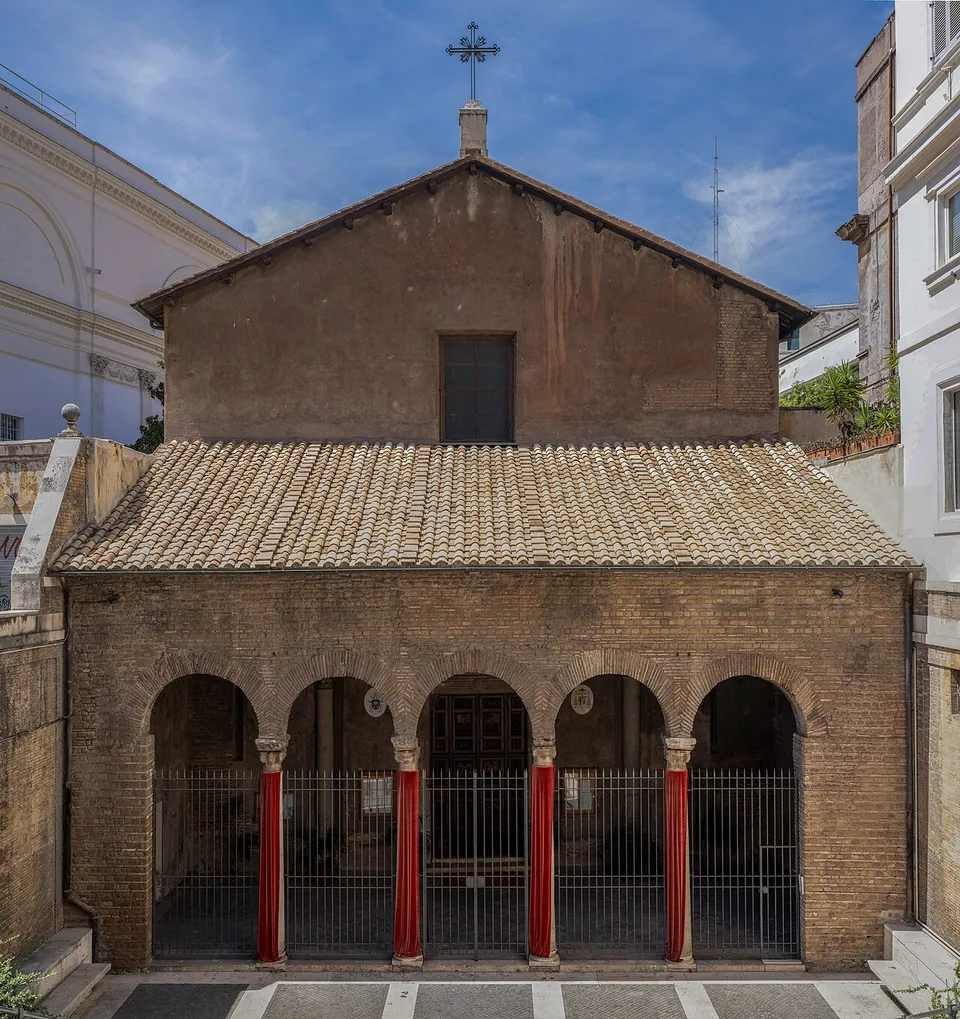
San Vitale. About 400 m away, on Via Nazionale, San Vitale is another early Christian church. It was built around 400 with money from a wealthy woman, Vestina, and consecrated under Pope Innocent I. Published dates differ: consecration in 402 (it.wikipedia; en.wikipedia; the parish), or about 412 after building from 408 (de.wikipedia). It now lies about 6 m below the street, down a broad flight of steps. The portico with its granite columns survives from the early church, as do the lower part of the façade, the massive apse walls, and on the right-hand side the walled-up arcades of the old nave with their columns and capitals; the inside was turned into a single hall in 1475 and frescoed around 1600 (de.wikipedia). It is open every day from 07.45 to 19.00, and in August only from 18.00 to 19.00 (the parish, read 20 October 2026).
History
Tradition holds that the church stands on the house of the senator Pudens, whose daughters Pudentiana and Praxedes were martyrs, and that St Peter stayed there; for centuries it was taken to be the oldest church in Rome (it.wikipedia; the basilica). The documented history begins later. By 384, under Pope Damasus, the titulus Pudentis had been founded here, as the epitaph of its lector Leopardus shows. Under Pope Siricius (384–399) priests paid for the altar area, and the inscription under the apse mosaic says that the church was finished under Innocent I (401–417) (de.wikipedia). The mosaic’s own date is given as about 390 (it.wikipedia), or as the pontificate of either Siricius or Innocent I (en.wikipedia); de.wikipedia puts it around 415.
What the Roman building was is not settled. It was an apsed hall in a larger complex of the 2nd century, perhaps the baths of a private house, the domus Pudentiana. Its bricks carry the stamps of the brickworks of Quintus Servilius Pudens, of a known Roman family of that century, which may also have owned the house (de.wikipedia). Restoration in the 1940s led to the view that the walls belonged to the 2nd-century Baths of Novatus, while more recent studies reject a bath building, because no basins, water channels or pools have been found (it.wikipedia). Pleiades records the church as the successor of the Baths of Novatus.
In turning the hall into a church, the builders kept its piers and upper windows, made an apse of its flat west wall and the side corridors into aisles; the church measured about 27.5 by 17 m. Pope Hadrian I (772–795) lengthened it by two bays and replaced the piers with late antique columns carrying 4th-century capitals (de.wikipedia). The remodelling of about 1588, for Cardinal Enrico Caetani, by Francesco da Volterra, gave the church its present form (de.wikipedia; it.wikipedia). It is today the national church of the Filipinos in Rome (it.wikipedia).
More photographs



Nearby
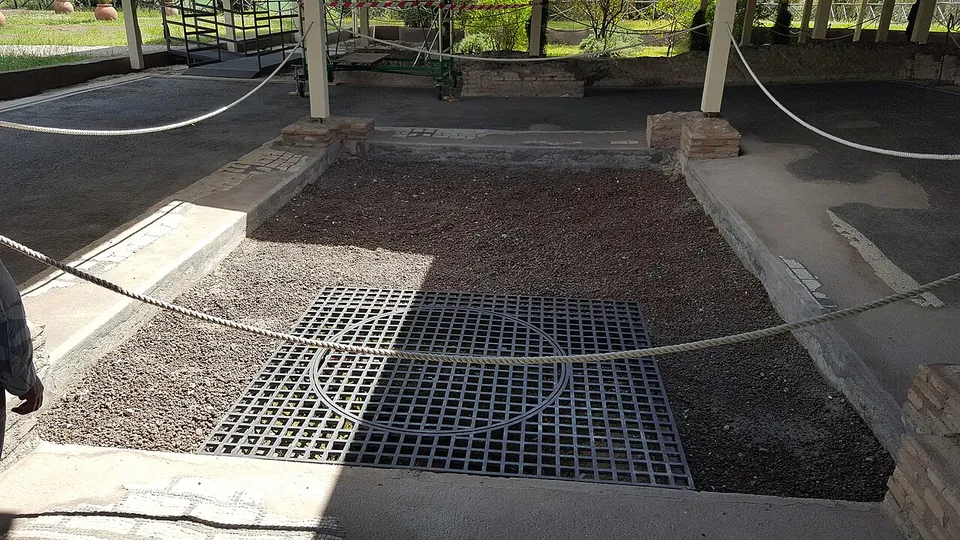
Photo: MumblerJamie · CC BY-SA 2.0 · Commons
12 km · villa · Lazio
Villa of Livia
The operator describes the private wing with the bedrooms of Livia and the emperor, an atrium and a small inner garden, and the large reception rooms that open onto a peristyle; the rooms once had painted walls and floors of mosaic and cut marble (Soprintendenza Speciale di Roma).
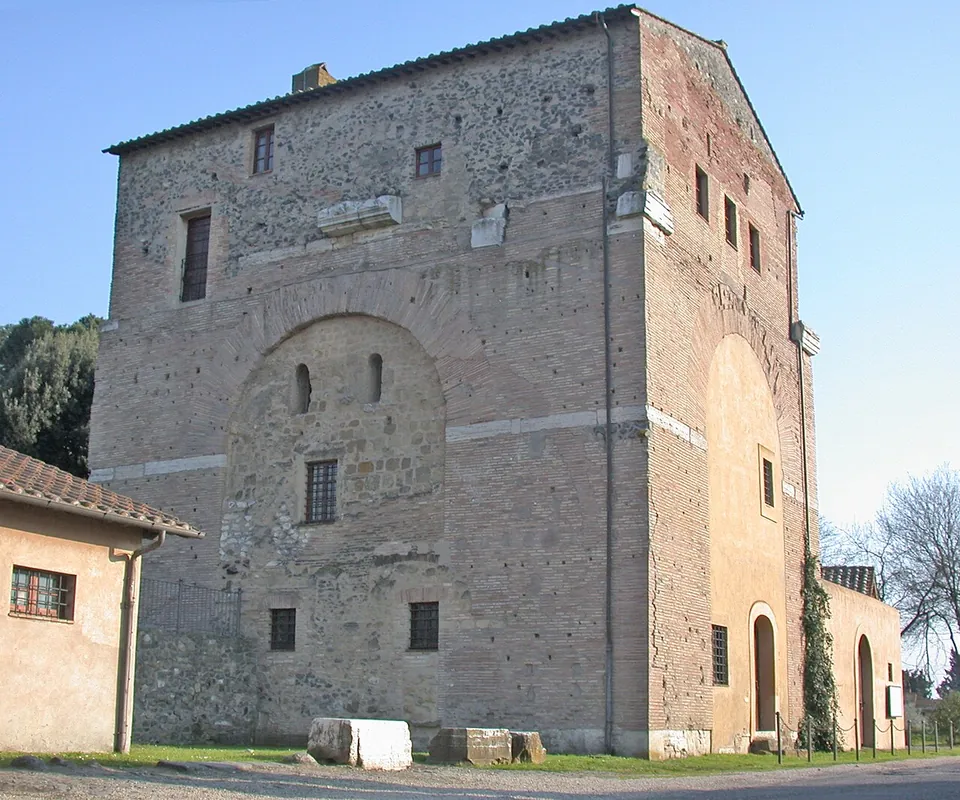
Photo: MM · Public domain · Commons
17 km · arch · Lazio
Arch of Malborghetto
At first sight you see an austere farmhouse rather than an arch (it.wikipedia).
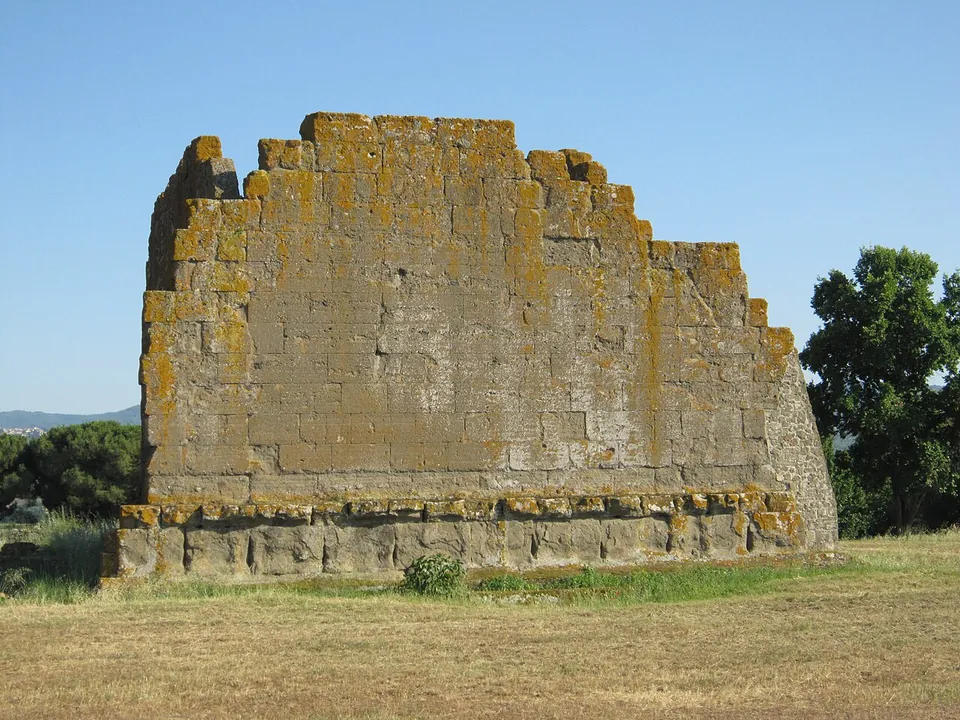
Photo: Carlomorino · CC BY-SA 3.0 · Commons
19 km · city · Lazio
Gabii
The park the state holds covers about 70 hectares on the southern rim of a volcanic crater whose lake was drained in the 19th century (the operator; en.wikipedia).


Straight-line distances.
Sources
Every fact on this page comes from the records below, each used under the licence noted.
| Source | Licence |
|---|---|
| Pleiades 626333929 | CC BY |
| Wikidata Q1526417 | CC0 |
| OpenStreetMap way/112796242 | ODbL |
| Wikipedia (de) — Santa Pudenziana | CC BY-SA 4.0 |
| Wikipedia (it) — Basilica di Santa Pudenziana | CC BY-SA 4.0 |
| Wikipedia (en) — Santa Pudenziana | CC BY-SA 4.0 |
| Wikipedia (fr) — Basilique Santa Pudenziana | CC BY-SA 4.0 |
| Basilica di Santa Pudenziana — opening hours and news (the basilica's own site) | licence not recorded |
| Basilica di Santa Pudenziana — Basilica schedule 2025 (PDF) | licence not recorded |
| Wikipedia (de) — San Vitale (Rom) | CC BY-SA 4.0 |
| Wikipedia (it) — Basilica di San Vitale (Roma) | CC BY-SA 4.0 |
| Wikipedia (en) — San Vitale, Rome | CC BY-SA 4.0 |
| Basilica di San Vitale — opening hours (the parish's own site) | licence not recorded |