

What is there today
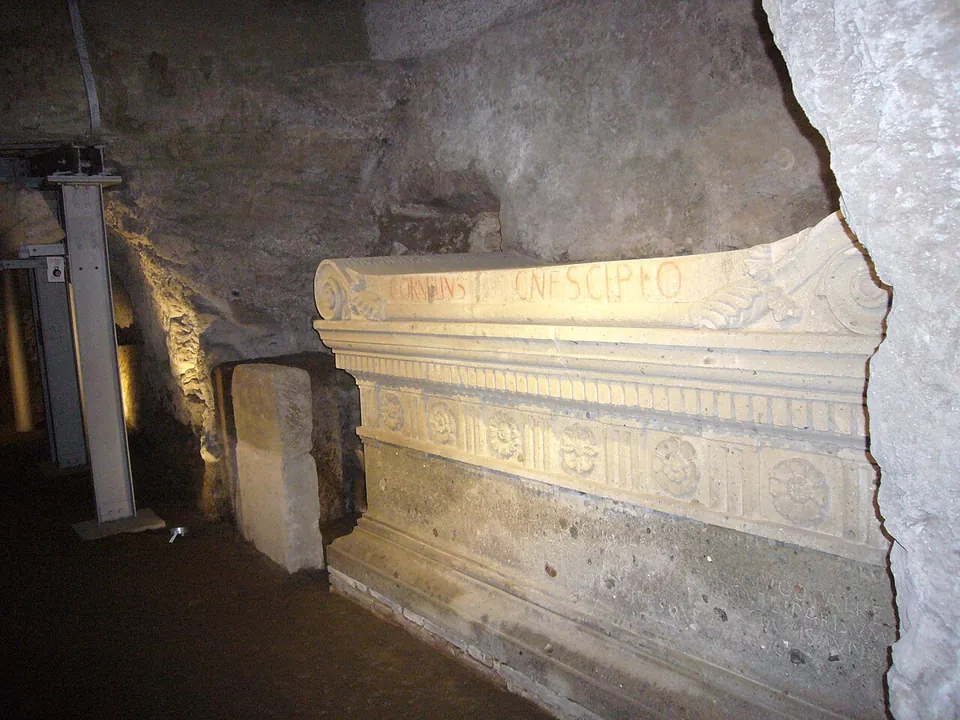
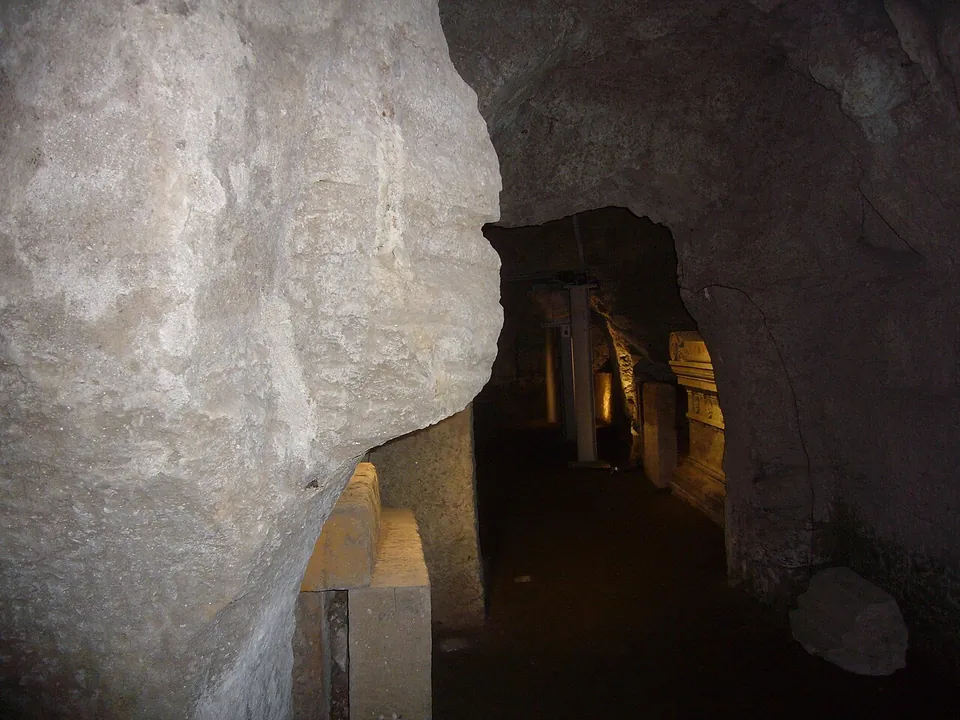
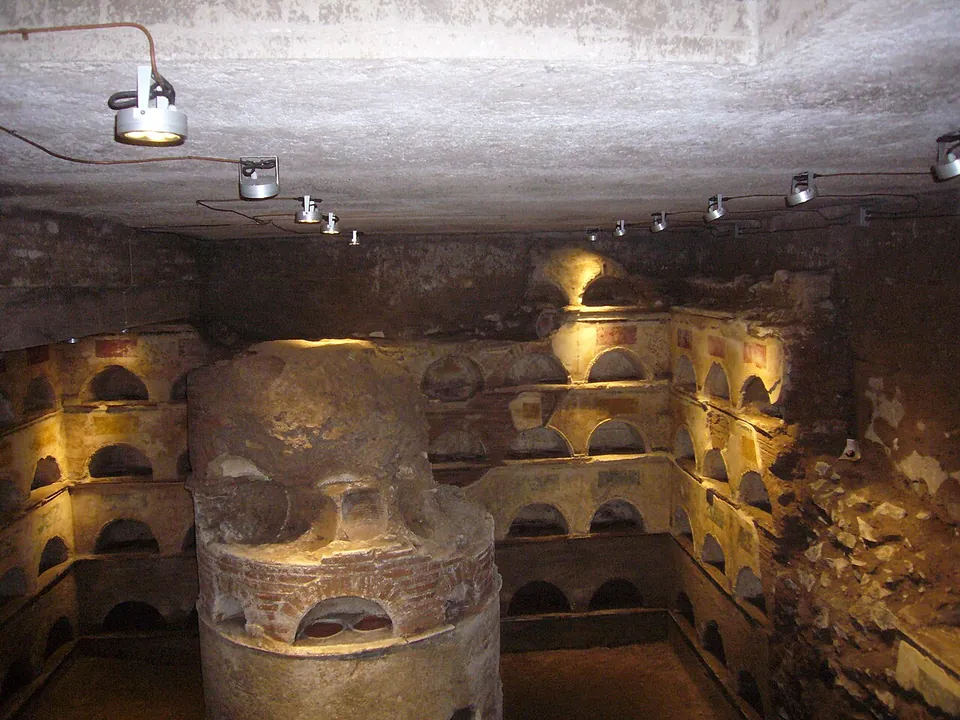
Underground, the tomb itself: a roughly square block of rock cut into a grid of galleries around four great pillars left standing to hold up the roof, with about 30 burial places along the walls and in niches (Sovrintendenza Capitolina; en.wikipedia). The plan measures about 15 by 17 metres (de.wikipedia). Everything inscribed or carved was taken to the Vatican after the tomb was found in 1780, so the inscriptions and carved sarcophagi you see are copies, put back in place in 1926–1929; the burial recesses cut into the walls are where they always were (de.wikipedia; en.wikipedia). At the end of the central gallery is a copy of the sarcophagus of the founder, Scipio Barbatus, with its frieze of rosettes and triglyphs; the original is in the Vatican Museums (Sovrintendenza Capitolina; en.wikipedia). Steel props hold up parts of the rock that were in danger of collapsing (en.wikipedia), and you wear a helmet inside (the operator).
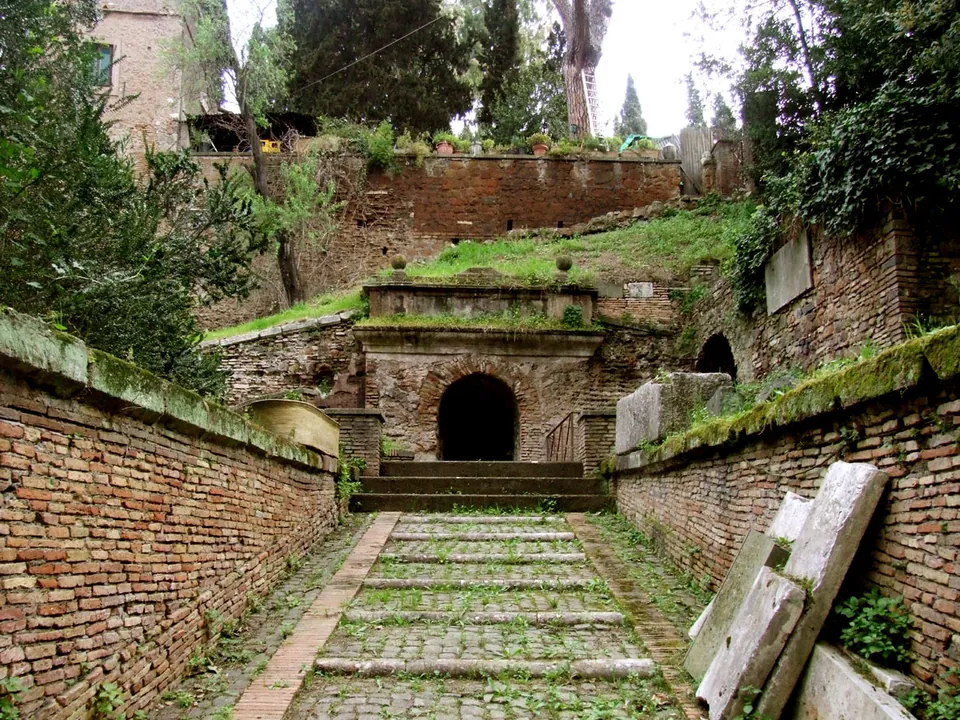
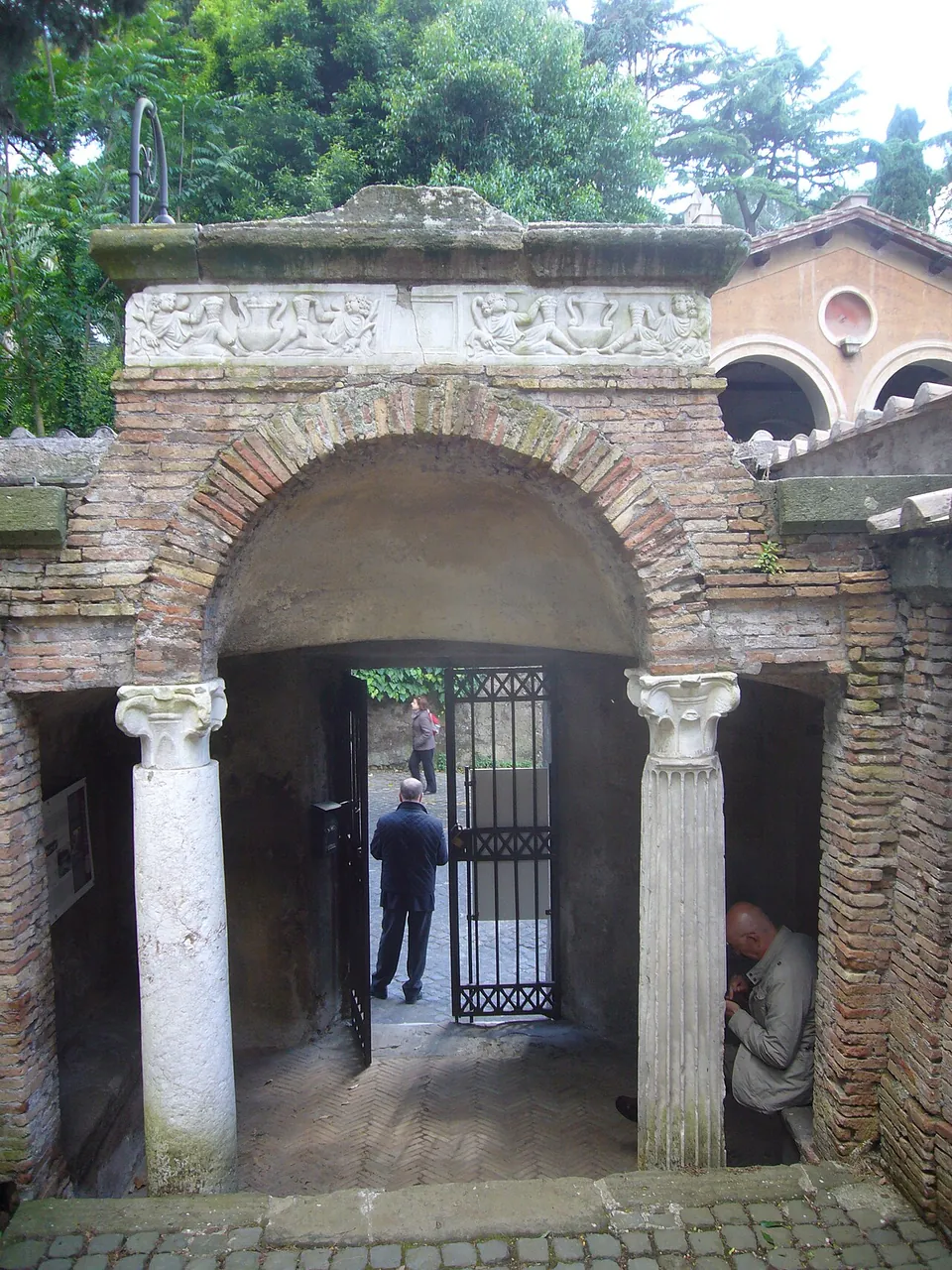
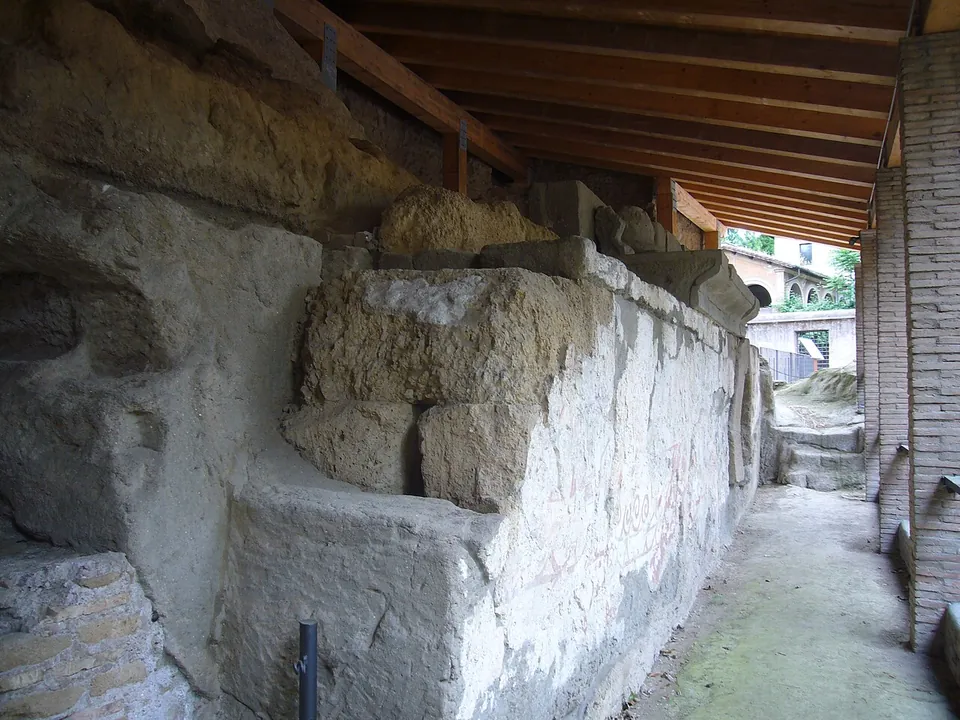
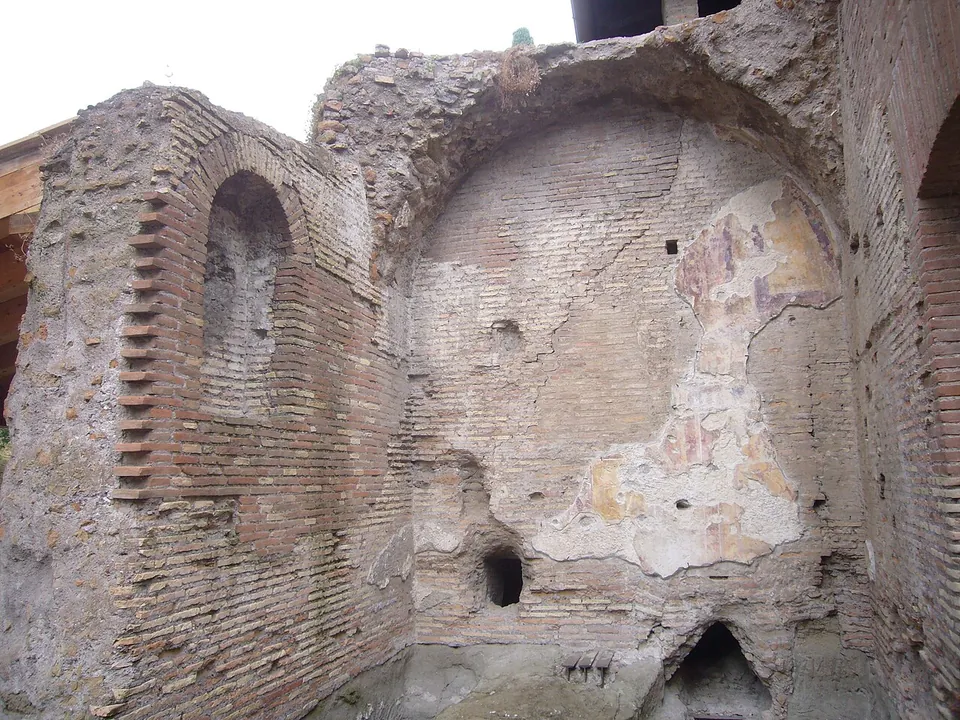
Outside, a small piece of the façade survives at its right-hand end: the podium, with faint remains of painting (en.wikipedia; it.wikipedia). Around it, the archaeological area holds more than the Scipios. There are tombs of the Republic built of tufa blocks, a frescoed columbarium (a burial chamber lined with niches for cremation urns), the walls of a three-storey building raised over the tomb in imperial times and later reused as a farmhouse, and a late tomb building with the entrance to a small catacomb (Sovrintendenza Capitolina).
Is it worth the trip?
For the history, yes: this is where one of the Republic’s great families buried its dead from about 300 BC, and two of the epitaphs found here are among the oldest known Latin texts in verse (de.wikipedia). But it is a hard place to get into. There are no opening hours: groups of up to 12 with their own guide book a slot, and individual visitors can book only on the few dates the city publishes each quarter. For October to December 2026 that is one day, 30 December. The sarcophagi are copies, and the visit is a tour of dim rock-cut galleries rather than of a building. If you have a date, it costs only €4; if you do not, there is little to see from the street, which is walled along most of its length (en.wikipedia). The Baths of Caracalla are about 800 m away in a straight line, and the Porta San Sebastiano in the Aurelian Walls about 300 m, so the tomb fits into a walk down the old Appia; see Rome for the rest of the city.
Getting there
The tomb stands on Via di Porta San Sebastiano, the stretch of the Via Appia inside the Aurelian Walls, before the Porta San Sebastiano (Sovrintendenza Capitolina); OpenStreetMap gives the address as number 9. An ATAC bus stop named “Porta S. Sebastiano/Sepolcro Scipioni” is about 45 m away, and there is a car park by San Giovanni a Porta Latina about 200 m away (OpenStreetMap).
Entry is by booking only, through Rome’s 060608 line (daily 09.00–19.00). Groups and associations of up to 12 with their own guide book a slot and buy at least five tickets; individual visitors can book only on the dates of the quarterly calendar, which for October to December 2026 has a single day for the tomb, Wednesday 30 December. A ticket is €4, or €3 reduced, paid in cash on site, and free for residents of Rome and its metropolitan area and for holders of the MIC Card. A guided tour is not included (Sovrintendenza Capitolina, read 24 October 2026). The tomb also opens on occasional event days, as for Appia Day on 3 October 2026 (Turismo Roma).
Visiting details
- Opening hours
- By booking only, on 060608 (daily 09.00–19.00). Groups and associations of up to 12 with their own guide book a slot; individual visitors can book only on the dates the operator publishes each quarter. The only individual date for October to December 2026 is Wednesday 30 December.
- Tickets
- €4, reduced €3, paid in cash on site; free for residents of Rome and its metropolitan area (with an identity document) and for MIC Card holders. Groups must buy at least five tickets. A guided tour is not included and has to be arranged separately.
- Parking
- A car park by San Giovanni a Porta Latina about 200 m away, and two free surface car parks about 265 m away (OpenStreetMap).
Before you go
- The tomb is not open on demand. Without a booked slot you see only the walls along the street; individual visitors get a handful of dates a year, announced quarterly on the Sovrintendenza's access page.
- A protective helmet must be worn inside the tomb; the site provides them.
Hours and prices checked 24 October 2026 on the operator's own site. Confirm before travelling.
History
The tomb was begun in the first decades of the 3rd century BC by Lucius Cornelius Scipio Barbatus, consul in 298 BC and head of the Scipios, a branch of the Cornelii. The site was close to the Via Appia, opened in 312 BC, at the foot of a hill rising towards the Via Latina (Sovrintendenza Capitolina). It was then outside the city; the Aurelian Walls brought it inside later (en.wikipedia). Barbatus died around 280 BC and was the first known burial (en.wikipedia).
The family’s most famous member, Scipio Africanus, who defeated Hannibal, most likely does not lie here: Livy and Seneca put his grave at his villa at Liternum (en.wikipedia), though the ancients were already unsure, since there was a funerary monument with his statue at both places (it.wikipedia). Around 150 BC, perhaps on the initiative of Scipio Aemilianus, a new gallery with its own entrance was cut on the Appia side, and probably at the same time the façade was rebuilt: half-columns above, and a podium painted with figured scenes. Livy records three statues on it, traditionally identified as Africanus, his brother Asiaticus and the poet Ennius, who had celebrated the family’s glories (Sovrintendenza Capitolina). The oldest layers of paint on the podium show historical scenes, with some soldiers still recognisable (it.wikipedia). The last two burials were made in the 1st century AD by the Cornelii Lentuli, a side branch that took the tomb over after the Scipios had died out (Sovrintendenza Capitolina).
A house was built over the tomb in the 3rd century AD, damaging part of it (it.wikipedia), and a lime kiln, where marble and travertine were burned for lime, was later cut into one corner, probably in the Middle Ages (Sovrintendenza Capitolina; en.wikipedia). The tomb was first found in 1614 and lost again, then found for good in 1780, when the brothers Sassi, priests who owned the vineyard above, broke into it while enlarging their cellar. Everything inscribed or carved went to the Vatican, and the tomb became a stop on the Grand Tour (Sovrintendenza Capitolina). The city bought the land in 1880 at the suggestion of the archaeologist Rodolfo Lanciani (en.wikipedia); between 1926 and 1929 it excavated and restored the area and laid out the Parco degli Scipioni behind it (Sovrintendenza Capitolina). Closed to visitors in 1992, the tomb reopened at the end of 2011 after work to consolidate the tufa and the old metal supports (Sovrintendenza Capitolina).
More photographs




Nearby
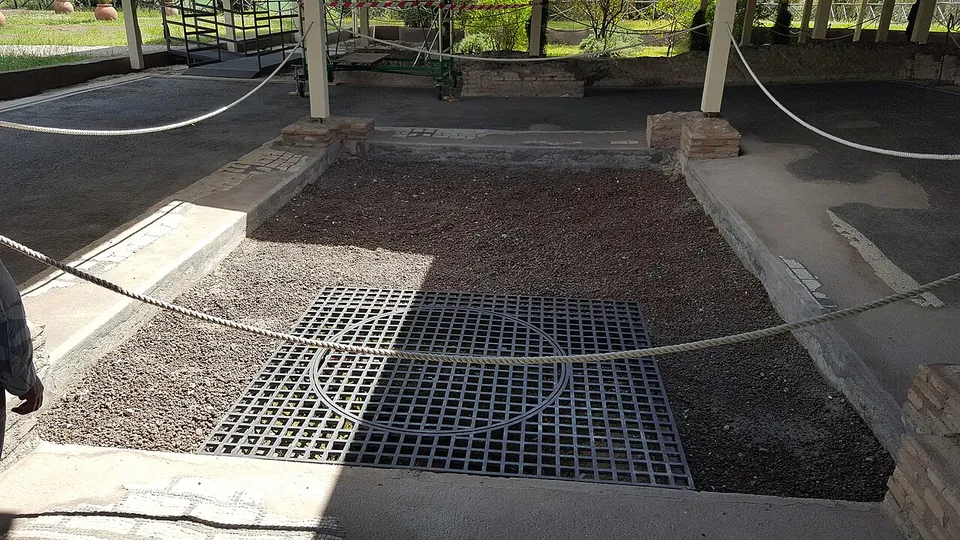
Photo: MumblerJamie · CC BY-SA 2.0 · Commons
14 km · villa · Lazio
Villa of Livia
The operator describes the private wing with the bedrooms of Livia and the emperor, an atrium and a small inner garden, and the large reception rooms that open onto a peristyle; the rooms once had painted walls and floors of mosaic and cut marble (Soprintendenza Speciale di Roma).
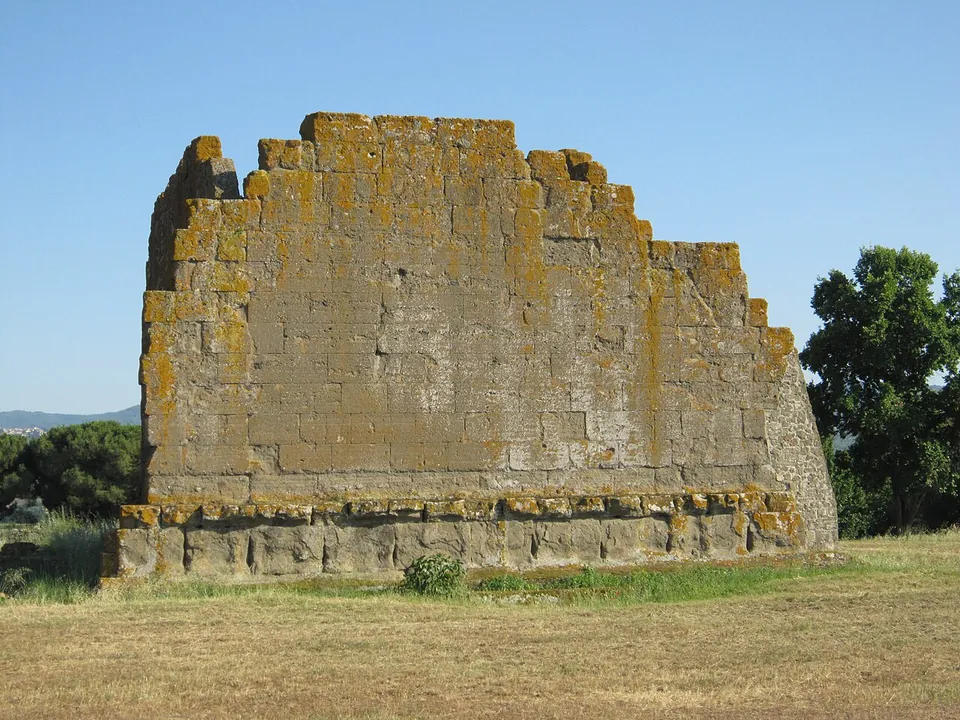
Photo: Carlomorino · CC BY-SA 3.0 · Commons
18 km · city · Lazio
Gabii
The park the state holds covers about 70 hectares on the southern rim of a volcanic crater whose lake was drained in the 19th century (the operator; en.wikipedia).
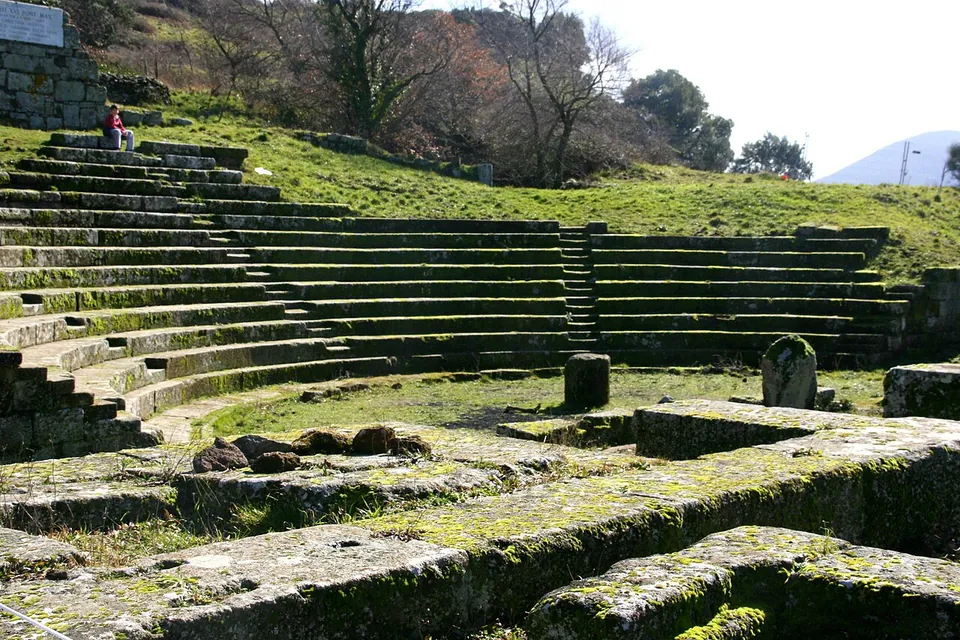
Photo: Luiza Serpa Lopes · Public domain · Commons
19 km · city · Lazio
Tusculum
The visitor route runs mainly through the forum, with the theatre halfway round (the operator).


Straight-line distances.
Sources
Every fact on this page comes from the records below, each used under the licence noted.
| Source | Licence |
|---|---|
| Pleiades 999196280 | CC BY |
| Wikidata Q1540716 | CC0 |
| Vici.org 17966 | CC BY-SA (text), CC0 (metadata) |
| OpenStreetMap way/254710670 | ODbL |
| Sovrintendenza Capitolina — Sepolcro degli Scipioni (the operator) | licence not recorded |
| Sovrintendenza Capitolina — access and booking for the city's monuments, 24 September 2026 (the operator) | licence not recorded |
| Sovrintendenza Capitolina — individual visiting dates, October to December 2026 (the operator) | licence not recorded |
| Turismo Roma — Area Archeologica del Sepolcro degli Scipioni (Roma Capitale's tourism portal) | licence not recorded |
| Turismo Roma — Appia Day 2026, events of the Sovrintendenza Capitolina | licence not recorded |
| Wikipedia (en) — Tomb of the Scipios | CC BY-SA 4.0 |
| Wikipedia (it) — Sepolcro degli Scipioni | CC BY-SA 4.0 |
| Wikipedia (de) — Grab der Scipionen | CC BY-SA 4.0 |